
Google AI Mode and SEO: The Complete Guide for SMEs, AEO and AI Visibility
A complete guide to Google AI Mode: how it works, how it differs from AI Overviews, what query fan-out changes for SEO, and why SMEs need approved execution, not more dashboards.
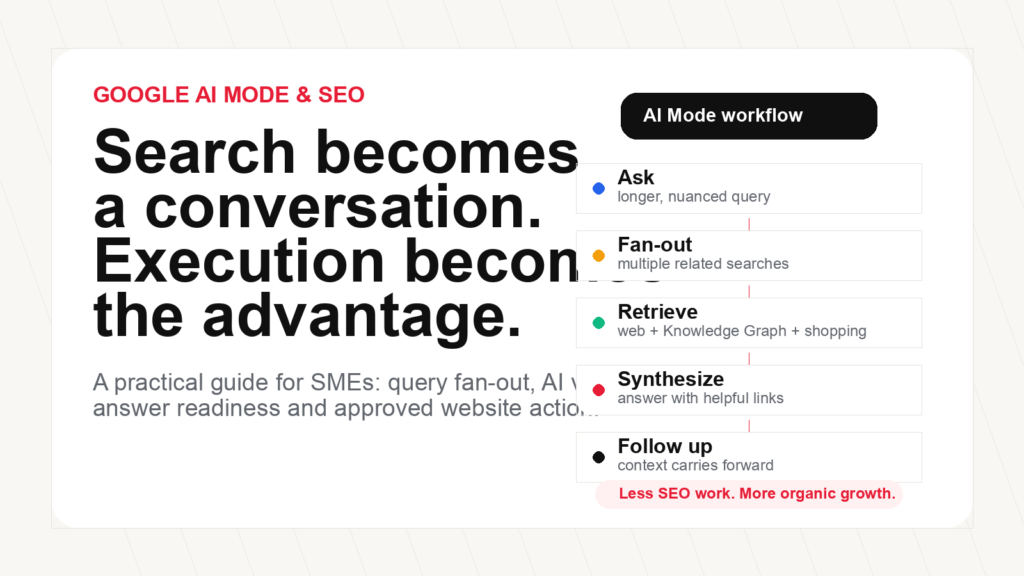
Executive summary: Google AI Mode is not just a new search result layout. It is a deeper shift in how people search: more conversational questions, follow-up prompts, multimodal inputs, AI-generated synthesis and more complex retrieval behind the scenes. For SEO teams, AEO teams, content marketers and business owners, the important question is not “how do we trick AI Mode?” The real question is: how do we make a website easier to understand, retrieve, cite, recommend and act on?
In my opinion, AI Mode will make weak SEO operations more visible. Generic content, messy technical foundations, unclear business information, poor Internal linking, thin service pages and slow execution will become bigger problems. AYSA fits in this new search reality as an Approved Execution layer: it monitors the website, prepares SEO/AEO/GEO and AI visibility work, asks for approval and executes accepted changes inside the website workflow.
What is Google AI Mode?
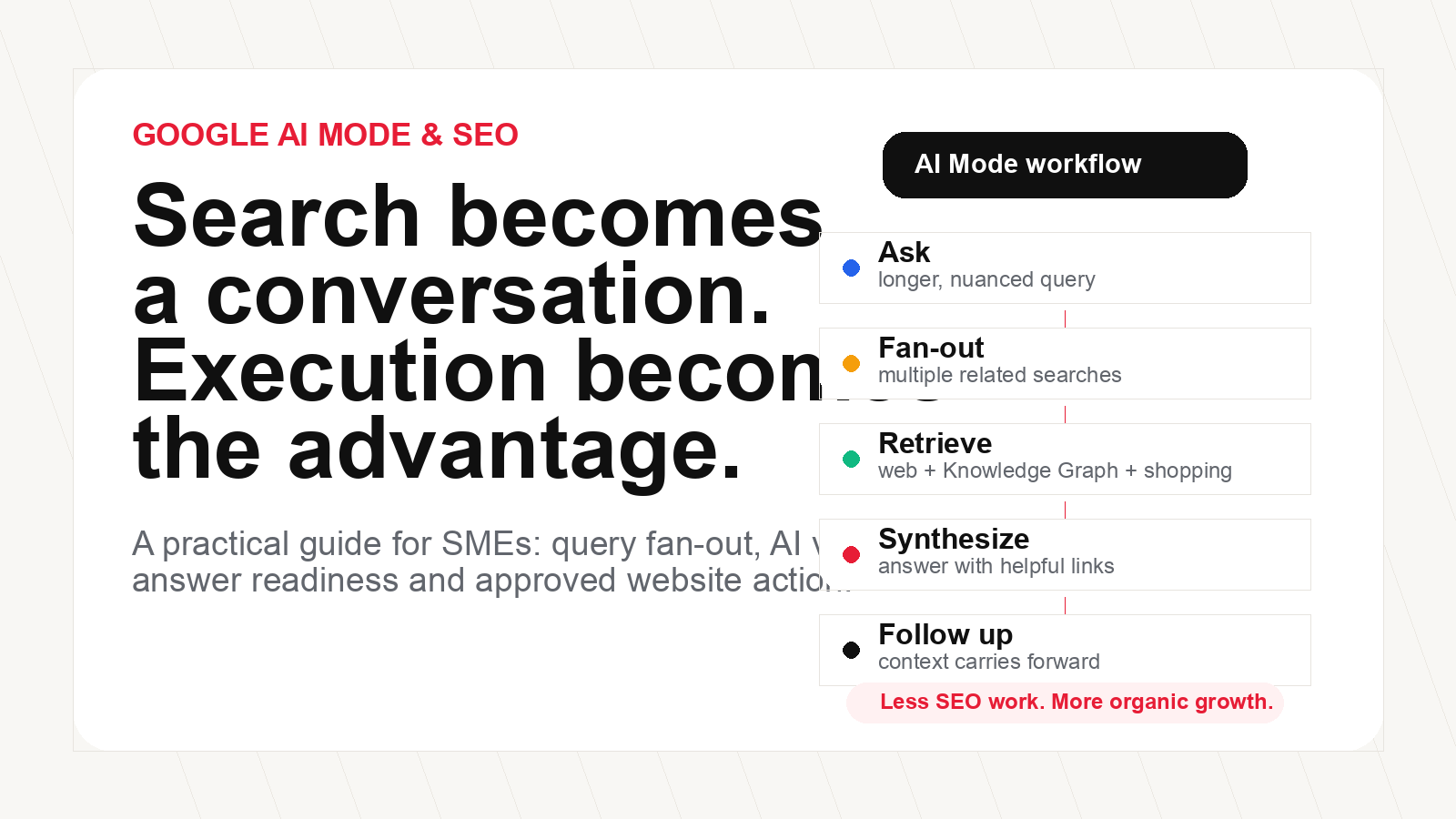
Google AI Mode is a more AI-native way to search. Instead of typing a short query and scanning a list of blue links, users can ask longer, more complex questions, continue the conversation with follow-up prompts, use multimodal inputs and receive an AI-generated response supported by links and web sources.
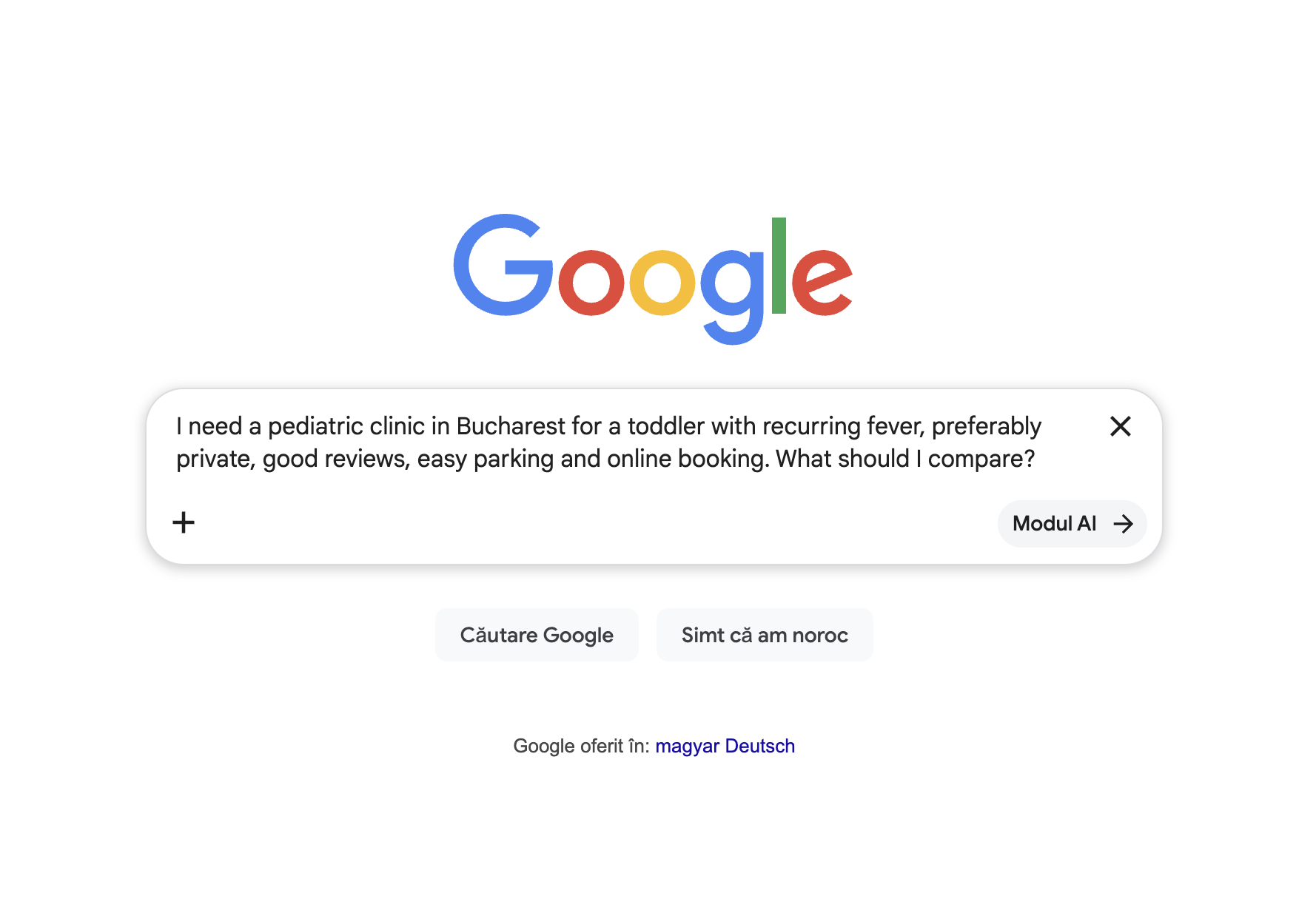
Google has described AI Mode as a Search experience built for more advanced reasoning, multimodality and deeper exploration. In practice, it changes the shape of the user journey. A person may no longer search “best pediatric clinic Bucharest,” open five tabs and manually compare results. They may ask: “I need a pediatric clinic in Bucharest for a toddler with recurring fever, preferably private, good reviews, easy parking and online booking. What should I compare?” AI Mode can decompose that question, retrieve information from multiple sources and produce a synthesized response with follow-up paths.
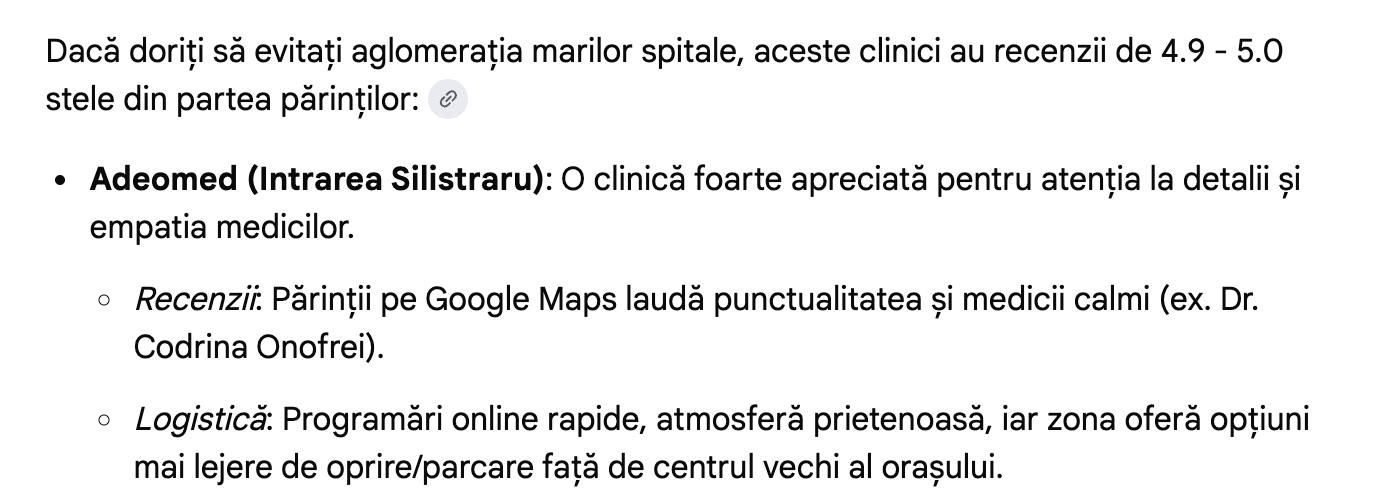
That matters because the query is no longer only a keyword. It becomes a task. It includes constraints, context, preferences and intent. Classic SEO was already moving in this direction, but AI Mode makes the shift more visible. Businesses are no longer competing only for a ranking position. They are competing to be understood as a reliable answer, option, source, entity or next step inside a more complex search flow.
For small and medium-sized businesses, this can be intimidating. But the foundation is still familiar: clear pages, crawlable content, useful answers, accurate business information, structured data where appropriate, strong internal linking, authority, good user experience and regular updates. The difference is that these fundamentals need to be executed continuously, not once every few years.
AI Mode vs AI Overviews: what is the difference?
AI Overviews are AI-generated summaries that can appear inside the normal Google Search results page for eligible queries. They usually sit above or near traditional results and summarize information from across the web. AI Mode is more like a dedicated AI search experience: conversational, exploratory, follow-up friendly and designed for more complex questions.
The difference matters for SEO. AI Overviews can affect click distribution on classic SERPs. AI Mode can change the entire discovery path. In AI Mode, the user may refine the question, compare options, ask for recommendations, request a plan, evaluate pros and cons, or continue with a new branch of the same task. The website may be discovered not because it matches one exact keyword, but because it supports one part of a broader answer.
That is why old SEO thinking becomes fragile. If a page is optimized only for one phrase, but does not explain the topic well, connect to related questions, include specific details or prove trust, it may not be useful in a multi-step AI search process. AI Mode rewards websites that can support deeper retrieval: entities, context, examples, comparisons, steps, FAQs, evidence, local details, products, pricing and process information.
Important: this does not mean AI Mode creates a guaranteed new optimization formula. Google’s public guidance still points back to Search fundamentals. There is no official “AI Mode ranking checklist” that guarantees inclusion. The correct approach is to improve the website’s ability to be crawled, understood, trusted and useful.
Query fan-out: the concept every SEO should understand
The most important concept behind AI Mode for SEO is query fan-out. In plain language, query fan-out means the system can take a complex user question and issue multiple related searches behind the scenes. Instead of one query, there may be several subqueries. Instead of one narrow result set, the system may retrieve information around multiple angles of the user’s need.
For example, a user may ask: “What is the best SEO automation tool for a small ecommerce store that cannot afford an agency?” Behind that one question, relevant subtopics may include ecommerce SEO tools, automation, content generation, technical SEO, pricing, agency alternatives, Shopify or WordPress support, approval workflows, AI search visibility, reviews and business size. A page that only says “best SEO automation tool” without depth may not support the answer well.
This is where topical authority becomes practical. Topical authority is not about publishing thousands of pages. It is about covering the real decision space around a topic. If your website sells SEO automation, you need pages that explain what SEO automation is, how it differs from reporting tools, how credits work, how approval works, what technical SEO automation can and cannot do, what happens with AI content, how authority building is controlled, how AI visibility is monitored and how non-specialists use the product.
Query fan-out also makes internal linking more important. If related pages are isolated, Google and AI systems may not understand the relationship between them. If pages are connected semantically, the website becomes easier to retrieve as a coherent source. That is why glossary, blog, product pages, examples and help documentation should not live as separate islands.
Classic keyword mindset
One keyword, one landing page, one ranking position. The page tries to match a phrase.
AI Mode mindset
How AI Mode changes SEO work
AI Mode does not kill SEO. It changes the execution standard. In my opinion, the phrase “SEO is dead” is lazy. What is dying is slow, shallow, disconnected SEO: thin pages, outdated reports, keyword stuffing, weak internal links, generic AI content and recommendations that nobody implements.
The SEO work that matters becomes more operational. Websites need clearer entity signals, better information architecture, more useful content, stronger answer formatting, accurate business details, better crawl efficiency, improved technical health and faster content refreshes. These are not abstract ideas. They translate into real tasks:
Rewrite pages that receive impressions but do not answer the query well. Search Console already shows pages with potential. AI Mode increases the need for pages to satisfy broader intent, not just rank for a term.
Build topic clusters that match real user journeys. A clinic, ecommerce store, SaaS company or local service business needs content around decisions, objections, comparisons, pricing, process, trust and after-sale questions.
Improve internal links between related pages. If an article about “AI visibility monitoring” does not link to glossary terms, product pages and execution examples, the website loses semantic strength.
Keep technical SEO clean. Indexability, canonical tags, redirects, sitemaps, page speed, structured data and crawl paths are still essential. AI retrieval does not fix a messy website.
Move from reporting to execution. The biggest bottleneck remains implementation. A report saying “fix internal links” does not improve search visibility. Approved changes do.
AEO, GEO and AI visibility in the AI Mode era
AEO, GEO and AI visibility are useful labels if they help teams do better work. AEO, or Answer Engine Optimization, focuses on making content easier to use as a direct answer. GEO, or Generative Engine Optimization, focuses on making content easier to retrieve, synthesize and cite in generative search experiences. AI visibility focuses on whether a brand, product, person or business is visible in AI-assisted discovery environments.
But these labels can become noise if they are separated from SEO fundamentals. Google’s own guidance keeps pointing back to useful content, technical accessibility, page experience, structured data where appropriate and high-quality site practices. That means AEO and GEO should not be treated as hacks. They are extensions of good search work.
For AI Mode, answer readiness matters because users ask complete questions. A page should include concise definitions, clear sections, comparisons, examples and practical next steps. Entity clarity matters because AI systems need to understand who the business is, what it offers, where it operates, what it is known for and why it is trustworthy. Authority matters because AI systems need reliable sources, not only self-description.
In AYSA’s view, AEO and GEO are not separate departments. They are part of the same website execution system. If a service page lacks clear pricing, process information, FAQs and trust signals, that is an SEO problem, an AEO problem and an AI visibility problem at the same time.
Content strategy for AI Mode
Content for AI Mode should be specific, useful and grounded in real experience. The goal is not to write robotic “AI-friendly” pages. The goal is to create pages that genuinely help a user complete a task.
A page about “best pediatric clinic in Bucharest” should help a parent compare options, understand emergency vs scheduled care, evaluate reviews, see what specialties matter, understand appointment flow and decide what to do next. A page about “technical SEO audit” should explain the checks, examples, risks, prioritization, implementation and what happens after the audit. A page about “SEO automation tools” should explain what tools automate, what they do not automate, where business approval matters and how execution works.
AI Mode may reward this kind of usefulness because it needs source material that can support nuanced answers. Generic pages are replaceable. Specific pages with context, proof, examples and structure are harder to replace.
Good AI Mode content usually has several qualities:
It answers the main question quickly. Users and AI systems both need a clear answer.
It includes the surrounding decision context. A user rarely needs a definition only. They need criteria, trade-offs, examples and next steps.
It uses clear headings and chunkable sections. This helps users scan and helps systems understand structure.
It connects to related pages. Internal links make the topic network visible.
It contains real business information. Generic content is weak. Specific service details, product information, examples and proof create trust.
It is updated. AI search is not friendly to stale information, especially in fast-moving topics like SEO, AI, ecommerce, local search and technical standards.
Technical SEO for AI Mode
Technical SEO becomes AI visibility infrastructure. If Google cannot crawl, render, index or understand a page, the page is weak in classic search and weak in AI-assisted search. AI Mode does not remove the need for technical hygiene.
The key technical priorities are crawlability, indexability, canonical consistency, internal linking, fast mobile rendering, clean HTML, useful structured data, image and video accessibility, sitemap quality and reduced duplicate noise. These are not glamorous, but they matter.
For WordPress websites, the most common blockers are familiar: too many plugins, slow themes, Elementor bloat, heavy JavaScript, unoptimized images, redirect chains, duplicate archives, bad canonicals, noindex mistakes, broken internal links, thin tag pages and sitemaps full of low-value URLs. These issues waste crawl budget and reduce trust in the website structure.
For AI Mode, technical problems also reduce retrieval confidence. A page with unclear canonical signals, duplicate versions, poor internal links and slow mobile performance is harder to treat as a stable source. A clean website helps both search engines and users.
AYSA’s execution angle is practical: technical SEO should not stay in an audit. If the site has redirect chains, broken internal links, weak schema, missing meta descriptions, orphan pages or crawl waste, those should become approval-ready actions. The user should understand what is being changed and why.
Local businesses and ecommerce in AI Mode
AI Mode may have a large impact on local and ecommerce discovery because these searches are often task-driven. Users do not only ask for a page. They ask for a recommendation, comparison, product, service, route, price, availability or decision.
For local businesses, the website and business profile need to agree. Address, phone, opening hours, service area, appointment process, pricing logic, reviews, services and categories should be consistent. If a clinic, restaurant, repair shop or local service business has incomplete or contradictory public information, AI-assisted search has less confidence.
For ecommerce, product and category pages need to be useful. Product descriptions, availability, shipping, returns, images, size guides, comparison content and category explanations matter. AI Mode can help users compare products more deeply, but it needs good source data.
SMEs often underestimate how much work this requires. Keeping business details, product pages, categories, reviews, local pages, FAQs and technical SEO up to date is not a one-time project. It is an operating system.
How do you measure AI Mode impact?
Measurement is still evolving. Google has indicated that traffic from AI experiences in Search is part of Search traffic reporting, but marketers do not always receive perfect separation for every AI surface. That means businesses should avoid pretending they have complete visibility when they do not.
In practice, measurement should combine several layers:
Search Console: queries, pages, impressions, clicks, countries, devices and indexing changes.
Analytics: engagement, conversions, assisted conversions and landing page behavior.
Rank and SERP monitoring: visibility movement, AI Overview presence where measurable, competitor changes and volatility.
Brand and entity monitoring: whether the business appears in AI-assisted answers, comparison contexts and external mentions.
Content execution history: what changed, when it changed and whether performance improved.
The last point is usually missing. Most teams track rankings, but not the operational history of what was approved and executed. Without action history, it is hard to learn which changes work.
Where AYSA fits: from AI Mode theory to approved execution
AYSA is built around a simple idea: SEO should move from research to approved action. AI Mode makes that idea more important. A business does not need to read one more report about AI search every week. It needs a system that identifies what should be improved and moves the work forward safely.
AYSA can help detect pages that receive impressions but do not satisfy intent well, weak internal links between related pages, missing topics, thin service pages, FAQ opportunities, schema opportunities, technical issues, authority-building gaps and AI visibility signals. More importantly, AYSA can prepare the work, explain it, ask for approval and execute accepted changes inside the website workflow.
That is the difference between a dashboard and an operating system. A dashboard shows what happened. An operating system helps the business act.
In my opinion, AI Mode will increase the gap between businesses that only know about SEO problems and businesses that actually fix them. The winners will not be the companies with the longest list of tools. They will be the companies that can monitor, decide, approve and execute faster.
This matters especially for SMEs and non-SEO users. They cannot afford to hire a specialist for every small SEO task, wait weeks for implementation, or interpret 20 dashboards. They need plain-language recommendations, business context and controlled automation.
AYSA’s role is not to promise guaranteed inclusion in AI Mode or AI Overviews. Nobody should promise that. AYSA’s role is to improve the signals that matter: useful content, clarity, crawlability, structured information, internal links, authority, monitoring and execution speed.
My final view
AI Mode is not the end of SEO. It is the end of lazy SEO. It makes the search journey more conversational, more contextual and more demanding. It rewards websites that are useful, clear, current and technically sound. It exposes websites that rely on generic content, stale pages and disconnected reports.
For SMEs, the right reaction is not panic. The right reaction is to build an execution workflow. Connect search data. Understand the business. Monitor changes. Prepare useful updates. Approve important actions. Execute consistently. Measure. Repeat.
That is the practical bridge between SEO, AEO, GEO and AI visibility. AI Mode changes the interface. Execution remains the advantage.
Less SEO work. More organic growth.
Prepare your website for AI Mode with approved SEO execution.
AYSA monitors your website, prepares SEO, AEO and AI visibility actions, asks for approval and executes accepted changes inside your website workflow.
Sources and further reading
This article is based on Google’s public documentation and announcements, including Google’s AI Mode announcement, Google Search Central documentation on AI features and your website, Google’s guide to optimizing for generative AI experiences, and Search industry reporting such as Search Engine Land’s coverage of Google’s generative AI optimization guidance. The AYSA sections are our interpretation and product point of view, not a claim of guaranteed AI Mode inclusion.
Continue the AI search topic inside AYSA.
Use these pages to connect the article with AI SEO tools, AI visibility monitoring, AI Overviews and approved website execution.
Turn this topic into a website action plan.
Use these AYSA hubs to move from reading to technical fixes, AI visibility monitoring, research, glossary context and approval-first SEO execution.

