
AI Judgment Literacy: The Missing Skill in AI Search, Content, and SEO Execution
Prompting is easy. Knowing when not to use AI—and how to govern AI output so it doesn’t quietly erode expertise, trust, and search visibility—is the real literacy businesses need. Here’s a practical judgment framework for SMEs and agencies, plus an execution model built for approval-first SEO changes.
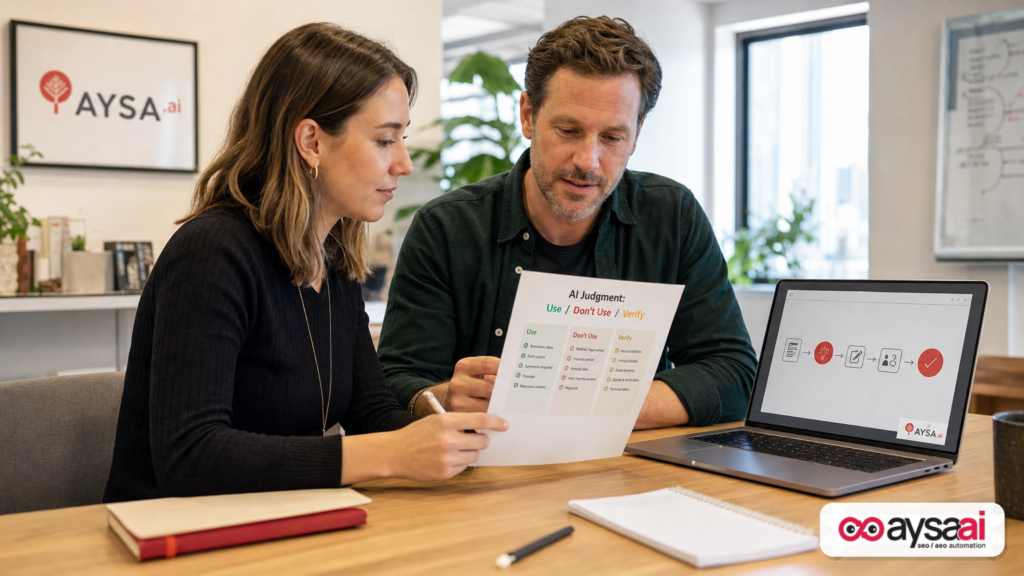
AI is now embedded in the daily workflow of marketing teams, agencies, and business owners. That part isn’t new. What is new is how quickly “AI literacy” has been reduced to a narrow skill: writing better prompts.
That’s why Ann Handley’s framing landed with so many practitioners: AI literacy is not prompt literacy; it’s judgment literacy—the ability to decide when not to use AI, when to use it with guardrails, and when to lean into slower human work because the struggle is the skill.
This editorial is my AYSA.ai perspective on what changed, why it matters to search and business outcomes, and what you should actually do next—especially if you run an SME, lead marketing, or operate an agency. I’ll also explain where AYSA fits: not as “more AI,” but as an Approval-First Execution system that makes judgment operational—monitor, prepare, ask for approval, then execute accepted website changes.
Primary research lead: Greg Jarboe’s write-up of Ann Handley’s argument on Search Engine Journal is the spark for this piece. Read it here: AI Literacy Is Not Prompt Literacy. Ann Handley Says It’s Judgment Literacy (Search Engine Journal).
Concise summary
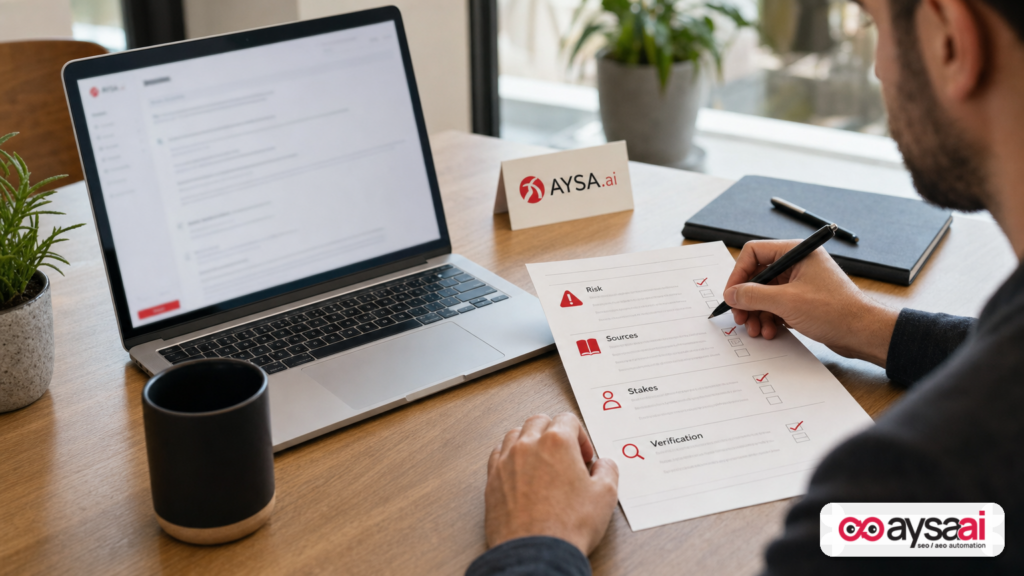
- Prompt literacy (how to ask AI) is fast to learn. Judgment literacy (when to use AI, when not to, and how to verify) is the durable advantage.
- AI Search systems increasingly turn your content into evidence used to assemble answers. That changes what “good content” means: not just persuasive, but verifiable and accountable.
- Businesses that over-automate without governance risk invisible failure modes: incorrect claims, diluted expertise, loss of differentiation, and reputational damage.
- SMEs and agencies need a repeatable decision framework, a verification workflow, and an approval-first execution model to safely scale AI-assisted work.
- AYSA fits at the execution layer: monitoring and AI search visibility signals → prepared recommendations → approvals → implemented changes, with accountability.
Table of contents

- Prompt Literacy vs. Judgment Literacy: Why This Distinction Changes Everything
- The New Reality: AI Search Turns Your Content Into Evidence
- Why the Gap Exists: Incentives Favor Speed, Not Restraint
- What Changed for SMEs: From “Ranking Pages” to “Earning Mentions in Answers”
- What Can Go Wrong: The Quiet Failure Modes of AI-First Marketing
- A Practical Framework: The 6 AI Judgment Decisions (Use, Don’t Use, or Use With Guardrails)
- A Verification Workflow You Can Run This Week (No New Tools Required)
- Concrete SME Scenario: Local Clinic Content That Can’t Afford to Be Wrong
- What Agencies Should Rethink: Selling Judgment, Not Just Output
- Culture, Not Coursework: Making “When Not to Use AI” a Team Norm
- Where AYSA Fits: Judgment as a System, Not a Slogan
- What to Do Next: A 30-Day AI Judgment Action Plan
- Sources and further reading
Prompt Literacy vs. Judgment Literacy: Why This Distinction Changes Everything

Prompt literacy is the new spreadsheet skill. It’s useful. It’s teachable. It’s also not the moat.
Here’s the uncomfortable truth: if your competitive plan is “we learned prompts,” you’re competing on a skill that:
- is rapidly commoditized,
- is increasingly embedded directly inside products, and
- does not guarantee business outcomes.
Judgment literacy is different. It’s the ability to decide—under real constraints—what gets automated, what stays human, and what demands verification before it touches customers. It’s also the ability to weigh what you gain (speed, breadth, drafts) against what you may silently lose (expertise, trust, brand specificity, institutional learning).
Ann Handley’s core provocation—why are we teaching people how to use AI without teaching them when not to?—cuts deeper than marketing. It’s a governance question. And in AI search, governance is now a visibility question.
My AYSA take: you don’t need “more prompting.” You need a decision system that makes the safe choice the default choice. That system must be operational: it must live in your workflow, not in a slide deck.
Why judgment compounds (and prompts don’t)
A prompt can get you a passable blog post. Judgment can get you a defensible knowledge base that AI systems trust, users cite, and your team can build on for years.
Judgment literacy compounds because it creates:
- Repeatable standards (what “good” means here),
- Fewer reversals (less rework after mistakes go live),
- Stronger internal expertise (teams still learn the domain),
- Durable brand differentiation (you don’t sound like everyone else).
The New Reality: AI Search Turns Your Content Into Evidence
Classic SEO trained businesses to think in pages and rankings: create a page, optimize it, earn links, rank, get Clicks.
AI-driven search experiences (across engines and interfaces) increasingly train users to think in answers: ask a question, get a synthesized response, click optionally—or not at all.
That shift changes what your website content does. It’s not just a destination; it’s a source. It becomes evidence the system uses to assemble narratives about your business, your industry, and your advice.
That’s why sloppy AI usage is riskier now: you’re not only risking a bad page. You’re risking being the bad source that gets quoted, summarized, or used to “prove” something you didn’t intend.
Implication for SMEs: Your best-performing “AI search content” often won’t be the most clever content. It will be the most verifiable content: clear definitions, constraints, updated facts, explicit policies, and direct experience.
E-E-A-T isn’t a slogan; it’s a publishing operating system
Google’s public guidance around quality has long emphasized concepts like expertise and trust. In an AI-shaped world, those aren’t abstract ideals—they’re operational requirements. If your content is vague, un-sourced, or generic, you may still publish it, but you’ll struggle to become a source that AI systems choose to cite or rely on.
If you want the most official entry point to how Google thinks about quality, start with Google Search Central documentation rather than social posts or tool vendors. (This is a general best practice note; the specific SEJ source we’re building from did not include direct links to Google documentation.)
For broader context on search visibility, our own framing lives here: AYSA: AI Search Visibility.
Why the Gap Exists: Incentives Favor Speed, Not Restraint
The market rewards “do more, faster.” Most AI training and tool ecosystems are shaped by that incentive. It’s easier to sell:
- “Write 50 pages this weekend,” than
- “Decide which 10 pages matter, and verify them like your reputation depends on it.”
Search Engine Journal’s source article points out a structural problem: there’s no obvious business model for teaching restraint. That’s the heart of the gap.
My additional angle: The gap also exists because restraint looks like “doing less,” and doing less is hard to justify when marketing performance is reported weekly. Judgment literacy often looks like:
- slower publishing,
- more review steps,
- more cross-functional input (legal, product, clinical, finance),
- more editorial discipline.
But those aren’t inefficiencies. They’re quality controls. In AI search, quality controls are a growth strategy.
What Changed for SMEs: From “Ranking Pages” to “Earning Mentions in Answers”
SMEs used to ask: “How do I rank #1?”
Now the question is increasingly: “How do I become the source that AI systems trust enough to cite, paraphrase, or learn from?”
This isn’t only about visibility. It’s about customer journey Compression. AI answers shorten the path between question and decision. If your business is missing from the answer layer, you may still rank—but you’re often arriving later to the conversation.
Your content is a collection of claims—treat it that way
Most “AI content” workflows treat pages as output. Judgment literacy treats pages as claims that must be defended.
A practical shift: for every page you publish, be able to answer these questions internally:
- What are the top 5 factual claims on this page?
- What is each claim based on (primary sources, internal policy, first-hand experience)?
- What could go wrong if this claim is wrong or misleading?
- Who is accountable for the claim staying updated?
That’s not prompt work. That’s judgment work.
What Can Go Wrong: The Quiet Failure Modes of AI-First Marketing
Most teams know the obvious risks: hallucinations, made-up citations, wrong numbers. But the more dangerous failures are often quiet because they don’t look like “errors.” They look like “fine.”
Failure mode #1: Generic sameness (you stop sounding like you)
AI content tends toward median language. When everyone uses similar tools and templates, differentiation collapses. Your copy becomes “industry average,” which is a polite way of saying: forgettable.
Failure mode #2: Competence erosion (the team stops learning)
The SEJ source references research that suggests junior engineers leaning heavily on AI can show weaker understanding when tested later (the specific underlying paper isn’t linked in the provided source context, so treat this as a directional insight rather than a fully cited claim).
In marketing, the parallel is clear: when you outsource thinking to AI, you may still ship assets, but you slowly lose the internal muscle to evaluate quality, nuance, and risk. You become dependent on the tool you’re trying to “use.”
Failure mode #3: Policy and legal exposure (especially in regulated industries)
If you’re a clinic, a financial services firm, or a business making claims about outcomes, warranties, safety, or compliance, AI-generated copy can create real exposure. Even if it’s “mostly right,” the one overconfident sentence can become a problem.
Failure mode #4: Internal truth drift (your website contradicts your operations)
AI can “improve” copy by adding plausible details that aren’t true for your business: shipping times, return policies, availability, service areas, appointment steps, pricing ranges. The result: your website begins to contradict reality, and customer support pays the tax.
Failure mode #5: SEO debt (you publish faster than you can maintain)
Publishing is easy. Maintenance is not. AI can accelerate content production beyond your organization’s ability to update, prune, or verify it. Over time, that creates a content estate you can’t govern—exactly the opposite of what AI search rewards.
A Practical Framework: The 6 AI Judgment Decisions (Use, Don’t Use, or Use With Guardrails)
If judgment literacy is the skill, you need a framework that makes it repeatable. Here’s one you can adopt immediately. For each task, make one of three calls: Use AI, Don’t use AI, or Use with guardrails.
Decision 1: What’s the stake if it’s wrong?
- Low-stakes: brainstorming blog angles, rewriting internal notes → Use AI.
- High-stakes: medical advice, legal claims, pricing, guarantees → Don’t use AI for final wording; Use with guardrails for structure.
Decision 2: Is the work about truth or taste?
- Taste-driven: tone options, headline variants, ad concept drafts → Use AI.
- Truth-driven: “what is covered,” “how it works,” “what it costs,” “who qualifies” → Use with guardrails and verification.
Decision 3: Is the struggle the skill?
This is the Handley point I want every leader to internalize. Sometimes the value is not the output; it’s the learning you build while producing it.
- Examples where struggle matters: writing your positioning, defining your ICP, documenting your onboarding process, articulating your unique POV → often Don’t use AI for first drafts.
- Use AI after you’ve written a human draft, to tighten and test clarity.
Decision 4: Are you using primary sources—or vibes?
If you can’t point to primary sources (internal policies, product documentation, contracts, regulatory guidance, original data, first-hand experience), AI will fill the gaps with plausible language. That’s not a feature; it’s risk.
Rule: when primary sources aren’t available, either pause or redesign the task. Don’t “prompt harder” to solve missing truth.
Decision 5: Can you verify quickly?
If verification is fast and cheap (e.g., confirm shipping policy, confirm service hours, confirm product spec sheet), AI can accelerate. If verification is slow or requires an expert (clinical nuance, legal interpretation), constrain AI to outlines and question generation.
Decision 6: Who is accountable after publish?
Judgment literacy includes ownership. If nobody owns the page after it goes live, you’re not publishing content—you’re publishing liabilities.
Operational note: This is one reason we think “Approved Execution” matters: automation should not remove accountability; it should make accountability easier.
A Verification Workflow You Can Run This Week (No New Tools Required)
The SEJ source describes an editorial experiment: using multiple AI engines against the same source material, comparing outputs, then applying human reporting and quotes to close the gap. I won’t repeat the details, but the underlying workflow is the important part—and it generalizes well to SEO and SME content.
Here’s a version you can implement immediately:
Step 1: Start with the sources, not the prompt
- Gather your primary materials: product specs, policies, meeting notes, contracts, SOPs, pricing sheets.
- List what must be true on the final page.
Step 2: Run “multi-draft” on high-stakes content
For important pages (pricing, services, medical, compliance, category pages), don’t rely on a single model output. Generate multiple drafts and compare:
- Where do drafts disagree?
- Which claims are unsupported?
- Which parts sound confident but vague?
Disagreement is a signal: it points to areas that require human judgment and sourcing.
Step 3: Identify the “25% that matters”
The SEJ source includes a practical frame: AI can often get you most of the way, but the last portion—details, nuance, context—requires humans. Whether your split is 80/20, 70/30, or 60/40 doesn’t matter. What matters is that you plan for the human portion instead of pretending prompts will eliminate it.
Step 4: Verify the claims, not the paragraphs
Verification is easier when you reduce content to a checklist of claims:
- Claim: “We offer same-day shipping.” Verify against operations and policy.
- Claim: “Most patients are eligible.” Verify against criteria.
- Claim: “This reduces costs by X.” Either prove it or remove it.
Step 5: Publish with ownership and update rules
Assign an owner, set an update interval, and keep a short internal note: “What must stay true for this page to be accurate?” That’s governance.
For teams building this into a system, start with Monitoring. If you don’t monitor, you can’t govern. See: AYSA Monitoring.
Concrete SME Scenario: Local Clinic Content That Can’t Afford to Be Wrong
Let’s make this real with a scenario that many SMEs share: a local clinic with multiple services (dermatology, cosmetic procedures, and general care). The clinic wants to show up when people ask AI systems questions like:
- “Is this procedure safe for my skin type?”
- “What’s recovery time like?”
- “What questions should I ask at a consultation?”
What AI can do safely (with guardrails)
- Create an outline for a service page based on the clinic’s actual steps and policy documents.
- Generate a patient-friendly FAQ draft after clinicians provide bullet-point answers.
- Rewrite existing, approved clinical explanations into clearer language for non-experts.
What AI should not do
- Invent eligibility statements (“most patients qualify”).
- State medical outcomes as guaranteed.
- Provide individualized medical advice.
What judgment literacy looks like here
- Every factual claim is traceable to a clinician-approved note or official clinic policy.
- Content includes constraints: who it’s for, who it’s not for, and when to consult a professional.
- Pages are reviewed and updated on a schedule (new devices, new procedures, new guidelines).
AI search angle: In answer-based discovery, the clinic’s visibility isn’t only about ranking. It’s about being a trustworthy source in summaries. Judgment is how you earn that role.
What Agencies Should Rethink: Selling Judgment, Not Just Output
Agencies are under pressure to “do more with less.” AI makes that tempting: faster drafts, faster audits, faster reporting. But clients don’t hire agencies for drafts. They hire them for outcomes and risk reduction.
In the AI era, agencies that win will productize judgment:
- Clear content governance: what can be AI-assisted, what cannot.
- Verification SOPs: who checks what, and how claims are sourced.
- Editorial ownership: named reviewers for high-stakes pages.
- Approval-first execution: changes prepared, reviewed, and approved before deployment.
The billing model shift: from deliverables to decisions
If AI makes “words” cheaper, the value moves to:
- choosing the right pages to build,
- choosing the right entities and claims to defend,
- choosing what not to publish,
- choosing how to measure AI answer visibility.
Those are judgment problems. That’s where senior strategy becomes tangible—not in a deck, but in what is approved and executed.
Culture, Not Coursework: Making “When Not to Use AI” a Team Norm
One of the strongest ideas in the SEJ source is that we may not need a course as much as we need permission and modeling—leaders explicitly showing restraint and explaining why.
I agree. Here’s how to make it real inside a business without turning it into bureaucracy:
Norm 1: Say “We’re not using AI for that” out loud
Make it normal for someone to say, in a meeting: “This is high-stakes. We’re drafting this ourselves.” That’s cultural permission.
Norm 2: Create a “Do Not Automate” list
Three examples most SMEs can adopt:
- Legal and compliance language
- Pricing and contractual terms
- Customer promises (guarantees, shipping times, outcomes)
Norm 3: Reward fewer, better pages
If your KPI is “publish volume,” you’ll produce content debt. If your KPI includes “accuracy, updates, and conversion,” you’ll build an asset.
Norm 4: Treat AI outputs as drafts, not truth
This sounds obvious—until you’re on deadline. Culture is what keeps the obvious true under pressure.
Where AYSA Fits: Judgment as a System, Not a Slogan
At AYSA.ai, we’re building for the reality that businesses don’t just need ideas—they need execution that’s safe, accountable, and measurable.
Here’s the problem with a lot of “AI SEO” tools in the market: they either stop at recommendations (so nothing happens), or they auto-change things (so risky things happen).
Judgment literacy demands a third path:
- Monitor what matters (performance signals, content changes, visibility shifts).
- Prepare specific changes (pages, sections, structured updates) aligned to a strategy.
- Ask for approval so humans stay accountable for claims and risk.
- Execute the accepted changes reliably.
This is what we mean by an approved execution system.
- Start with: AYSA AI SEO Tools
- Understand the visibility layer: AI Search Visibility
- Put governance on autopilot (without auto-publishing): Monitoring
- Evaluate fit: Pricing
- More frameworks and field notes: AYSA Blog
What AYSA operationalizes for SMEs and agencies
- Speed with brakes: AI helps prepare changes, but publishing requires approval.
- Fewer untraceable edits: changes can be reviewed and accepted consciously.
- Execution reliability: accepted changes actually get implemented—no “strategy shelfware.”
In other words: judgment literacy isn’t just a mindset. It’s a workflow design decision.
What to Do Next: A 30-Day AI Judgment Action Plan
If you’re an SME owner, marketing lead, or agency operator, here’s an action plan that doesn’t require a tool migration or a certification binge.
Days 1–7: Define your “AI use policy” in one page
- Create a three-column list: Use, Don’t Use, Use with Guardrails.
- Include 5–10 tasks in each category.
- Assign owners for high-stakes pages.
Days 8–14: Audit your top 20 pages as claims
- Pick 20 pages that drive revenue or leads.
- List the top factual claims per page.
- Decide which claims need sources, rewrites, or removal.
Days 15–21: Build your verification loop
- Implement multi-draft comparison for high-stakes pages.
- Require claim-level checks.
- Document what was verified and by whom.
Days 22–30: Operationalize approvals and execution
- Stop “auto-publishing” AI outputs.
- Move to an approval-first workflow for website changes.
- If you want this as a system, start with monitoring and then connect prepared changes to approvals and execution.
What to do next (quick list)
- Pick 3 pages you can’t afford to be wrong on (pricing, services, returns, compliance). Add an owner and update schedule.
- Create your “Don’t Use AI” list and share it with the team.
- Adopt claim-based verification for AI-assisted content.
- For important pages, compare multiple drafts and flag disagreements as verification targets.
- Move SEO/content changes into an approval-first execution workflow (AYSA is designed for this model).
Sources and further reading
- Search Engine Journal: AI Literacy Is Not Prompt Literacy. Ann Handley Says It’s Judgment Literacy
- Search Engine Journal: SEO section (ongoing context)
- Search Engine Journal: SEO News
AYSA internal resources:
Note on sourcing: The SEJ source references additional research and studies (e.g., on AI’s impact on junior engineer learning) without providing direct primary links in the extracted context we received. Where primary sources aren’t present, I’ve treated those points as directional and focused this editorial on verifiable operational guidance.
Continue the AI search topic inside AYSA.
Use these pages to connect the article with AI SEO tools, AI visibility monitoring, AI Overviews and approved website execution.
Turn this topic into a website action plan.
Use these AYSA hubs to move from reading to technical fixes, AI visibility monitoring, research, glossary context and approval-first SEO execution.

