
AI Search Broke Your Attribution: How to Measure Visibility and Revenue Impact Without Clicks
AI answers are collapsing the buyer journey into zero-click conversations. Here’s a practical measurement framework that blends attribution with new “influence signals” so SMEs and agencies can prove what’s working—and what to fix next.

Search marketing used to be measurable in a simple, comforting way: Impressions became Clicks, clicks became visits, and visits became customers. Even when Attribution wasn’t perfect, at least the buyer journey left footprints we could follow.
AI Search is changing that. Prospects can ask ChatGPT, Claude, or Google’s AI-driven experiences for recommendations, comparisons, and summaries—then arrive at your site days later through a Branded Search or a direct visit. In analytics, the story looks like: “Direct → Convert.” In reality, there may have been five AI touchpoints that did the persuading.
This editorial is my practical take on what changed, why it matters, and how SMEs and agencies should measure “influence” when attribution falls short—building on the research and framing from Search Engine Land’s analysis of tracking AI search visibility when attribution falls short.
Concise summary
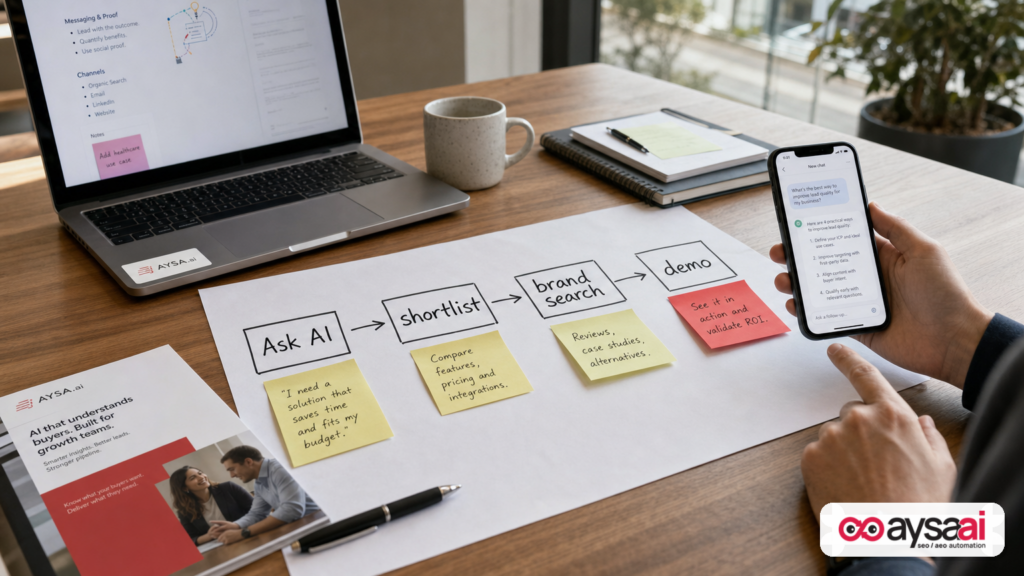
AI answers accelerate the zero-click trend: the research phase happens inside AI interfaces, not on your website. Traditional attribution still matters, but it now explains less of the buyer journey. The fix isn’t one new metric—it’s a measurement stack that blends:
- Traditional attribution (conversions, assisted conversions)
- Demand signals (branded search, direct traffic trends, sales-intent indicators)
- AI visibility signals (mentions, recommendations, citations, and how your brand appears in AI-generated comparisons)
Then you need execution: Monitoring is useless if your team can’t turn insights into site improvements fast and safely. That’s where AYSA fits: monitor what’s changing, prepare prioritized fixes, ask for approval, and execute accepted website changes.
Key takeaways

- Clicks are no longer the main proof of influence. AI can recommend you without sending you traffic.
- Attribution isn’t “broken,” it’s incomplete. Treat it as one layer in a wider measurement model.
- Branded demand is the bridge metric. If AI exposure is working, you often see it first in brand searches and direct intent.
- AI visibility must be tracked deliberately. If you don’t measure presence in AI prompts, you’ll misdiagnose performance.
- Execution is now the advantage. Teams that can implement improvements quickly will win the new search landscape.
Table of contents

- What changed: the buyer journey moved into AI conversations
- The new measurement problem: “invisible influence” in AI answers
- Why traditional attribution fails (and where it still works)
- The Influence Measurement Stack (IMS): a practical model for AI-era measurement
- The 10 signals to track when clicks disappear
- GA4 + Google Search Console: what you can measure reliably today
- How to track visibility inside AI systems (without fooling yourself)
- Common mistakes: vanity metrics, wrong baselines, and false causality
- A concrete SME scenario: the local clinic that “lost traffic” but gained patients
- Agency reset: how reporting and retainers must change
- Execution matters more than insights: the new operating cadence
- Where AYSA fits: monitor → prepare → approve → execute (at scale, safely)
- What to do next (action list)
- Sources and further reading
What changed: the buyer journey moved into AI conversations
For years, search evolved toward “answers on the SERP”: featured snippets, knowledge panels, local packs, and other experiences that reduce the need to click. The shift to generative AI compresses this even further. Instead of opening eight tabs to compare options, people can ask one prompt and get a synthesized shortlist.
That has two big consequences for measurement:
- Discovery happens earlier and off-site. A prospect can learn your name, your positioning, and your differentiators without visiting your website.
- Evaluation happens before analytics can see it. AI can “pre-sell” the user—then your website becomes a confirmation step, not the discovery step.
Search Engine Land frames this clearly: AI experiences make the path from discovery to decision harder to see, and brands need to combine traditional attribution with new signals of influence (source).
My editorial POV: in 2026, analytics is no longer just about “who clicked.” It’s about “who got considered.” If your dashboards can’t tell you whether you’re being considered, you’re flying blind.
The new measurement problem: “invisible influence” in AI answers
Let’s define the thing that’s driving everyone crazy.
Invisible influence is when your brand shapes a decision before a website session exists. Examples you’ve probably seen already:
- A prospect asks an AI tool: “Best project management software for architecture firms.” Your brand is recommended. No click happens.
- A buyer asks: “Alternatives to [competitor].” You’re mentioned as a credible option. No click happens.
- A user asks: “What should I ask a dentist before Invisalign?” The AI answer cites a page from your clinic site. The user later searches your clinic name directly.
In each case, influence occurs—without a neat referrer string, without a tracked session, without a last-click path.
AI doesn’t just change channels. It changes behavior. People are delegating the early work of evaluation to systems that don’t reliably pass attribution data to you. Search Engine Land calls out this gap: the interactions that introduce your brand and shape consideration can stay invisible in reporting (source).
Why traditional attribution fails (and where it still works)
Attribution models were built around click-based journeys. Even modern multi-touch approaches typically need the user to touch your measurable surfaces: your website, your app, your tracked emails, your paid campaigns.
AI experiences interrupt that in three ways:
1) No click, no session, no “source”
If a prospect gets your brand recommendation inside an AI-generated answer and then later types your URL, you’ll often see that as direct traffic. The influence happened; the measurement didn’t.
2) The buyer arrives late in the funnel
AI can compress the research stage. So the first measurable website visit is closer to conversion. That skews channel credit toward “bottom-of-funnel” touchpoints—direct, branded search, retargeting—regardless of what created awareness.
3) Identity and cross-device are messier than ever
Even before AI, cross-device behavior broke paths. Now add: mobile AI app → work laptop search → phone call. Your analytics sees fragments.
Where attribution still works: it still tells you what happens once someone is on your properties. Conversion rates, funnel drop-off, assisted conversions, and the performance of known campaigns are still critical. We’re not abandoning attribution; we’re demoting it from “the whole truth” to “one layer of truth.”
The Influence Measurement Stack (IMS): a practical model for AI-era measurement
When a system becomes harder to observe directly, you don’t respond with one magic metric. You respond with triangulation: multiple imperfect signals that, together, point to what’s real.
Here’s the Influence Measurement Stack (IMS) I recommend for SMEs and agencies.
Layer 1: Business outcomes (what you ultimately care about)
- Revenue (or pipeline created)
- Qualified leads
- Bookings / calls / demo requests
- Repeat purchases (for ecommerce)
Layer 2: Attribution outcomes (what analytics can still connect)
- Conversions by channel
- Assisted conversions (when available)
- Landing page conversion performance
- Path exploration (used carefully)
Layer 3: Demand signals (the bridge between influence and outcomes)
- Branded search growth
- Direct traffic trends (with skepticism)
- Increase in “high-intent” navigational queries
- Sales team “heard of you from…” call notes (yes, still valuable)
Layer 4: AI visibility signals (what’s happening in the AI layer of the internet)
- Mentions in AI answers for category prompts
- Inclusion in “best options” lists
- Comparisons vs competitors
- Citations (when the AI provides sources)
- Sentiment/positioning: how you’re described
This approach aligns with the idea from Search Engine Land: no single metric explains AI-driven influence, so you combine traditional attribution with emerging signals of visibility and consideration (source).
The 10 signals to track when clicks disappear
If you’re a business owner, you don’t need 50 KPIs. You need a small set that covers: outcomes, demand, and visibility. Here are 10 signals that tend to be both useful and realistic for SMEs.
1) Assisted conversions (where available)
Assisted conversion reporting helps you see which channels show up earlier, even when they don’t get last-click credit. Search Engine Land explicitly calls this out as a starting point (source).
2) Branded search growth
This is the clearest “bridge” signal. If AI tools repeatedly expose your brand, more people will search you by name. Search Engine Land highlights branded search growth as a key indicator of AI visibility creating awareness (source).
3) Direct traffic trend (carefully interpreted)
Direct traffic can be inflated by tracking issues. But if you see a sustained lift that doesn’t match seasonality, it can be a clue that off-site influence increased. Search Engine Land notes direct traffic can sometimes indicate buyers returning later through direct navigation (source).
4) Share of “category consideration” in AI prompts
This is not classic share of voice. It’s narrower: for a defined set of prompts, how often are you in the consideration set? Are you absent in prompts where you should be a natural recommendation?
5) How you’re positioned (category + differentiators)
AI can mention you but describe you incorrectly. Track the language used about you: are you framed as premium, budget, enterprise, local, specialized? That positioning can affect who clicks (or calls) later.
6) Citation footprint (when sources are shown)
When AI experiences cite sources, those citations often correlate with what content is considered “reference-worthy.” Even without clicks, citations can indicate authority and potential influence.
7) Competitor comparisons and “alternatives to” prompts
These prompts are often where deals are decided. If you’re missing here, your top-of-funnel content could look fine but your consideration-stage visibility is weak.
8) Conversion rate by landing page type
As more people arrive “pre-sold,” conversion rates can rise even as sessions fall. Track conversion rate by page intent: pricing, services, category pages, comparison pages, contact.
9) Sales and support “self-report” data
It’s not glamorous, but it’s real. Add one field in your CRM or booking form: “Where did you hear about us?” Include “AI tool (ChatGPT/Claude/Google AI)” as an option. Even a small sample can validate what analytics cannot.
10) Content reuse signals (what gets summarized)
Track which pages are repeatedly referenced in AI summaries (via citations, prompt testing, or your own monitoring). Those pages are your “AI entry points” into the category conversation.
GA4 + Google Search Console: what you can measure reliably today
Even in the AI era, your first job is to make your existing measurement stack dependable. If GA4 is misconfigured, you’ll chase ghosts. If Search Console is ignored, you’ll misread demand.
Google Search Console (GSC)
GSC remains your best source of truth for Google organic search performance at the query and page level. Use it to:
- Track branded query impressions and clicks over time
- Monitor changes in non-branded query mix (what topics you’re being discovered for)
- Spot content that’s losing impressions (which can signal SERP changes or AI answer cannibalization)
Search Engine Land also points readers toward developments around GSC and AI reporting/controls (as a related research lead): Google Search Console AI performance reports and controls to block your content in AI responses. I’m not going to speculate on details beyond what we have here, but the direction is clear: measurement and controls are becoming part of the search console conversation.
GA4
GA4 is still critical because it connects on-site behavior to outcomes. Focus on:
- Clean conversion definitions (forms, calls, purchases, bookings)
- Channel grouping sanity checks (avoid “everything is Direct” due to tagging mistakes)
- Landing page performance and conversion rate trends
- New vs returning users and engagement quality (as a proxy for “pre-sold” traffic)
And a reminder: when AI influence increases, it’s normal for your “last-click” mix to shift toward branded and direct. That’s not automatically a problem. It’s only a problem if outcomes fall or if AI visibility is going to competitors instead of you.
How to track visibility inside AI systems (without fooling yourself)
“Track AI visibility” is easy to say and hard to do well. The risk is building a fragile process that creates impressive-looking reports with little business value.
Here’s a practical approach that SMEs can maintain.
Step 1: Build a stable prompt set (your ‘AI SERP’)
Create 30–100 prompts that represent how customers actually ask for help. Include:
- “Best [category] for [industry/use case]”
- “[category] pricing”
- “[category] alternatives to [competitor]”
- “Compare [you] vs [competitor]” (even if it feels uncomfortable)
- Problem prompts: “How do I fix…” “What should I choose if…”
Step 2: Score for presence, position, and description
For each prompt, capture:
- Presence: are you mentioned?
- Role: recommended, included, or dismissed?
- Positioning: what attributes are assigned to you?
- Citations: are sources shown; are you cited?
Step 3: Set a cadence that matches your market
For many SMEs, monthly is enough. For aggressive categories, weekly checks may be needed. The point is trend detection, not daily noise.
Step 4: Maintain an execution change-log
If you want to connect AI visibility changes to your work, you need a simple log: what changed on the site, when, and why. Without it, you’ll assign credit randomly.
If you want a broader strategic view, Search Engine Land also links to related context about buyer behavior shifts—like delegation search, where users outsource decisions to AI (Delegation search: Why users outsource decisions to AI). That’s the behavioral foundation behind the prompt set approach.
Common mistakes: vanity metrics, wrong baselines, and false causality
This is where teams lose months.
Mistake 1: Treating “AI share of voice” as the KPI
Share of voice can be a useful directional measure, but it can also be a trap if:
- Your prompt set is biased toward your brand or your language (not your customers’)
- You don’t track whether mentions are positive, relevant, or conversion-driving
- You ignore the prompts that actually decide deals (“alternatives,” “compare,” “for my use case”)
Search Engine Land flags this issue in a related piece: The problem with AI share of voice and 3 metrics that matter more. The takeaway I agree with: “how often you’re present” is less important than “where you influence consideration.”
Mistake 2: Comparing AI-era performance to click-era benchmarks
If your benchmark assumes CTR growth is the primary win, you’ll conclude you’re failing even when pipeline is rising. Update your scorecard to include demand and visibility signals.
Mistake 3: Confusing correlation with causation
Branded search up? Could be AI, could be PR, could be seasonality, could be a competitor’s outage, could be offline. That’s why you need a measurement stack and an execution log, not one chart.
Mistake 4: Measuring and not acting
In 2026, the slowest part of SEO is often not ideation—it’s implementation. If your measurement doesn’t lead to approved changes, it’s entertainment, not strategy.
A concrete SME scenario: the local clinic that “lost traffic” but gained patients
Here’s a realistic scenario I see frequently with service businesses.
Business: a local dental clinic offering Invisalign and implants.
What the owner notices: “Organic traffic is down 18% year-over-year. Are we in trouble?”
What the P&L says: consult bookings are flat-to-up, and higher-value procedures are up.
What’s happening?
- More prospects ask AI tools: “How much does Invisalign cost in [city]?” “How to choose a dentist for implants?”
- The AI summary answers basic questions (no click needed) and recommends a few clinics (including ours) based on reputation and specialization.
- The prospect then searches the clinic name, checks reviews, calls, and books.
If you only look at non-branded organic traffic, you’ll panic. If you look at the measurement stack:
- Outcomes: bookings stable/up
- Demand signals: branded searches up, direct visits up, calls up
- AI visibility: present in “best dentist for implants” prompts; missing in “Invisalign cost” prompts
Now you have a strategy: improve the content and authority around Invisalign pricing, financing, and candidacy—because you can see where AI consideration is weak, not just where clicks fell.
Agency reset: how reporting and retainers must change
Agencies are going to feel this shift before many internal teams, because clients judge agencies by reports.
The old retainer logic: “We grew organic sessions and improved rankings.” The new client reality: “Sessions don’t match revenue, and AI answers are stealing clicks.”
Agencies should update three things:
1) The scorecard
Stop anchoring success solely to sessions. Add:
- Branded demand trends
- High-intent landing page conversion performance
- AI visibility coverage for a stable prompt set
2) The deliverables
Move from “blog posts” to “category influence assets.” That includes:
- Comparison pages
- Alternatives pages
- Use-case pages
- Evidence pages (case studies, methodologies, pricing explanations)
3) The operating model
In the AI era, execution speed is strategic. If implementation takes 6–10 weeks because of tickets, dev backlogs, and approvals, your “insights” will always arrive late.
Search Engine Land’s broader news context underscores how fast the ecosystem changes—from core updates to new search experiences. For example, it references Google’s May 2026 core update completion (source). Regardless of specifics, the practical implication is that search environments shift continually; slow execution compounds risk.
Execution matters more than insights: the new operating cadence
Here’s the uncomfortable truth: most teams don’t have an “SEO problem.” They have a throughput problem.
You can know exactly which pages are missing from AI answers and still fail—because implementation is slow, fragmented, or risky.
I recommend an operating cadence like this:
- Weekly: monitor search + AI visibility volatility; triage issues and opportunities
- Biweekly: approve a batch of changes (content refreshes, internal linking, schema, page improvements)
- Monthly: report the measurement stack (outcomes + demand + AI visibility), not just sessions
- Quarterly: revisit prompt set, competitor set, and category strategy
And keep it simple: the goal is not to “predict the algorithm.” The goal is to ensure your brand is present where AI systems build shortlists—then make the on-site experience convert the motivated traffic that still arrives.
Where AYSA fits: monitor → prepare → approve → execute (at scale, safely)
AYSA exists for the part most teams struggle with: turning insights into safe, consistent implementation.
Here’s how AYSA supports AI-era measurement and action:
1) Monitor what’s changing
Use AYSA monitoring to keep a steady pulse on performance signals and site health. When the environment shifts, you want early detection, not a monthly surprise.
2) Prepare prioritized improvements
AYSA helps prepare changes that reflect your goals: improve category coverage, strengthen key pages, fix technical gaps, and align content to the questions customers (and AI systems) actually use.
3) Ask for approval
This is the difference between “AI suggestions” and a real operating system. Your team stays in control. AYSA proposes changes; you approve what matches your brand, compliance needs, and business priorities.
4) Execute accepted website changes
Approved execution is where compounding advantage happens. When you can implement improvements steadily—without endless back-and-forth—you adapt faster than competitors.
If you want to explore the feature set behind this workflow, start here:
- AI search visibility
- AI SEO tools
- Monitoring
- Pricing
- AYSA blog (ongoing editorials and playbooks)
My perspective: the winners in AI search won’t be the teams with the prettiest dashboards. They’ll be the teams with the tightest loop between measurement → decision → approved execution.
What to do next (action list)
- Stop overreacting to session drops. First check outcomes (revenue/leads/bookings) and conversion rates.
- Build your Influence Measurement Stack. Pick 2–3 outcome metrics, 2–3 demand metrics, and 3–5 AI visibility metrics.
- Create a stable prompt set. 30–100 prompts that represent your category and your buyers’ language.
- Track branded search trends in Search Console. Treat branded growth as a leading indicator of AI-driven awareness.
- Add one self-report field to your forms/CRM. Include “AI tool” as an option for “How did you hear about us?”
- Identify your ‘consideration-stage’ pages. Pricing, comparisons, alternatives, use cases, and “best for” content.
- Commit to an execution cadence. Weekly monitoring, biweekly approvals, monthly stack reporting.
- Use AYSA to operationalize the loop. Monitor, prepare changes, approve, and execute—consistently.
Sources and further reading
- Search Engine Land: 4 ways to track AI search visibility when attribution falls short
- Search Engine Land: Delegation search: Why users outsource decisions to AI
- Search Engine Land: The problem with AI share of voice and 3 metrics that matter more
- Search Engine Land: Google Search Console AI performance reports and controls to block your content in AI responses
- Search Engine Land: Google May 2026 core update rollout is now complete
AYSA internal resources:
Continue the AI search topic inside AYSA.
Use these pages to connect the article with AI SEO tools, AI visibility monitoring, AI Overviews and approved website execution.
Turn this topic into a website action plan.
Use these AYSA hubs to move from reading to technical fixes, AI visibility monitoring, research, glossary context and approval-first SEO execution.

