The Agentic Gemini Era Is Here: What Google’s May 2026 AI Updates Mean for Search, Shopping, and Your Website Execution
Google’s May 2026 AI announcements point to a clear direction: AI that doesn’t just answer, but monitors, plans, and takes action across apps. Here’s what changed, why it matters for search behavior and conversions, and the practical execution plan SMEs and agencies need now—plus how AYSA’s approved execution model turns visibility into shipped website improvements.

May 2026 wasn’t “another AI update month.” It was Google putting a stake in the ground: we’re moving from AI that responds to AI that acts. In Google’s own roundup of announcements, the theme is explicit—an “agentic Gemini era,” new agent-like capabilities in Search, and shopping, health, and Android experiences designed to keep AI running in the background on your behalf.
As a business owner or marketer, you don’t have to memorize every product name. You do have to understand the shift in user behavior that these updates signal—because that shift changes what “visibility” means, what “ranking” produces, and what kind of website work actually moves revenue.
In this editorial, I’ll break down what Google announced in May 2026, why it matters for SMEs and agencies, and a practical Execution Plan. I’ll also explain where AYSA fits: not as a reporting layer, but as an Approved Execution system—Monitoring, preparing changes, asking for approval, and then shipping accepted updates to your website in a controlled way.
Concise summary (read this if you’re busy)
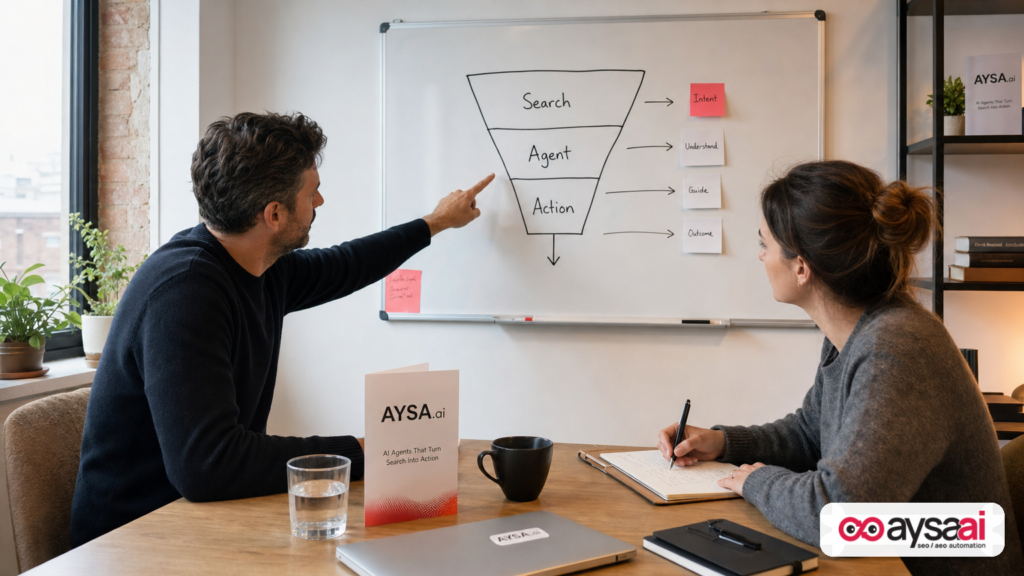
- Search is becoming agentic: Google is talking about information agents that monitor and update users, plus generative UI and coding capabilities inside Search. This points toward fewer one-off queries and more ongoing tasks handled by AI.
- Websites must be machine-ready: If AI systems summarize, compare, and “act,” your site needs clean structure, explicit answers, verifiable claims, and content that’s easy to ground and cite.
- Shopping becomes cross-surface: “Universal Cart” suggests the buying journey will increasingly happen across Search, assistants, email, and video—so Attribution, feeds, and product content consistency matter more than ever.
- Execution speed beats deck-building: The winners will be the teams that detect changes early and ship improvements weekly, not quarterly—without breaking brand, compliance, or conversions.
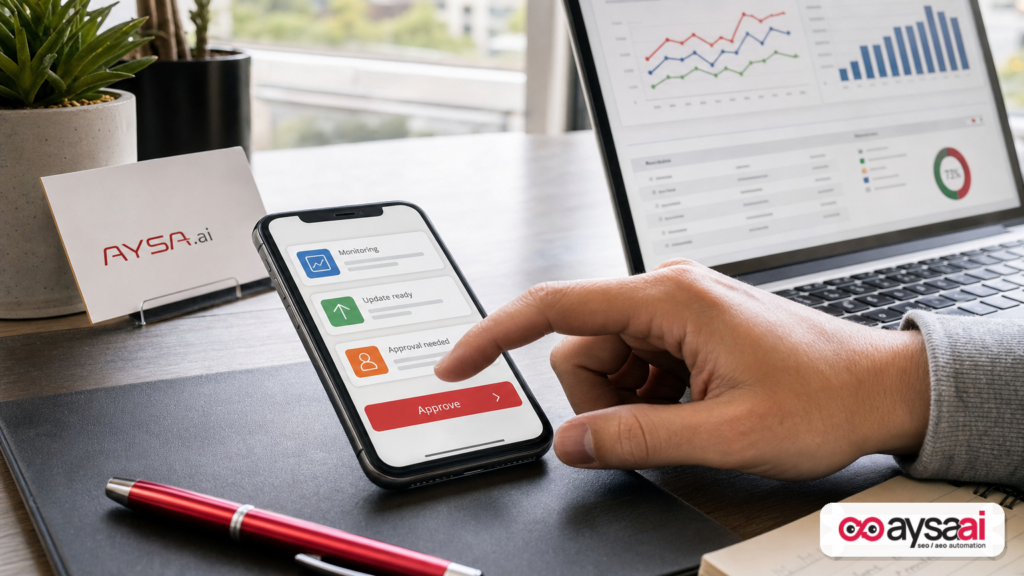
- AYSA’s role: AYSA monitors search visibility, prepares prioritized SEO/AEO/GEO changes, routes them for approval, and executes accepted changes—so you can keep up with agentic search without relying on slow, manual cycles.
Table of contents
- 1) Context: why May 2026 matters more than a recap
- 2) What changed: from “AI answers” to “AI that acts”
- 3) The new Search reality: information agents, generative UI, and a smarter Search box
- 4) Gemini Omni and multimodal creation: why it matters even if you don’t make videos
- 5) Android Halo and the rise of “agent management”
- 6) Universal Cart: the buying journey becomes distributed
- 7) Google Health + Fitbit Air: more sensitive queries, higher trust requirements
- 8) What goes wrong: publisher, brand, and SMB pitfalls in agentic search
- 9) SME scenario: a clinic, an ecommerce store, and a local service business
- 10) What to monitor now: signals that your visibility model is changing
- 11) What to build on your website for AEO/GEO: a practical blueprint
- 12) What agencies should rethink: deliverables, SLAs, and governance
- 13) Where AYSA fits: approved execution for AI Search
- 14) What to do next (action list)
- Sources and further reading
1) Context: why May 2026 matters more than a recap

Google’s “AI updates” roundups can look like product confetti: models, apps, hardware, health, shopping, developer tools. But the May 2026 set—anchored around announcements from Google I/O 2026 and adjacent events—reads like a single narrative: AI is moving from chat to capability.
Google frames this as an “agentic” era built around Gemini models and integrated experiences. In their May 2026 recap, they highlight:
- New Gemini models (including Gemini 3.5 and Gemini Omni) emphasizing action-taking and multimodal creation
- Search becoming more proactive with information agents that monitor on a user’s behalf and deliver updates
- Shopping upgrades like Universal Cart spanning multiple Google surfaces
- Android features built around “Gemini Intelligence,” including Android Halo to manage agents
- New health and wellness tooling including a new Google Health app and Fitbit Air
- Broader research initiatives (including quantum + AI intersecting life sciences)
Source: Google Search Blog / The Keyword: “The latest AI news we announced in May 2026”.
Here’s the key business takeaway: if the platform is shifting from “find information” to “get a task done,” then your website is no longer just a destination. It’s an input into an agent’s decision process. Your content will be parsed, compared, summarized, and used to trigger actions—sometimes without a classic click-through journey.
That’s uncomfortable for traditional SEO. It’s also an opportunity for businesses that can provide clear, trustworthy, well-structured information and keep it updated.
2) What changed in May 2026: from “AI answers” to “AI that acts”
We’ve been talking about AI in search for years. But the May 2026 language matters: “agentic,” “action-taking,” “monitor information on your behalf,” “execute complex, multi-step workflows across your apps.” That’s different from “AI provides a summary.” It implies:
2.1 The unit of value shifts from a query to a workflow
Classic search is a loop: query → results → click → website → conversion. Agentic search introduces a new loop: goal → agent monitors and plans → agent fetches and compares → agent recommends or executes → user approves (or doesn’t).
For businesses, that means the best “ranking” isn’t always position #1 for a single Keyword. The best outcome might be:
- Your product becomes the default recommendation inside a comparison
- Your policy page becomes the source that an agent cites
- Your availability and pricing becomes the trusted input that an agent uses to build a plan
2.2 Proactivity changes who wins
If Search agents “monitor information 24/7” and push updates, users will increasingly subscribe to outcomes (e.g., “tell me when this drops in price,” “tell me when appointments open,” “keep me updated on regulations”). Businesses that publish information in ways that are easy to monitor—clear change logs, visible pricing, explicit availability—will be easier for agents to track and surface.
2.3 The interface becomes fluid
Google’s recap describes bringing “agentic coding capabilities” into Search to build generative UI, interactive visuals, and custom dashboards or mini apps for ongoing tasks. If that becomes the norm, it means:
- Users may interact with your data through a Google-generated interface
- Your brand and content could be experienced as “components” rather than pages
- Consistency and clarity in your underlying information becomes critical
This is not a reason to panic. It’s a reason to stop treating your website as a static brochure and start treating it as a living knowledge base with conversion paths.
3) The new Search reality: information agents, generative UI, and a smarter Search box
Google’s May recap includes several Search-specific directions that every business should translate into operational priorities:
3.1 Information agents in Search: “monitor and update” behavior
Google says it is launching “information agents” in Search that work in the background, “24/7,” monitoring information and sending updates with links to go deeper and take action. (Again, this is per Google’s recap article.)
Operational implication: your customers might stop re-searching. Instead, they set a monitoring task. So ask:
- What would a customer want monitored in our category? Price? Availability? New inventory? New regulations? Appointment openings?
- Do we publish those changes in a way machines can understand and trust?
- If our data changes, does our site reflect it quickly and consistently?
3.2 Generative UI and “mini apps” in Search
Google also references Search building interactive visuals and “custom experiences like dashboards or mini apps” for ongoing tasks, plus coding capabilities that could create things like a “custom fitness tracker” using real-time data such as reviews, maps, and weather.
Even if you’re not in fitness, the point is: Search is positioning itself as a place where users do things, not just learn things.
Business implication: you must make your content and product/service information “composable.” Think in:
- Clear definitions
- Explicit constraints (shipping zones, eligibility, requirements)
- Up-to-date policies
- Structured content patterns (FAQs, comparisons, specs, steps)
3.3 The “intelligent Search box” and the UI upgrade
Google mentions a new “intelligent Search box” and calls it the biggest upgrade in over 25 years. When the entry point changes, it often reshapes what users type, what they expect, and how quickly they trust the first screen.
For you, it means: your content must be ready to be used earlier in the journey. If the first interaction is “goal-based,” your pages must answer:
- What is this for?
- Who is it for?
- What does it cost?
- How do I start?
- What are the limitations, risks, or policies?
Those are AEO/GEO questions, not old-school keyword questions. (More on that later.)
4) Gemini Omni and multimodal creation: why it matters even if you don’t make videos
Google’s recap highlights Gemini Omni as a model that can take “images, audio, video and text as input” and generate high-quality video grounded in real-world knowledge, starting with video generation.
If you’re an SME, you might think: “Great, but I’m not a media company.” Here’s why you should still care:
4.1 Multimodal input means multimodal discovery
When AI systems can take mixed inputs, customers will use mixed inputs. They’ll upload a photo of a broken part, record a voice note about symptoms, or share a screenshot of a product list. Discovery becomes less “keyword → page” and more “context → decision.”
Your job becomes to make sure your site has content that AI can use to map from real-world signals to the right answer. Examples:
- A home services company: “Is this mold or soot?” photo-based questions should route to a clear diagnostic page with disclaimers and next steps.
- An auto parts ecommerce store: include fitment rules, compatibility tables, and “how to confirm” steps.
- A clinic: symptom explainer pages must be accurate, cautious, and transparent—especially around medical boundaries.
4.2 “Creation” increases competition for attention
If anyone can generate high-quality video quickly, then the volume of content will explode. The differentiation will shift toward:
- Original expertise
- Trust and verification
- Clear sourcing
- Proprietary data (inventory, availability, pricing, policies)
In other words: you can’t out-produce the internet. You can out-clarify it.
5) Android Halo and the rise of “agent management”
In Google’s May recap, Android Halo is described as a new space on your phone that lets you see agents’ progress and receive contextual assistance without interrupting your flow.
This matters because it normalizes something that most businesses haven’t modeled yet: customers will have multiple agents running concurrently.
That creates practical implications:
- Latency becomes reputation: if your site updates slowly or your data is inconsistent, agents may learn you’re unreliable.
- Clarity beats persuasion: agents operate on constraints. Ambiguity hurts you.
- Friction becomes fatal: complicated forms, unclear steps, or missing answers create drop-off before a human even lands on your page.
In short: if the customer is delegating tasks, your website needs to be easier for both humans and agents to complete those tasks.
6) Universal Cart: the buying journey becomes distributed
Google highlights Universal Cart as a hub for shopping on Google that works across merchants and services, letting users add items while browsing Search, chatting with Gemini, watching YouTube, or even reading Gmail.
Two important takeaways:
6.1 Conversions become cross-surface (and less attributable)
If a user adds an item in one surface and checks out later via another, attribution becomes messy. The “last click” fantasy breaks even harder than it already has.
So the tactical move isn’t to obsess over perfect attribution—it’s to:
- Make product information consistent everywhere (site, feeds, metadata)
- Eliminate surprises that create returns or support tickets
- Optimize the post-click experience for speed and confidence
6.2 Product content quality becomes your ad budget
When AI assistants and shopping systems summarize and compare, they will prefer products that are easy to describe accurately: clear titles, specs, shipping constraints, and policies.
In practical terms, treat your product pages like structured “truth sources,” not marketing collateral. A good product page in the agentic era includes:
- Plain-English value proposition
- Specs in a consistent table
- Compatibility/fit rules (where relevant)
- Shipping costs and timelines upfront
- Returns/warranty clearly stated
- FAQs that handle objections
This is where AI Search visibility becomes a content + operations discipline, not just an SEO project.
7) Google Health + Fitbit Air: more sensitive queries, higher trust requirements
Google’s recap also spotlights the new Google Health app and the Fitbit Air device, describing advanced tracking features and wellness focus. Health is where agentic systems collide with the most sensitive “Your Money or Your Life” expectations: trust, accuracy, and safety.
Even if you’re not in healthcare, the health direction matters because it raises the bar for how Google thinks about:
- Content transparency
- Verification
- Safety boundaries
Google’s May recap also mentions expanding content transparency and verification tools across Search, Gemini, Chrome, Pixel, and Cloud to help users understand whether content online is AI-generated.
Implication: “content quality” is not just readability. It’s provenance and accountability. Businesses should be ready to clearly state:
- Who wrote or reviewed the content (especially in regulated industries)
- When it was last updated
- What sources or standards it follows
- What it does not claim (limits, disclaimers, eligibility)
If you’re in health, finance, legal, or safety-adjacent categories, being vague will increasingly be a competitive disadvantage.
8) What goes wrong: publisher, brand, and SMB pitfalls in agentic search
Agentic search sounds helpful. It’s also a minefield. Here are the failures I expect more SMEs and agencies to run into as these ideas become product reality.
8.1 Your content is “used” but you don’t get the click
This isn’t new—featured snippets and AI summaries have been doing this. What changes is how often your content becomes an intermediate input to an agent’s workflow.
Response strategy: stop measuring success purely by clicks. Track:
- Brand mentions and branded demand
- Assisted conversions
- Lead quality and close rate
- Visibility for “decision queries” and “constraint queries”
8.2 Your pages are too ambiguous to be reliably summarized
Marketing copy is fun for humans. Agents need specifics. If your page hides pricing, buries restrictions, or uses vague promises, an agent may either omit you or misrepresent you.
Response strategy: create “agent-friendly” page sections: clear pricing ranges, clear service areas, clear eligibility, clear steps.
8.3 Your site becomes outdated faster than your team can update it
When information agents monitor changes, out-of-date pages become visible liabilities. A single outdated shipping promise can create support volume and refund churn—and if agents learn you’re inconsistent, you lose recommendations.
Response strategy: move to a monitoring-and-execution cadence where updates ship continuously. This is exactly why we built AYSA Monitoring as a foundation—visibility without action is just anxiety.
8.4 Governance breaks: people fear AI changing the site
Many businesses want “automation” until it touches the website. Then legal, brand, and leadership get nervous (often for good reason). The answer isn’t zero automation. It’s approved execution—automation that prepares changes but requires human approval before shipping.
9) SME scenario: a clinic, an ecommerce store, and a local service business in the agentic era
Let’s ground this in three realistic businesses and the exact ways agentic search changes their priorities.
9.1 A private clinic (multi-location) trying to fill appointment slots
What customers want now: not just “best dermatologist near me,” but “find me the earliest appointment within 10 miles that accepts my insurance and handles this condition.”
Agentic behavior: a Search agent monitors openings, checks constraints, and pushes a notification when a slot appears—rather than the user repeating searches every day.
What the clinic should do on the website:
- Create explicit pages per service with clear eligibility and next steps
- Publish transparent policies: referrals, insurance notes, what to bring, cancellation rules
- Maintain accurate location and hours information
- Use structured FAQ sections to answer high-intent questions quickly
How AYSA fits: Monitor visibility for service + location queries, detect when key pages lose coverage, prepare content updates (FAQs, page structure, internal linking), and route them for approval before execution.
9.2 An ecommerce store selling specialty home goods
What customers want now: “show me the best options under $200 that ship fast and match this style.” They may add items across surfaces (Search, YouTube, email) via a universal cart-style flow.
What the store should do:
- Standardize titles, attributes, and specs across the catalog
- Make shipping/returns unmistakable on every product page
- Create comparison content (“how to choose”) that agents can cite
- Use internal linking to connect guides → categories → products
How AYSA fits: Identify thin product templates, missing attributes, broken internal linking patterns, and “answer gaps” in FAQs; prepare fixes in a batch; get approvals; ship changes continuously.
9.3 A local HVAC company that lives on urgent demand
What customers want now: “My AC is making this noise—what is it and how fast can someone come?” They might upload a video/audio clip or describe symptoms by voice.
What the company should do:
- Publish symptom-based diagnostic content with safe disclaimers
- Create clear service-area pages and emergency availability notes
- Add “what it costs” ranges and what changes the price
- Make contact and scheduling frictionless on mobile
How AYSA fits: Monitor local visibility and AI search inclusion, suggest changes that improve clarity (service pages, FAQs, internal links), and execute after approval—without waiting for a quarterly site refresh.
10) What to monitor now: signals that your visibility model is changing
If agentic search accelerates, the first symptom won’t always be “rankings dropped.” It’ll be a pattern shift across demand, behavior, and query types.
Here’s what I’d monitor in a practical SME-friendly way:
10.1 Query mix: more “goal and constraints,” fewer “simple keywords”
Watch for more long-tail queries that include:
- Budget constraints (“under $X”)
- Timing (“today,” “this weekend,” “next-day shipping”)
- Eligibility (“for kids,” “for sensitive skin,” “works with X model”)
- Comparison intent (“best,” “vs,” “alternatives”)
10.2 Engagement quality: fewer clicks, higher-intent clicks
As more questions get answered in-SERP, total clicks can fall while conversion rate on remaining traffic rises (because the click happens later, when intent is higher). Your KPI stack must adapt.
10.3 Coverage: do you show up in summaries and comparisons?
Even if you can’t perfectly measure “agent inclusion,” you can track:
- Whether your key pages are being surfaced for decision queries
- Whether competitors are being cited for your core topics
- Whether new SERP features appear for your category
This is why automated monitoring matters. If you wait for a monthly report, you’ll always be late. See how we think about continuous visibility tracking at AYSA Monitoring.
10.4 Freshness and accuracy: are your “facts” consistent across the site?
Agents will punish inconsistency. You should routinely audit:
- Prices that differ between category and product pages
- Old policy pages that contradict newer messaging
- Location pages with wrong hours
- Outdated “best of” guides
11) What to build on your website for AEO/GEO: a practical blueprint
If AI systems are going to summarize and act, your site must provide structured, verifiable, and complete answers.
I like to frame this as moving from SEO (search engine optimization) to a stack that includes:
- AEO: Answer Engine Optimization (be the best source for direct answers)
- GEO: Generative Engine Optimization (be easy to ground, summarize, and cite in generative responses)
Here’s the blueprint I recommend most SMEs implement over 60–120 days, then iterate continuously.
11.1 Build “decision pages,” not just traffic pages
Many sites still optimize for awareness queries. In agentic search, decision support is the moat. For each core offering, create a page that answers:
- Who it’s for / not for
- Pricing (range, what affects it)
- Timeline (delivery, scheduling, turnaround)
- Requirements (documents, prerequisites)
- Risks/limitations (honest constraints)
- Next step (clear CTA)
11.2 Add FAQ blocks where humans hesitate (and agents look for clarity)
Don’t add FAQs as fluff. Add them where objections happen:
- Shipping, returns, warranty
- Compatibility and sizing
- Service area and response time
- Privacy and data handling (especially for health and finance-adjacent services)
11.3 Standardize entity information across the site
Agentic systems rely on entity consistency. Standardize:
- Business name variants
- Location details
- Service names
- Product naming patterns
11.4 Make “proof” easy to find
As transparency tools expand (Google mentions this across Search/Gemini/Chrome/Pixel/Cloud), your site needs visible credibility signals:
- About page with real leadership and operating details
- Editorial standards (where relevant)
- Policies that are current and consistent
- Clear contact methods and support expectations
11.5 Build internal linking like you’re training an agent
Internal links are not just SEO plumbing. They’re relationships between concepts. Build a predictable structure:
- Guides → categories → products
- Symptoms/problems → services → booking
- Use-cases → features → pricing
This is the kind of work AYSA can help operationalize using monitoring and approved execution. Start with our overview of AI SEO tools and how we approach AI search visibility.
12) What agencies should rethink: deliverables, SLAs, and governance
If you’re an agency, May 2026 is a warning label: your clients will increasingly judge you on outcomes across AI-driven surfaces, not just “rankings.”
12.1 The new deliverable is a shipping cadence
Decks don’t compound. Shipped improvements do. Agencies should productize:
- Weekly release cycles for content and technical updates
- Monitoring that triggers change proposals
- Approval workflows that reduce client bottlenecks
12.2 Strategy without execution will get squeezed
Agentic AI makes “strategy-only” work less defensible. Clients want:
- What changed?
- What broke?
- What did we ship this week?
- What improved?
12.3 Governance becomes a competitive advantage
Clients are right to be cautious with automation. Agencies that can offer approved execution (prepare → review → approve → ship) will win over agencies that either:
- Move too slowly (manual everything), or
- Move too recklessly (auto-change without controls)
AYSA is built to support this model: it doesn’t just generate ideas—it turns ideas into controlled website changes. If you’re evaluating this operationally, explore pricing and the broader perspective on our blog.
13) Where AYSA fits: approved execution for AI Search
Let me be blunt: most businesses do not lose in search because they lack ideas. They lose because they fail to execute consistently.
Agentic search increases that pressure. When Google talks about background monitoring, generative UI, and proactive assistants, the pace of change accelerates. That means your website must improve continuously—without chaos.
AYSA is designed to be the execution layer. The model is simple:
- Monitor your search visibility and pages that matter (not vanity metrics).
- Prepare prioritized website changes (technical, content, internal linking, structure) aligned to AI search realities.
- Ask for approval so stakeholders (brand, legal, leadership) control what ships.
- Execute the accepted changes—so the plan becomes reality.
Learn more about the monitoring foundation here: AYSA Monitoring.
And if the term “AI SEO” still feels fuzzy, start with our overview: AI SEO Tools.
14) What to do next (action list)
If you want a practical plan that works whether you’re a founder, in-house marketer, or agency operator, use this list.
Immediate (this week)
- Inventory your decision pages: list the 10 pages that drive leads/sales. Do they clearly state pricing, constraints, and next steps?
- Pick 20 “constraint queries” your customers ask (shipping, eligibility, timelines, compatibility). Make sure each has a clear on-site answer.
- Set monitoring for your highest-value topics and pages so you detect changes early (not after revenue dips).
Near-term (next 30 days)
- Rewrite top pages for AEO/GEO clarity: add scannable sections, FAQs, and explicit constraints.
- Standardize product/service naming and eliminate contradictory claims across pages.
- Improve internal linking from guides → money pages so agents and humans can traverse your site logically.
Ongoing (monthly cadence)
- Ship weekly: even small changes compound.
- Refresh trust signals: update policies, authorship/review notes where relevant, and ensure contact/support info is consistent.
- Audit for “stale facts”: pricing, availability, hours, policies.
If you want a system to operationalize this with approvals and execution, review AYSA’s positioning around AI search visibility and see how our monitoring-to-execution loop works at AYSA Monitoring.
Sources and further reading
- Google / The Keyword: The latest AI news we announced in May 2026
- Google DeepMind blog
- Google Research blog
- Google Developers Blog
- Google Cloud Blog
- Google Security Blog
- Google Ads & Commerce blog
- Waze blog
Note on sourcing: This editorial is based on Google’s own May 2026 recap and the official Google blogs linked above. I have not independently verified product performance claims beyond what’s described in the supplied source context, so I’ve focused on strategic implications and operational best practices rather than speculative metrics.
Continue the AI search topic inside AYSA.
Use these pages to connect the article with AI SEO tools, AI visibility monitoring, AI Overviews and approved website execution.
Turn this topic into a website action plan.
Use these AYSA hubs to move from reading to technical fixes, AI visibility monitoring, research, glossary context and approval-first SEO execution.