AI Search Visibility Finally Gets Infrastructure: What Google’s New GSC AI Reports, UK Opt-Out Rules, and Core Updates Mean For Your Business
Google is testing dedicated AI visibility reporting and AI appearance controls in Search Console—starting in the UK—while UK regulators require publisher opt-outs for AI search features. Here’s what changed, why it matters, and how to build an execution-ready plan for AI search, not just a measurement theory.

AI Search has been stuck in an awkward phase: it was influencing customer behavior and publisher outcomes, but it wasn’t fully measurable or controllable. That’s starting to change.
Google is testing dedicated AI visibility reporting in Search Console, along with a toggle that lets site owners control whether they appear in AI Overviews and AI Mode—initially rolling out to a subset of UK sites. At the same time, the UK’s Competition and Markets Authority (CMA) is requiring Google to offer publishers an opt-out for AI search features, and to separate that from standard search ranking impacts. Add a volatile May 2026 core update into the mix and one theme becomes obvious: AI search visibility is becoming its own surface with its own infrastructure.
This editorial is a practical guide for business owners, marketers, and agencies who need to make decisions now—without waiting for perfect click tracking or perfect definitions.
Concise Summary

Google is moving AI visibility from “mystery box” to “reportable surface” by testing new Search Console reports and AI appearance controls. The UK is forcing publisher opt-outs, which may become a global template. But reporting still lacks click data, so teams must build a measurement stack across multiple signals (AI Impressions, Brand Mentions, referrals, conversions). The May 2026 core update also reinforces a new reality: your classic organic visibility and your AI answer visibility can move in different directions.
Key Takeaways (What You Should Remember)
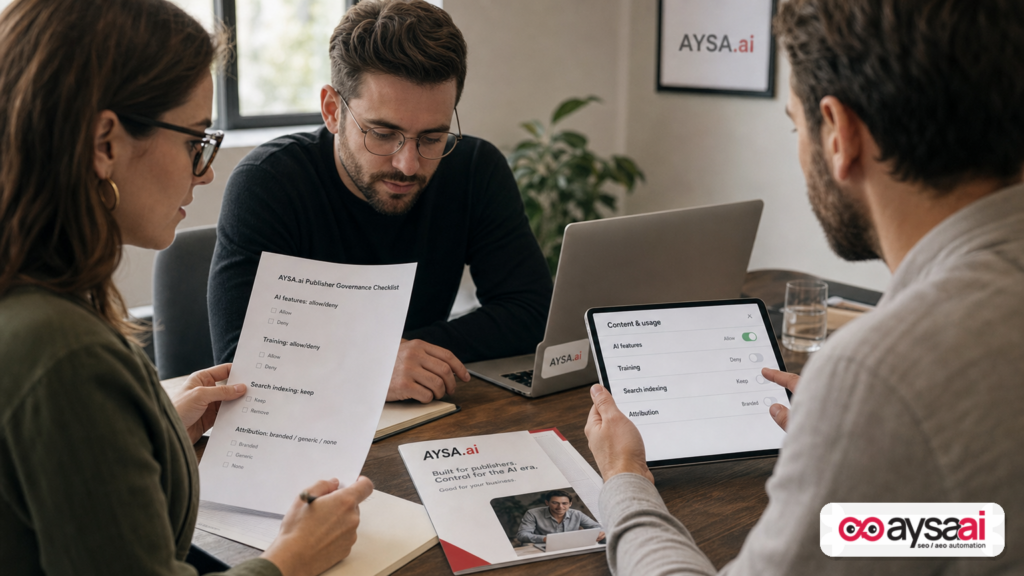
- AI visibility is becoming measurable in Search Console (impressions by page/country/device/date, with hourly granularity), but not yet clickable (no Clicks reported).
- Control is arriving: Google is testing an AI inclusion toggle in Search Console for UK sites, while the UK CMA is requiring an opt-out option for publishers.
- The UK matters even if you’re not in the UK: regulatory patterns tend to spread, and product changes tested in one region often scale.
- Core updates now have “two scoreboards”: classic rankings and AI answer placements may diverge.
- Execution will outperform speculation: teams that can monitor, prepare, approve, and ship fixes fast will gain share as AI search surfaces evolve weekly.
Table of Contents

- What Actually Changed: Measurement and Control Are Splitting From Traditional Search
- Google’s AI Reports in Search Console: What They Are (and What They Aren’t)
- Why Click Data Is Missing (and What to Measure Instead)
- The UK Opt-Out Requirement: A Signal That Publisher Control Is Becoming Policy
- What This Means for SMEs vs. Publishers vs. Agencies
- Core Updates in an AI World: One Update, Two Different Outcomes
- How AI Search Changes Customer Behavior (Even When You Still Rank #1)
- A Practical Measurement Framework for AI Search Visibility
- What Businesses Should Do Now: An Execution-First Action Plan
- The SME Scenario: A Local Clinic That Wins Calls, Not Just Rankings
- Where AYSA Fits: Monitoring + Approved Execution for AI Search
- What to Do Next (Checklist)
- Sources and Further Reading
What Actually Changed: Measurement and Control Are Splitting From Traditional Search
Classic SEO assumed a mostly linear story:
- Your page ranks for a query.
- A user sees a snippet.
- They click.
- You measure clicks, CTR, and conversions.
AI search breaks that linearity. A user can receive an answer without clicking. Your brand can be referenced without being visited. Your content can influence the answer even if your URL isn’t visibly prominent. And your “visibility” can mean at least three different things:
- Inclusion: whether your content is used or cited in AI features.
- Presence: how often your pages appear inside AI surfaces (impressions/appearances).
- Outcome: whether AI visibility leads to visits, leads, sales, calls, bookings, or brand lift.
The news (as reported by Search Engine Journal) is that Google is beginning to treat AI visibility as a separate surface worth reporting and controlling in Google Search Console (GSC)—with initial rollouts to UK sites and hourly-level granularity on the reporting side. That’s not just a feature update. It’s a directional change in how search will be managed operationally.
External source: Search Engine Journal coverage of Google’s AI Search Console tests and UK opt-out requirements.
Google’s AI Reports in Search Console: What They Are (and What They Aren’t)
According to Search Engine Journal’s reporting, Google is testing two related capabilities in Search Console:
- Dedicated AI performance reports showing how URLs appear in AI features across Search and Discover, including breakdowns by impressions, pages, countries, devices, and dates with hourly granularity.
- A toggle to control appearance in AI Overviews and AI Mode.
Why this is a big deal (even without clicks)
Until now, many teams have been forced into guesswork:
- “We think AI Overviews reduced traffic.”
- “We think we’re being referenced.”
- “We don’t know which pages are showing.”
If you can isolate AI appearances, you can run a real operational loop:
- Identify which pages are getting AI impressions.
- Review those pages for clarity, structure, and up-to-date facts.
- Strengthen entity signals (brand, authorship, locations, products, policies).
- Monitor changes after updates.
What it doesn’t solve yet
The obvious hole is no click data. That means you still can’t answer, directly inside GSC, the question a CFO cares about:
- “How much revenue did AI Overviews drive or steal?”
But it does give you something that’s been missing: a stable definition of AI surface impressions. In practice, teams need a definition even if it’s imperfect—because operations are built on definitions.
A note on scope and rollout reality
It’s important to treat “tests” as tests. Early rollouts often have limitations, and reporting schemas can change. The right mindset is:
- Don’t redesign your entire KPI stack overnight.
- Do start collecting baselines now so you can detect meaningful deltas later.
If you want a practical system to track AI visibility signals beyond what Google provides, see: AI Search Visibility and AYSA Monitoring.
Why Click Data Is Missing (and What to Measure Instead)
When people complain about “no click data,” they’re not wrong—clicks are the cleanest bridge between visibility and business outcomes. But the deeper issue is that AI search experiences don’t always have a meaningful “click” to attribute.
Even if Google eventually adds click metrics, there are at least four reasons click data may remain incomplete or ambiguous:
- Answer completion: users get what they need without leaving the SERP.
- Multi-source synthesis: the model uses several sources; the user might click none or click a different one.
- Interface variance: AI surfaces vary by device, country, query type, and experiment cohort.
- Behavior shifts: users may search less, or search differently, after receiving an AI answer (delayed attribution).
What to measure instead (in a business-usable way)
You can build a practical measurement stack with three layers:
Layer 1: AI visibility (surface-level)
- AI impressions (from GSC AI reports when available)
- Page coverage: which URLs appear
- Country/device segmentation
- Time segmentation (especially around core updates)
Layer 2: Demand capture (site and brand signals)
- Branded search trends inside your own analytics (do people search for you more after AI exposure?)
- Direct traffic and returning visitors (as directional indicators, not perfect truth)
- Referral traffic patterns (do you see new referrers or changed landing-page mixes?)
Layer 3: Business outcomes (what pays you)
- Leads, calls, bookings, purchases
- Assisted conversions (where possible)
- Conversion rate by landing page (are AI-impacted pages converting better or worse?)
AYSA’s stance: in AI search, measurement without execution is theater. You don’t need perfect click data to act. You need a reliable enough signal to prioritize what you’ll fix next—and a workflow that actually ships fixes.
See AYSA’s tools and execution approach here: AI SEO Tools.
The UK Opt-Out Requirement: A Signal That Publisher Control Is Becoming Policy
Search Engine Journal reports that the UK CMA imposed a conduct requirement on Google under the UK’s digital markets regime: publishers must be able to opt out of having their content used in AI search features (AI Overviews and AI Mode) without being demoted in classic search. It also includes an option to opt out of content being used to train AI models, with a timeline for compliance.
Even if you’re not a publisher, you should care—because regulation often becomes product design. Once controls exist in one major market, they tend to appear elsewhere in some form (or at least influence expectations).
Why this matters beyond the publisher world
Publisher opt-out sounds niche, but the principle is universal:
- AI participation becomes configurable.
- Indexing becomes separable from AI use.
- “Visibility” becomes a settings decision, not just an algorithmic outcome.
That’s a big governance shift. It creates a new category of SEO/AEO decision-making:
- Which content should be referenced in AI answers?
- Which content should remain click-driving only?
- Which content is too sensitive, proprietary, or monetization-critical to allow into AI summaries?
The uncomfortable truth: opt-out is not a strategy
Many teams will treat opt-out like a “panic button.” Sometimes that will be rational. But often, opting out simply trades one uncertainty for another:
- You may preserve some clicks.
- You may lose mindshare where AI answers become the default discovery experience.
Businesses need a more nuanced posture: segment content by purpose and decide where AI visibility helps or hurts.
What This Means for SMEs vs. Publishers vs. Agencies
AI search infrastructure changes affect everyone, but not equally. Here’s how I’d frame it as an operator.
For SMEs (local services, ecommerce, SaaS): focus on “being the chosen source”
If you’re a florist, clinic, home services company, boutique hotel, or ecommerce store, you’re not monetizing pageviews; you’re monetizing outcomes (calls, bookings, purchases).
AI answers can help you if they:
- Include your brand as a recommended option
- Quote your pricing, policies, service areas, or unique offers accurately
- Send high-intent visitors who are ready to buy
AI answers can hurt you if they:
- Answer the question fully and remove the need to visit
- Recommend competitors by name while using your content as background
- Get critical facts wrong (hours, locations, eligibility, shipping, refunds)
For publishers: the business model conflict becomes explicit
Publishers live and die by traffic and impressions. AI summaries can compress the value of original reporting into a few sentences without sending visits.
So publishers will likely need two playbooks:
- Participation playbook: content designed to be cited, referenced, and to build brand authority.
- Protection playbook: content gated, structured, or selectively controlled to preserve monetization.
For agencies: the contract deliverable is changing
Agencies that sell “rankings reports” will struggle. Agencies that sell business outcomes and can explain multi-surface visibility (classic + AI) will win.
AI reporting in GSC will accelerate this shift because clients will start asking new questions:
- “Why do we have AI impressions but no leads?”
- “Which pages are influencing AI answers?”
- “Why did we lose AI placements after the core update?”
Answering those questions requires a system—not a monthly PDF.
Core Updates in an AI World: One Update, Two Different Outcomes
Search Engine Journal also noted that Google’s May 2026 core update completed after a volatile rollout, and that some practitioners saw classic rankings recover while AI answer visibility declined (or vice versa).
That divergence should change how you run post-update analysis. Historically, you could look at organic ranking and organic traffic changes and make decent decisions. Now you need to treat AI surfaces as additional “products” with separate incentives and evaluation patterns.
What “two scoreboards” means operationally
After a major update, you should compare:
- Classic surface: rankings, clicks, CTR, landing pages, query groups
- AI surface: AI impressions/appearances (when available), page inclusion, and qualitative review of AI answers for your top intents
If you only track one surface, you’ll make wrong decisions:
- You may “fix” something that wasn’t broken.
- You may miss a real decline because it doesn’t show up in classic traffic yet.
What you should not do
- Don’t chase volatility with random rewrites. If you change everything at once, you learn nothing.
- Don’t assume authority equals AI inclusion. AI answers may prefer certain formats, “source type fit,” or structured clarity over brand strength in some cases (as practitioners discussed in the source).
How AI Search Changes Customer Behavior (Even When You Still Rank #1)
Many businesses still think: “If I rank on page one, I’m fine.” That was a workable simplification in 2015. It’s less true in 2026.
AI answers shift behavior in at least five ways that matter to SMEs:
1) The customer’s first impression becomes a summary, not your page
Your website can be excellent and still lose the “first explanation” moment to an AI answer. That means your brand narrative needs to be consistent across sources (your site, major directories, your own profiles, and other places AI systems learn from).
2) The decision set becomes curated
AI answers often present a shortlist: 3 options, 5 steps, 7 recommendations. Being “one of the options” matters more than being “somewhere on page one.”
3) Queries become more conversational and comparative
AI interfaces invite questions like:
- “Best option for X near me that’s open late”
- “Which is better: A or B for my situation?”
- “What should I ask before buying?”
If your content only targets short head terms, you’ll miss the new intent shapes.
4) Trust cues matter more than ever
AI systems prefer sources that look reliable: clear authorship, up-to-date information, consistent entity signals (brand/location), and clean site architecture. This isn’t about gaming AI. It’s about being a good reference.
5) Conversion happens off-page more often
In some verticals, customers will call directly, visit in person, or search your brand after reading an AI answer. That makes “last-click attribution” weaker—and makes consistent brand signals stronger.
If you’re building an AI visibility practice, start with the fundamentals and then add structured improvements. AYSA is designed to help teams monitor what’s changing and ship the fixes that matter with approval-first governance: AYSA Monitoring.
A Practical Measurement Framework for AI Search Visibility
Here’s a framework you can implement without waiting for perfect tools. It’s built for SMEs and agencies who need to run weekly operations.
Step 1: Define your “AI intents” (not just keywords)
Group queries by customer intent, not by keyword similarity. Examples:
- Evaluation intents: “best,” “top,” “compare,” “alternatives,” “reviews”
- Eligibility intents: “can I,” “do you accept,” “does it work for,” “requirements”
- Pricing intents: “cost,” “pricing,” “how much,” “what’s included”
- Local intents: “near me,” “open now,” “in [city],” “emergency,” “same day”
- Troubleshooting intents: “why is,” “how to fix,” “symptoms,” “what to do next”
AI Overviews and AI Mode tend to show up heavily on these intent types. That makes them your starting point.
Step 2: Build an “AI visibility baseline”
Use what you have today:
- Classic GSC performance trends (impressions/clicks/queries)
- Landing page performance (which pages are most tied to these intents)
- Qualitative review: run a consistent set of AI queries weekly and record whether you’re cited or mentioned
When GSC AI reports are available to you, incorporate them. Even without clicks, impressions will help you validate whether your qualitative checks correlate with Google’s reporting.
Step 3: Map “AI pages” to “conversion pages”
A common failure mode is optimizing an informational page for AI inclusion but forgetting the conversion path. If AI references an informational URL, that URL needs clear next steps:
- Call-to-action blocks
- Internal links to relevant services/products
- Trust elements (policies, credentials, testimonials where appropriate)
This is where execution matters. Monitoring without shipping changes is how you stay “aware” and still lose.
Step 4: Track outcome metrics that AI can’t hide
Choose a short list of outcomes tied to revenue:
- Leads
- Bookings
- Sales
- Calls
Then build lightweight attribution assumptions:
- If AI visibility increases for pages tied to “pricing” intents and your calls increase, that’s meaningful—even if you can’t see AI clicks yet.
What Businesses Should Do Now: An Execution-First Action Plan
Most teams will treat AI reporting as “nice to know.” That’s a mistake. The teams that win will treat it like an operational trigger.
1) Separate your content into three business categories
- Acquire: content meant to be summarized and cited (guides, definitions, comparisons, how-tos)
- Convert: content meant to close the sale (service pages, product pages, pricing, booking flows)
- Protect: content that’s proprietary, premium, or sensitive (research, paid tools, unique data, subscriber-only content)
This categorization makes future “opt out / opt in” decisions rational rather than emotional.
2) Upgrade “AI readability” on your most important pages
This is not about writing for robots. It’s about eliminating ambiguity for humans and machines.
- Make key facts explicit (prices, hours, locations, policies, eligibility)
- Use clear headings and short sections
- Answer common questions directly
- Keep content current (stale content is the fastest path to AI errors)
3) Strengthen entity signals (especially for multi-location businesses)
AI systems need consistency. Ensure your business name, addresses, phone numbers, and service coverage are consistent across your site and public references. If you’re multi-location, location pages must not be thin clones—they need real differentiation and locally relevant details.
4) Treat internal linking as “AI routing,” not just SEO
Internal links shape how your site’s topics connect. For AI systems and modern search, internal linking also helps indicate what’s central versus supporting.
Prioritize:
- Linking from informational pages to conversion pages
- Linking between related services/products
- Using descriptive anchors that match customer language
5) Build a weekly AI visibility review
Keep it simple:
- Review your top AI intents
- Check whether your brand/pages appear in AI answers
- Log changes
- Ship one improvement per week on the pages that matter most
AYSA can support this loop by monitoring, preparing recommended changes, asking for approval, and executing accepted website changes—so progress doesn’t die in a backlog. Start here: AI Search Visibility.
The SME Scenario: A Local Clinic That Wins Calls, Not Just Rankings
Let’s make this real with a scenario that mirrors what I see across SMEs.
The situation
A local clinic ranks well for “urgent care near me” and “walk-in clinic [city].” They also publish helpful articles like “When to go to urgent care vs ER” and “How long does a flu test take?”
Then AI Overviews become more common. Patients start seeing summarized guidance directly on Google, including a shortlist of clinics and next steps. The clinic’s traffic dips slightly, but their calls don’t drop—and sometimes increase. Meanwhile, the front desk reports a new pattern:
- Patients call and say, “Google says you take walk-ins—do you?”
The risk
If the clinic’s hours, walk-in policy, insurance info, or service scope are unclear or inconsistent, AI summaries may produce wrong answers. Wrong answers don’t just lose traffic—they create operational friction and lost trust.
The fix (practical, not theoretical)
- Update the clinic’s key service pages to state policies clearly (walk-ins, age limits, insurance, hours, wait times)
- Add a short “What to expect” section
- Improve internal links from informational content to booking/call pages
- Monitor AI visibility for intent queries weekly and correct inaccuracies fast
How you’d evaluate success without AI click data
- AI impressions (when available) on key informational pages
- Calls and bookings
- Conversion rate on landing pages
- Reduction in “confusion calls” (qualitative but real)
This is exactly why the “no click data” debate can be a distraction. Many SMEs don’t need clicks; they need outcomes.
Where AYSA Fits: Monitoring + Approved Execution for AI Search
AI search is shifting SEO from a monthly reporting discipline to a weekly execution discipline.
Here’s the operational gap I see repeatedly:
- Teams can identify what’s wrong.
- They can even agree on what to change.
- But the change doesn’t ship—because it requires dev time, approvals, and coordination.
AYSA is built for that gap: monitor, prepare, approve, execute.
How the loop works in practice
- Monitor: Track AI search visibility signals and site changes that affect inclusion (content updates, structure, internal links, key page health). See: AYSA Monitoring.
- Prepare: Generate specific recommended website changes tied to business goals (not generic “write more content”).
- Ask for approval: Governance matters—especially when AI summaries can amplify mistakes. You approve before anything goes live.
- Execute: Ship accepted changes quickly so you’re not analyzing last quarter’s problems.
Why this matters specifically for AI Overviews and AI Mode
AI surfaces reward clarity, consistency, and freshness. That means frequent small improvements outperform occasional big redesigns. Approved execution turns that into a manageable operational rhythm instead of a constant fire drill.
If you’re evaluating what it would cost to run this loop, review: AYSA Pricing. For more strategy and practical playbooks, explore: AYSA Blog.
What to Do Next (Checklist)
- Decide your stance: Are you optimizing primarily for AI citations, clicks, or a balanced model?
- Inventory your “AI intents” (evaluation, pricing, eligibility, local) and list the pages that serve them.
- Baseline today: record classic GSC performance, top landing pages, and weekly qualitative checks of AI answers for your main intents.
- Fix clarity on top pages: make key facts explicit (pricing, policies, hours, service coverage).
- Improve routing: add internal links from informational pages to conversion pages with clear CTAs.
- Set a weekly cadence: one AI visibility review + one shipped improvement per week.
- Operationalize it: use a monitoring and approved-execution system so improvements don’t stall.
Sources and Further Reading
- Search Engine Journal: Google Tests AI Search Data, UK Requires Opt Out – SEO Pulse
- Search Engine Journal: Latest News (for ongoing context and follow-up reporting)
- Search Engine Journal: SEO section
- Search Engine Journal: Google Algorithm Updates archive (context for core update cadence)
Related AYSA resources:
Disclosure and
Continue the AI search topic inside AYSA.
Use these pages to connect the article with AI SEO tools, AI visibility monitoring, AI Overviews and approved website execution.
Turn this topic into a website action plan.
Use these AYSA hubs to move from reading to technical fixes, AI visibility monitoring, research, glossary context and approval-first SEO execution.