
Ecommerce AI Search Citations: Why Product Pages Are No Longer Enough
AI search can cite far more than product pages. Ecommerce brands need product data, helpful guides, reviews, policies, support content and authority signals that reduce buyer uncertainty.
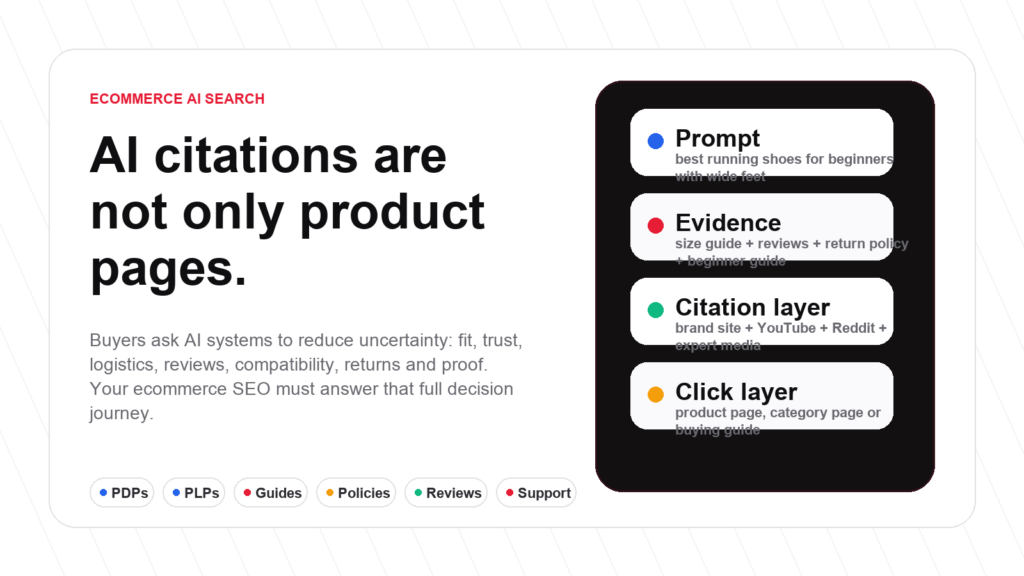
Executive summary: Ecommerce SEO used to be heavily centered on product pages, category pages and transactional keywords. Those still matter. But AI Search changes the citation surface. When a buyer asks an AI system what to buy, which product to compare, which store to trust, whether a product fits a specific use case or what risks to consider, the answer may cite buying guides, reviews, support pages, return policies, comparison pages, videos, forums, local inventory pages, third-party editorial mentions and structured product data. The ecommerce page that wins the click is often not the only page that helped the AI system build the answer.
This article builds on Aleyda Solis’ analysis of ecommerce citations in AI search, while connecting the topic to the AYSA view: ecommerce AI visibility is not a report. It is an execution workflow. Brands need to map the evidence layer, fix product data, improve page clarity, strengthen internal links, create decision-support content and keep Monitoring what AI systems and search interfaces use to answer commercial questions.
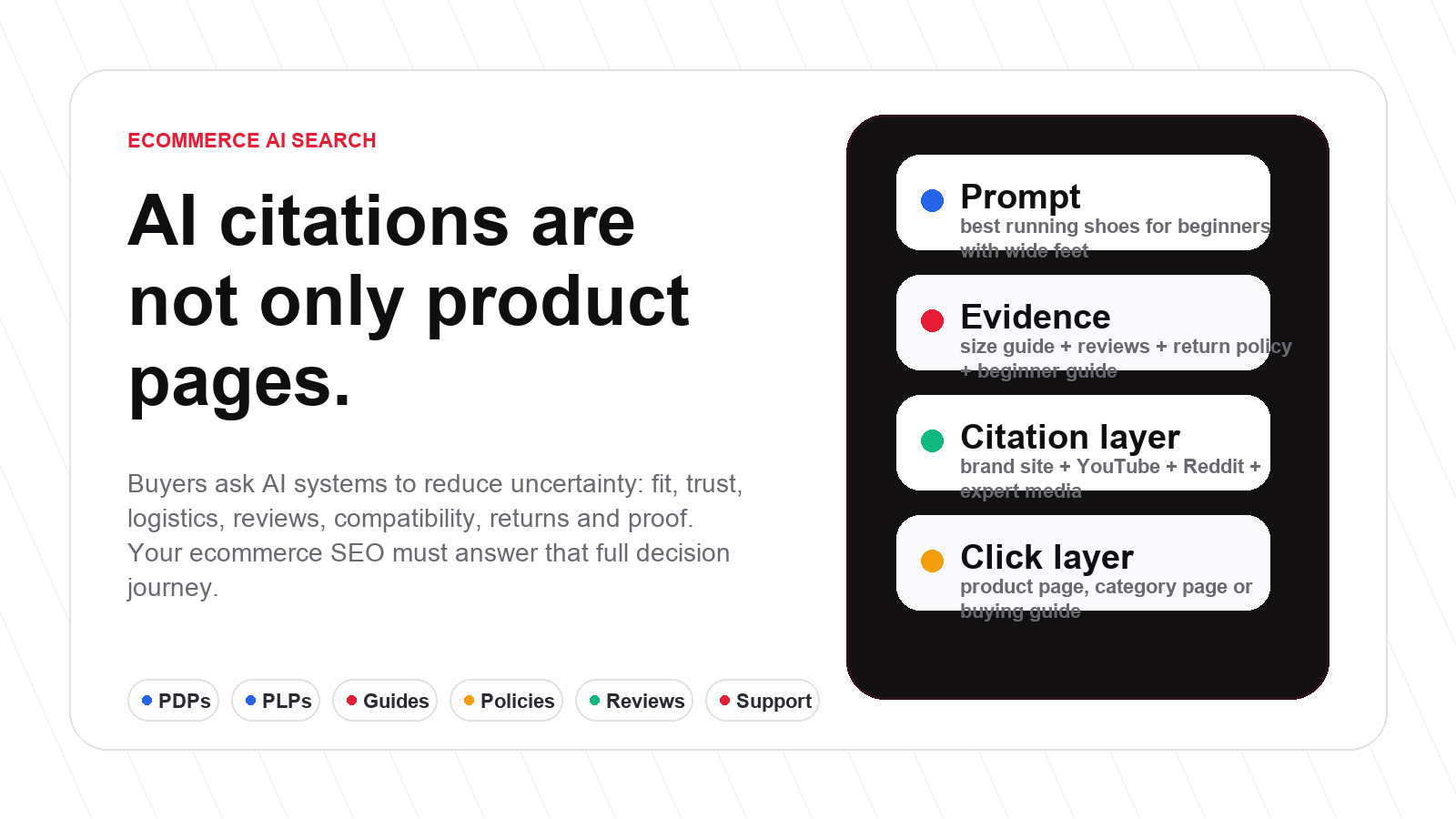
What changed: ecommerce discovery is becoming answer-led
Ecommerce SEO used to have a relatively clear mental model. A user searched for a product or category, Google returned links, the user clicked a Category page or product page, compared options, and maybe bought. Good ecommerce SEO meant crawlable categories, strong product pages, unique descriptions, Structured data, reviews, internal links, fast pages, filters under control and enough authority to rank.
That model still matters, but it is no longer complete. Search behavior is moving from Keyword-to-page toward question-to-answer-to-action. A buyer may ask Google AI Mode, ChatGPT, Perplexity or another assistant: “What is the best stroller for a small apartment and frequent travel?” “Which running shoes are good for beginners with wide feet?” “What should I compare before buying a refurbished laptop?” “Which flower delivery service is reliable for same-day delivery?” The answer is not simply a list of product URLs. It is a synthesized recommendation that may blend product attributes, reviews, guides, expert advice, policies, brand reputation and availability.
This is why Aleyda Solis’ article is important. Her analysis shows a pattern ecommerce teams should not ignore: AI search citations are often not limited to product detail pages. Informational, comparison, support and other context-rich pages can influence the generated answer. In plain language, AI systems try to understand the purchase decision, not only the product SKU.
As we discussed in our article on agent-ready websites, the web is being reshaped for agents that can compare, decide and act. Ecommerce pages must therefore become more machine-readable and more buyer-useful at the same time. It is not enough to optimize a product page for a keyword. The brand must build a full evidence environment around the buying decision.
The new citation surface is wider than the click surface
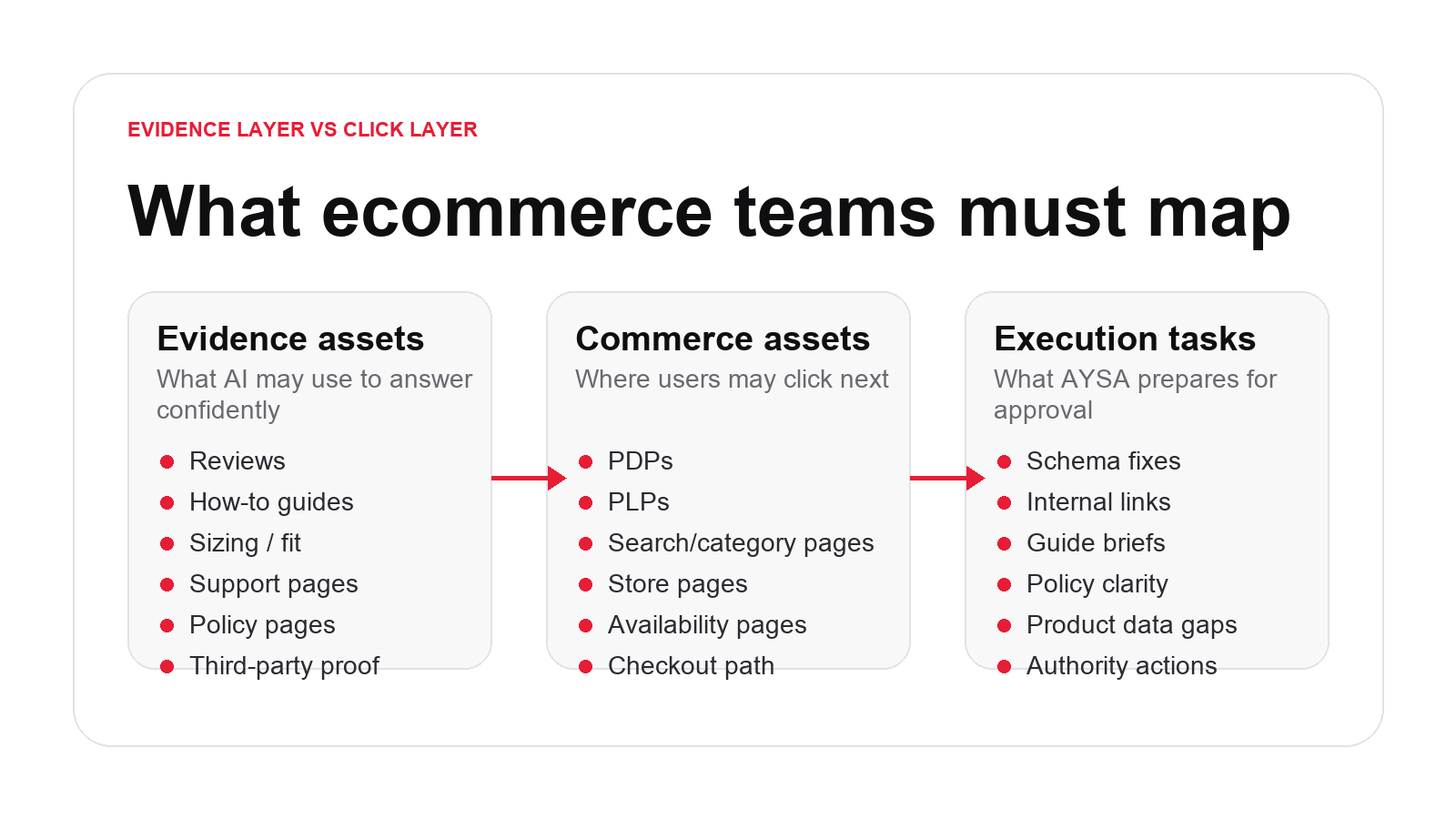
One of the most useful distinctions for ecommerce AI search is the difference between the click surface and the citation surface. The click surface is where the user may land: a product page, a category page, a collection page, a store page or a checkout path. The citation surface is broader. It includes any page or asset that helps the AI system answer the question with confidence.
For ecommerce, that citation surface can include product detail pages, category pages, buying guides, comparison pages, “best for” articles, size guides, fit guides, return policies, shipping pages, warranty pages, FAQ pages, reviews, videos, social posts, Reddit discussions, publisher reviews, marketplace listings, local inventory pages, Google Business Profile data and Merchant Center product feeds.
This changes the job of ecommerce SEO. A brand can no longer ask only, “Does this product page rank?” It must also ask, “Does the web contain enough trustworthy, structured, useful evidence for an AI system to understand when our product or store is a good recommendation?”
For SMEs, this matters because AI answers often compress the research journey. A buyer who once visited five websites may now ask one assistant for a shortlist. If your brand is not easy to retrieve, compare and cite, you may be absent before the click stage begins.
Why product pages are not enough
Product pages are essential, but they are often incomplete for AI search. A product page usually answers questions such as price, availability, specifications, images, reviews and purchase options. But many buyer questions are contextual: “Is this good for my situation?” “Is this safe?” “How does it compare?” “Can I return it?” “Will it arrive in time?” “Is this brand reliable?” “What do real people say?”
If those answers are hidden, scattered, generic or absent, AI systems may rely on other sources. That can be good if other sources validate the brand. It can be bad if competitors, marketplaces, forums or outdated pages explain the decision better than the brand’s own website.
Think about a private clinic, a florist, a car rental company, a parking service near an airport, a hotel or a niche ecommerce store. A product or service page alone rarely answers the real decision. The buyer needs criteria, proof, logistics, trust and reassurance. In AI search, those support assets become part of the optimization field.
This connects directly to the principle we keep using when writing AYSA content: quality content starts with a harder question. What would make this page the most useful result for a specific user, at a specific stage of the journey, in a specific market? For ecommerce, the best page is not necessarily the page with the most keywords. It is the page, or cluster of pages, that helps the buyer decide with less uncertainty.
The ecommerce evidence layer
The evidence layer is the set of assets that proves your product, store or brand deserves to be considered. It is not only “content marketing.” It is commercial proof. For AI search, this layer must be easy to crawl, easy to understand and aligned with visible user value.
Important evidence assets include buying guides that explain how to choose, comparison pages that clarify trade-offs, product category pages that group options logically, review pages that show real customer feedback, support pages that answer common objections, policy pages that explain returns and warranties, shipping pages that make logistics clear, local pages that show availability, videos that demonstrate use, and third-party mentions that confirm authority.
For example, an ecommerce store selling running shoes should not only optimize “men’s running shoes” and product names. It should also answer questions about foot type, beginner training, surface, injury risk, return policy, sizing accuracy, durability and comparison by use case. A store selling flowers should answer delivery areas, same-day conditions, freshness, occasion matching, substitutions, customer photos and trust signals. A store selling electronics should answer compatibility, warranty, returns, refurbished grading, setup and comparison against alternatives.
In AI search, the brand that gives better decision evidence may become easier to cite. The product page may still get the click, but the buying guide, FAQ or policy page may have helped the AI answer choose that product page as a relevant destination.
Product data and structured data still matter
AI search does not remove the need for technical ecommerce SEO. It increases the cost of messy data. Product names, descriptions, prices, availability, images, reviews, shipping details, return policies, variants and identifiers must be consistent across the website, feeds and structured data.
Google’s ecommerce documentation and structured data documentation make this clear. Product structured data can help Google understand product information for rich results and merchant listing experiences. Merchant Center feeds help Google understand products, availability, price and other commerce attributes. This does not guarantee visibility, but it creates a cleaner machine-readable foundation.
For AI search and answer engines, clean product data supports retrieval. If a system cannot confidently understand what the product is, who it is for, whether it is available, what it costs, where it ships and why it is relevant, it has less reason to recommend it. This is also why duplicate, thin or templated product descriptions are risky. They do not provide enough differentiating evidence.
As we mentioned in our AI Mode guide, optimization for AI-assisted search is not about tricking an AI system. It is about making the website more understandable, useful, structured and trustworthy. Ecommerce brands should treat product data, structured data, internal linking and helpful support content as one system.
Examples by ecommerce query type
Different ecommerce queries need different citation assets. A transactional query like “buy waterproof hiking boots size 42” needs product pages, availability, price, shipping and reviews. A comparison query like “best waterproof hiking boots for muddy trails” needs category content, comparison criteria, expert guidance, review summaries and durability information. A problem-led query like “why do my running shoes hurt my knees?” may need educational content, product recommendations by use case and warnings about medical advice.
A local commerce query like “flower delivery today in Bucharest” needs delivery area pages, same-day rules, Google Business Profile consistency, customer reviews, opening hours, contact details and clear delivery cutoffs. A high-risk or expensive purchase like “best refurbished laptop for video editing” needs warranty, grading standards, benchmark explanations, return policy, compatibility, trust signals and third-party validation.
The point is not to create hundreds of generic AI pages. The point is to identify the buyer uncertainty behind the query. Once you know the uncertainty, you can create the right asset and connect it to the commercial page. That is where many ecommerce sites fail. They have product pages, but not enough decision-support content. Or they have blog posts, but the posts do not link cleanly to products and categories. Or they have reviews, but the reviews are not summarized or connected to use cases.
AI search rewards clarity. If your website helps a buyer compare in plain language, with specific evidence, it becomes more useful for both humans and retrieval systems.
Signals and statistics ecommerce teams should watch
There is still no perfect public dashboard for “AI citation share” across all AI search systems. But ecommerce teams can monitor surrounding signals. SparkToro and Datos’ 2024 zero-click study found that a large share of Google searches end without a click, with only 374 clicks to the open web for every 1,000 Google searches in the EU and 360 in the U.S. That matters because ecommerce discovery is no longer only about winning a classic click.
McKinsey’s 2025 State of AI survey reported that 88% of respondents say their organizations use AI regularly in at least one business function. That matters because buyers and businesses are increasingly comfortable using AI systems as research assistants. Google has also continued expanding AI-assisted search experiences, including AI Overviews and AI Mode, which means ecommerce brands should expect more answer-led discovery.
For ecommerce, the practical metrics include classic SEO visibility, branded search demand, product feed health, Search Console impressions and CTR by query type, category page visibility, product page indexation, structured data validity, review quantity and quality, AI referral traffic where detectable, assisted conversions, internal search behavior, return policy engagement, FAQ engagement and third-party mention growth.
Do not chase a single magic AI metric. Build a measurement layer that shows whether your brand is becoming easier to discover, understand, compare and trust.
The execution workflow: what ecommerce teams should do next
Start by mapping your commercial pages: product pages, category pages, collection pages, store pages and key landing pages. Then map the evidence assets that support them: guides, FAQs, reviews, policies, comparison pages, support content, videos and third-party mentions. Look for gaps between what buyers ask and what your site clearly answers.
Next, fix product data. Product names should be specific. Descriptions should be useful and unique. Attributes should be complete. Images should be optimized. Availability and price should be accurate. Structured data should match visible content. Merchant feeds should be clean. Canonicals, variants and filters should not create crawl chaos.
Then build internal links between evidence and commerce. A guide should not sit alone. It should link to relevant categories and products. Product pages should link to buying guides, size guides, return policies and comparison content where useful. Category pages should explain selection criteria, not only list products.
Finally, create a review and authority workflow. AI systems may use or be influenced by third-party validation, depending on the surface. Brands should monitor mentions, reviews, publisher coverage, social proof and marketplace presence. Authority building should be approved and controlled, not random link buying.
Manual approach
Run a report, find many issues, write briefs, ask developers, update pages slowly and hope AI systems understand the store better.
Execution approach
Where AYSA fits
AYSA is built for this exact shift: from SEO recommendations to approved execution. Ecommerce AI search optimization is not a one-time checklist. It requires continuous monitoring, research, technical cleanup, content planning, internal linking, product data improvement, authority signals and AI visibility tracking.
AYSA can help identify pages that receive impressions but do not answer buyer intent well, categories without enough explanatory content, product pages with weak metadata, internal linking gaps, FAQ opportunities, schema opportunities, technical issues that reduce crawlability and authority-building opportunities that need approval. The important part is what happens next: AYSA prepares the work, explains it in plain language, asks for approval and can execute accepted changes inside the website workflow.
For SMEs, this matters because ecommerce teams rarely have unlimited SEO resources. A small store cannot manually track every product, category, query, guide, policy, review and AI search change. It needs an operating system that reduces manual work while keeping the business owner in control.
In my opinion, the ecommerce brands that win in AI search will not be the ones that publish the most AI-generated text. They will be the ones that build the clearest evidence layer around real buyer decisions and execute improvements consistently.
Less SEO work. More organic growth.
Turn ecommerce AI visibility into approved website action.
AYSA monitors your website, prepares SEO, AEO and AI visibility work, asks for approval and executes accepted changes inside your website workflow.
Sources and further reading
This article cites and builds on Aleyda Solis’ ecommerce AI search citations analysis, Google Search Central’s AI features optimization guide, Google’s product structured data documentation, Google Merchant Center product data specification, SparkToro and Datos’ zero-click search study, and McKinsey’s 2025 State of AI survey. The AYSA sections are our product perspective and do not claim guaranteed rankings, guaranteed AI citations, guaranteed AI Overview inclusion or guaranteed ecommerce sales.
Continue the AI search topic inside AYSA.
Use these pages to connect the article with AI SEO tools, AI visibility monitoring, AI Overviews and approved website execution.
Turn this topic into a website action plan.
Use these AYSA hubs to move from reading to technical fixes, AI visibility monitoring, research, glossary context and approval-first SEO execution.

