
What Google UCP Tells Us About Agent-Ready Websites
Google UCP is more than an ecommerce protocol. It is a signal that websites are becoming action surfaces for AI agents. Here is what SMEs should prepare now.
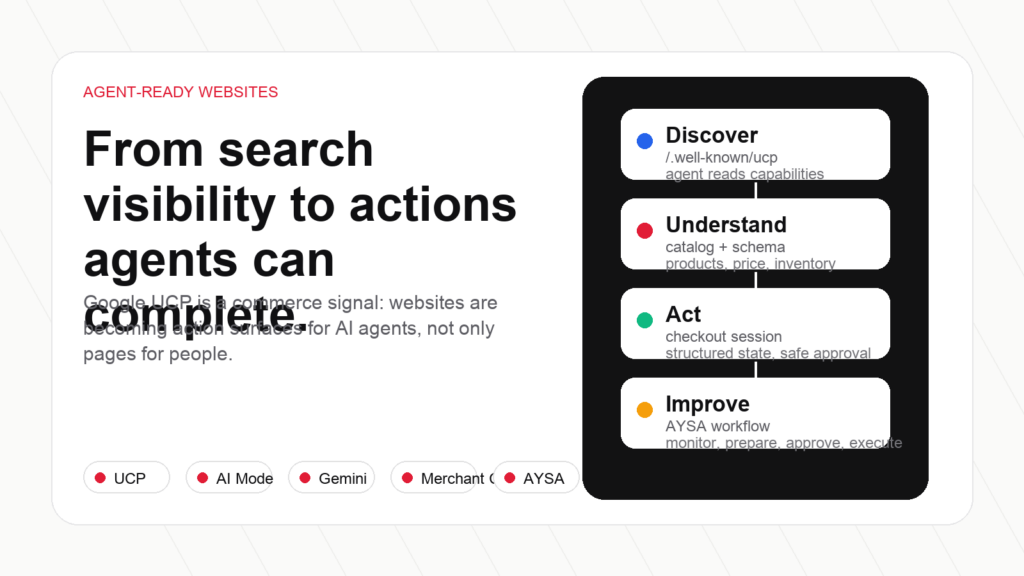
Executive summary: Google’s Universal Commerce Protocol is not just another technical announcement for large retailers. It is a clear sign of where the web is moving: from pages that only explain things to websites that agents can understand, trust and act on. In agentic commerce, an AI assistant may discover a product, compare options, understand business rules, create a checkout session, handle payment context and continue post-purchase support.
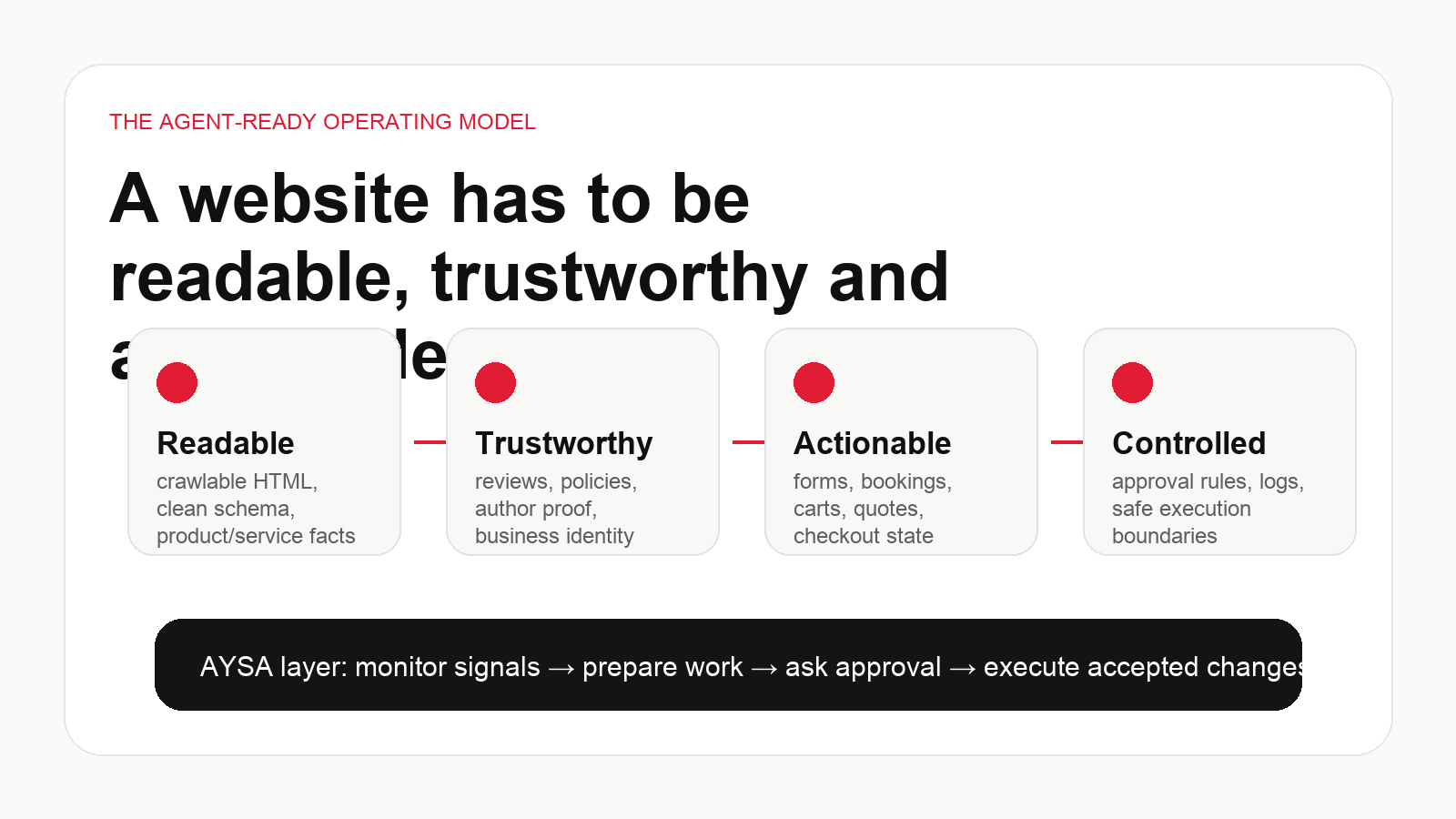
For small and medium-sized businesses, the lesson is not “implement UCP tomorrow.” The lesson is broader and more urgent: make the website agent-ready. That means clean business data, crawlable content, structured products and services, clear policies, trustworthy proof, safe actions, and an execution workflow that keeps humans in control. This is exactly the operating gap AYSA is built around: monitor the website, prepare the SEO/AEO/AI visibility work, ask for approval and execute accepted changes.
What Google UCP is, in plain English
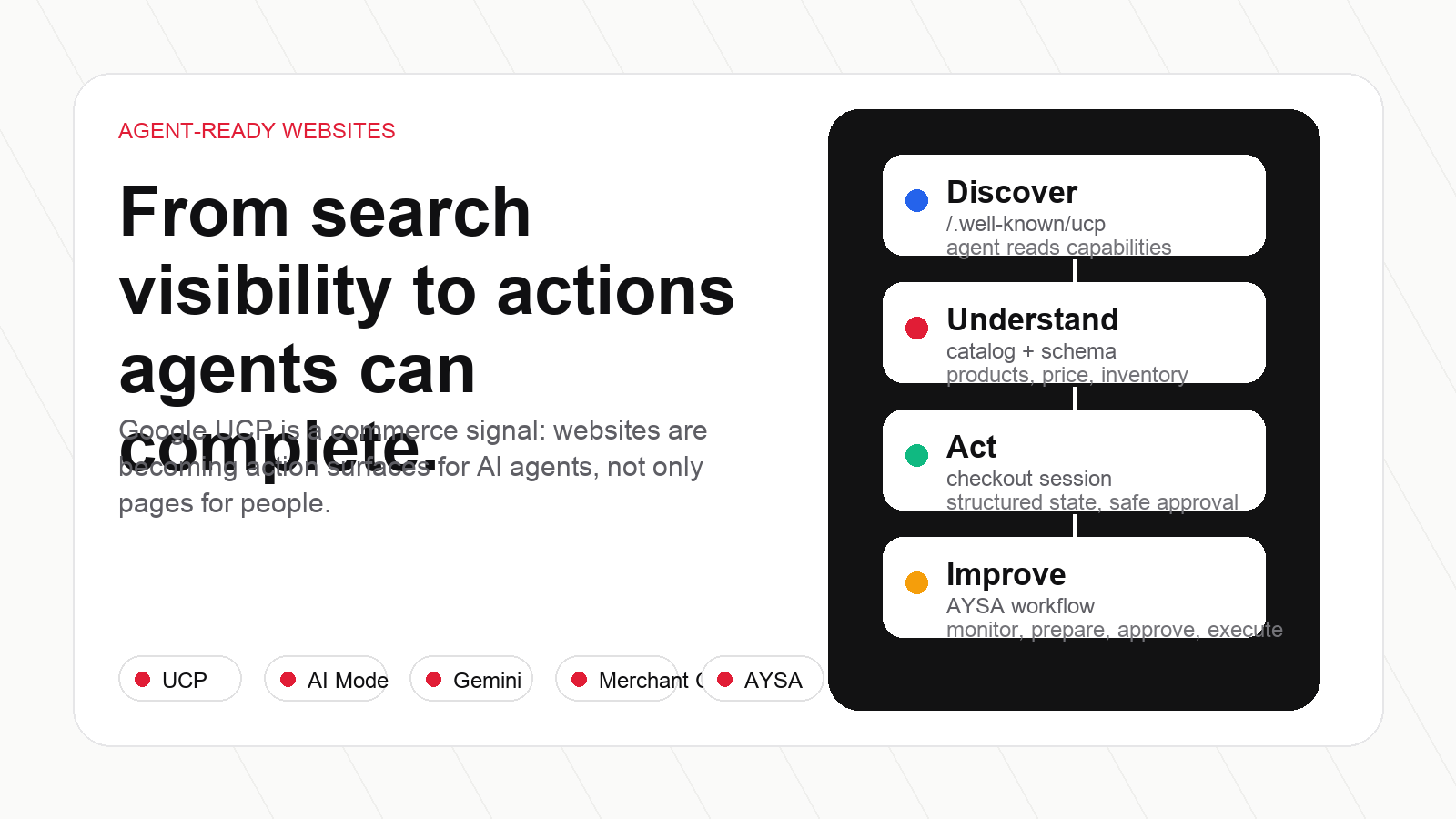
Google announced the Universal Commerce Protocol on January 11, 2026 as an open standard for agentic commerce. In Google’s own framing, UCP is meant to work across the entire shopping journey, from discovery and buying to post-purchase support. It gives agents, businesses and payment providers a common language so commerce systems do not need a separate custom integration for every AI assistant.
The official UCP specification describes a technical model built around business profiles, platform profiles, capabilities, services, endpoint resolution, identity, authentication, payment architecture, transports, versioning and security. A business can expose a profile at a well-known URI, declare what capabilities it supports and let platforms negotiate the intersection of what the platform can do and what the business can safely provide.
That sounds technical because it is. But the business implication is simple: websites are no longer only documents. They are becoming action surfaces. A page can still explain a product, service or policy to a human. But an agent may also need to know whether the business can search a catalog, create a cart, start checkout, apply a discount, identify the user, answer a product question, access order information or support a post-purchase task.
This is why UCP matters even if a business is not an eligible U.S. retailer and even if it does not sell physical products. UCP shows the direction of travel. The web is becoming more structured, more conversational and more action-oriented. Search is not only about being ranked. It is about being understood well enough that an agent can include the business in a task.
Why this is bigger than checkout
The Search Engine Journal article that prompted this analysis makes a useful point: UCP is part of a broader shift toward agent-ready websites. I agree with that framing. The mistake would be to treat UCP as a narrow ecommerce feature and miss the larger lesson. Google is building around a future where AI systems help users move from question to comparison to decision to transaction.
Google’s own announcement connects UCP to AI Mode in Search and the Gemini app. It also introduces Business Agent, a way for shoppers to chat with brands directly on Search, and new Merchant Center attributes that go beyond traditional keywords to include answers to common product questions, compatible accessories or substitutes. That is the key. The discovery surface is becoming conversational, contextual and action-oriented.
In classic ecommerce, the user did the labor. They searched, clicked, compared, opened tabs, read reviews, checked shipping, found coupons, selected a product and completed checkout. In agentic commerce, part of that labor can move to the agent. The agent may ask the business systems what is available, what matches the user’s constraints, what can be shipped, what can be returned, what is compatible and how checkout can be completed safely.
This changes what “good SEO” means. A good page still needs to be useful for humans. But a good website also needs reliable machine-readable information. It needs clear business identity, consistent product and service data, structured policies, fast pages, clean crawl paths, coherent internal links, trustworthy external validation and safe action boundaries. The agent has to know what it can trust and what it is allowed to do.
Old website mindset
Publish pages, add keywords, hope users click, make people interpret everything manually, then push them through a generic form or checkout.
Agent-ready mindset
What an agent-ready website actually means
An agent-ready website is not a website with an AI chatbot slapped on top. It is a website whose content, data and actions are organized so that both humans and software agents can understand the business. That starts with boring fundamentals: crawlable HTML, indexable pages, canonical consistency, working internal links, fast mobile performance, clean sitemaps, valid schema and no important information hidden inside broken scripts or inaccessible widgets.
Then comes business clarity. Agents need to identify what the business is, what it offers, who it serves, where it operates, what proof exists, what constraints apply and what actions are possible. For an ecommerce store, that means product attributes, categories, price, stock, shipping, returns, compatibility, reviews and support. For a local service business, it means service areas, appointment options, pricing context, opening hours, staff or expertise, location, parking, phone, reviews and policies. For a SaaS company, it means features, use cases, pricing, integrations, security, support and onboarding.
The next layer is actionability. A website may be readable and still not agent-ready if no safe action path exists. Can a user request a quote? Can an agent identify the right plan? Can a booking be started? Can a cart be created? Can a discount be applied? Can the user review before committing? Can the business explain which actions require approval?
UCP deals with this problem for commerce by defining capabilities and transport bindings. The same logic applies outside commerce. The future website has to answer a question that old SEO rarely asked: what can a trusted agent do here on behalf of a user, and what should always require human confirmation?
SEO, AEO and GEO implications
For SEO, UCP confirms a larger pattern we are already seeing in AI Overviews, AI Mode, ChatGPT Search, Perplexity and other answer engines: search visibility is becoming retrieval visibility plus action readiness. Ranking in a list of blue links is still valuable, but it is no longer the only meaningful visibility surface.
Answer Engine Optimization and Generative Engine Optimization are not separate from SEO fundamentals. They are extensions of the same trust and clarity problem. If a page cannot be crawled, indexed, summarized, cited or understood, it is weak for classic search and weak for AI retrieval. If a business has inconsistent information across its website, Google Business Profile, directories, product feeds and publisher mentions, agents may struggle to choose it confidently.
Google’s generative AI optimization guidance says SEO remains relevant because generative AI experiences are rooted in Search’s crawling, indexing and quality systems. It also warns against creating many pages just to capture every possible fan-out query. That matters. The response to UCP and agentic search should not be spammy page generation. It should be better structure, better data and better execution.
The biggest shift is that “content” must support decisions, not just impressions. A page that says “we offer airport parking” is weaker than a page that explains distance to terminal, shuttle frequency, security, booking flow, cancellation policy, pricing model, real location and customer proof. A product category that only lists products is weaker than one that helps compare use cases, compatibility, availability and buying criteria. An SEO article that defines a term is weaker than one that explains what to do next.
What SMEs should do now
Most small and medium-sized businesses should not begin with UCP implementation. They should begin with readiness. The first step is to make sure the website is a reliable source of truth. That means removing contradictory information, fixing old pages, cleaning duplicate metadata, improving internal links, reviewing indexation, organizing service pages, writing useful FAQs, improving schema where it is accurate and making contact/booking/purchase paths obvious.
For ecommerce, the priority is product and category data. Product pages need complete attributes, original descriptions, clear availability, returns, shipping, reviews and compatibility. Category pages need buying guidance. Merchant feeds need to be aligned with the website. If Google and future commerce agents rely on structured product attributes, incomplete data becomes a visibility problem, not only a conversion problem.
For local businesses, the priority is entity consistency. The website, Google Business Profile, local citations, review platforms and social profiles should say the same thing about the business. Opening hours, phone, address, service areas, booking options and categories must be accurate. Local pages should explain real-world criteria: emergency vs appointment, parking, response time, pricing expectations, service limits and proof.
For service businesses and SaaS companies, the priority is explaining the operating model. What does the product do? Who is it for? How does onboarding work? What integrations exist? What is automated and what requires approval? What data is used? What outcomes are realistic? AI agents and answer engines cannot recommend a business confidently if the business cannot explain itself clearly.
The risks: trust, control and broken automation
Agentic commerce sounds exciting, but it introduces real risk. The moment an agent can take action, the website is no longer only a marketing surface. It becomes part of a transaction system. That means identity, authentication, payment, consent, privacy, fraud prevention, order integrity and support all matter.
The UCP specification spends a lot of space on identity, authentication, payment architecture, transaction integrity, versioning, namespace governance and protocol compatibility. That is not accidental. Agentic systems need governance. A business should not expose actions casually just because an AI trend makes it sound modern.
There is also a content risk. If companies respond to agent-ready search with mass-generated pages, they may damage trust. If agents encounter thin pages, duplicate content, misleading schema or inconsistent policies, the business becomes harder to trust. The right approach is not volume at any cost. It is structured usefulness.
Finally, there is the approval problem. Not every action should be automatic. Buying media placements, changing legal copy, editing medical or financial content, deleting pages, changing redirects or modifying checkout rules should require a clear approval workflow. The best agent-ready systems will combine automation with control.
Where AYSA fits in this shift
AYSA is not UCP. AYSA is not a payment protocol. AYSA is an AI SEO execution agent built for the layer that many businesses will need before and around protocols like UCP: making the website understandable, monitorable and executable.
In practical terms, AYSA can help a business identify pages that do not answer user questions well, missing service or product information, weak internal links, schema opportunities, Google Business Profile gaps, technical SEO issues, crawl/indexation problems, authority-building opportunities and AI visibility weaknesses. It prepares the work, explains why it matters, asks for approval and executes accepted changes inside the website workflow.
That matters because agent-ready websites are not created in one migration. They require continuous improvement. A product feed changes. A policy changes. Google changes the interface. AI Mode expands. A competitor creates better comparison pages. A review pattern shifts. A technical issue blocks crawling. The website needs an operating system, not a one-time audit.
My opinion is that SMEs will not win the agentic web by becoming protocol specialists. They will win by building websites that are easier to understand, easier to trust and easier to act on. AYSA’s role is to reduce the manual SEO work between insight and execution. Less SEO busywork, more organic growth.
A practical agent-ready website checklist
If I had to reduce this article to a practical checklist, I would start here:
- Business identity: Make company name, location, contact, services, categories and ownership clear and consistent.
- Product and service clarity: Explain what is offered, who it is for, what constraints apply and what action the user can take.
- Structured data: Use schema only where it matches visible content. Prioritize organization, local business, product, FAQ-like visible answers, article, breadcrumb and review/product data where appropriate.
- Technical crawlability: Fix noindex mistakes, canonical conflicts, broken links, redirect chains, slow pages and duplicate low-value URLs.
- Decision support: Add comparison criteria, pricing context, FAQs, use cases, policies, trust signals and examples.
- Action paths: Make forms, booking, quote requests, carts, checkout and contact options clear. Reduce ambiguity.
- Authority: Build relevant external mentions, publisher placements, citations, reviews and proof that support the business entity.
- Governance: Define what can be automated and what requires human approval.
- Monitoring: Track search performance, AI visibility, branded demand, technical health, indexation drift and action history.
How I would audit an SME website for agent readiness
If an SME asked me where to start, I would not start with a protocol document. I would start with a practical audit that asks whether a human, a search engine and an AI assistant can all reach the same understanding of the business. The first pass is identity. Does the site clearly say what the company does, where it operates, what it sells, who it helps and how the customer can act? If the answer is scattered across five pages and two outdated profiles, the website is not ready for agentic discovery.
The second pass is page intent. Every important page should have a job. A service page should explain the service, eligibility, process, pricing context, location context, proof and next step. A category page should help the customer choose, not only display products. A product page should answer compatibility, availability, delivery, returns and trust questions. A blog article should help a real user decide what to do next, not merely define a keyword. Agentic systems are good at synthesizing fragments, but they still need fragments worth synthesizing.
The third pass is technical. I would check whether the pages that matter are indexable, canonicalized correctly, included in the right sitemap, internally linked and free from obvious rendering problems. I would look for redirect chains, broken links, orphan pages, duplicate title tags, thin tag archives, blocked resources, schema errors and inconsistent hreflang or canonical signals. These issues are not glamorous, but they often decide whether useful content is discoverable at all.
The fourth pass is action readiness. If an AI assistant wanted to help a user book, buy, request a quote, compare a plan, choose a service or contact the business, what would it need? Many SME websites fail here because the information exists only in the owner’s head or in a PDF, WhatsApp message, invoice template or sales conversation. Agent-ready websites need those rules to become visible: accepted payment methods, opening hours, appointment rules, availability, delivery areas, support limits, cancellation terms, refund policies and approval steps.
The fifth pass is trust. UCP may be a protocol, but agent-ready visibility is also a trust problem. Does the site show real experience? Are there reviews, case studies, founder information, media mentions, authoritative external references and accurate business data? Are claims specific enough to be verifiable? In AI search, vague marketing copy is weak input. Specific, sourced, current and useful information is stronger input.
The sixth pass is maintenance. An agent-ready website cannot be prepared once and then forgotten. Products change, prices change, policies change, rankings change, AI interfaces change and competitors improve. A business needs a repeatable process for detecting drift and executing fixes. This is where many agencies and classic SEO tools become slow: they can diagnose problems, but implementation still depends on manual back-and-forth. The agent-ready web rewards teams that can move from detection to approved execution quickly.
What not to do after reading about UCP
The wrong reaction is to chase the acronym. A business does not become agent-ready by adding one page that says “AI commerce” or by publishing generic articles about agentic shopping. The wrong reaction is also to expose actions without control. If a website lets software agents trigger sensitive workflows without identity, consent, rate limits, audit logs and approval rules, the business creates operational risk.
Another mistake is to confuse structured data with truth. Schema can help machines understand content, but only when it describes visible, accurate information. Marking up reviews that are not visible, product information that is incomplete or FAQ content that does not exist on the page is not a strategy. It is a trust problem. Google’s own guidance has repeatedly moved toward rewarding helpful, reliable content and discouraging manipulative scaled content. Agentic search does not change that direction.
The third mistake is to ignore non-ecommerce use cases. UCP is commerce-specific, but agent readiness is relevant to clinics, hotels, car rental businesses, parking providers, florists, agencies, SaaS products, publishers and local services. A future agent may not buy a product; it may help a user compare clinics, choose a hotel, book airport parking, request a quote, identify a service provider or understand whether a company is trustworthy. Every one of those tasks depends on clear website information.
Finally, do not assume that AI agents will magically understand messy websites. Large language models are impressive, but they are not a replacement for business clarity. If a website has old pages, conflicting phone numbers, vague service descriptions, missing prices, broken links, duplicate metadata, outdated opening hours and no useful proof, AI systems may summarize the confusion. The responsibility is still on the business to make its public information coherent.
Final take: UCP is a warning shot for the whole web
Google UCP is commerce-specific, but the message is broader: agents are becoming users of the web. They will not browse exactly like humans, and they will not judge websites only by traditional ranking signals. They will need reliable data, clear context, safe actions and trust.
This does not mean every SME needs to implement every new protocol immediately. It means businesses should stop treating the website as a brochure. A modern website must be a structured operating layer: useful for humans, understandable for search engines, retrievable for AI systems and safe for approved execution.
The companies that prepare early will have an advantage. They will not need to panic every time Google, OpenAI, Perplexity, Shopify or another platform changes the interface. Their website will already be organized around clarity, trust and action. That is the future AYSA is building for.
Less SEO work. More organic growth.
Prepare your website for the agent-ready web.
AYSA monitors your website, prepares SEO, AEO and AI visibility actions, asks for approval and executes accepted changes inside your website workflow.
Sources and further reading
This article uses Search Engine Journal’s analysis as a starting point and cross-checks the technical direction against official documentation and source material: Search Engine Journal on Google UCP and agent-ready websites, Google’s announcement of UCP and agentic commerce tools, the official Universal Commerce Protocol specification, Google’s guide to optimizing for generative AI experiences, and Google’s AI Mode update. The AYSA sections are our product interpretation and do not claim guaranteed rankings, AI Overview inclusion or agent citations.
Continue the AI search topic inside AYSA.
Use these pages to connect the article with AI SEO tools, AI visibility monitoring, AI Overviews and approved website execution.
Turn this topic into a website action plan.
Use these AYSA hubs to move from reading to technical fixes, AI visibility monitoring, research, glossary context and approval-first SEO execution.

