How to Prioritize SEO Efforts Like a Pro
A practical AYSA guide to prioritizing SEO work by impact, confidence, effort, risk and approved execution instead of drowning in endless task lists.
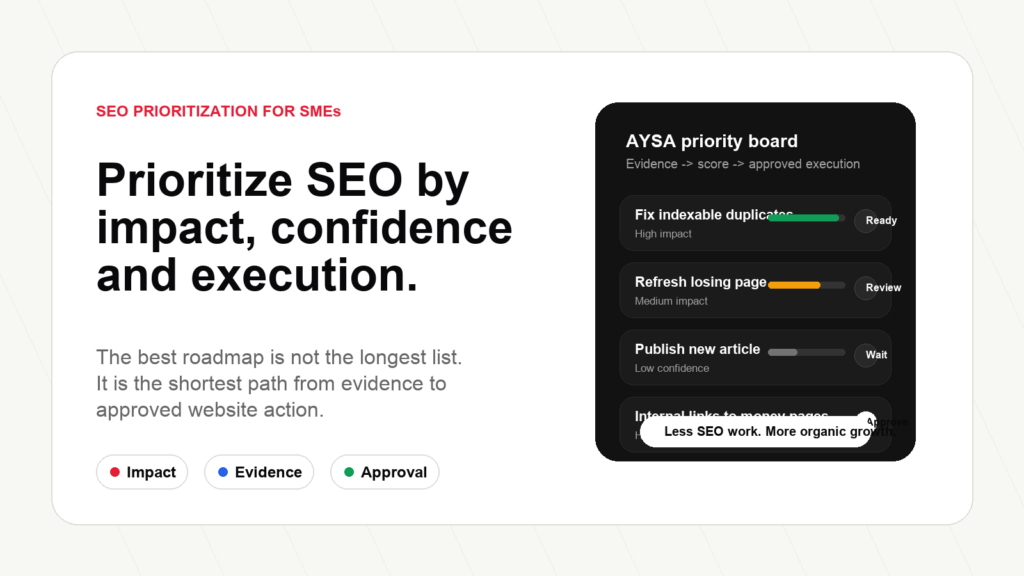
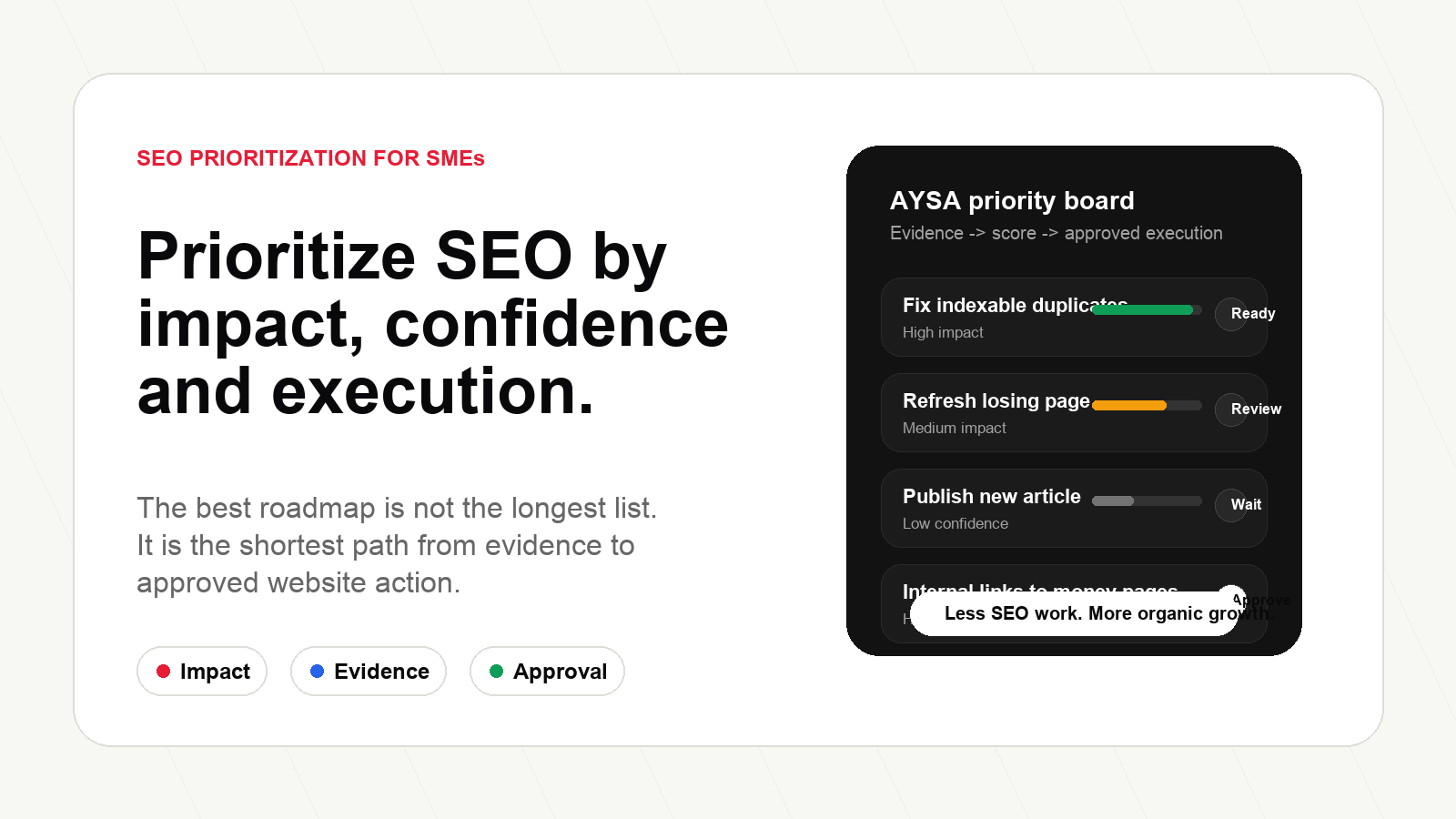
SEO prioritization is where strategy becomes real. A business can have a technical audit, a keyword map, a content plan, a Backlink Gap analysis and a list of Core Web Vitals issues. None of that creates growth by itself. Growth happens when the right work reaches the website, in the right order, with a clear reason and a way to measure whether it worked.
This is why the ProductLedSEO article “Prioritize SEO Efforts Like a Pro” is a useful prompt for the current SEO market. The article argues against random SEO action and points toward more deliberate decision-making. My view is even sharper: in 2026, SEO without prioritization is not strategy. It is inventory management for unfinished work.
For small and mid-sized businesses, this is not an abstract problem. The owner sees invoices, tasks and dashboards. They do not see why one redirect matters more than another, why a Category page deserves a rewrite before a blog post, why one internal link is worth doing now and another can wait, or why “publish more content” can become dangerous when the website already has thin, duplicated or poorly connected pages.
Why SEO Prioritization Matters More Than Ever
Classic SEO used to tolerate a lot of waste. A team could publish a lot of pages, build a lot of links, fix a few technical issues, wait a few months and still look productive. That world is fading. Google’s documentation around helpful, reliable, people-first content is clear that pages should be useful for people, not created primarily to attract search traffic. Google’s Search Console documentation also makes it clear that performance needs to be understood through queries, pages, countries, devices and dates, not through a single ranking screenshot.
At the same time, AI-assisted search and answer engines are changing the surface area. A website does not only need to rank. It needs to be easy to understand, cite, summarize, compare and trust. That means technical clarity, Entity Clarity, content usefulness, authority and freshness now interact more tightly. The wrong priority can waste budget. The right priority can unlock several layers at once.
For example, fixing a broken canonical system may improve crawl quality, reduce duplicate signals, make sitemap data cleaner and help AI Retrieval systems understand which page is the source of truth. Refreshing one strong commercial page may be more valuable than publishing ten generic blog posts. Adding internal links from pages that already receive impressions may help both users and crawlers discover important service pages. These are priority decisions, not checklist decisions.
The Most Common Bad Prioritization Patterns
The first bad pattern is volume-based prioritization: doing whatever appears most often in an audit. If a crawler finds 500 missing image alt attributes and 12 broken internal links to important commercial pages, the larger number can feel more urgent. It may not be. The broken links may have a stronger impact on crawl paths, user journeys and conversion.
The second bad pattern is stakeholder loudness. The CEO wants a landing page. The content person wants a blog calendar. The developer wants to clean technical debt. The agency wants to show activity. The PPC team wants SEO pages for Quality Score support. None of these requests are automatically wrong, but none should win just because they are loud.
The third pattern is tool-driven urgency. Many SEO tools mark issues as errors, warnings or opportunities. That language is useful, but it is not a business strategy. A “critical” tool warning may be low business impact. A small internal linking improvement may be strategically important because it connects a high-intent page with related authority pages.
The fourth pattern is content calendar autopilot. Publishing every week feels productive, especially for SMEs trying to compete with larger brands. But if the new content is not mapped to search demand, business goals, internal links and topical authority, the calendar can create crawl waste instead of growth.
The fifth pattern is ignoring execution reality. A recommendation that requires three teams, two developers and six approvals may not be the best first move, even if it is theoretically valuable. A smaller action that can be approved and implemented today may generate faster learning and create momentum.
The AYSA Priority Model: Impact, Evidence, Effort, Risk and Execution
At AYSA, I prefer a practical prioritization model that can be understood by business owners, not only SEO specialists. Every proposed action should be scored through five questions.
1. What is the expected impact?
Impact is not “this is good SEO.” Impact means the action can plausibly improve visibility, clicks, conversions, crawl quality, user understanding, AI citation readiness or authority. A page that already has impressions but low click-through rate may be a high-impact candidate for title and meta improvement. A page that ranks nowhere, has no internal links and serves no business purpose may not deserve immediate attention.
2. What evidence supports the action?
Evidence can come from Search Console, analytics, crawl data, indexation data, SERP analysis, customer questions, sales conversations, reviews, competitor coverage or AI answer patterns. The stronger the evidence, the more confidence you can have. Without evidence, the work is a bet. Bets are allowed, but they should be labeled as bets.
3. How much effort is required?
Effort includes writing, editing, development, design, legal review, approval, QA and deployment. This is where many SEO roadmaps become unrealistic. A task that looks small in a spreadsheet may be heavy in real life. A good priority system respects operational friction.
4. What is the risk?
Risk matters. Redirect changes, canonical changes, robots.txt rules, large content pruning and template edits can have consequences if handled carelessly. Some actions should be reviewed more carefully before execution. A priority model should not only ask “can we do this?” It should ask “what could break?”
5. Can it be executed and measured?
This is the part many tools skip. A recommendation that cannot reach the website is not execution. A change that cannot be measured becomes a story, not learning. The ideal action is clear enough to approve, safe enough to execute and specific enough to review later.
- Fix meta descriptions
- Publish 10 articles
- Improve internal linking
- Check Core Web Vitals
- Rewrite titles for 12 pages with high impressions and low CTR.
- Refresh 4 pages losing clicks after the last query shift.
- Add internal links from 9 indexed authority pages to 3 money pages.
- Fix the LCP template affecting the top mobile landing page.
Practical SEO Prioritization Examples for SMEs
Example 1: Ecommerce
An ecommerce store has hundreds of product pages, dozens of categories and a blog that was built over several years. The crawler reports duplicate titles, missing descriptions, thin product pages, slow category pages and broken links. A weak prioritization process tries to fix everything. A stronger process starts with revenue paths.
First, identify categories and products that already receive impressions or sales. Then check whether their titles, descriptions, content, internal links, schema and page speed support the buying journey. If a category page has demand and poor click-through rate, it may deserve title and intro copy work before a new blog article. If product pages are thin but categories convert, category improvements may come first. If filters create indexable duplicates, index control may become urgent before content expansion.
Example 2: Local business
A local business often wants “more SEO” but does not know where to start. The priority may not be a huge blog. It may be clearer service pages, better location signals, stronger Google Business Profile alignment, reviews, local schema, FAQs that answer real customer questions and internal links between services and service areas.
If Search Console shows impressions for “service + city” queries but the website sends users to a generic page, the priority is obvious: build or improve the page that matches the local intent. If the business has reviews that mention specific trust signals, those signals should appear naturally on the website. If the website lacks pricing, process or availability information, AI-assisted search may struggle to summarize why the business is a good answer.
Example 3: Publisher or content site
A publisher may have thousands of articles. The temptation is to keep publishing. But priority may come from content decay, cannibalization, weak internal linking and outdated articles. If older pages still receive impressions but lose clicks, refresh may beat new production. If several articles answer the same intent, consolidation may beat expansion.
Example 4: SaaS or B2B
A SaaS website may need fewer but stronger pages: comparison pages, integration pages, use-case pages, documentation, glossary entries and product-led guides. Prioritization should follow the path from search intent to product understanding. A glossary term may support discoverability. A comparison page may support evaluation. A product page may support conversion. A help article may support retention and AI retrieval.
How to Measure SEO Priorities Without Fooling Yourself
Measurement is where prioritization becomes learning. Google Search Console’s Performance report lets you evaluate clicks, impressions, CTR and average position across queries and pages. It is not perfect, but it is one of the most important sources for seeing whether a change influenced search visibility. Analytics can help connect organic visits to engagement and conversions. Crawl tools can show whether technical changes improved crawlability, indexability or internal linking structure.
The trap is measuring too soon or too broadly. If you rewrite titles on 20 pages, measure those pages. If you add internal links to 5 money pages, monitor those pages and the source pages. If you fix a canonical problem, monitor indexation and duplicate URLs. If you publish a new cluster, monitor impressions, internal links, queries and assisted conversions over time.
A simple measurement plan should include:
- the page or group of pages affected;
- the baseline before the change;
- the exact change made;
- the date of implementation;
- the expected outcome;
- the review window;
- the next decision if the result is positive, neutral or negative.
This is the difference between “we did SEO” and “we learned what works for this website.”
AI Search Changes SEO Prioritization
AI search does not remove the need for SEO prioritization. It makes it more important. Google’s guidance on AI features and websites points back to many fundamentals: useful content, crawlability, indexability, structured data where appropriate, page experience and clear content. The difference is that answer engines and AI-assisted results reward clarity and extractability in new ways.
For prioritization, this means that certain tasks deserve more attention than they used to. Entity clarity matters. Pages should explain who the business serves, what it offers, where it operates, what proof exists and what users should do next. FAQ content should be visible and genuinely helpful, not just markup. Author and business credibility should be easy to understand. Content should be chunkable: sections, definitions, examples, comparisons and direct answers help both humans and retrieval systems.
Technical SEO also becomes more strategic. If pages are blocked, slow, duplicated, poorly linked or buried deep in the site, they are harder for search systems to process. If important facts only exist in images, scripts or inaccessible UI, they may not support AI visibility. Prioritization should therefore ask: which improvements make the website easier to crawl, understand, cite and trust?
Where AYSA Fits: From Priority Decision to Approved Execution
AYSA was built around a very practical frustration: most businesses do not need more SEO homework. They need a system that can identify the work, explain why it matters, prepare the change, ask for approval and execute what was approved. Prioritization is central to that model.
In the AYSA workflow, the agent can monitor Search Console signals, website structure, technical issues, content opportunities, internal linking gaps, AI visibility signals and authority-building opportunities. The point is not to generate an endless list. The point is to prepare a smaller, clearer queue of actions that a business owner can approve without becoming an SEO specialist.
For example, AYSA can identify pages with impressions but weak CTR, prepare title and meta improvements, explain the expected effect and queue the update for approval. It can detect technical issues that affect crawlability or indexation, separate safe automated actions from manual-review items and preserve the action history. It can connect research, content planning, on-page work, monitoring and authority building into one operating model.
That is the real value of prioritization. It is not a prettier spreadsheet. It is a way to make SEO execution calmer, safer and faster.
Turn your SEO backlog into a prioritized execution queue.
If every SEO task feels urgent, AYSA can help your website monitor opportunities, prepare the right actions first and execute approved changes inside your workflow.
Sources and Further Reading
Continue the AI search topic inside AYSA.
Use these pages to connect the article with AI SEO tools, AI visibility monitoring, AI Overviews and approved website execution.
Turn this topic into a website action plan.
Use these AYSA hubs to move from reading to technical fixes, AI visibility monitoring, research, glossary context and approval-first SEO execution.