
Stop Tracking AI Prompts Like Rankings: A Practical Stability Framework For AI Search Visibility
AI answers aren’t a SERP, and “prompt rank tracking” is turning into a false sense of precision. Here’s a better framework built around stability, representation, and context—plus a practical operating model for SMEs and agencies using AYSA to monitor, prepare, approve, and execute changes.

AI Search visibility reporting is heading toward the same trap SEO fell into years ago: mistaking a convenient metric for the truth.
“Prompt tracking” sounds like the next logical step after Rank tracking. But AI answers are not rankings, citations are not stable links, and the output you see today might not exist tomorrow—even if your website didn’t change at all. If you measure AI like it’s a SERP, you’ll build a dashboard that feels precise and tells the wrong story.
This editorial is my practical reframing: treat AI prompt tracking as a system for measuring stability, representation, and context—not as a new version of Position Tracking. That shift changes what you monitor, how you report progress, and what actions you prioritize.
I’m building this perspective using an excellent provocation from Search Engine Journal: We Need To Change Our Approach To AI Prompt Tracking. The core idea is right: volatility, changing citation behavior, and partial third‑party visibility make “AI rankings” a dangerously shaky foundation.
Concise summary
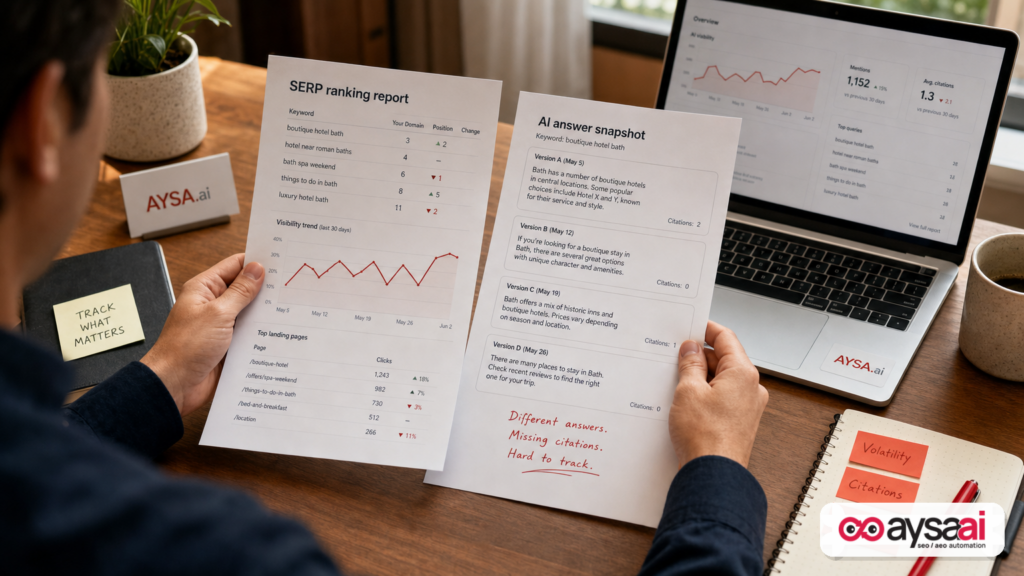
- AI answers are volatile across time, users, and models—so “rank-like” tracking often turns into noise.
- Citation behavior can change due to product/UI decisions (not your performance), making link/citation dashboards misleading.
- A better measurement model is SRC: Stability, Representation, Context.
- Businesses should invest less in “winning prompts” and more in reducing misrepresentation risk and improving how consistently AI systems describe them.
- AYSA fits best when measurement is connected to Approved Execution: monitor, prepare changes, request approval, then implement accepted website updates.
Table of contents

- What changed: why AI visibility is not a rank-tracking problem
- Why “prompt rank tracking” breaks down in AI search
- Third-party tracking blind spots (and how to talk about them)
- The new measurement model: Stability, Representation, Context (SRC)
- The metrics that matter (and the ones to stop reporting)
- Sampling strategy: how to choose prompts without fooling yourself
- A practical SME scenario: when AI gets your business wrong
- What agencies should rethink: deliverables, reporting, and expectations
- Execution beats observation: what changes actually improve SRC
- Where AYSA fits: monitoring + approved execution (not just reporting)
- A 30–60–90 day action plan
- What to do next
- Sources and further reading
What changed: why AI visibility is not a rank-tracking problem

For 20 years, SEO teams could tell a simple story:
- Google shows a ranked list.
- Your page is in a position.
- If your position improves, more people click and you get more traffic.
That story was never perfect, but it was coherent. It supported the operational model of SEO: measure, optimize, measure again.
Generative AI breaks the story in three ways:
- The output is synthesized. Users get a composed answer, not ten blue links.
- The “source behavior” is inconsistent. Some AI experiences show citations, some show fewer, some show none, and the format changes.
- The answer is not a stable unit. It can vary by user history, location, device, and model version, even for the same prompt.
That means you can’t treat a prompt like a Keyword and treat an AI answer like a SERP. If you do, you’ll be measuring an artifact of the product experience, not your underlying visibility.
Dan Taylor’s SEJ piece points to exactly this failure mode: when models change how (or whether) they expose citation links, trackers that depend on those links can report a “drop” that has nothing to do with your brand getting worse. That’s not a minor tooling issue. It’s a sign that the whole measurement metaphor needs to change.
Why “prompt rank tracking” breaks down in AI search
Prompt tracking tools often try to recreate the SERP era:
- Pick prompts (like keywords).
- Run them on a schedule.
- Score “visibility” (like rankings).
- Report gains/losses (like position changes).
That approach fails for practical reasons that business owners feel immediately:
1) The output changes even when the truth didn’t
In classic SEO, you could see ranking churn, but the page was still the page and the query was still the query. In AI, the product can change how it phrases answers, how it groups concepts, whether it adds caveats, and how it displays citations. Your brand presence might be “there” but expressed differently—so naive trackers read that as volatility or loss.
2) Citations are not a stable proxy for influence
When an AI answer includes citations, you’re tempted to treat that like a link. But citations can be:
- inconsistent across sessions,
- limited in number (a UI decision),
- biased toward certain sources (a system decision),
- sometimes absent altogether.
SEJ’s article calls out a real operational risk: if a model reduces visible citations, citation-based tracking reports a decline, and the organization reacts as if performance dropped. That’s the analytics equivalent of chasing a shadow.
3) “Winning” one phrasing can be irrelevant
Tracking a prompt like “best accounting software for contractors” is easy. But users ask that in dozens of ways, and AI experiences often map many phrasings into the same intent cluster. If your reporting celebrates that you “won” a single phrasing while you’re absent across the intent cluster, you’re not measuring the business reality.
4) You can’t manage what you can’t reproduce
Executives will ask, “Can I see it?” If a tracker shows a result that no one can reproduce (because of personalization, model version, or session context), your program loses credibility. That’s why the reporting model must emphasize patterns, not point-in-time snapshots.
Third-party tracking blind spots (and how to talk about them)
Every third-party tool has blind spots, and that’s not a knock—it’s physics. The problem is when we pretend those blind spots don’t exist.
Here are the blind spots businesses must learn to communicate internally:
Blind spot A: Partial visibility into “true mentions”
SEJ’s piece notes a mismatch between what a tool reports and what an AI system might reveal directly. Even without validating specific numbers, the concept is important: third-party tools may sample and interpret outputs differently than the native experience.
How to report it: treat the tool as a sensor, not an oracle. It helps you detect changes and direction, but it is not a full census.
Blind spot B: Model and UI changes masquerade as performance changes
If citations disappear or shift, your “AI visibility” line graph may drop. The business will pressure the team to “fix it.” Often, there’s nothing to fix on your site—because the change is upstream.
How to report it: separate platform volatility from brand volatility. Your reporting needs a way to say, “The ecosystem changed; our representation did/didn’t.”
Blind spot C: Overfitting to your test prompts
If you optimize and track the same narrow list of prompts, you can accidentally train your team (and your content strategy) to win a measurement game rather than the market.
How to report it: maintain a disciplined prompt sampling strategy (we’ll cover one) and rotate prompts within intent cohorts.
The new measurement model: Stability, Representation, Context (SRC)
If you want AI visibility reporting that survives product shifts, you need a model that does not depend on the illusion of a stable “rank.”
I recommend a framework I’ll call SRC:
- Stability: How consistent is your brand’s presence over time across a meaningful set of prompts?
- Representation: When you appear, is the business described accurately (offer, location, pricing logic, differentiators, constraints, trust signals)?
- Context: What situations and comparisons include you (or exclude you), and what reasons does the model imply?
Stability is your early warning system
Stability is not “Are we #1?” It’s “Are we consistently included when it makes sense?” and “Do we show up the same way week to week?”
High volatility is a business risk. It means the AI ecosystem’s understanding of your brand is fragile. If you rely on AI discovery (directly or indirectly), fragility is expensive.
Representation is brand safety for SMEs
SMEs don’t lose money because they were “position 4 instead of 2.” They lose money when customers are told the wrong things:
- hours, availability, shipping cutoffs, return policy
- what you do and don’t offer
- who you serve (or don’t)
- pricing and guarantees
- locations and service areas
Representation is the KPI that aligns with revenue protection and customer experience.
Context is how you win without chasing “the top”
Context tells you what “category” the AI assigns you to. Are you the premium option? The budget one? The local specialist? The enterprise vendor? The AI’s context is often built from signals spread across your site, third-party references, and how clearly you explain who you’re for.
This is where modern SEO/AEO/GEO starts to resemble positioning strategy, not just page optimization.
The metrics that matter (and the ones to stop reporting)
If you adopt SRC, your metrics change. This is where many teams struggle, because legacy dashboards are built to tell a linear growth story.
Metrics to prioritize
- Inclusion rate by intent cohort: In what percentage of sampled prompts within a cohort does the brand appear?
- Representation accuracy checks: A pass/fail or scored rubric for key facts (offer, location, constraints, brand claims).
- Volatility index: How much does inclusion/representation vary over time for the same cohorts?
- Sentiment and stance (with caution): Not “positive/negative” as a simplistic label, but whether the model frames you as recommended, optional, or risky.
- Competitive context frequency: How often you’re compared to specific competitors, categories, or alternatives.
- Citation presence (as a supporting signal): Track it, but treat it as an unstable UI-dependent metric—not the core KPI.
Metrics to de-emphasize (or stop presenting as primary)
- “Rank” within an AI answer: The answer is not an ordered list in a stable way.
- Single prompt wins: Easily gamed, rarely representative.
- Vanity “AI visibility scores” without methodology: If a metric can’t be explained to a CFO, it won’t survive budget scrutiny.
The executive translation
When you present SRC to leadership, the narrative becomes:
- We are reducing misrepresentation risk.
- We are protecting category presence across AI discovery journeys.
- We are building resilient visibility that survives model changes.
This aligns strongly with SEJ’s point about changing the success narrative: the “dashboard ROI” is no longer a hockey stick of vanity metrics; it’s a risk-managed operating system for discovery.
Sampling strategy: how to choose prompts without fooling yourself
Prompt selection is where most teams accidentally rig their own results. The goal is not to find the 20 prompts where you look best. The goal is to sample the market reality.
SEJ references the idea of sample design (as mentioned by Kevin Indig). Even without relying on external details, the concept is clear: good sampling beats obsessive precision on a bad sample.
Step 1: Build “intent cohorts,” not a flat prompt list
For most businesses, cohorts look like:
- Category discovery: “best [category] for [audience]”
- Problem-to-solution: “how to fix / choose / compare”
- Local/near-me: “in [city] / near me / open now”
- Alternatives and comparisons: “X vs Y”, “alternatives to X”
- Trust and proof: “is X legit”, “reviews”, “pricing”, “return policy”
- Support and how-to: usage, troubleshooting, onboarding
Step 2: For each cohort, generate variation families
Don’t track one phrasing. Track a family:
- short vs long prompts
- beginner vs advanced wording
- brand-agnostic vs brand-aware
- urgent vs research-mode language
Step 3: Rotate prompts, keep cohorts stable
To avoid overfitting, keep the cohort definitions stable but rotate specific prompts within them. That gives you trend-level signal without turning your program into a memorization exercise.
Step 4: Log the context of the run
At minimum, record:
- date/time
- model/product environment (as best as possible)
- geo/language assumptions
- whether citations were displayed
This matters because your job is to separate your brand’s changes from the platform’s changes.
A practical SME scenario: when AI gets your business wrong
Consider a realistic business: a multi-location dental clinic group.
A prospective patient asks an AI assistant: “Do you do emergency dental appointments on weekends near me?” The AI answers with confidence, listing your clinic and stating weekend emergency availability—except you don’t offer weekend emergencies at that location. You offer weekday emergencies and weekend referrals.
What happens next isn’t an “SEO problem.” It’s an operational and revenue problem:
- The patient calls and is disappointed.
- Your front desk gets an angry interaction.
- You lose trust, reviews suffer, and staff time is wasted.
Now imagine you track “prompt rank.” You might still “show up,” so the tool says you’re winning. But your representation is wrong, and your context (emergency/weekend) is misaligned.
How SRC would catch it
- Representation check: Does the AI state correct hours and emergency policy?
- Context check: Are you included in “weekend emergency” scenarios where you shouldn’t be?
- Stability check: Is this misrepresentation consistent or a one-off?
What you’d do about it (without pretending there’s one magic trick)
You’d audit and tighten the signals that AI systems can learn from:
- Make location pages unambiguous about emergency hours and referral flows.
- Clarify “what we do / don’t do” in plain language.
- Improve structured data where appropriate (and validate it).
- Ensure internal links and headings reinforce the correct policy.
- Reduce contradictory statements across pages (FAQs, blog posts, outdated PDFs).
The key is that you’re not optimizing for a prompt. You’re optimizing for truth density and consistency across your web presence.
What agencies should rethink: deliverables, reporting, and expectations
Agencies are under pressure right now because clients want an “AI plan” that looks like an SEO plan. Many agencies respond by re-skinning rank tracking with AI terminology. That is a short-term sales move with long-term retention damage.
Stop selling “AI rankings” as the deliverable
When you sell rankings, you’re implicitly promising:
- the metric is stable,
- the platform is stable,
- improvement is linear,
- the client can reproduce the result.
None of those assumptions reliably hold in consumer-facing AI.
Start selling stability and risk mitigation
The client-friendly packaging looks like:
- AI representation monitoring: detect when the model describes the business incorrectly
- Category presence protection: maintain inclusion across high-value intent cohorts
- Volatility alerts: identify ecosystem shifts quickly
- Execution pipeline: a steady backlog of content/technical changes tied to observed issues
This aligns with SEJ’s argument: the tools are expensive, so the value isn’t “we’re #1.” The value is “we have eyes and ears in an ecosystem that changes underneath us.”
Update your reporting cadence and artifacts
Weekly “movement reports” are a legacy format. For AI visibility, many organizations do better with:
- weekly volatility + incident notes (what changed, what might have caused it)
- monthly cohort coverage trends (inclusion/representation/context)
- quarterly narrative reviews (how the AI ecosystem frames the brand, what to correct)
Execution beats observation: what changes actually improve SRC
Tracking is only valuable if it changes what you do next. In practice, improving Stability, Representation, and Context comes from boring, repeatable execution.
1) Make your “truth” easy to extract
AI systems reward clarity. That usually means:
- plain-language explanations of products/services
- strong page hierarchies and consistent terminology
- FAQ sections that address high-risk misunderstandings
- updated policy pages (shipping, returns, cancellation, eligibility)
2) Reduce contradictions across the site
Contradiction is the enemy of representation. Common SME contradictions include:
- old blog posts contradicting new pricing
- location pages with different hours than contact pages
- PDF menus/brochures left live after changes
- service pages that imply you do something you stopped offering
3) Structure content for discovery, not just conversion
Conversion pages are often thin on explanation because they’re designed to “sell.” AI discovery needs explanatory depth. The fix isn’t to bloat every page; it’s to ensure your content ecosystem includes:
- clear comparison pages
- use-case pages mapped to real audiences
- glossaries and guides that define terms correctly
- trust pages (about, methodology, editorial policy where relevant)
4) Treat structured data as hygiene, not hype
Schema and structured markup can help systems interpret entities and relationships. But it isn’t a magic lever. The mindset should be:
- implement the markup that accurately reflects what’s on-page,
- validate it,
- keep it current.
If you’re unsure what’s appropriate, you should consult official schema documentation and validation tools—rather than copying random snippets.
5) Build authority signals you can stand behind
Many teams will read “GEO/AEO” and assume the fix is to churn AI content. That’s not the durable path. Durable representation comes from:
- credible, consistent explanations
- proof points you can verify
- clear authorship and accountability
- being cited by reputable sources (when it happens naturally)
Do not invent claims to “feed the model.” In AI ecosystems, misinformation is not just unethical; it’s a brand risk.
Where AYSA fits: monitoring + approved execution (not just reporting)
Most businesses don’t fail because they can’t see the problem. They fail because they can’t ship the fix consistently.
That’s the gap AYSA is designed to close: an execution system for SEO/AEO/GEO that monitors, prepares website changes, asks for approval, and executes the accepted updates.
Here’s how it maps to this editorial’s framework:
1) Monitor SRC signals continuously
Instead of monitoring “rank,” you monitor the patterns that matter:
- stability changes (volatility spikes)
- representation issues (wrong facts, wrong positioning)
- context gaps (missing from key cohorts, or included in the wrong ones)
Start here: AYSA Monitoring
2) Prepare an approved backlog of fixes
AI visibility work becomes operational when every insight becomes a concrete recommendation, like:
- update a location page section
- add a clarifying FAQ
- fix internal linking to the canonical policy page
- consolidate two conflicting pages
- improve a product/category description for clarity
Explore the toolset approach: AI SEO Tools
3) Keep humans in control with approval
SMEs need speed, but they also need safety. “Approved execution” means:
- AYSA prepares changes and explains why,
- you review and approve what matches your business truth and brand voice,
- AYSA executes only what you accept.
This is the difference between automation that helps and automation that creates new risk.
4) Connect visibility to business outcomes (carefully)
AI discovery won’t map cleanly to last-click attribution. But you can still connect the work to outcomes by tracking:
- reduction in misrepresentation incidents (support tickets, call logs)
- improved lead quality (sales notes, CRM fields)
- improvements in branded search behavior (where measurable)
More on the broader concept: AI Search Visibility
5) Make it affordable and scoped
Budgets are real. The question isn’t “Should we track everything?” It’s “What’s the smallest monitoring + execution loop that materially reduces risk?” Pricing and packaging matter, especially for SMEs and agencies serving them: AYSA Pricing
A 30–60–90 day action plan
If you’re a business owner or marketing lead trying to be practical, here’s a plan that doesn’t require pretending AI measurement is mature.
Days 1–30: Establish your SRC baseline
- Define 5–8 intent cohorts that reflect how customers discover you.
- Select a rotating set of prompts per cohort (not a fixed list forever).
- Create a representation rubric: 10–20 business facts that must be correct.
- Run baseline checks and document volatility and accuracy issues.
- Set up monitoring and alerts: AYSA Monitoring.
Days 31–60: Fix the high-risk representation issues
- Prioritize errors that harm customers: hours, availability, eligibility, policies.
- Identify contradictions on-site and remove/redirect/clarify them.
- Create or strengthen key pages that define your offer and constraints.
- Prepare changes for approval and execute accepted updates via AYSA.
Days 61–90: Expand context coverage and stabilize presence
- Build content that addresses comparison and alternatives honestly.
- Improve internal linking so “source of truth” pages are dominant.
- Track cohort inclusion trends and volatility month over month.
- Report to leadership using SRC: stability trends, representation accuracy, context expansion.
What to do next
- Stop reporting “AI rank.” Replace it with cohort inclusion + representation accuracy.
- Pick your SRC rubric. Decide what “accurate representation” means for your business.
- Implement monitoring. Use a tool as a sensor, not as a truth machine: AYSA Monitoring.
- Turn every insight into an execution task. Don’t collect volatility graphs without shipping fixes.
- Adopt approved execution. Prepare changes, review, approve, and implement—fast, but controlled.
- Educate stakeholders. The win is resilience and correct representation, not a hockey-stick chart.
Sources and further reading
- Search Engine Journal — We Need To Change Our Approach To AI Prompt Tracking
- Search Engine Journal — SEO section (context and ongoing coverage)
- Search Engine Journal — Latest marketing and search news
- AYSA — AI search visibility
- AYSA — AI SEO tools
- AYSA — Monitoring
- AYSA — Pricing
- AYSA — Blog
Note: AI ecosystems change quickly, and many platform-level shifts (like changes to citation display) may not be accompanied by formal public documentation. When you can’t verify a cause, report it as a hypothesis and focus on what you can control: your site’s clarity, consistency, and execution velocity.
Continue the AI search topic inside AYSA.
Use these pages to connect the article with AI SEO tools, AI visibility monitoring, AI Overviews and approved website execution.
Turn this topic into a website action plan.
Use these AYSA hubs to move from reading to technical fixes, AI visibility monitoring, research, glossary context and approval-first SEO execution.

