
How to Strengthen Buy-In for Technical SEO Work
Technical SEO work often fails because nobody understands why it matters, who owns it or when it should ship. Here is how to turn crawl, speed and indexation issues into approved action.
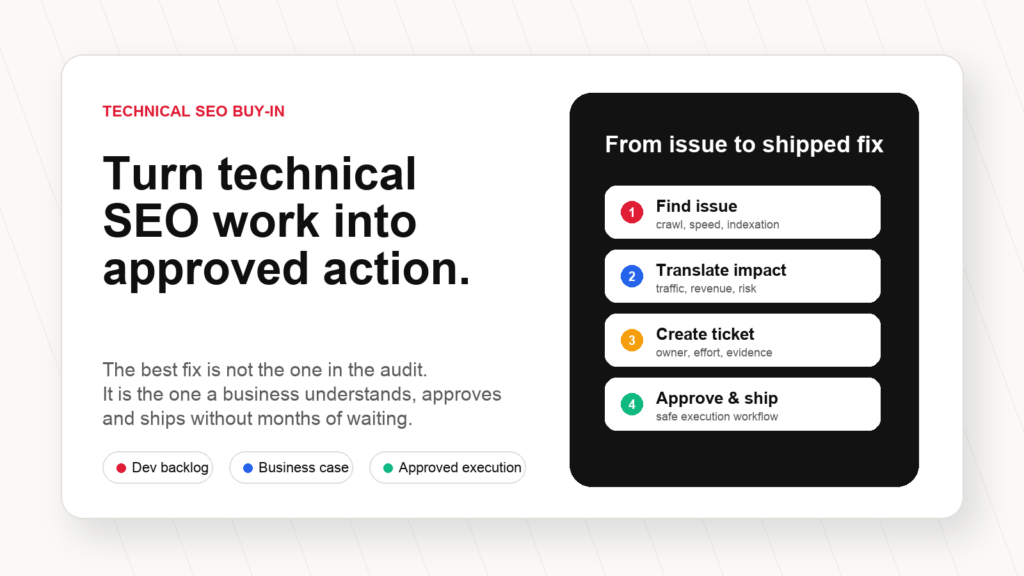
Summary: Technical SEO problems rarely fail because the audit missed them. They fail because the work does not get buy-in. Developers see another vague ticket. Managers see cost without revenue context. Marketers see risk, delay and dependency. The result is familiar: crawl issues, speed problems, redirect chains, duplicate templates and indexation waste sit in a backlog for months.
The way forward is to stop presenting technical SEO as a list of defects and start presenting it as a business execution workflow: evidence, impact, risk, effort, approval and shipping. That is also where AYSA’s model fits: the agent can monitor, prepare, explain and move technical SEO work toward approval instead of leaving the user with a static report.
Why technical SEO work struggles to get approved
Technical SEO is often obvious to the person doing the audit and invisible to everyone else. A crawl report can show hundreds of issues: broken internal links, canonical conflicts, duplicate titles, orphan pages, slow templates, bloated JavaScript, redirect chains, Noindex mistakes, sitemap pollution, schema errors and Core Web Vitals problems. To a technical SEO specialist, the pattern is clear. To the business, it can look like a spreadsheet of abstract warnings.
That is the first buy-in problem: the issue is described in technical language, but the decision is made in business language. “Render-blocking resources” is accurate, but it does not tell a business owner why the fix should be prioritized over a campaign, a new landing page or a developer sprint. “Canonical mismatch” matters, but it needs to be connected to indexation, duplicate signals and wasted Crawling. “Orphan pages” sounds minor until the business understands that important pages may receive little internal equity and may be harder for search engines and AI systems to discover.
The second problem is ownership. Technical SEO touches marketing, development, content, analytics, hosting and sometimes legal or product teams. If no one owns the workflow, the audit becomes a queue of recommendations with no execution path. The third problem is trust. Developers are often tired of vague SEO tickets. Managers are tired of SEO claims that do not explain risk, effort or expected benefit. That tension is not irrational. It is usually a symptom of weak translation.
Translate technical SEO into business impact
The most useful technical SEO work is not always the most technically interesting. It is the work that improves crawl efficiency, index quality, user experience, discoverability and the ability of search systems to understand the website. That impact has to be made explicit.
Instead of saying “fix 122 redirect chains,” say: “Important pages are reached through multiple redirects, which slows crawling, creates maintenance risk and can weaken signal consolidation. We should update internal links to point directly to final URLs and keep redirects only for external legacy traffic.” That version is still technical, but it gives a reason, a scope and a safer action.
Instead of saying “improve LCP,” say: “The mobile hero image and blocking CSS are delaying the first meaningful content. This affects user experience and may reduce the quality of the landing page experience. The fix is to resize/preload the right image, remove unnecessary render-blocking CSS and test the template after deployment.”
Instead of saying “sitemap includes low-value URLs,” say: “Search engines are being sent URLs that should not be prioritized: parameter pages, thin tags, non-canonical URLs or redirects. We should make the sitemap a clean list of canonical, indexable, useful URLs.”
The principle is simple: every technical recommendation should answer four questions: what is wrong, why it matters, what should change and who needs to approve it.
Weak technical ticket
- “Fix canonical issues”
- No page examples
- No business context
- No effort or risk
- No owner
Approval-ready ticket
- Problem and affected URLs
- Search impact explained
- Expected fix described
- Risk and rollback noted
- Owner and approval path
Use evidence instead of SEO pressure
Technical SEO buy-in gets stronger when recommendations are backed by evidence. That evidence can come from crawls, Google Search Console, analytics, server logs, PageSpeed Insights, Structured data tests, sitemap checks, internal link exports, indexation reports and real user journeys.
For example, if a page has high impressions but low click-through rate, the problem may be metadata, search intent mismatch or SERP competition. If a category has many products but weak Organic traffic, the problem may be crawl depth, thin category copy, duplicate filters, weak internal links or poor indexation. If a site loses pages from the index, the problem may be thin content, canonical mistakes, quality signals, crawl waste or duplicate templates.
The strongest technical SEO cases combine several signals. A single PageSpeed score is useful, but not enough. A crawl issue is useful, but not enough. A ranking drop is useful, but not enough. The buy-in becomes stronger when the team sees the relationship: affected template, search demand, traffic potential, user experience problem and clear implementation path.
This is also important for AI search and GEO. If a page is slow, thin, poorly structured or buried deep in the site, it is not only weaker for classic search. It is also weaker as a source that answer engines can retrieve, understand and cite. Technical SEO is becoming part of AI visibility readiness.
Build a technical SEO workflow, not a one-time audit
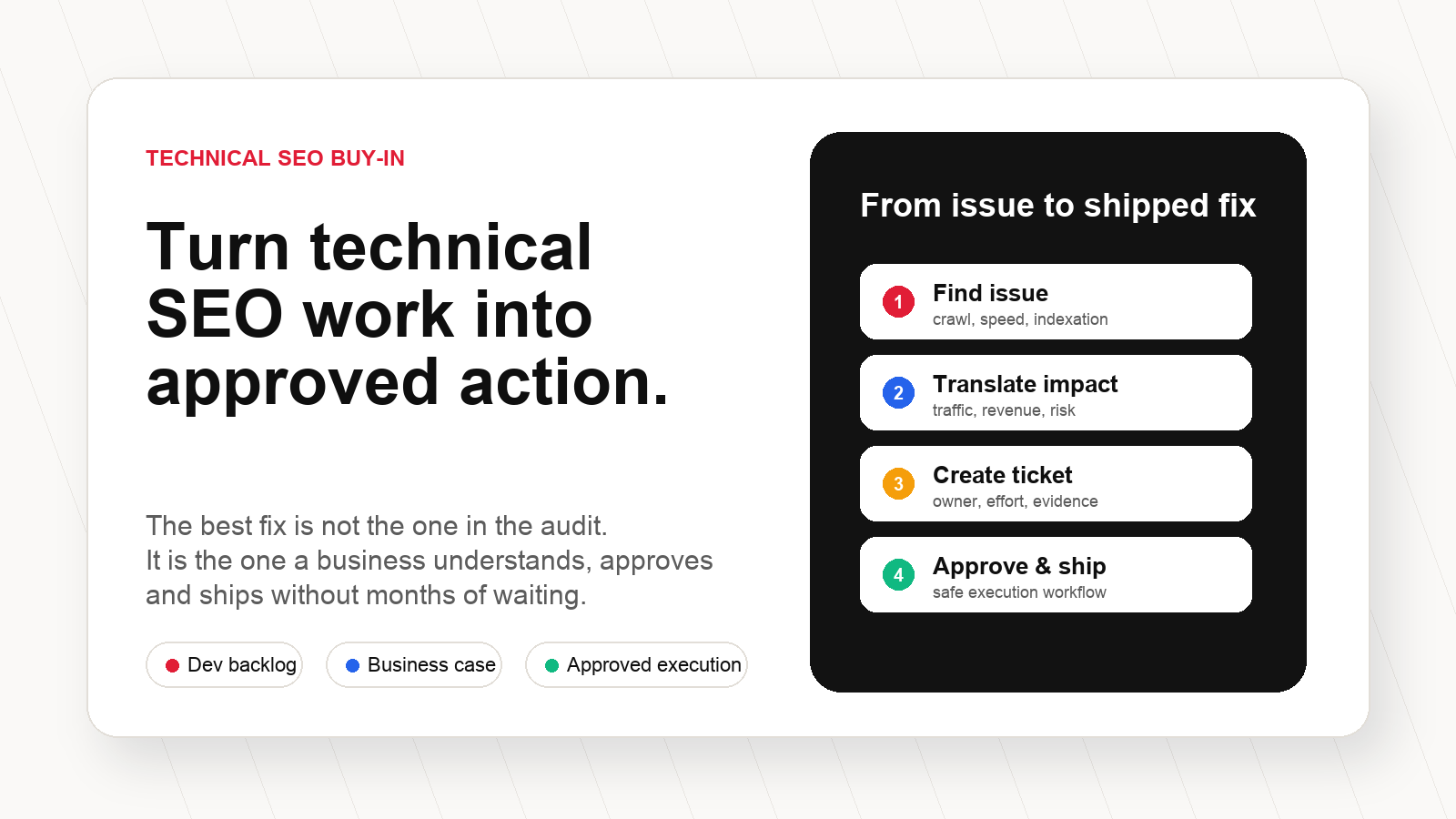
The biggest technical SEO mistake is treating the audit as the work. The audit is diagnosis. The work is prioritization, approval, implementation, QA and monitoring. A business needs a workflow that turns technical findings into shipped fixes.
A useful workflow looks like this:
- Detect issues continuously, not only once per year.
- Group issues by template, impact and implementation owner.
- Translate each issue into business impact and technical risk.
- Separate quick wins from high-risk engineering changes.
- Create approval-ready recommendations.
- Ship accepted changes safely and document what changed.
- Monitor the result after deployment.
This workflow matters because technical SEO often competes with product work. Developers need clear tickets. Managers need prioritization. Marketers need confidence that changes will not break conversion pages. Everyone needs to understand what happens if the work is ignored.
Good technical SEO buy-in is not created by fear. It is created by clarity. The business should understand the upside, the risk, the cost of delay and the safest next step.
What SMEs should do differently
For SMEs, the problem is not lack of technical SEO theory. The problem is execution capacity. Many small businesses run WordPress or ecommerce sites with heavy themes, too many plugins, oversized images, inconsistent redirects, duplicated templates and messy indexing rules. They do not have a dedicated technical SEO team or a developer sprint every week.
That means the technical SEO system must be practical. Start with the pages that matter most: homepage, service pages, product categories, top organic landing pages, local pages, blog posts with impressions and pages that should convert. Then ask:
- Can Google and AI crawlers access the page?
- Is the page indexable and canonical?
- Does it load well on mobile?
- Does it answer the user’s real question?
- Is it internally linked from relevant pages?
- Are schema and page content consistent?
- Is the next action clear for the user?
For a business owner, this is far more useful than “you have 312 technical issues.” The question is not how many warnings exist. The question is which fixes will help search visibility, AI discoverability and revenue, and which ones can be approved and shipped safely.
Where AYSA fits: technical SEO that moves toward approved execution
AYSA is designed around the gap between recommendation and implementation. The agent can monitor a website, detect technical SEO issues, explain them in plain language, prepare approval-ready actions and execute accepted changes inside the website workflow where possible.
That matters because most businesses do not need another technical SEO report that sits in a folder. They need a system that keeps watch, prepares the work and reduces the amount of manual coordination required to improve the website.
In my opinion, technical SEO buy-in improves when the discussion stops being “please fix these SEO issues” and becomes “here are the approved actions that protect crawl quality, improve discoverability and reduce future execution debt.” That is the bridge between SEO expertise and business action.
A practical buy-in checklist
- Attach examples, affected URLs and screenshots to every recommendation.
- Translate each technical issue into traffic, revenue, risk or user experience impact.
- Group issues by template so developers can fix systems, not one URL at a time.
- Separate low-risk fixes from changes that need engineering or brand approval.
- Define the owner, expected effort, rollback plan and post-deploy QA.
- Track what was approved, shipped, rejected and still waiting.
Sources and further reading
Less SEO work. More organic growth.
Turn technical SEO issues into approved website action.
AYSA monitors your website, prepares technical SEO improvements, asks for approval and executes accepted changes inside your website workflow.
Continue the AI search topic inside AYSA.
Use these pages to connect the article with AI SEO tools, AI visibility monitoring, AI Overviews and approved website execution.
Turn this topic into a website action plan.
Use these AYSA hubs to move from reading to technical fixes, AI visibility monitoring, research, glossary context and approval-first SEO execution.

