
Agentic AI for SEO: Discoverability Now Means Being Understood, Selected and Executed
Agentic AI changes SEO from ranking-only visibility into continuous discoverability. Here is how websites should prepare for humans, search engines and AI agents.
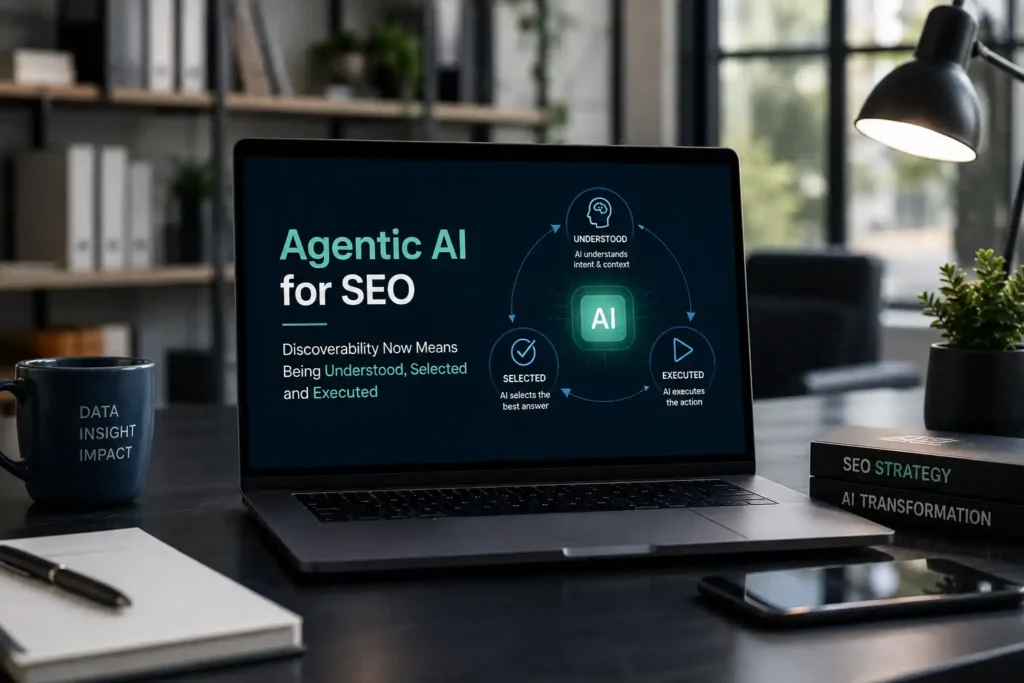
Discoverability used to be a comfortable SEO word. If a page could be crawled, indexed and ranked, it was discoverable. That definition is now too small. In the age of AI Overviews, answer engines and agentic AI, discoverability means something more demanding: your business must be easy to find, easy to understand, easy to trust, easy to cite and easy to act on.
Yoast recently published a useful article about discoverability with agentic AI for SEO. The core idea is right: AI agents do not experience the web the same way a human user does, and websites need to become easier for machine systems to interpret. But the commercial SEO conclusion should be sharper. The future is not only “make content machine-readable.” The future is make search work executable.
That difference matters. A website can be technically accessible and still fail to win visibility. A page can have schema and still be ignored. A brand can appear in search and still lose the buyer journey when an AI system summarizes competitors, compares options or recommends a path forward. Agentic AI raises the standard: websites now need to be understood not only as pages, but as entities, offers, workflows, answers and actions.
What agentic AI changes in SEO
Agentic AI describes systems that can pursue goals through a sequence of steps: interpret a request, gather information, compare options, decide what to do next and sometimes take an action. In SEO, the important implication is that discovery is no longer only a search result page with ten links. Discovery may involve a user asking a conversational system, an AI assistant comparing sources, an agent extracting structured information from a website, or a search engine synthesizing an answer from multiple sources.
This does not make classic SEO irrelevant. It makes classic SEO the foundation. Crawlability, Indexability, fast pages, useful content, internal links, Structured data and authority still matter. Google’s own guidance for AI features says that the same fundamentals that make content eligible for Search remain important for AI experiences. The difference is that the output surface is changing.
In a traditional search journey, the user enters a query, scans links and chooses a result. In an AI-assisted journey, the system may summarize the answer, mention sources, compare brands, extract product details, surface local options or help the user refine the request. The website is not only trying to rank. It is trying to become a reliable source in a machine-mediated decision.
Discoverability now has five layers
The old SEO question was often: “Can Google find and rank this page?” That is still important, but it is not enough. A modern discoverability strategy should cover at least five layers.
1. Technical discoverability
This is the foundation: can crawlers access the site, render the important content, follow internal links, understand canonical signals, read structured data and index the pages that matter? Technical discoverability includes robots directives, XML sitemaps, Internal linking, JavaScript rendering, status codes, redirects, canonical tags, Page speed and mobile usability.
If this layer fails, the rest becomes theory. An AI agent or search system cannot reliably use content that is blocked, duplicated, slow, buried or technically ambiguous.
2. Semantic discoverability
Semantic discoverability asks whether the website clearly explains what the business is, what it offers, who it serves, where it operates and how its pages relate to one another. This is where entities, topical structure, schema markup, headings, internal links and consistent terminology matter.
AI systems need clarity. If a company has five different ways of describing the same service, weak location signals and disconnected content, the system has to infer too much. The website may still rank for some queries, but it becomes harder to summarize, cite or recommend confidently.
3. Answer discoverability
Answer discoverability is the AEO layer. It asks whether the website gives direct, useful, extractable answers to the questions users ask. This does not mean writing thin FAQ pages for every keyword. It means structuring real expertise so that questions, answers, examples, definitions, comparisons and next steps are visible in the content.
For AI Overviews and answer engines, this matters because synthesized answers often reward clarity. A page that hides the answer inside vague marketing copy is harder to use than a page that states the answer, explains the nuance and supports it with context.
4. Authority discoverability
Authority discoverability asks whether the business is referenced, trusted and connected across the web. Links still matter, but the broader picture includes brand mentions, publisher references, reviews, business profiles, author credibility, citations and the consistency of external signals.
For local businesses, Google Business Profile and trusted local references matter. For ecommerce and publishers, product data, reviews, editorial coverage and authority-building matter. For B2B companies, founder expertise, case studies and credible mentions can help reinforce the entity behind the website.
5. Action discoverability
This is the layer many SEO discussions miss. If an AI assistant or human visitor understands the business, what can they do next? Can they see pricing? Can they contact the company? Can they understand plans, availability, product details, service areas, legal terms, support routes and conversion paths?
Agentic AI makes this layer more important. A system that helps a user compare options may need clear product data, pricing logic, service coverage, FAQs, policies and next actions. A website that is vague may still be found, but it may not be selected.
Why schema alone will not solve agentic SEO
Structured data is important. It can help search engines understand page meaning, eligible rich result features and the relationship between visible content and machine-readable markup. But schema is not a magic layer that fixes weak content, unclear pages or poor execution.
Google’s structured data guidelines emphasize that structured data should match visible content and follow quality guidelines. In practical terms, schema should clarify reality, not invent it. If the page does not explain the service well, adding schema will not make the business genuinely easier to evaluate.
The better approach is to connect three things:
- Visible content: the user can read and understand the page.
- Structured signals: search systems can parse important facts.
- Execution workflow: the business can keep improving pages as search behavior changes.
That third part is where most websites fail. They do not fail because nobody has heard of schema. They fail because nobody consistently reviews the site, identifies missing clarity, prepares improvements, gets approval and publishes the changes.
The new SEO problem is operational, not theoretical
Agentic AI creates a lot of intellectual discussion: agents, retrieval, embeddings, answer engines, AI citations, entity graphs, structured data and LLM visibility. These are useful concepts. But the business problem remains brutally practical: who is going to update the website?
If a website needs clearer service pages, stronger entity signals, better FAQs, improved internal links, schema cleanup, author pages, Google Business Profile alignment, product data, local landing pages, comparison content and updated pricing explanations, someone must do the work.
Most businesses do not have that operating system. They have scattered tools. A crawler finds issues. A rank tracker shows movement. An AI assistant drafts copy. A spreadsheet stores ideas. A developer waits for tickets. A marketer reviews pages when there is time. An agency sends a report. The result is slow implementation.
That is why AYSA’s view is that SEO software must evolve from discovery to execution. Not because discovery is unimportant, but because discovery without execution is unfinished work.
What agentic AI discoverability should mean for a real business
Let’s make this practical. Imagine a medical clinic, ecommerce store, SaaS company or local service business. What does agentic discoverability actually require?
The business must be understood as an entity
The website should clearly identify the business, services, locations, team, expertise, contact routes, policies and relationship to other entities. About pages, author pages, organization schema, local business information, consistent naming and external references all help reduce ambiguity.
The offer must be easy to compare
AI-assisted discovery often involves comparison. If users ask for the best option, the safest choice, the fastest service, the most affordable plan or the right tool for a job, the website needs content that makes comparison possible. That includes pricing, use cases, limitations, FAQ answers, product differences and honest positioning.
The content must answer real questions
AI systems are strong at extracting concise answers from clear content. Pages should answer the questions customers actually ask, not only repeat marketing phrases. This includes definitions, examples, eligibility, steps, risks, costs, alternatives and when not to use a service.
The site must be technically clean
Agentic discoverability does not excuse technical SEO. Broken redirects, blocked pages, duplicate content, missing canonicals, weak internal linking and poor page speed still create friction. A website that is hard for search engines to crawl is also hard for AI systems to use reliably.
The business must keep improving
Search is moving too quickly for one-time optimization. Google updates AI experiences, competitors publish new content, user behavior changes and new questions appear. Discoverability needs monitoring and approved execution, not a yearly audit.
Where AYSA fits: from discoverability audit to approved execution
AYSA operating system
From discoverability audit to approved execution
Audit signals
Classic search, AI search and answer-engine gaps.
AYSA prepares the work
The agent turns signals into clear actions with context, risk and next step.
Approved execution
Nothing important is published before approval.
AYSA is built around the idea that SEO should move from research to approved action. In the context of agentic AI, that means the agent can help a website become more discoverable across classic search, AI-assisted search and answer engines by continuously preparing the work that improves clarity, structure and execution.
For example, AYSA can help identify:
- pages that receive impressions but do not answer the query well;
- topics where the business lacks enough coverage to build authority;
- weak internal links between related pages;
- service pages that lack clear pricing, location or process information;
- FAQ opportunities for answer readiness;
- schema opportunities that match visible content;
- technical issues that reduce crawlability or indexability;
- authority-building opportunities that need review and approval;
- AI visibility gaps where the brand is not easy to identify, cite or recommend.
The important part is what happens next. AYSA does not only show the issue. It prepares the work, explains why it matters, asks for approval and can execute accepted changes inside the website workflow. That is the difference between a discoverability report and a discoverability operating system.
Agentic AI does not remove human approval
One mistake in AI SEO is assuming that autonomy means blind publishing. That is not the right model for serious businesses. A system can be autonomous in monitoring, research, drafting, prioritizing and preparing execution while still requiring human approval for important changes.
Approval matters because SEO touches business reality. A recommendation may involve pricing language, medical claims, legal statements, brand positioning, product descriptions, partner mentions, linkbuilding budget or sensitive technical changes. These are not places for uncontrolled automation.
The better model is autonomous execution after approval. AYSA can do the heavy operational work, but the user remains in control of what gets published or purchased.
How to prepare a website for agentic discoverability
Here is a practical checklist for businesses that want to be discoverable in the next version of search.
Build a clear business profile
Document what the business does, who it serves, where it operates, what it sells, what makes it credible, what tone it uses and which competitors matter. This is not only marketing work. It becomes machine-readable context for better SEO decisions.
Map topics to real pages
Do not create disconnected content. Map primary topics, subtopics, service pages, guides and glossary entries into a coherent structure. AI systems need topical relationships, not only isolated articles.
Improve answer-ready sections
Add clear explanations, examples, FAQs and decision guidance where users need them. Avoid empty FAQ spam. The answer must be useful to a human reader first.
Use structured data responsibly
Add schema where it reflects visible page content: Organization, Article, BreadcrumbList, FAQPage where appropriate and visible, Product, LocalBusiness or other relevant types. Do not use markup to claim things the page does not show.
Strengthen internal linking
Internal links help users, crawlers and AI systems understand relationships between pages. Link semantically related topics, product pages, guides and glossary terms. Anchor text should be descriptive and natural.
Keep authority signals real
Authority is not only link volume. It is also credibility, references, reviews, mentions, author profiles, media coverage, useful resources and consistency across the web. For AYSA, authority building should remain approval-based, especially where spending is involved.
Monitor and execute continuously
The final step is the most important. Create a system that detects opportunities, prepares improvements and gets them live. A perfect strategy deck that never changes the website is not a strategy. It is shelfware.
My view: discoverability is becoming an execution discipline
I agree with the direction of Yoast’s argument: AI agents change how websites need to be discovered and understood. But I would push the conclusion further. Discoverability is no longer just an information architecture challenge. It is an execution discipline.
To be discoverable in AI-assisted search, a business needs to keep its website accurate, clear, structured, fast, internally connected, externally credible and aligned with changing user questions. That cannot be solved with one plugin setting or one schema pass. It requires an operating rhythm.
This is where SEO is becoming more like product operations. You monitor signals, decide what matters, prepare changes, approve work, ship improvements and measure the result. The winners will not only be the websites with the most content. They will be the websites that improve fastest without losing quality or control.
What businesses should do next
If you are a business owner, marketer or agency, do not wait for a perfect definition of agentic SEO. Start with the work that is already obviously useful:
- Make sure important pages are crawlable, indexable and internally linked.
- Clarify what your business does, who it serves and why it is credible.
- Answer the questions real buyers ask before they choose.
- Connect content into topical clusters instead of isolated posts.
- Use structured data to clarify visible facts.
- Improve pages with impressions but weak performance.
- Monitor AI search and answer-engine visibility, but avoid fake guarantees.
- Build a workflow that turns recommendations into approved website changes.
That last point is the bridge from theory to growth. Agentic AI will create more discovery surfaces, more comparison journeys and more machine-mediated decisions. The businesses that win will not be the ones that read the most articles about AI SEO. They will be the ones that build the most reliable execution system.
FAQ
What is agentic AI for SEO?
Agentic AI for SEO refers to AI systems that can help pursue SEO goals through multiple steps: analyzing a website, interpreting search signals, preparing recommendations, asking for approval and helping execute accepted work.
Is agentic SEO different from traditional SEO?
It builds on traditional SEO. Crawlability, content quality, links, structure and page experience still matter. The difference is that AI-assisted discovery adds more emphasis on entity clarity, answer readiness, machine-readable structure and continuous execution.
Does schema markup guarantee AI visibility?
No. Schema can help clarify page content, but it does not guarantee rankings, AI Overview inclusion or answer engine citations. The page still needs useful visible content, technical health, authority and relevance.
Can AYSA help with agentic AI discoverability?
Yes. AYSA can monitor website and search signals, prepare SEO, AEO, GEO and AI visibility actions, ask for approval and execute accepted changes inside the website workflow.
Should AI publish SEO changes automatically?
For serious businesses, important changes should go through approval first. The best model is autonomous preparation and execution after approval, not blind autopilot.
Sources and further reading
- Yoast: Discoverability with agentic AI for SEO
- Google Search Central: AI features and your website
- Google Search Central: SEO Starter Guide
- Google Search Central: Creating helpful, reliable, people-first content
- Google Search Central: Structured data general guidelines
Continue the AI search topic inside AYSA.
Use these pages to connect the article with AI SEO tools, AI visibility monitoring, AI Overviews and approved website execution.
Turn this topic into a website action plan.
Use these AYSA hubs to move from reading to technical fixes, AI visibility monitoring, research, glossary context and approval-first SEO execution.

