
AI Influencer Networks, UGC and SEO: Where Authority Ends and Scaled Content Risk Begins
Unilever’s reported 300,000-person creator network raises the right question for SEO and AI visibility: can AI-assisted content at scale create authority, or does it create noise?
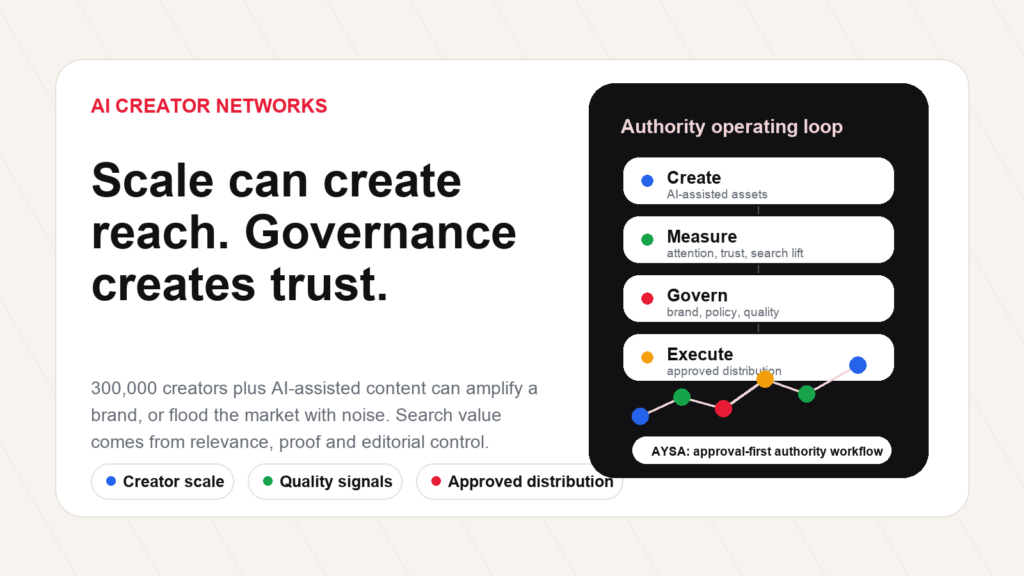
Executive summary: Search Engine Journal reported on Unilever’s plan, through Captiv8, to build a creator network that could reach roughly 300,000 creators and use AI-generated or AI-assisted content workflows. The strategic question is not whether AI can help brands create more assets. It can. The harder question is whether scale creates trust, search visibility and commercial outcomes, or whether it creates a louder version of the same low-quality content problem.
In my opinion, AI creator networks can work only when they are governed like an operating system: clear brand rules, real human context, measurement, editorial standards, disclosure where required, and a disciplined approval workflow. Without that, “influencer network” becomes another name for scaled content risk.
For SEO, AEO and AI Search visibility, this matters because modern authority is not just about publishing more. It is about being mentioned, cited, retrieved and trusted in contexts that users and AI systems can verify. That is exactly where SMEs should be careful: do not copy enterprise scale. Build controlled authority.
What happened
Search Engine Journal covered a major creator-marketing experiment: Unilever working with Captiv8 on a very large creator network supported by AI content workflows. The reported number is eye-catching because it reframes creator marketing from a relationship-led discipline into something closer to a scaled media and content infrastructure.
This is not happening in isolation. Big brands are under pressure to create more content variants, react faster to culture, localize messaging, improve measurement and lower production friction. At the same time, AI tools make it easier to generate scripts, captions, images, voiceovers, video variants, briefs and performance hypotheses.
Unilever’s leadership has also been talking publicly about a shift away from relying only on classic big-brand advertising. Search Engine Journal: Unilever creator network and AI content analysis comments from Unilever CEO Fernando Fernandez about the changing role of big brand ads and the need for more content at the edge of culture. That context matters: the creator network is not just a content factory. It is a bet that brand growth increasingly happens through distributed, contextual, creator-shaped touchpoints.
The interesting part for SEO is that this same idea is also moving into search. Brands no longer compete only for classic blue links. They compete for inclusion in summaries, recommendations, AI answers, social discussions, Reddit threads, YouTube explanations, product lists, publisher articles, local results and Conversational search surfaces.
AI scales the content, but the brand loses consistency, proof, trust and measurable search value.
Every placement has relevance, context, approval, measurement and a reason to exist.
Why brands want creator scale
The reason large brands are attracted to AI-supported creator networks is easy to understand. Traditional production is slow. Influencer relationships are hard to manage. Paid social fatigue is real. Search behavior is fragmenting. AI search is changing discovery. And consumers often trust lived experience more than polished corporate language.
Creator content can solve some of those problems. It can feel closer to the customer. It can demonstrate product usage in context. It can speak in local language, local humor and local objections. It can produce more surface area for a brand to be discovered.
AI makes the operating model more scalable. A brand can brief creators faster. It can generate content variations. It can analyze emotional response, comments, engagement and performance. It can match creators to audiences. It can transform one idea into multiple formats.
But scale is not automatically strategy. A network of 300,000 creators sounds powerful, but the number itself is not the asset. The asset is the quality of the relationship between brand truth, creator credibility, audience need and measurable outcome.
If that relationship is weak, AI does not fix it. It amplifies the weakness.
Where AI creator networks can break
There are five places where this model can fail.
First, authenticity can collapse. Creator marketing works when the audience believes the creator has a real point of view. If AI-assisted content makes thousands of creators sound like the same brand template, the content becomes more efficient but less believable.
Second, brand consistency can drift. A large network can introduce factual errors, exaggerated claims, regulatory problems, tone mismatch and off-brand positioning. For categories like healthcare, finance, supplements, education or children’s products, that risk is not theoretical.
Third, measurement can become vanity-led. Views, likes and Impressions are not the same as trust, brand recall, assisted conversion, search demand or citation potential. A creator network that optimizes only for low-cost reach may look successful while doing little for durable authority.
Fourth, content can become redundant. AI makes it easy to produce similar posts, similar explainers and similar product claims. That creates duplication across channels. In search and AI Retrieval environments, redundancy is not a moat. Distinctiveness is.
Fifth, distribution can create reputational risk. If a brand pushes content into low-quality placements, thin publisher pages, irrelevant creator contexts or paid mentions with no editorial value, the campaign may create short-term visibility and long-term trust problems.
The SEO and AI visibility risk
Google’s spam policies are useful here because they separate automation from abuse. Google does not say that all AI-assisted content is automatically bad. The problem is scaled content abuse: content created at scale primarily to manipulate search rankings and not help users. Google also calls out site reputation abuse, deceptive practices and other patterns where third-party content or distribution is used in ways that exploit trust.
The practical lesson is simple: if AI creator networks are used to manufacture low-value mentions, thin articles, repetitive “reviews,” fake expertise or irrelevant placements, they can cross from marketing into search risk.
For AI search, the risk is subtler. AI systems do not only look for pages. They retrieve signals across the web. A brand might be mentioned in creator posts, publisher articles, reviews, product pages, forums and comparison lists. Some of those signals may help the brand become easier to identify and recommend. But weak signals can also become noise.
AI search visibility is not a game of being mentioned everywhere. It is a game of being mentioned in contexts that make sense: the right entity, the right category, the right problem, the right proof, the right audience, the right timing.
A small business should take that seriously. A florist, clinic, ecommerce store, hotel, car rental company or SaaS product does not need 300,000 creators. It needs a smaller number of useful, credible, relevant signals that match what customers actually search and ask.
Authority building is not the same as distribution
This is the distinction many marketers miss. Distribution answers the question: “How do we get this message in more places?” Authority answers the question: “Why should a user, a search engine or an AI system trust this business on this topic?”
Distribution can be bought. Authority has to be earned, structured and maintained.
A creator mention can support authority if it demonstrates real use, specific experience, useful comparison, local context or credible endorsement. A Publisher placement can support authority if it is relevant, editorially coherent and clearly connected to the brand’s expertise. A backlink can support authority if the context makes sense and the page is useful. A brand mention can support AI visibility if it helps disambiguate who the business is and what it is known for.
But none of those things work well when they are random. Random creator posts, random backlinks and random AI-generated articles create a messy footprint. In my opinion, that is the biggest danger of AI-assisted scale: it makes randomness cheap.
More creators, more captions, more placements, more backlinks, more content variants.
Better context, better relevance, better evidence, better measurement and safer execution.
What SMEs should learn from this
The biggest mistake SMEs can make is trying to copy enterprise-scale creator marketing with a small budget and no governance. That usually turns into cheap sponsored posts, generic AI content, low-quality backlinks and campaigns that cannot be measured.
A better approach is to build an authority system in layers.
Layer one: website truth. Your website must clearly explain what you do, where you operate, who you serve, why you are credible and what the customer should do next. If the website is weak, creator mentions will send attention to a poor destination.
Layer two: topic ownership. Choose the topics where your business deserves to be known. A pediatric clinic may focus on emergency guidance, appointment flow, pediatric specialties, trust signals, location access and parent questions. A florist may focus on delivery areas, bouquet occasions, care guides and seasonal demand. An ecommerce store may focus on category advice, product comparisons and availability.
Layer three: useful external proof. Build mentions and placements that support those topics. This could include publisher opportunities, industry resources, local business profiles, expert interviews, real customer reviews, partner pages and creator content with genuine relevance.
Layer four: approval and measurement. Do not buy or publish authority signals blindly. Review the context, cost, risk, recommendation and expected role in the wider search strategy.
Layer five: continuous monitoring. Track whether the business is becoming easier to find, cite and recommend. That means classic SEO visibility, AI visibility, brand mentions, referral quality, page performance and conversion signals.
Where AI-generated content can help
AI is not the enemy here. Used properly, AI can help with brief creation, content planning, topic clustering, creator instructions, risk checks, content adaptation, multilingual versions, measurement summaries and approval workflows.
AI can also help SMEs avoid wasting money. A good system can look at a publisher opportunity and ask: does this match the business? Does this page have topical relevance? Is the content likely to help users? Is this a good authority signal or just a vanity placement? Should we approve it, reject it or ask for a better angle?
That is a much better use of AI than generating thousands of generic posts.
Where AYSA and Adverlink fit
AYSA.ai is built for approved SEO execution, not blind automation. In the context of creator networks and authority building, that matters. The goal is not to generate noise. The goal is to identify useful opportunities, explain them in plain language, ask for approval and track what happens after execution.
AYSA’s authority-building layer is connected with publisher opportunities through the AYSA ecosystem, including Adverlink. That gives SMEs a more controlled way to approach external visibility: relevant publisher opportunities, context, cost, recommendation and approval before action.
This is important because authority building is one of the areas where bad automation can do damage. Extra purchases or authority actions should require separate approval. The user should understand what is being bought, where it appears, why it matters and how it fits the SEO/AEO/GEO strategy.
In my opinion, this is the future of authority building for SMEs: not chaotic link buying, not mass AI content, not influencer spam, but an approval-first workflow where the agent helps the business decide what is worth doing.
Final opinion
Can a 300,000-person influencer network built on AI-generated or AI-assisted content work? Yes, but only for organizations that can govern it properly. Without governance, it becomes a scale machine for inconsistency.
For SMEs, the lesson is not “build a huge creator network.” The lesson is “treat authority as an operating system.” Search and AI discovery are becoming more distributed. Brand signals are coming from more places. But trust still depends on relevance, usefulness, evidence and consistency.
AI can accelerate that. It can also ruin it faster.
The winning businesses will not be the ones that publish the most. They will be the ones that use AI to prepare better decisions, approve the right actions and execute with discipline.
Build visibility without turning content distribution into spam.
If you want more search and AI visibility, but you do not want random backlinks, generic AI content or unmeasured creator campaigns, AYSA can help prepare, explain, approve and track authority-building work.
Sources and further reading
- Search Engine Journal: Can a 300,000 influencer network built on AI-generated content work?
- Search Engine Journal: Unilever creator network and AI content analysis
- Google Search Central: Spam policies for Google web search
- Google Search Central: Creating helpful, reliable, people-first content
- Adverlink: publisher network and authority-building platform
- AYSA: Link building tools and authority-building workflow
- AYSA: AI search visibility
Continue the AI search topic inside AYSA.
Use these pages to connect the article with AI SEO tools, AI visibility monitoring, AI Overviews and approved website execution.
Turn this topic into a website action plan.
Use these AYSA hubs to move from reading to technical fixes, AI visibility monitoring, research, glossary context and approval-first SEO execution.

