AI Didn’t Replace SEO. It Repriced It: Move From Execution To Judgment (And Automate The Rest)
Most teams use AI to write and summarize faster. That’s execution. The durable advantage is using AI to improve decisions, find blind spots, rehearse high‑stakes conversations, and critique strategies before the market does—then automating approved fixes at scale.

By Marius Dosinescu (AYSA.ai)
AI is everywhere in marketing now—drafting pages, rewriting product descriptions, summarizing competitor sites, translating FAQs, turning meeting notes into briefs. That’s progress. It’s also the most common way teams use AI because it produces visible output fast.
But the hard truth I see across SMEs and agencies is this: AI hasn’t “replaced SEO.” It has repriced it. The market is rapidly discounting execution-layer work (things that can be generated, reformatted, and shipped at scale) while increasing the value of judgment-layer work (things that require context, risk tradeoffs, and business accountability).
This editorial is informed by Duane Forrester’s analysis of a six-mode taxonomy of real-world AI usage—writing, identifying, deciding, ideating, talking, and critiquing—and the observation that most practitioners live almost entirely in the first two modes. That framing is the right diagnostic for 2026. The strategic question isn’t “Should we use AI?” It’s: Are we using AI to do more tasks—or to make better decisions?
Source that inspired this piece: Search Engine Journal.
Concise summary
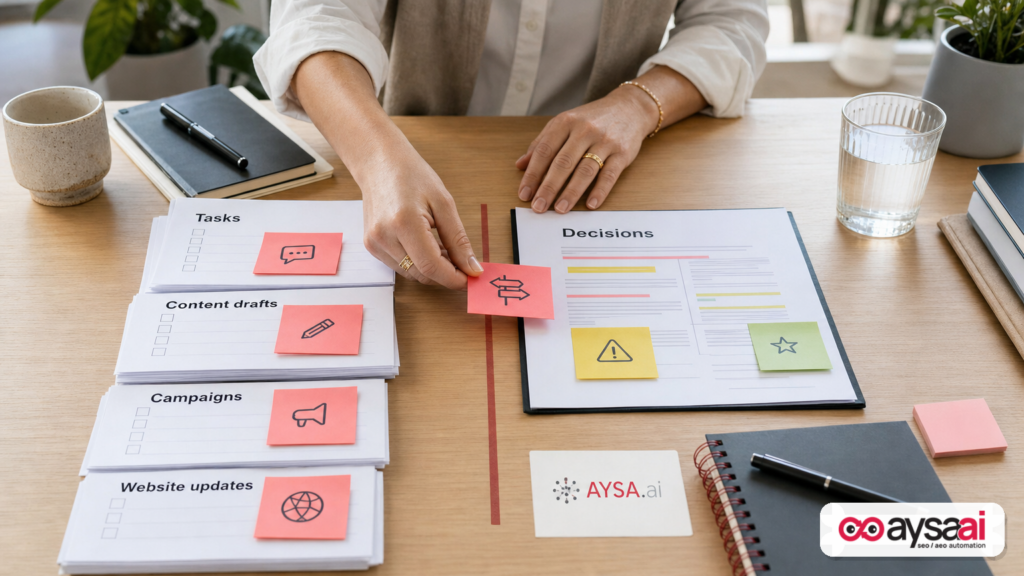
- Most AI usage in SEO/GEO is execution-layer: writing drafts and identifying information faster.
- The defensible advantage is judgment-layer: deciding, ideating, critiquing, and rehearsing conversations with AI—then acting on those insights.
- AI Search visibility changes the scoreboard: you’re not only competing for rankings; you’re competing to be referenced, cited, and recommended in AI answers.
- Teams fail when they “bolt AI onto old workflows” and measure productivity as output volume instead of decision quality.
- AYSA’s role: automate the execution layer with Monitoring and approved changes, so humans can spend time on judgment and strategy: Monitoring, AI Search Visibility, and AI SEO Tools.
Table of contents

- What changed (and why your old SEO playbook feels less reliable)
- The uncomfortable truth: AI didn’t kill SEO—it compressed the execution layer
- A practical taxonomy: six AI modes that map to two layers of work
- Why most teams get stuck in Writing + Identifying
- Deciding mode: use AI to pressure-test your assumptions before you spend money
- Ideating mode: find authority gaps and entity blind spots before your competitors do
- Critiquing mode: make AI your internal red team (without turning it into a morale problem)
- Talking mode: rehearse the meetings that determine budgets, timelines, and trust
- A concrete SME scenario: the local clinic that “did SEO” but lost the AI answer
- What can go wrong (and how to reduce AI-driven marketing risk)
- What to measure now: from traffic-only to visibility + citations + conversion signals
- What agencies should change: productize judgment, automate execution, and sell governance
- The AYSA approach: automate execution, preserve judgment, prove change control
- A 30-day action plan to move up the judgment stack
- What to do next
- Sources and further reading
What changed (and why your old SEO playbook feels less reliable)

If you run a business, you don’t need a philosophy lecture about “the future of search.” You need to know what changed in practical terms:
- Search is no longer just a list of links. Increasingly, people get synthesized answers—on search engines and inside AI chat experiences—before they ever click a website.
- Content supply exploded. Generative AI made it easy to produce “good enough” pages at scale. The web got louder, not smarter.
- Trust signals matter more than word count. In AI answers, being quoted, cited, or recommended depends on credibility, clarity, and consistency—not simply publishing volume.
- Execution got cheaper. Many tasks that used to justify a retainer—rewrites, expansions, first drafts, meta descriptions—can now be done quickly by anyone with a model and a prompt.
- Judgment got more valuable. Deciding what to do, what not to do, where risk lives, and how to build proof is where businesses win.
Duane Forrester’s SEJ piece frames the core issue clearly: practitioners often use AI where it’s easiest to show output (writing and identifying), not where it changes outcomes (deciding, ideating, critiquing, and talking). Read the original on SEJ for that framing and the referenced research context: You’re Using AI At The Execution Layer. The Value Is In The Judgment Layer.
My take: the industry isn’t facing “AI vs. SEO.” It’s facing “automation vs. accountability.” The businesses that win will automate what can be controlled and audited—and spend human attention where the calls are irreversible or expensive.
The uncomfortable truth: AI didn’t kill SEO—it compressed the execution layer
Let’s define terms in plain English.
Execution-layer work
This is work where the primary value is that it gets done:
- Drafting or rewriting pages
- Summarizing competitor content
- Producing title tags and meta descriptions
- Formatting FAQs
- Creating first-pass outlines
- Translating and localizing text
- Basic “what is X?” research
Execution matters. It’s just not scarce anymore. If everyone can do it faster, it stops being a differentiator.
Judgment-layer work
This is work where the value is the decision, not the artifact:
- Choosing the right battles (and ignoring the wrong ones)
- Diagnosing why visibility dropped (not just reporting it)
- Determining the minimal set of changes that will move the needle
- Balancing brand risk, compliance, and growth
- Explaining tradeoffs to leadership and getting buy-in
Judgment is what you can’t “template” without context. It’s where accountability lives.
Here’s the career and business implication: if your team uses AI mostly to do execution tasks, you are training your org (and your clients) to believe that your value is “faster production.” That’s a race to the bottom, because models keep improving and costs keep dropping.
Instead: use AI to strengthen judgment—and then automate execution under governance.
A practical taxonomy: six AI modes that map to two layers of work
Forrester’s article references a taxonomy of how people actually use AI in practice: Writing, Identifying, Deciding, Ideating, Talking, Critiquing. You don’t need the academic framing to benefit from the operational one.
I like this model because it forces honesty. If you look at your last two weeks of AI usage, where did it go?
Execution modes: Writing + Identifying
- Writing: drafting, editing, summarizing, translating, generating structured text.
- Identifying: explaining concepts, answering factual questions, summarizing documents, pulling quick syntheses.
These are the default “productivity” uses. They’re visible. They’re easy to justify. They also become commoditized fastest.
Judgment modes: Deciding + Ideating + Critiquing + Talking
- Deciding: pressure-testing options, clarifying criteria, analyzing tradeoffs, selecting priorities.
- Ideating: exploring new angles, mapping gaps, generating hypotheses, discovering overlooked segments.
- Critiquing: finding weaknesses, contradictions, missing proof, unclear claims; playing “red team.”
- Talking: rehearsing high-stakes conversations, role-playing objections, sharpening narratives.
These modes don’t always produce a neat deliverable. They produce better judgment, fewer wasted months, and better conversations with decision-makers. That value compounds.
The business move is simple: you keep humans on the judgment modes, and you systematize the execution modes.
Why most teams get stuck in Writing + Identifying
Teams don’t default to execution modes because they’re lazy. They default because incentives push them there.
- Output is measurable; judgment is not. A 2,000-word draft is visible. A better decision is invisible until weeks later.
- Operations reward speed. Many marketing teams are measured on throughput—publish cadence, ticket closure, “assets shipped.”
- AI governance often focuses on “don’t break things.” That nudges people toward safe tasks like summarization rather than critique of strategy.
- People confuse “more content” with “more presence.” In AI search, presence is also about whether systems can retrieve, trust, and cite you.
If you’re a founder, this is where your leadership matters: your team will do what you reward. If you reward volume, you’ll get volume. If you reward decision quality, you’ll get focus.
A practical tool: run a one-week audit where your team logs each AI interaction by mode. Don’t police it—measure it. You will likely see a lopsided distribution.
Then set an operating target like: “By end of quarter, 30% of our AI time is in Deciding, Ideating, Critiquing, or Talking.” Not because it’s trendy, but because that’s where your competitors won’t invest first.
Deciding mode: use AI to pressure-test your assumptions before you spend money
Most SEO failures aren’t execution failures. They’re decision failures:
- You picked the wrong priority keywords.
- You misdiagnosed the problem (technical vs. content vs. authority vs. product-market confusion).
- You assumed what customers ask, instead of verifying it.
- You chased a tactic that didn’t match your business model.
Deciding mode is where AI can help a senior operator—not by “choosing for you,” but by forcing your thinking to become explicit.
Three Deciding-mode exercises that actually work
1) Build a decision memo, not a prompt
Instead of “What should we do for SEO?”, provide structured context:
- Business model and margins
- Top products/services
- Geographies served
- Seasonality
- Constraints (budget, dev capacity, compliance)
- Known problems (Indexing, cannibalization, reviews, brand confusion)
Then ask AI to:
- List assumptions you’re making
- Rank which assumptions are most fragile
- Propose 3 alternative explanations for current performance
- Recommend a small set of “disconfirming tests” you can run in 2 weeks
This changes the output from “ideas” to “decision support.”
2) Force tradeoffs with explicit criteria
Teams waste quarters because they won’t say what they’re optimizing for. Ask the AI to help you define and weight criteria such as:
- Revenue potential
- Time-to-impact
- Operational complexity
- Brand risk
- Dependency risk (dev, legal, third parties)
Then have it score initiatives against those criteria—again, not as a final answer, but as a structured debate partner.
3) Pre-mortem your strategy
Ask: “Assume this SEO/GEO plan fails in 90 days. Why did it fail?”
Pre-mortems are a classic decision-making technique; AI makes them faster and more uncomfortable—in a good way—because it will surface failure modes you didn’t want to bring up in the meeting.
What you should get from Deciding mode
- A smaller backlog
- Clearer rationale
- Two-week tests instead of three-month bets
- Better alignment with leadership on what “winning” means
Once you decide, execution can be automated and governed. But without the decision quality, automation just scales the wrong work.
Ideating mode: find authority gaps and entity blind spots before your competitors do
Most teams treat ideation like “give me 20 blog topics.” That’s not ideation. That’s a list.
Ideating mode, used properly, is about exploring your market the way AI systems and customers do: via entities, comparisons, alternatives, and category narratives.
Ideation that matters in AI search
In AI answers, you often win not by having the longest page, but by being the clearest, most consistently referenced source on a concept.
Ideating mode can help you uncover:
- Authority gaps: topics your competitors “own” because they’ve explained them better, not necessarily because they have more pages.
- Entity gaps: concepts and attributes search systems associate with your category that you barely mention (or contradict across pages).
- Proof gaps: places where you make claims without evidence (case studies, specs, certifications, policies).
- Audience gaps: segments you serve but don’t speak to explicitly (e.g., “small bathrooms,” “pet-friendly,” “after-hours,” “same-day”).
Run an “AI gap workshop” in 45 minutes
Do this with a marketer, a sales/support person, and whoever owns the product/service. You can use any LLM, but keep the human panel in the room.
- List your top 10 customer questions (not keywords) on a whiteboard.
- For each question, ask AI to produce:
- common misconceptions
- the “decision criteria” customers use
- the sources people trust (types of sources, not specific sites)
- the comparisons they ask for
- Now ask AI: “What would a skeptical buyer still need to see to trust this answer?”
- Turn the result into a proof checklist: policies, pricing clarity, credentials, reviews, demos, images, specs, guarantees.
That checklist becomes your content and site improvement roadmap. Not “more content,” but more proof, clarity, and retrieval-friendly structure.
If you’re building for AI visibility specifically, AYSA’s guideposts and tooling are here: AI Search Visibility.
Critiquing mode: make AI your internal red team (without turning it into a morale problem)
Critiquing mode is uncomfortable because it challenges work you already paid for—content, site structure, brand positioning, even your “SEO strategy.”
But that discomfort is exactly why it creates advantage. Most teams don’t red-team themselves. They wait for the market to do it.
What to critique (practical list)
- Your homepage messaging: is it concrete enough that a model (and a human) can explain what you do in one sentence?
- Your category pages: do they answer comparison questions and decision criteria, or just describe products?
- Your claims: where do you say “best,” “trusted,” “leading,” or “expert” without evidence?
- Your internal consistency: do policies, pricing, availability, and positioning match across pages?
- Your local pages (if applicable): do locations differ meaningfully or look templated and thin?
A critique method that doesn’t devolve into “AI nitpicking”
Use a three-pass critique:
- Clarity pass: “What is confusing or ambiguous?”
- Proof pass: “What claims require evidence? What evidence is missing?”
- Retrieval pass: “What is likely to be quoted/cited? What is buried or too vague to reuse?”
Then convert critique into tickets with acceptance criteria. Without that last step, critique becomes noise.
In an Approved Execution system like AYSA, critique outputs can become monitored tasks and proposed changes—but still require human approval before execution. That’s how you get speed without losing control: AYSA AI SEO Tools.
Talking mode: rehearse the meetings that determine budgets, timelines, and trust
Talking mode sounds soft. It’s not. In most organizations, the biggest constraint on SEO/GEO impact isn’t Keyword research—it’s internal alignment.
Budgets get decided in rooms. Timelines get decided in rooms. Trust gets built (or lost) in rooms.
Where Talking mode pays off
- Explaining performance drops without panic: distinguishing seasonality, algorithm shifts, site changes, and measurement changes.
- Pitching an AI search visibility initiative: translating “citations” and “retrieval” into business language leadership understands.
- Pushing back on bad advice: disagreeing with a vendor while staying constructive.
- Aligning with legal/compliance: for healthcare, finance, and regulated categories where overclaiming is risky.
A simple rehearsal script
Ask the model to role-play three characters:
- The skeptical CFO (“Show me ROI and risk.”)
- The overwhelmed product owner (“We can’t do everything.”)
- The impatient CEO (“What are we doing this month?”)
Then rehearse:
- Your 60-second explanation
- Your 3-bullet ask
- Your “if we do nothing” risk statement
Talking mode doesn’t create a deliverable. It creates a better operator. That’s the point.
A concrete SME scenario: the local clinic that “did SEO” but lost the AI answer
Let’s make this real with a scenario you can picture. (No fake stats, no invented client names—just a realistic pattern we see.)
The business
A multi-location physical therapy clinic. They’ve invested in SEO for years:
- Location pages
- Service pages (sports injury, post-op rehab, etc.)
- Blog posts answering common questions
The problem they notice
They’re still getting some Google traffic, but front-desk staff hears a new pattern:
- Patients say, “ChatGPT recommended a different clinic.”
- Or: “Google’s AI answer mentioned other providers.”
- Or: “We saw Reddit threads warning about X—do you do that?”
This is the new reality: people arrive with a pre-formed narrative from AI answers. They’re not discovering you; they’re verifying (or rejecting) you.
Execution-layer response (what most teams do)
- Publish more blog posts
- Rewrite service pages with AI
- Add more FAQs
That may help, but it’s not targeted. It’s output.
Judgment-layer response (what changes outcomes)
Deciding mode: What are the 5 queries or questions where losing the AI answer costs real revenue?
- “Best physical therapy for runners near me”
- “Do I need a referral for PT?”
- “Dry needling safety”
- “PT for back pain, what to expect”
- “How much does PT cost”
Ideating mode: What proof and framing does the market expect?
- Clear credentialing and therapist specialties
- Insurance and pricing transparency
- What the first appointment looks like
- What conditions they do and do not treat
- Outcomes evidence and patient stories (within compliance)
Critiquing mode: Where does the site look “templated” or evasive?
- Location pages that read identical
- No clear statements on referrals/insurance
- Big claims (“best clinic”) with no evidence
Talking mode: Rehearse the internal meeting:
- “We’re not just doing SEO. We’re reducing leakage from AI answers.”
- “We will measure calls and booked appointments, not just traffic.”
- “We’ll prioritize the highest-intent questions and fix proof gaps first.”
Where AYSA fits in this scenario
Once the judgment is done, the clinic needs consistent execution across dozens (or hundreds) of pages:
- Monitor page changes, indexing, and visible shifts over time: AYSA Monitoring
- Prepare structured updates (FAQs, clarifications, internal links) for approval
- Execute approved changes reliably (without ad-hoc copy/paste workflows)
- Track AI search visibility posture as part of the KPI stack: AI Search Visibility
The win is not “AI wrote our content.” The win is “AI helped us choose the right fixes, then our system shipped them under control.”
What can go wrong (and how to reduce AI-driven marketing risk)
If you’re a business owner, you should treat AI adoption like any other operational change: it creates new failure modes.
1) Scaling inconsistency
AI makes it easy to create slight variations of the same claim across dozens of pages. That can confuse customers and reduce trust (and potentially create compliance issues in regulated categories).
Mitigation: Create a small set of approved claims and proof points, then enforce them through templates and review.
2) “Content inflation” without proof
More words aren’t more credibility. AI-generated expansions often add fluff and remove specificity.
Mitigation: Require each page to answer: “What would a skeptical buyer need to see to trust this?” Then add proof, not adjectives.
3) Strategy by prompt
Teams ask a model what to do, then treat the output as a plan. That’s outsourcing judgment to a system that doesn’t own your P&L.
Mitigation: Use AI for decision support, not decision authority. Document criteria and tradeoffs.
4) Hidden execution debt
AI can generate a plan faster than your organization can execute it. That creates a backlog of “good ideas” that never ship.
Mitigation: Pair judgment-layer planning with an execution system. If the plan can’t be implemented under your constraints, it’s not a plan.
5) Governance paralysis
Some orgs respond to risk by restricting AI so tightly that teams only use it for harmless drafting. That blocks judgment-layer use cases like critique and rehearsal—the very ones that could reduce risk.
Mitigation: Separate “AI for public-facing generation” from “AI for internal analysis.” Talking and critiquing are internal—high value and lower risk when handled properly.
What to measure now: from traffic-only to visibility + citations + conversion signals
Traffic still matters. But if your KPI stack is “sessions and rankings,” you’re measuring the wrong game.
AI search pushes businesses toward a broader scoreboard:
1) Visibility (classic SEO)
- Index coverage and crawlability
- Rank distribution for high-intent terms
- Branded vs non-branded demand
2) AI search presence (AEO/GEO)
- Whether your brand is mentioned in AI answers for category questions
- Whether your content is being used as a reference (citations vary by platform and experience)
- Whether the summary narrative about your brand is correct (and consistent)
AYSA’s framing here matters: you need to monitor AI visibility like you monitor rankings, because the customer journey is shifting: AI Search Visibility.
3) Outcomes (what businesses actually care about)
- Leads, calls, bookings, purchases
- Assisted conversions
- Sales cycle velocity and lead quality signals
Be careful with attribution narratives here. If you can’t verify a causal link, don’t claim one. But you can observe patterns and run tests. The point is to connect visibility improvements to business outcomes over time, not to invent a perfect model.
What agencies should change: productize judgment, automate execution, and sell governance
Agencies are feeling the pressure first because clients now believe content is “cheap.” The market is right about one thing: drafting is cheaper. The market is wrong about the conclusion: outcomes are not cheaper.
Here’s how agencies can adapt without racing to the bottom:
1) Stop selling deliverables; sell decisions
Clients don’t need 20 blog posts. They need:
- Which pages matter
- Which questions drive revenue
- Which proof gaps reduce trust
- Which changes are safe and measurable
That’s judgment-layer packaging. Price it accordingly.
2) Turn critique into a recurring “red team” product
Quarterly critique sprints (site messaging, entity coverage, proof, internal consistency) will outperform endless content calendars.
3) Build a rehearsal practice for stakeholder management
The best agencies win renewals by making clients feel informed and in control. Talking mode is a skill. Make it part of your service.
4) Automate execution under change control
Once priorities are decided, don’t waste senior talent on repetitive edits.
This is where an approved execution system matters. AYSA is designed to monitor, prepare, request approval, and execute accepted website changes—so your strategists spend time on judgment instead of copy/paste: AI SEO Tools.
5) Sell governance as a feature, not a limitation
In 2026, “we can ship changes safely with approvals and logs” is a competitive advantage. Businesses are tired of black-box SEO and risky automation.
The AYSA approach: automate execution, preserve judgment, prove change control
At AYSA.ai, our worldview is straightforward:
- AI should accelerate work you can audit.
- Humans should own the calls that carry business risk.
That’s why AYSA is built as an execution system that supports judgment rather than replacing it:
- Monitor: watch key pages and visibility signals over time so you don’t operate off hunches: AYSA Monitoring
- Prepare changes: generate and structure improvements based on your priorities and constraints.
- Ask for approval: you review what will change before anything ships.
- Execute accepted changes: once approved, changes can be implemented reliably at scale.
This approach is especially relevant as businesses blend SEO with AEO/GEO work. You’ll make fewer, better decisions (judgment), then execute them consistently (automation) without turning your website into an experiment gone wrong.
If you want to explore what that looks like operationally, start here:
A 30-day action plan to move up the judgment stack
This is a practical plan for SMEs, in-house teams, or agencies. The goal is not “use AI more.” The goal is “use AI in better modes.”
Week 1: Measure your AI mode mix
- Track every AI use in a simple sheet: mode (writing/identifying/deciding/ideating/critiquing/talking), time spent, outcome.
- Pick one revenue-critical segment (one product line, one service, one location cluster).
- List the top 10 customer questions that drive purchase decisions.
Week 2: Run decision memos and pre-mortems
- Write a one-page decision memo: what you’re trying to win, constraints, risks, what “done” means.
- Use AI in Deciding mode to pressure-test assumptions and propose 2-week disconfirming tests.
- Commit to a smaller backlog. Cut at least 30% of “nice to have” tasks.
Week 3: Run an AI gap workshop and proof audit
- Use AI in Ideating mode to map authority/proof gaps per question.
- Identify the 10 pieces of proof you can add quickly (photos, policies, credentials, pricing clarity, comparisons, troubleshooting steps).
- Use AI in Critiquing mode to identify unclear claims and inconsistencies across pages.
Week 4: Operationalize execution under approvals
- Turn the top improvements into a change list with acceptance criteria.
- Set up monitoring and an approval workflow so changes ship consistently.
- Rehearse the stakeholder conversation (Talking mode) before you ask for budget or dev time.
That is how you convert AI from a writing assistant into a strategic advantage.
What to do next
- Business owners: Ask your team/agency: “How much of our AI usage is improving decisions vs producing drafts?” If they can’t answer, you found the bottleneck.
- Marketing leads: Start a weekly 30-minute red-team (Critiquing mode) on your top revenue pages. One page per week beats a quarterly fire drill.
- Agencies: Package a “judgment layer sprint” (Deciding + Ideating + Critiquing + Talking) and pair it with an execution system that supports approvals.
- Teams ready to systematize execution: Explore AYSA’s monitoring and approved changes approach: Monitoring, AI SEO Tools, Pricing.
Sources and further reading
- Duane Forrester, Search Engine Journal: You’re Using AI At The Execution Layer. The Value Is In The Judgment Layer
- Search Engine Journal (SEO section): Search Engine Journal SEO
- Search Engine Journal (Local SEO section): Search Engine Journal Local SEO
- Search Engine Journal (Google Algorithm Updates archive): Search Engine Journal Google Algorithm History
- Search Engine Journal (Enterprise SEO section): searchenginejournal.com: Enterprise
- AYSA.ai: AI Search Visibility
- AYSA.ai: Monitoring
- AYSA.ai: AI SEO Tools
- AYSA.ai: Blog
Note: The SEJ source references additional research (e.g., surveys and an academic paper). Those primary documents were not included in the supplied research context, so I’ve treated the claims as context rather than independently verified statistics. Where you need numbers for internal reporting, pull the original primary sources directly and cite them in your board materials.
Continue the AI search topic inside AYSA.
Use these pages to connect the article with AI SEO tools, AI visibility monitoring, AI Overviews and approved website execution.
Turn this topic into a website action plan.
Use these AYSA hubs to move from reading to technical fixes, AI visibility monitoring, research, glossary context and approval-first SEO execution.