ChatGPT Ads Are Here: How To Detect Competitor Sponsored Placements (And What To Do About It)
Sponsored placements inside ChatGPT are becoming a new battleground for high-intent customers. Here’s a practical, no-fluff playbook to detect competitor ads, measure share of voice, protect your demand, and build an execution system that improves both paid visibility and AI citations over time.
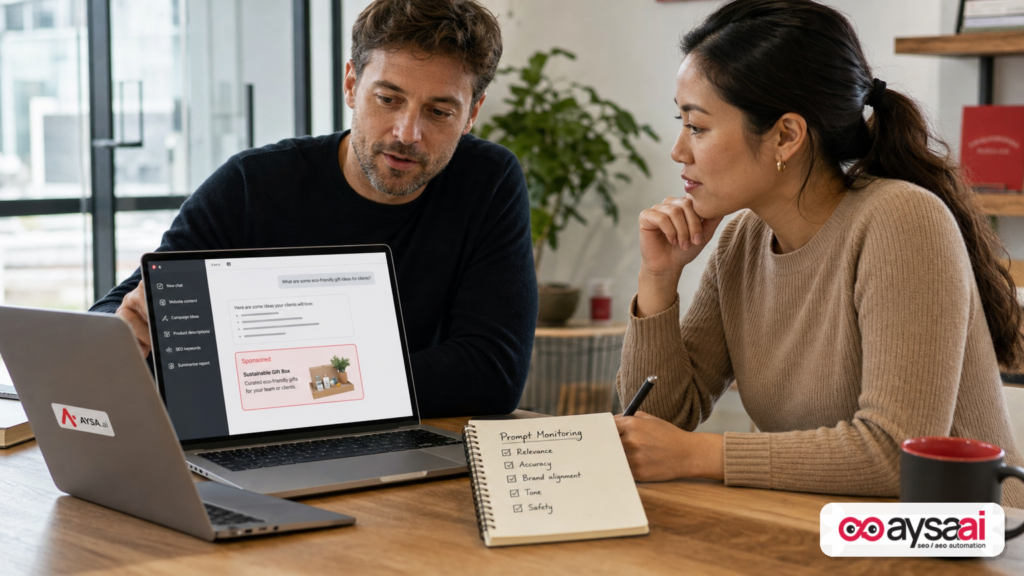
Search has been fragmenting for years—Google, TikTok, Reddit, marketplaces, “best of” lists. But 2026 is shaping up to be the year the fragmentation becomes operationally painful for businesses: ads are now showing directly inside AI answers, and your competitors can sit underneath the exact moment your buyer is deciding.
The uncomfortable part isn’t that ads exist. It’s that most teams can’t see them the way they can see Google Ads, Meta Ads, or even marketplace placements. No familiar ad library. No auction insights. No easy way to measure Share of Voice.
This editorial is a practical guide to fixing that—without hype, without pretending we have perfect data—and a roadmap for how to build a sustainable Monitoring + execution system using AYSA’s “prepare → approve → execute” model.
Concise summary
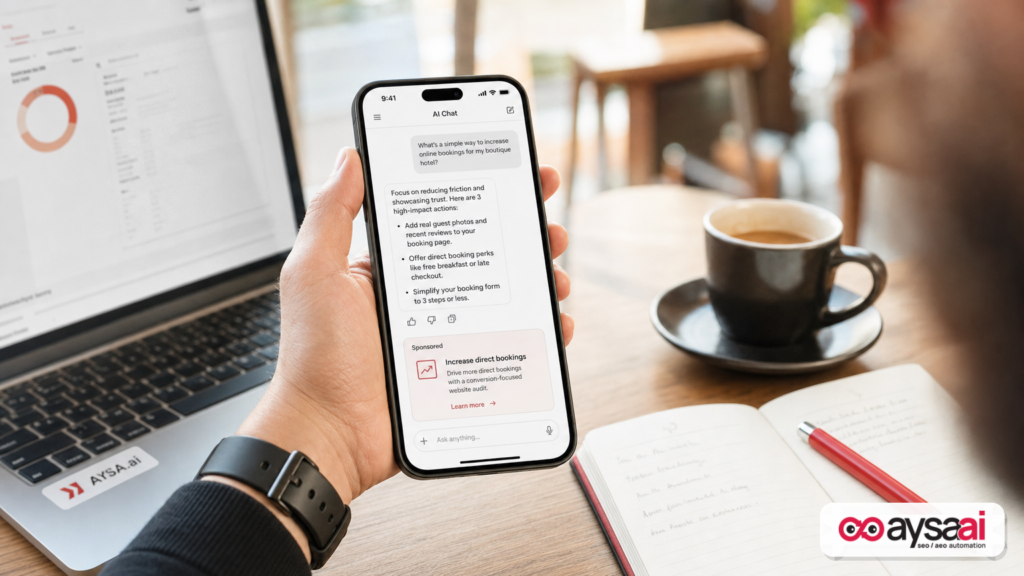
- Sponsored placements inside ChatGPT create a new paid channel where competitors can intercept high-intent demand at decision time.
- Because there isn’t a public “ad library” for ChatGPT placements (in the same way marketers expect from other platforms), you need a repeatable prompt-monitoring workflow to understand who’s showing up, how often, and with what positioning.
- The key metric isn’t “I saw an ad once.” It’s prompt-level share of voice over time.
- Monitoring alone is not a strategy. Winning requires fast Approved Execution across landing pages, product pages, comparison pages, and content built for AI citations and human conversion.
Key takeaways (what to do even if you skim)

- Build a prompt list from real buyer language (sales calls, support tickets, on-site search, PPC search terms)—not generic keywords.
- Run prompts repeatedly across time and capture the same fields every time (title, description, final URL, and frequency).
- Measure “share of voice” by prompt so you can separate a one-off impression from a competitor that actually “owns” a buying conversation.
- Respond with execution: tighten message match, strengthen comparison pages, improve conversion paths, and build content that earns AI citations so you aren’t only paying to be visible.
- Systemize the workflow with monitoring + approved execution so you’re not stuck in spreadsheet purgatory.
Table of contents
- What changed: ads inside ChatGPT moved from “rumor” to real distribution
- Why it matters: the buying moment just moved
- What sponsored placements look like (and why that matters for tracking)
- The visibility gap: no familiar ad library, no easy audit trail
- The new competitive unit: “prompt-level share of voice”
- A practical monitoring workflow you can run without an ad library
- What to monitor beyond ads: the organic AI answer layer
- SME scenario: the local clinic that loses “ready-to-book” patients without noticing
- What agencies should rethink (before clients ask why leads dropped)
- Common mistakes that waste time (and how to avoid them)
- Where AYSA fits: monitoring + approved execution for AI search reality
- What to do next (30/60/90-day plan)
- Sources and further reading
What changed: ads inside ChatGPT moved from “rumor” to real distribution
For years, “AI answers” were framed as an organic visibility topic: citations, Brand Mentions, and whether your content was being used as a source. Now we’re entering a new phase: the answer experience itself is a monetizable surface.
Search Engine Journal recently outlined a hands-on process for checking whether competitors are appearing as sponsored placements in ChatGPT answers—and the core point is blunt: if you’re not actively looking, you’re blind.
Reference (original source): Search Engine Journal — How To See If Competitors Are Advertising In Your Customers’ ChatGPT Answers.
From my perspective at AYSA: this is the same story we’ve watched play out in every channel shift. The early winners aren’t the teams with the fanciest dashboards. They’re the teams that build a repeatable monitoring habit and pair it with fast execution.
Why it matters: the buying moment just moved
If you run a local service business, ecommerce brand, or B2B SaaS, you already know the “money queries”:
- “Best [category] for [use case]”
- “[Brand] vs [Brand]”
- “Alternatives to [brand]”
- “Affordable [category] that integrates with [tool]”
Those used to be mostly Google moments. Increasingly, they’re conversational moments. And conversational doesn’t mean casual—many are deeply purchase-intent, because people feel comfortable including constraints:
- budget
- team size
- location
- timeline
- required integrations
That context makes ads more powerful, not less. If your competitor appears as the sponsored “next step” beneath the answer, they’re not just interrupting—they’re being presented as the action.
So this isn’t an SEO-only topic. It’s a revenue topic.
What sponsored placements look like (and why that matters for tracking)
In the SEJ walkthrough, sponsored placements are described as a distinct card below the AI answer, clearly labeled as sponsored, typically including:
- Advertiser name
- Short headline
- Brief description
- Destination URL
Two tracking implications matter for operators:
- Creative is compact. In small spaces, positioning becomes sharper. A single differentiator (“HIPAA-ready,” “same-day delivery,” “free trial,” “price match”) can win the click.
- Landing page strategy becomes visible. The final URL tells you whether competitors are sending people to a homepage, a Category page, a comparison page, or a “best for X” page—i.e., what stage of the funnel they’re optimizing for.
The visibility gap: no familiar ad library, no easy audit trail
Marketers are used to having some kind of institutional memory in ad platforms:
- Google Ads has Auction Insights and a mature ecosystem.
- Meta has a public Ad Library.
- Even many retail media networks offer basic competitive context.
In contrast, the SEJ walkthrough emphasizes that you can’t simply “search an ad library” to see all sponsored placements. You have to observe the market by running prompts and recording what appears.
This is exactly why a lot of teams will lose early: they’ll treat AI placements like a curiosity, check once, and move on. Meanwhile, competitors are iterating weekly.
The new competitive unit: “prompt-level share of voice”
Here’s the mindset shift: in AI answer environments, “Keyword rank” is less meaningful than “conversation ownership.”
In the SEJ framework, the most practical way to get there is to track a normalized metric: impression share by prompt over a sample window. Not because it’s perfect, but because it’s actionable:
- It separates “I saw Competitor A once” from “Competitor A shows up nearly half the time.”
- It helps you prioritize. If five prompts drive most of your close-won deals, you care about those prompts far more than generic ones.
- It gives you a baseline for testing. If you launch a new comparison page or change offer messaging, you can track whether your presence (paid and organic) improves across the same prompt set.
Important caution: because we’re relying on sampling, treat share-of-voice data like a decision input—not an absolute truth. The point is directionally correct competitive awareness, not courtroom-grade certainty.
A practical monitoring workflow you can run without an ad library
The SEJ article describes a manual workflow to uncover competitor advertising activity. Below is an expanded, operator-grade version you can hand to a marketing manager and actually run.
Step 1 — Build a buyer-true prompt map
If your prompt list is wrong, everything downstream is theater.
Start from evidence you already have:
- Paid Search query reports (your highest-converting queries)
- Top organic queries (especially “best,” “near me,” “pricing,” “alternatives,” “vs”)
- Sales call notes: what prospects ask before they buy
- Support tickets: “Can you do X?” often reveals the differentiators buyers care about
- On-site search logs: what visitors type once they’re on your site
- Reviews/Q&A: language used by real customers (and real objections)
Then rewrite those into conversational prompts. People don’t talk to ChatGPT like they search Google. They give context.
Prompt categories to include (aim for 30–50 prompts total):
- Direct comparisons: “[Brand A] vs [Brand B] for [use case]”
- Recommendations: “What’s the best [category] for [constraints]?”
- Switching: “Alternatives to [competitor] that do [feature]”
- Fit by segment: “Best [category] for a small team / enterprise / [industry]”
- Pricing intent: “Affordable [category] with [must-have]”
- Integration edge cases: “[category] that integrates with [tool stack]”
AYSA lens: this prompt map becomes your monitoring “contract.” If it’s stable, you can measure change. If it’s random, you can’t.
Step 2 — Run sessions like a sampler, not like a demo
The biggest mistake teams make is treating AI ad observation like a one-and-done test.
You need to sample repeatedly because outcomes can vary by:
- time of day
- session state (fresh vs repeated)
- user/account context
- auction rotation and ad testing
A practical baseline sampling plan:
- For each high-value prompt: run it 20–30 times across multiple days.
- Spread runs across mornings/afternoons/evenings (don’t batch everything in 10 minutes).
- Keep a simple log of when/where you ran it and what environment it was (at minimum, location and any relevant session notes).
This is operationally annoying—which is why most teams won’t do it. But if you’re serious about defending demand, you need the discipline until tooling catches up.
Step 3 — Capture the four fields that make competitor ads actionable
The SEJ walkthrough highlights four data points that turn “I saw something” into “I can act on this.” I agree with that framing. Here’s how I’d define them for a business team:
- Ad title (headline): Their positioning in one breath. Capture it exactly.
- Ad description: The proof point or offer. Capture the full text you see.
- Final URL: Where they want the click to land. Record the canonical page (and optionally the tracked URL in a second field).
- Impression share (calculated): How often they appear in your sample set for that prompt.
Add these operational fields too so the data is usable later:
- Prompt text
- Date/time
- Any session notes that could explain variation (e.g., location)
Why final URL is a strategic tell:
- If competitors send traffic to comparison pages, they’re confident in “vs” moments.
- If they send to category pages, they’re optimizing for general fit.
- If they send to the homepage, they may be early, lazy, or brand-led.
That URL pattern should influence what you build next on your own site.
Step 4 — Repeat to reveal the real winners (and the real risks)
If you don’t repeat, you’ll overreact to noise.
A cadence that tends to balance signal with sanity:
- Daily: top 5–10 “money prompts” closest to purchase
- Weekly: full 30–50 prompt list
- Monthly: trend review to see who’s gaining and who’s fading
What you’re looking for:
- New entrants: a competitor that suddenly appears across multiple prompts
- Creative iteration: frequent headline changes suggest aggressive testing
- Landing page shifts: URLs rotating toward comparison pages, pricing pages, or segment pages indicates where conversion is happening
What to monitor beyond ads: the organic AI answer layer
Paid placements are only half the story. The other half is whether the AI answer itself:
- mentions your brand (or not)
- frames your category in a way that helps/hurts you
- recommends criteria that you do/don’t match
- cites sources that you can influence (your site, partners, directories, reviews, forums)
This is where AEO/GEO work matters: improving the likelihood that your brand and your pages become the “default” reference points, so you aren’t forced to rent visibility forever.
If you’re building your 2026 plan, treat this as a dual track:
- Paid AI visibility: defend the bottom-of-funnel moments
- AI citations and brand presence: earn the top/mid-funnel moments and reduce reliance on paid
AYSA resources that align to this track (internal):
- AI search visibility (AEO/GEO) overview
- AI SEO tools for modern search workflows
- Monitoring: what to track and how to operationalize it
SME scenario: the local clinic that loses “ready-to-book” patients without noticing
Let’s make this real with a scenario I see constantly: a local clinic (or dental practice, physical therapy office, medspa, etc.) that relies on a mix of Google Ads + organic + referrals.
The situation: the clinic notices that phone calls are down 12–15% month over month. Nothing obvious changed in Google Ads CPCs. The website traffic looks stable. The team assumes it’s seasonality.
What’s actually happening (plausible, increasingly common):
- Prospects ask AI chat: “I’m new in town. What’s the best clinic for same-week appointments that takes [insurance]?”
- The AI answer gives general guidance… and then a competitor appears as the sponsored card below it with “Same-week appointments. New patient offer.”
- The click bypasses the clinic’s website entirely.
Why the clinic doesn’t see it in analytics:
- There’s no referral traffic because the click went to the competitor.
- Google Search Console won’t show it because it isn’t a Google search impression.
- GA4 won’t show it because the visit never occurred.
What the clinic should do in the next 30 days:
- Build a prompt list from real intake calls and FAQs (insurance, availability, location, specialty).
- Monitor those prompts on a weekly cadence and record sponsored placements.
- Create (or improve) service pages that match those intents (same-week availability, insurance info, new patient process) and make them easy to cite and easy to convert.
- Use an execution system so changes ship quickly and safely—because “we’ll update the site next quarter” is how you lose market share quietly.
What agencies should rethink (before clients ask why leads dropped)
If you run an agency, this shift changes two uncomfortable realities:
1) Your reporting stack may be incomplete by default
Most client reporting revolves around:
- Google Ads / Microsoft Ads
- Search Console
- GA4
- Rank tracking
None of those inherently answer: “Are competitors buying sponsored placement underneath AI answers for our money prompts?”
So when leads dip, you can be correct about every metric you track—and still wrong about the cause.
2) Execution speed becomes a competitive advantage again
AI-era paid + organic is a tighter feedback loop. If you observe that competitors are:
- pushing “alternatives” pages
- leading with compliance claims
- sending traffic to segmented landing pages
…you need to be able to respond in weeks, not quarters.
This is where an approved execution system matters. AYSA’s orientation—monitor, prepare changes, request approval, then execute accepted updates—fits the agency reality where stakeholders need control but also need speed.
AYSA internal references for agencies and operators:
Common mistakes that waste time (and how to avoid them)
Mistake 1: Treating prompts like keywords
Prompts are conversations. Your prompt list should include constraints (budget, location, compliance, integrations). Otherwise you’re monitoring a world your buyers aren’t living in.
Mistake 2: Running everything once
A single run is a screenshot, not intelligence. You need repeated sampling to see rotation and true competitive presence.
Mistake 3: Capturing only “who showed up”
You also need the message and the final URL. That’s where strategy is hiding.
Mistake 4: Separating paid monitoring from website execution
Monitoring without execution turns into busywork. The moment you see a competitor sending traffic to a comparison page you don’t have, you’ve discovered a content and conversion gap—not just an ad fact.
Mistake 5: Assuming “AI visibility” is purely SEO
In practice, AI visibility is a blend of:
- paid placements (capture the click)
- organic/citation presence (shape the answer)
- landing page conversion (close the deal)
Where AYSA fits: monitoring + approved execution for AI search reality
At AYSA, we think most businesses don’t have a strategy problem—they have an execution and feedback-loop problem.
When a new surface like ChatGPT sponsored cards emerges, the winners are the teams that can:
- Detect what’s changing (who’s showing up, where, and how often)
- Decide what it means (which prompts are revenue-critical, which competitor messages are resonating)
- Deploy changes safely (landing pages, content, internal links, schema, messaging, conversions)
- Repeat (because the market iterates weekly)
AYSA is built to support this cycle as an execution system: it monitors, prepares recommended site changes, asks for approval, then executes the accepted updates—so you can move fast without losing control.
Relevant AYSA links (internal):
- Monitoring (what to track across AI and search)
- AI search visibility (AEO/GEO) foundation
- AI SEO tools and workflows
- Pricing (for planning and procurement)
- Blog (more operator playbooks)
What AYSA is not: a magical replacement for marketing strategy. You still decide which prompts matter, what your differentiators are, and what offers you can support operationally. But once you decide, execution speed is the moat—and AYSA is built for that.
What to do next (30/60/90-day plan)
Next 7 days: set the baseline
- Pick a category focus (one product line, one service line, or one location cluster).
- Build a first prompt list of 30–50 prompts from real buyer language.
- Create a simple tracking sheet with consistent fields (prompt, advertiser, title, description, final URL, date/time, notes).
Next 30 days: measure and prioritize
- Run sampling on your top 5–10 money prompts frequently enough to see rotation.
- Calculate prompt-level impression share from your samples.
- Identify the top 2–3 competitor positioning themes (price, compliance, speed, quality, niche fit).
Next 60 days: build the response assets
- Create or improve comparison and alternatives pages where you see competitor pressure.
- Align landing pages to the exact “job to be done” implied by the prompt.
- Make conversion paths frictionless (clear next step, fast contact, transparent pricing signals where possible).
Next 90 days: systemize and compound
- Turn monitoring into a recurring cadence (weekly full list, daily money prompts if possible).
- Roll insights into both paid strategy and organic AI citation strategy.
- Adopt an execution system (like AYSA) so changes ship continuously with approval controls.
What to do next (checklist)
- Decide your money prompts: the 5–10 conversations that correlate with real revenue.
- Start sampling: run those prompts across multiple days and record sponsored cards.
- Extract competitor strategy: note headline themes and final URLs.
- Patch the site gaps: build the pages competitors are using to convert (comparison, segment, pricing, integrations) and make them genuinely helpful.
- Operationalize: assign an owner, a cadence, and a tool/process to avoid “we’ll get to it later.”
Sources and further reading
- Search Engine Journal: How To See If Competitors Are Advertising In Your Customers’ ChatGPT Answers
- Search Engine Journal: Latest marketing and search news (context and ongoing coverage)
- Search Engine Journal: SEO coverage
- Search Engine Journal: PPC news
- AYSA: AI search visibility (AEO/GEO) overview
- AYSA: Monitoring
- AYSA: AI SEO tools
- AYSA Blog
Note on sourcing: This editorial is based on the provided SEJ source and general operational marketing principles. Where platform-specific details require official documentation, we’ve avoided inventing specifics beyond what’s described in the cited source.
Continue the AI search topic inside AYSA.
Use these pages to connect the article with AI SEO tools, AI visibility monitoring, AI Overviews and approved website execution.
Turn this topic into a website action plan.
Use these AYSA hubs to move from reading to technical fixes, AI visibility monitoring, research, glossary context and approval-first SEO execution.