
The New Business Visibility Problem: When Google’s AI Completes the Journey Without You
Google’s agentic demos point to a future where search doesn’t just recommend— it books, buys, and completes tasks. The visibility challenge for businesses is no longer “rank and get the click,” it’s “be selected, be trusted, and be measurable” inside AI-mediated flows.

Google’s latest AI demos didn’t just show smarter answers. They showed something more disruptive: search experiences that finish the job—adding items to carts, booking appointments, Monitoring listings, and returning with a decision.
For consumers, that’s frictionless. For businesses, it’s a new kind of uncertainty: if the journey happens inside an AI layer, how do you get discovered, how do you influence selection, and how do you measure performance when fewer people ever reach your site?
This editorial is my practical take as Marius Dosinescu, writing for AYSA.ai. The core argument is simple: the “visibility problem” is no longer only about rankings and Clicks. It’s about whether your business can be understood, trusted, selected, and measured in agent-mediated journeys—across search, maps-like flows, shopping surfaces, and whatever replaces them next.
Concise summary
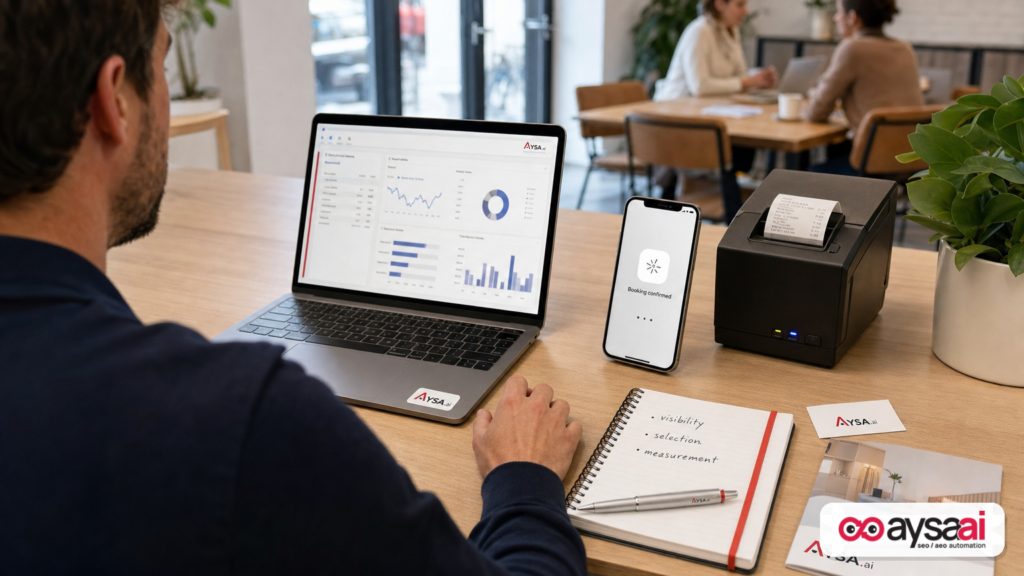
- What changed: Google is pushing search toward task completion (buy, book, schedule, compare) through AI features that keep the user inside Google surfaces longer.
- Why it matters: Businesses risk losing “visibility” without losing rankings—because the decision may happen before a click.
- What to do: Treat product/service data quality, operational readiness, and entity consistency as your new “SEO basics.” Build content for reasoning (not just keywords). Upgrade measurement around “visibility > clicks.”
- Where AYSA fits: You need a system that monitors, prepares changes, asks for approval, and then executes accepted improvements across your site—continuously.
Key takeaways (read this if you only have 3 minutes)

- Clicks are no longer the only proof of visibility. AI agents can evaluate, compare, and choose without sending you traffic.
- Selection replaces ranking in the final mile. Your job is to become the “safe default” for an agent to recommend.
- Your product/service data is now marketing. Accurate attributes, pricing, availability, policies, and clarity become eligibility signals.
- Operational readiness becomes a visibility factor for local businesses. If an AI calls to book and your team can’t answer fast and consistently, you can lose the customer before they ever see your site.
- Measurement will lag reality. The market will spend years arguing about Attribution; meanwhile, businesses must build for resilience and multi-surface visibility.
Table of contents

- What Google I/O signaled (and what it didn’t)
- What changed: search is becoming an agent manager, not a link list
- The new visibility stack: from ranking to being selected
- Why business visibility breaks when the journey is completed in-platform
- Ecommerce: merchants may “own the transaction,” but not the discovery
- Local & service businesses: readiness becomes ranking
- Measurement: visibility > clicks (and what to track anyway)
- What can go wrong: 10 failure modes businesses should expect
- A concrete SME scenario: “Why did bookings drop when rankings didn’t?”
- What agencies and in-house teams must rethink
- A practical 90-day action plan
- Where AYSA.ai fits: approved execution for AI-era visibility
- What to do next
- Sources and further reading
What Google I/O signaled (and what it didn’t)
The Search Engine Journal coverage that sparked this conversation highlights a pattern across Google’s demos: many experiences end in a transaction, a booking, or task completion—clean consumer journeys with messy implications for business visibility.
That’s the heart of the new problem:
- The consumer path is increasingly clear: ask → delegate → confirm → done.
- The business path is increasingly unclear: how do I become the chosen option—and how do I even know I was considered?
From the coverage, examples include concepts like a universal cart experience, agentic booking for local services, and “information agents” that monitor things in the background and report back with a recommendation. Even if the specific product names evolve, the strategic direction is consistent: Google wants to reduce the steps between intent and completion.
Read the original reporting here (used as research input, not reproduced): Search Engine Journal: Google’s I/O Demos Reveal The New Business Visibility Problem.
What Google did not show (at least not in a way businesses can act on) is equally important:
- Clear selection criteria for recommendations inside these agentic flows
- Clear reporting that distinguishes “not eligible,” “considered,” and “rejected”
- A durable measurement model for agent-mediated decision paths
That gap is where anxiety grows—and where smart operators will build an advantage, because uncertainty creates opportunity for disciplined execution.
What changed: search is becoming an agent manager, not a link list
Historically, search worked like a directory with an auction attached:
- You publish pages.
- Google ranks them.
- The user clicks, compares, and decides.
In an agentic model, the shape changes:
- The user states a goal (“find me the best option under these constraints”).
- The AI agent translates that into sub-tasks (filters, comparisons, checks).
- The agent may complete the task (book, buy, schedule, message) with minimal user involvement.
Even in the most “open” version of this, the agent becomes the primary consumer of your marketing. It’s not that humans disappear—humans still set preferences and confirm decisions—but the evaluation layer becomes machine-mediated.
In the SEJ piece, Sundar Pichai is described as characterizing search as an “agent manager” in a conversation with Stripe’s Patrick Collison. I can’t independently verify the exact phrasing beyond the provided context, but the direction is consistent with what we’ve been observing: search is positioning itself as orchestration for tasks, not just retrieval for documents.
This matters because marketing playbooks were built around human browsing behavior—ten blue links, tab hoarding, comparison shopping on multiple sites. The new demos were built for a different user: someone who delegates and waits for a result.
The new visibility stack: from ranking to being selected
In classic SEO, “visibility” often meant:
- Impressions
- Rankings
- Clicks
- Sessions
- Conversions
In AI-mediated journeys, a business can lose share without obvious changes in those metrics, because selection may occur before a click.
So the stack expands. You still need to rank, but you also need to be:
- Eligible: the agent can access your offer (inventory/availability/pricing/policies are clear enough).
- Comparable: your attributes map cleanly against other options.
- Trustworthy: the agent can justify choosing you (quality signals, policy clarity, consistency).
- Actionable: the agent can complete the next step (checkout, booking, contact) with low friction.
- Measurable (at least partially): you can detect changes in outcomes even if attribution is imperfect.
This is the uncomfortable shift: visibility is becoming a property of systems, not just pages. Your website, your feeds, your policies, your customer support responsiveness, your Structured data, and your operational consistency all become part of what the agent “sees.”
In other words, “SEO” blends into what I’d call digital operational excellence.
AEO/GEO isn’t a buzzword—if you define it correctly
People throw around AEO (Answer Engine Optimization) and GEO (Generative Engine Optimization) like they’re separate from SEO. Practically, they are extensions of the same goal: make your business the best source for a system to answer with confidence.
But the execution focus changes:
- Less: “How do I stuff this keyword into the H1?”
- More: “How do I make my offering unambiguous, verifiable, and easy to choose?”
That demands better data, better content design, and better monitoring—not just more blog posts.
Why business visibility breaks when the journey is completed in-platform
Let’s name the economic reality plainly: when a platform carries the user through the journey, it can capture more of the value chain—even if it still “sends” the transaction to the merchant at the end.
In the SEJ reporting, one concern is that merchants may still be the merchant of record, yet lose ownership over discovery and intent data. That’s a meaningful distinction.
Here’s why the visibility problem emerges:
1) Less exposure to your brand narrative
If the user never reaches your site, they don’t see your differentiators: your craftsmanship story, your clinical approach, your guarantees, your comparison charts, your FAQs, your before/after work.
That’s not just a branding issue. It’s a conversion control issue. Your site has historically been where you reduced uncertainty. If uncertainty is reduced upstream by an AI summary or agent recommendation, you must influence that layer.
2) Fewer first-party data signals
Sites generate data: what products users viewed, which FAQs they read, which policies they checked, what made them hesitate. If an AI layer does that work, you may lose behavioral insights.
This will pressure businesses to invest in:
- Better product/service data systems
- Cleaner event tracking where possible
- Stronger CRM/lead intelligence
3) More opaque competition
In classic SEO, you can see who ranks above you. In an agent flow, you may only see the outcome: fewer orders, fewer calls, fewer bookings. The “why” becomes harder to observe.
This is not hypothetical. Even today, many businesses can’t answer basic questions like:
- Are we losing because we’re not being shown—or because we’re being shown but not chosen?
- Is it a content issue, a pricing issue, an availability issue, or a trust issue?
4) Higher velocity changes
When selection is software-driven, small differences (data freshness, policy clarity, response time, attribute completeness) can cause large swings. And because it’s automated, those swings can happen quickly.
The SEJ piece frames the “adaptation window” as potentially shorter than prior platform shifts. That aligns with what I’m seeing: you cannot wait for a yearly site refresh to keep up.
Ecommerce: merchants may “own the transaction,” but not the discovery
Ecommerce businesses are used to fighting for:
- Top-of-funnel visibility (SEO, paid search, social)
- Mid-funnel persuasion (landing pages, reviews, email)
- Bottom-of-funnel conversion (checkout UX, trust badges, returns)
Agentic commerce compresses those stages.
In the SEJ reporting, there’s mention of Google positioning an open standard for agentic commerce and surfacing features like a persistent cart across Google surfaces. I’m not going to over-speculate on exact implementation details, but the business implication is clear: your catalog becomes an interface and your checkout becomes an endpoint.
The new ecommerce eligibility checklist
If you sell online, expect AI-driven shopping flows to increasingly rely on “structured reality”:
- Accurate price and availability (including variants)
- Clear shipping costs and timelines (by region, thresholds, carriers)
- Return policy clarity (windows, conditions, fees)
- Trust signals (reviews, guarantees, business details)
- Rich attributes that make comparison possible (materials, compatibility, sizing, certifications)
These are not “SEO extras.” They are what allows a system to confidently compare you against alternatives.
Content for reasoning, not just ranking
One of the most common ecommerce mistakes in the AI era is thinking “we need more content around products” (as if content volume alone creates trust). Aleyda Solís is referenced in the SEJ piece as emphasizing that ecommerce SEO and AI optimization can’t be reduced to content around products. The bigger point I agree with: you need content and data that answer the agent’s decision criteria.
Examples of “reasoning-ready” content:
- Compatibility guides (what fits what, what won’t fit, and why)
- Comparison tables that reflect real choice factors (not marketing fluff)
- Maintenance and lifecycle content (durability, warranty, repairability)
- Transparent policies written in plain English
When an agent tries to justify a recommendation, this kind of content becomes quotable, paraphrasable, and defensible.
Your feeds are the new front page
Most SMEs still treat feeds and structured product data like a “technical requirement” delegated to a developer or marketplace ops person.
That mindset is outdated. In an AI-mediated shopping world, your feed is often the first and most consistent description of your offer.
Practically, that means:
- Audit attribute completeness and consistency across variants.
- Resolve mismatches between on-site copy and structured data.
- Ensure policy pages align with what your data claims.
If you’re wrong—or just unclear—you may not be “penalized” in the old sense. You may simply become non-preferred.
Local & service businesses: readiness becomes ranking
Local businesses are entering the agent era from a different angle. The “transaction” is often a call, an appointment, a reservation, or a quote—not a cart checkout.
The SEJ piece describes Google features that consolidate pricing/availability and even place calls on behalf of users in certain categories. The detail that should wake up every service operator is this: your operational readiness can become the deciding factor.
When the agent calls, disorganization becomes disqualification
If a user asks an agent to “book me a haircut at 4pm near me under $60,” the system will likely prioritize places where it can quickly confirm price and availability.
If your business is:
- slow to answer the phone,
- inconsistent with pricing,
- unclear about services,
- or unable to confirm availability,
…the agent may move on before a human ever sees your website.
This aligns with the SEJ-cited perspective that agentic booking turns “readiness” into a visibility factor. That’s a powerful way to describe it.
Local visibility becomes ops + marketing
Local SEO used to be mainly about:
- your Google Business Profile basics,
- citations,
- reviews,
- service pages,
- and proximity/relevance.
All of that still matters. But the agent layer adds “bookability” and “confirmability”:
- Are your service menus structured and current?
- Can a system understand your pricing rules?
- Is availability accessible in a standard way?
- Is staff trained to answer quickly and consistently?
If you’re a multi-location business, multiply this by every location. Consistency becomes strategy.
Local content that actually helps agents
Most local sites have thin “Service + City” pages. In an AI era, those pages need to do more than rank; they need to reduce uncertainty.
Practical upgrades that help both humans and agents:
- Transparent price ranges and what changes the price
- Service area maps and boundaries
- Scheduling expectations (same-day, lead times, emergency fees)
- Credential details (licenses, insurance, practitioner qualifications)
- Clear intake steps (“what to bring,” “how long it takes,” “who it’s for”)
Measurement: visibility > clicks (and what to track anyway)
The SEJ piece quotes the idea that we’re moving toward “visibility > clicks.” I agree—but you still need measurement discipline, or you’ll drift into superstition.
Here’s the realistic approach: accept that perfect attribution may decline, but don’t accept measurement chaos.
What still works (and becomes more valuable)
- Revenue and margin by channel (even if channel definitions evolve)
- Lead quality metrics (close rate, average order value, time-to-close)
- Branded demand indicators (brand search trends in your own tools, direct inquiries)
- Operational conversion metrics (missed calls, response time, booking completion)
New proxy metrics you should start using
If you can’t measure “the agent considered us,” measure the things that correlate with being chosen:
- Offer completeness: attribute fill rates, policy completeness, content coverage on key decision questions
- Consistency: mismatches between site copy, structured data, and listings (pricing, hours, services)
- Freshness: how quickly changes propagate across your site
- Readiness: response time, appointment confirmation rate, quote turnaround
A warning about overreacting to traffic drops
In the past, a traffic drop often meant a visibility drop. In AI search, it can mean:
- users got the answer without clicking (still a form of visibility),
- users clicked less but converted more efficiently via a different path,
- or you’re being skipped entirely.
These scenarios require different actions. This is why monitoring must become more granular than “sessions up/down.”
What can go wrong: 10 failure modes businesses should expect
When the world shifts from “rank my page” to “select my business,” failure modes look different. Here are ten that I expect SMEs to encounter repeatedly.
1) Your offer is not machine-readable
Pricing rules buried in a PDF. Service menus only in images. Product compatibility described vaguely. An agent can’t confidently compare, so it avoids risk.
2) Your data is inconsistent across surfaces
Your site says one thing, a listing says another, and reviews suggest a third. Inconsistency is selection poison.
3) Your policies are unclear, so you lose on “safety”
Agents will prefer options with predictable returns, warranties, cancellation policies, and clear terms.
4) Your availability is opaque
If availability can’t be confirmed quickly, your business becomes “high effort.”
5) Your content is persuasive but not precise
Flowery copy without specifics may convert humans—but agents need specifics: dimensions, timelines, criteria, exclusions.
6) You optimize pages while ignoring the system
Great blog content, but broken internal linking, poor page templates, missing structured data, slow update cycles.
7) Your customer support becomes your marketing
In local/service categories, the agent’s “moment of truth” is often a call or a message. If your team can’t answer, you’re invisible.
8) You mistake “presence” for “preference”
Being listed is not the same as being recommended. You must become the default choice within constraints.
9) You don’t notice you’re losing until it’s expensive
Attribution lags. By the time revenue drops are obvious, recovery requires paid spend or discounting.
10) You treat AI visibility as a one-time project
Agentic systems reward freshness and consistency. This is continuous improvement work, not a quarterly sprint.
A concrete SME scenario: “Why did bookings drop when rankings didn’t?”
Let’s make this real with a scenario I’ve seen variations of across local services.
The business
A mid-sized dental clinic (or any appointment-based business: med spa, PT clinic, home services) relies on local visibility. They rank well for key terms like “teeth whitening near me” and “dentist open Saturday.” Traffic looks stable. Rankings look stable.
The problem
Bookings drop 18% over six weeks. The owner blames competition or seasonality. The marketer blames Google updates. Nobody has a clean answer.
What actually happened (plausible agentic explanation)
- More users start using AI-style search to ask: “Find me a Saturday appointment under $X with great reviews and no surprise fees.”
- The AI flow prioritizes clinics with clear service pricing ranges and appointment availability that can be confirmed quickly.
- This clinic’s pricing is vague (“call for pricing”), and staff often send calls to voicemail during lunch.
- Even though the clinic still ranks well, it gets skipped in the new decision layer.
The fix isn’t “more SEO content”
The fix is operational + digital clarity:
- Publish clear price ranges and what affects price.
- Standardize call handling and add overflow coverage.
- Make appointment request flows faster and reduce back-and-forth.
- Ensure service pages answer the agent’s constraints (timelines, eligibility, anesthesia, aftercare, cancellation policy).
None of these are “AI gimmicks.” They are fundamentals that become decisive when an agent is trying to complete a task with minimal uncertainty.
What agencies and in-house teams must rethink
If you sell SEO as a deliverable list—“X blog posts, Y backlinks, Z technical fixes”—this shift will break your model.
Because the new goal isn’t just ranking. It’s being chosen under constraints.
Move from keyword plans to decision plans
Keywords still matter, but they’re no longer the best organizing principle. Decision criteria are.
Instead of building content around “best running shoes,” build around:
- foot type, injury history, surface, mileage, stability needs
- return policy, delivery speed, sizing reliability
- comparison of models with tradeoffs
That’s what an agent uses to make a recommendation that feels responsible.
Move from page optimization to system optimization
System optimization includes:
- templates that consistently expose key facts,
- structured data (where appropriate) that aligns with visible content,
- internal linking that helps both crawlers and users reach decision content,
- policies and trust elements that reduce perceived risk.
Execution speed becomes a competitive moat
The teams that win won’t just know what to do—they’ll ship improvements weekly.
That’s why “approved execution” matters: your stakeholders need governance, but you can’t afford a three-month ticket backlog. (More on AYSA’s approach below.)
A practical 90-day action plan
Below is a pragmatic plan for SMEs and lean teams. This is not theory; it’s designed to reduce risk while building durable visibility in AI-mediated search flows.
Days 1–15: Establish your visibility baseline (beyond clicks)
- Document your current funnel: top landing pages, top converting pages, top lead sources.
- List your “decision points”: what customers must believe to buy/book (price certainty, speed, trust, fit).
- Inventory your core entities: brand, locations, products/services, key people (for trust), policies.
- Identify your risk surfaces: places where mismatches occur (hours, pricing, availability, service names).
Days 16–45: Make your offer machine-credible
- Fix offer clarity: publish pricing ranges, define exclusions, clarify timelines.
- Upgrade your decision content: comparison pages, FAQs, eligibility criteria, compatibility guides.
- Standardize templates: ensure every product/service page includes the same core facts.
- Align structured data with visible content (don’t add markup that contradicts the page).
Days 46–75: Improve readiness and friction removal
- Speed up response: calls, forms, chat—set internal SLAs and coverage plans.
- Reduce back-and-forth: better intake forms, clearer prerequisites, transparent next steps.
- Strengthen trust: policies, guarantees, credentials, review acquisition processes.
Days 76–90: Build the monitoring loop
- Monitor key pages for content drift and policy mismatches.
- Track conversion proxies: lead quality, response times, booking completions.
- Run a monthly “agent readiness” audit: what would a system need to recommend you confidently?
At the end of 90 days, your goal is not to “beat AI.” It’s to become the most complete, consistent, low-risk option for AI systems to select.
Where AYSA.ai fits: approved execution for AI-era visibility
This is the part most articles skip: knowing what to do is not the same as doing it—especially for SMEs.
AI-era visibility demands ongoing, system-level improvements across content, technical SEO, and operational clarity. But most businesses face constraints:
- Limited internal time
- Slow dev cycles
- Approval requirements (legal, compliance, brand)
- Too many moving parts to monitor manually
AYSA is built for exactly this execution gap:
- Monitors your site and visibility signals continuously (AYSA Monitoring).
- Prepares improvements (content upgrades, technical fixes, clarity enhancements) with business context.
- Asks for approval before changes go live—so you keep governance.
- Executes accepted changes so you don’t get stuck in a backlog.
That “approved execution” model matters more now because the market is shifting faster than traditional quarterly SEO cycles.
How SMEs use AYSA in this new visibility landscape
- Ecommerce: keep product and policy content consistent, expand decision FAQs, strengthen internal linking to comparison content, and continuously improve pages so they remain “selection-ready.” Start here: AI SEO Tools.
- Local services: improve service page clarity (pricing ranges, timelines, prerequisites), tighten location consistency, and reduce friction in lead capture. Learn more: AI Search Visibility.
- Lean marketing teams: maintain an always-on backlog of prioritized fixes and content upgrades without drowning in tickets.
What AYSA is not
AYSA is not a magic “rank me #1” button. Nobody credible can promise that—especially as AI surfaces evolve. AYSA is an execution system that helps you ship the improvements that make you more likely to be understood, trusted, and selected, while keeping humans in control via approvals.
If you want to evaluate fit quickly, pricing is here: AYSA Pricing. If you want more practical playbooks, browse the AYSA blog: AYSA Blog.
What to do next
- Pick one revenue-critical journey (one product category or one service line) and map the decision criteria a customer uses.
- Audit your offer clarity: pricing ranges, availability, shipping/returns, cancellation terms, prerequisites—make them explicit.
- Upgrade your “reasoning content”: comparisons, compatibility, FAQs that answer tradeoffs.
- Fix operational readiness (local/service): response times, booking confirmation process, voicemail fallback.
- Set monitoring for drift and mismatches so you don’t regress.
- Adopt an execution system that can ship improvements weekly with approvals—this is where AYSA can help: AYSA Monitoring.
Sources and further reading
- Search Engine Journal – Google’s I/O Demos Reveal The New Business Visibility Problem
- Search Engine Journal – SEO section (additional context and related reporting)
- Search Engine Journal – News (ongoing platform updates context)
Note on sourcing: The research input references concepts like “Universal Cart,” an “agent manager” framing, and an “open standard” for agentic commerce. I’ve treated those as directional signals based on the provided source context. For implementation-level decisions, always cross-check with official Google documentation and product announcements as they become available.
If you want to operationalize this shift rather than debate it, start with a monitoring-and-execution loop: AYSA AI Search Visibility and AYSA AI SEO Tools.
Continue the AI search topic inside AYSA.
Use these pages to connect the article with AI SEO tools, AI visibility monitoring, AI Overviews and approved website execution.
Turn this topic into a website action plan.
Use these AYSA hubs to move from reading to technical fixes, AI visibility monitoring, research, glossary context and approval-first SEO execution.

