Paid Search After 20 Years: Why AI Won’t Replace Great Marketers (But It Will Replace Button-Pushers)
PPC has evolved from manual bids and affiliate arbitrage to automated auctions and AI-assisted creative. The next era won’t reward people who “know the interface.” It will reward teams that understand customers, economics, and experimentation—and can execute fast with guardrails.

PPC didn’t die. It grew up.
Over the last two decades, paid search has moved from “buy some Clicks” to “operate a real-time market for attention,” where the winners aren’t the people who know which button to press—but the people who can consistently translate customer psychology into offers, creative, and landing experiences that convert profitably.
That’s the core thread I pulled from Brad Geddes’ reflections on the evolution of paid search, published by Search Engine Land. Geddes has been around since the earliest days (SEO in the mid-90s, paid search by the late 90s), and his take is refreshingly unsentimental: automation is real, AI is real, but the job is not becoming less human. It’s becoming more human where it counts.
I’m Marius Dosinescu, and my perspective at AYSA.ai is straightforward: businesses don’t lose because they lack tools. They lose because they can’t turn insight into execution fast enough—especially when platforms change, SERPs change, and AI introduces both leverage and risk. The next 20 years of paid search will reward teams who build an operating system, not a collection of tactics.
Concise summary
- PPC evolved from manual bidding and affiliate arbitrage into a system that rewards better user experiences, better measurement, and better creative.
- Automation is a productivity unlock, not a strategy. It frees time—but it also hides mistakes faster if your inputs (offers, tracking, landing pages) are weak.
- AI won’t “run your account” safely on its own. It can generate options and patterns; it can’t own your business constraints, brand risk, or real-world customer nuance.
- Search is changing around the ad unit (AI Overviews, AI Mode, conversational ad experiences). Paid and organic are converging into one buyer journey.
- SMEs win with a simple operating system: margin-aware goals, clean tracking, structured experiments, creative cadence, and landing page iteration.
- AYSA fits as an execution layer that monitors, prepares changes, asks for approval, and executes accepted website changes—closing the gap between insight and action.
Table of contents
- Why this matters now: ads are changing, search is changing, buyer behavior is changing
- The arc of PPC: from paying for clicks to designing experiences
- How Google became the default—and why that history still matters
- Turning points that permanently changed PPC (and what they taught us)
- Control, clarity, and the myth of “set it and forget it”
- What to stop romanticizing (SKAGs) and what to miss (useful constraints)
- Automation changed the job. AI will change the definition of “good.”
- Why human creativity remains the moat (even with AI everywhere)
- The SERP is being rewritten: AI Overviews, AI Mode, and “ads as conversations”
- Measurement reality: what most advertisers still get wrong
- A concrete SME scenario: the $200/day Google Ads account that either prints money or burns it
- What agencies must rethink (and what clients should demand)
- A practical action plan for modern paid search teams
- Where AYSA fits: approved execution for the parts marketers neglect
- What to do next
- Sources and further reading
Why this matters now: ads are changing, search is changing, buyer behavior is changing
The classic paid search story is linear:
- Someone searches.
- You show up.
- You pay for the click.
- Your website converts.
That story still happens every day. But it’s no longer the whole movie.
Three forces are colliding:
- Search results are being compressed. Search experiences increasingly summarize, answer, and shortlist before the user ever reaches a website.
- Ads are becoming more assistive. Google and others are pushing toward ad experiences that feel more like guided interactions than a simple “headline + link.” Search Engine Land framed this shift well in: Google’s latest AI ad push shows ads are becoming conversations, not clicks.
- Marketing teams are being asked to operate with less certainty. Between automation, privacy constraints, shifting Attribution, and new SERP layouts, many “old reliable” levers are softer than they used to be.
That’s why the comforting myth is so attractive: “AI will run it.” But that’s also why Geddes’ warning lands: just as you shouldn’t blindly hit “accept all” on auto-applied recommendations, you shouldn’t hand total control to AI systems whose incentives don’t perfectly match your business.
My opinion: if you treat AI as an autopilot, you will eventually fly into a mountain. If you treat AI as a production system—one that needs guardrails, measurement, and approvals—you can move faster than competitors without taking reckless brand and profit risk.
The arc of PPC: from paying for clicks to designing experiences

Geddes points to the 1998 launch of Goto.com (Bill Gross) as the real “PPC moment”—because it put a financial value on the click, not just the impression. That subtle difference created a mindset shift: marketing could be managed like a market.
But that’s only chapter one. PPC didn’t remain a bid-and-pray channel. Over time, the job migrated up the stack:
- From buying attention → to earning attention. Quality and relevance (to users, not just platforms) became a sustainable advantage.
- From keywords → to intent. Even if the Keyword list exists, the real question is: what job is the user trying to get done, and what outcome do they want?
- From ad copy → to end-to-end persuasion. Ads still matter, but landing pages, proof, pricing psychology, and friction removal often decide the outcome.
- From manual work → to system design. Once bidding automates, your leverage comes from shaping the inputs and designing experiments.
If you’re an SME, this is the most important reframing: you’re not “running Google Ads.” You’re running a customer acquisition system that uses Google Ads as one engine.
How Google became the default—and why that history still matters
One of the best reminders in Geddes’ timeline is that Google wasn’t instantly the unquestioned king of paid search. He notes that Google didn’t feel like the accepted industry leader until around 2006–2007, and advertisers initially disliked the complexity.
What changed? Google’s search experience drew the traffic. Advertisers followed the attention.
Why should you care about that history in 2026 and beyond?
- Because platform friction is recurring. Every time Google introduces new campaign types, shifts controls into automation, or changes how visibility works, the industry repeats the same cycle: confusion → resistance → adaptation → normalization.
- Because dominance changes incentives. When a platform is the default, its roadmap becomes your roadmap unless you intentionally diversify and build resilience.
- Because culture changes performance. Geddes recalls earlier “Wild West” days where information sharing was easier and NDAs were fewer. Today, you have more tools, but often less transparency and less peer learning.
So the practical takeaway isn’t “fear Google.” It’s: build a marketing operating system that assumes the ground will move—and that your job is to keep the business stable while the environment shifts.
Turning points that permanently changed PPC (and what they taught us)
Geddes highlighted two major turning points that changed PPC forever: organic complexity forcing specialization, and automated bidding changing the work. I’ll expand those and add the business lesson behind each.
Turning point 1: Organic got harder, and specialization became inevitable
When major algorithm updates made SEO dramatically more complex (Geddes references updates like Panda, Penguin, and Pigeon), many marketers had to stop being generalists. You could still “do both,” but it became harder to be world-class in both without a real team.
Even if you’re primarily paid-focused, this matters because the click does not exist in isolation. PPC performance depends on the site:
- Landing page quality influences conversion rates, which influences how much you can afford to pay per click.
- Brand verification journeys are real. Users often click an ad, then go search your brand name, read reviews, and compare alternatives. A weak organic presence can lower conversion rates.
- Content depth builds trust. Many purchases (health, finance, B2B software, home services) require more than a catchy headline.
That’s why, even in a “paid search” conversation, you should care about execution across the site: content, technical quality, and credibility.
Turning point 2: Automated bidding freed time—and raised the bar
Before modern automation, bidding was an Excel grind. Geddes describes the tedious “transient” work of adjusting bids with formulas and spreadsheets.
Automation removed that labor. Good. But it also changed what “good work” looks like:
- Input quality became the bottleneck: Conversion tracking, values, offline signals (when available), and clean measurement.
- Offer quality became the differentiator: pricing, bundles, guarantees, shipping policies, financing, scheduling availability.
- Creative quality became the competitive edge: the same algorithm can promote very different messages; your message must be specific and believable.
- Page quality became decisive: speed, clarity, proof, and friction removal make the difference between “expensive traffic” and “profitable growth.”
Automation didn’t remove strategy. It removed excuses.
Turning point 3: “One ad per domain” and the end of lazy arbitrage
Geddes also points to a big 2005 change: Google allowing only one ad per domain per results page. The impact: affiliates and arbitrage players who relied on flooding the SERP had to build better landing pages and add real value to survive.
This is a recurring theme in platform evolution: when tactics get abused, platforms change rules to push advertisers toward better user experiences.
Business lesson: if your advantage depends on an exploit or loophole, it’s not an advantage. It’s a countdown.
Control, clarity, and the myth of “set it and forget it”
Modern marketing teams often confuse three different things:
- Less manual work (good).
- Less decision-making (dangerous).
- Less accountability (fatal).
Automated systems can do a lot. They can also do a lot wrong very quickly. The myth is that “set it and forget it” is a scalable model. It isn’t. It’s a model for drifting into whatever outcome the platform can most easily optimize for—often volume, sometimes short-term conversion count, rarely long-term profit and brand health by default.
So what should you want in an AI-and-automation era?
- Clarity of levers: what changes are being made, and why.
- Clear goals: not just “more conversions,” but conversions that meet profit or quality thresholds.
- Controlled experimentation: change one major thing at a time, measure, keep what works.
- Governance: approvals for high-risk changes (brand claims, pricing language, compliance).
This is the mental model that scales: fewer random tweaks, more deliberate system tuning.
What to stop romanticizing (SKAGs) and what to miss (useful constraints)
Stop romanticizing SKAGs as the “right way”
Geddes calls out SKAGs (Single Keyword Ad Groups) as a tactic he strongly disliked—over-segmentation that forced advertisers to build thousands of campaigns due to early platform limitations.
SKAGs weren’t always nonsense. They were often a workaround for an era when:
- match types behaved more predictably,
- control was a primary edge, and
- platform automation was weaker or nonexistent.
But SKAGs also became a comfort blanket: teams could “do work” (build more structure) without addressing the harder questions (offer, proof, landing page, measurement).
Today, with broader matching and automated bidding, SKAG thinking can actively hurt by fragmenting data, slowing learning, and increasing maintenance overhead.
What to miss: features that increased intentionality
Geddes mentions features he misses, like an older version of Enhanced CPC that allowed advertisers to dictate the exact price they wanted to pay per click and have Google “do the math,” plus hyper-specific GEO-targeting capabilities.
I’m not here to argue for any specific retired feature (and you should always validate what’s available in your account and official docs). But the underlying point matters: advertisers miss tools that made it easier to express business constraints precisely.
When platforms reduce explicit controls, your response should be to strengthen your internal controls:
- Document your target economics (CAC, payback, contribution margin).
- Keep a changelog (what changed, when, and why).
- Make approvals explicit for claims, pricing, and brand safety.
That’s how you keep performance marketing aligned with business reality.
Automation changed the job. AI will change the definition of “good.”

Here’s the pivot I want every business owner and marketing lead to internalize:
Automation makes it easier to do things.
AI makes it easier to create things.
That second line is where the risk (and opportunity) explodes.
If AI can generate 50 ad variations in seconds, the limiting factor becomes:
- Do you know what to say?
- Do you know who you’re saying it to?
- Do you know what you can promise (legally, operationally, reputationally)?
- Do you have measurement you trust to know whether it worked?
Geddes warns against the misconception that AI can completely run an advertising account. That’s the right warning. AI can write both good and bad ads. It can propose both smart and dangerous ideas. The platform doesn’t suffer the consequences of “dangerous.” Your brand does.
In practical terms, this means you should treat AI as a proposal engine, not a decision-maker:
- AI proposes ad angles and variations.
- Humans approve based on brand rules and business constraints.
- Humans design experiments with clean measurement.
- Humans decide what to scale, what to cut, and what to iterate.
It’s not anti-AI to demand approvals. It’s pro-business.
Why human creativity remains the moat (even with AI everywhere)
Geddes’ core belief is one I share: marketing depends on connecting with human beings, and humans often make illogical choices that don’t match how an AI “thinks.”
Let’s translate that into what actually matters on Monday morning.
Creativity in paid search is not art. It’s applied empathy under constraints.
When people hear “creativity,” they think of slogans and visuals. In performance marketing, creativity is usually:
- Choosing a promise that the customer cares about,
- Backing that promise with proof,
- Removing friction that makes the promise feel risky,
- Doing all of that without lying, exaggerating, or damaging the brand.
AI can help generate options. But humans still have to know what’s true, what’s feasible, and what’s wise.
The new moat is not “the best algorithm.” It’s the best understanding of the customer.
When everyone has access to similar bidding automation and similar generative tools, differentiation moves upstream:
- Positioning: why you, not the category.
- Offer design: what you bundle, guarantee, price, and emphasize.
- Experience design: what happens between click and conversion.
- Operational excellence: shipping times, service quality, appointment availability—things ads cannot fix.
That’s why “button-pushing” is dying. The job is becoming cross-functional: marketing plus product plus operations plus analytics.
The SERP is being rewritten: AI Overviews, AI Mode, and “ads as conversations”
The biggest risk for many businesses isn’t that CPCs go up or down. It’s that they keep running paid search as if the SERP is unchanged.
Search Engine Land’s surrounding coverage (included in the provided research context) highlights three related shifts you should track:
- Google AI Overviews & AI Mode gaining preferred sources and labels
- The SEO-GEO gap: how AI search traffic differs from organic traffic
- How to get your Google Ads seen in AI Overviews
We should be careful here: I’m not claiming specific mechanics or guaranteed outcomes from these articles without validating in official product documentation and live accounts. But the strategic direction is clear: the traditional “10 blue links + a few ads” model is being replaced by more AI-mediated discovery and decision support.
What does that mean for paid search operators?
1) Paid and organic now compete for the same moment of trust
If AI surfaces summarize options, a buyer might meet your brand before they ever see your website. They will still verify. They will still compare. But they may arrive with a pre-formed impression.
That means your paid ads must do more than “get clicked.” They must:
- match the user’s intent,
- reduce uncertainty fast, and
- make your landing page feel like a continuation of the promise—not a bait-and-switch.
2) “Ads as conversations” changes what you optimize for
If ad experiences become more interactive, your job shifts from writing a single perfect headline to designing a path:
- What question is the user trying to answer?
- What objection will they raise next?
- What proof will actually persuade them?
- What action is truly the next step (call, book, quote, checkout, demo)?
This is more like sales than “advertising.” That’s not new—good PPC was always sales. But AI interfaces make it explicit.
3) Visibility is now multi-surface, so monitoring must be multi-surface
You can’t manage a modern acquisition system by staring at one dashboard. You need monitoring across:
- what queries drive paid demand,
- what pages convert that demand,
- where organic and AI surfaces are shaping brand perception, and
- how on-site execution is keeping up with market changes.
This is one reason AYSA emphasizes monitoring as a foundation: if the environment changes faster than your execution cycle, your performance will degrade even if your “strategy” is sound.
Measurement reality: what most advertisers still get wrong

Geddes observes that PPC professionals rarely test as much as they claim. I’ll broaden that: many teams don’t measure as well as they claim, either.
Here are the failure modes I see repeatedly in SMEs and mid-market brands. None of these require a data science team to fix—just discipline.
1) Conversion tracking exists, but it’s not trustworthy
- Leads are counted, but lead quality isn’t.
- Duplicate conversions inflate performance.
- Phone calls, form fills, and booked appointments are mixed together with no weighting.
- “Thank you page views” are treated like revenue.
If your goal signal is noisy, automation optimizes toward noise. Then people blame the algorithm. The algorithm didn’t choose the signal—you did.
2) Value is missing—so bidding optimizes for volume, not profit
Most businesses can’t afford to buy every conversion at any cost:
- If you sell physical products, you have margins, shipping costs, returns, and inventory constraints.
- If you sell services, you have capacity constraints, close rates, and no-show rates.
- If you sell SaaS, you have churn, onboarding costs, and payback windows.
If you don’t translate those realities into measurement—sometimes with simple proxy values—you can “improve” CPA while losing money.
3) Teams accept attribution stories that feel good
Attribution is hard. The easy path is believing the dashboard that flatters you. The durable path is triangulation: platform reporting + analytics + CRM (or POS) + sanity checks.
SME-friendly sanity checks look like:
- When spend rises 20%, do qualified leads rise too—or just total leads?
- When conversions rise, do refunds rise?
- When CPA improves, do sales teams report better lead quality—or worse?
These aren’t perfect, but they keep you from optimizing into fantasy.
4) “Testing” is often just “changing”
A real test has:
- a hypothesis,
- a clear change,
- a success metric,
- and a decision rule for what happens next.
Many accounts have constant movement but no learning. The goal is not activity. It’s accumulated advantage.
A concrete SME scenario: the $200/day Google Ads account that either prints money or burns it
Let’s make this real—because abstract PPC advice is how budgets get wasted.
Imagine a small ecommerce brand selling specialty skincare. Budget: $200/day. The founder is also the operator. There’s one marketer, part-time. No in-house analyst. A typical setup.
This business has two possible futures in an AI-driven PPC world.
Future A: automation “works,” but profit doesn’t
- They turn on automated bidding with a basic purchase conversion.
- They let AI generate ads that sound like every competitor: “Clean ingredients. Fast shipping. Shop now.”
- They run broad targeting and hope the algorithm finds buyers.
Results might look good for a while: purchases happen, ROAS looks okay, spend scales. Then reality shows up:
- Returns rise because expectations were set poorly.
- Discount dependence increases because there’s no differentiated reason to buy.
- Repeat purchase rate stays weak because the experience doesn’t build trust.
- Customer acquisition cost creeps up, quietly.
Automation didn’t fail. The business system failed to steer it.
Future B: automation becomes a force multiplier
Same budget. Same platform. Different operating system:
- They define a margin-aware goal. Not “get purchases,” but “get purchases that meet a contribution threshold.”
- They restructure landing pages around intent. “Acne routine” traffic sees different proof and guidance than “dry skin” traffic.
- They build credibility fast. Clear ingredients, usage instructions, realistic expectations, and support policies.
- They run structured creative testing. Hypotheses like: ingredient transparency vs. authority framing vs. routine simplicity.
- They fix execution bottlenecks. When ads reveal questions, the site gets new FAQs and comparisons quickly—because execution is part of the system, not an afterthought.
Now automation amplifies a good system instead of masking a weak one.
This is the part many SMEs miss: AI doesn’t remove the need for business thinking—it punishes the absence of it.
A quick local-service variant (because most SMEs aren’t ecommerce)
Take a dental clinic running search ads for “emergency dentist near me.”
- If the ad promises “same-day appointments” but the schedule is full, you pay for angry calls and bad reviews.
- If the landing page hides pricing and doesn’t explain what “emergency” includes, you attract the wrong calls.
- If conversion tracking counts every call equally, the bidding system learns to buy cheap calls—not booked patients.
The clinic doesn’t need “more AI.” It needs a tighter system: clear constraints, better measurement (booked appointment, not just calls), and faster page iteration.
What agencies must rethink (and what clients should demand)
If you run an agency—or hire one—there’s an uncomfortable truth: the historical agency value proposition (“we know the platform”) is eroding.
Platforms will keep pushing toward:
- simpler setup,
- more default automation,
- more AI-generated assets,
- more recommendations that are easy to apply.
So where does real agency value come from now?
1) Business translation
Turning margins, inventory, seasonality, and capacity into measurable goals and guardrails.
Clients should demand to see this translation in plain English. If the agency can’t explain what success means in business terms, they’re managing a platform—not growing a business.
2) Creative and positioning
In an AI era, “writing ads” is cheap. Knowing what to say is expensive.
Agencies should be able to articulate:
- which customer segments matter,
- which objections matter,
- which proof matters, and
- how landing pages reinforce the ad promise.
For context on structured creative experimentation (the principles translate beyond social), see: How to structure paid social creative testing for better performance.
3) Experiment design and learning capture
Modern accounts can generate lots of output. Your advantage is what you learn and keep.
Agencies should maintain an experimentation log that answers:
- What did we test?
- What did we learn?
- What did we change as a result?
If you don’t have this, you’re paying for motion, not progress.
4) Execution velocity (especially on-site)
The best strategy is useless if it sits in a deck. Winning teams ship improvements continuously.
This is where many agency-client relationships break: the agency identifies needed landing page changes, but the client’s dev queue is jammed. Weeks go by. Spend continues. The gap widens.
In the AI era, that execution gap becomes more expensive because competitors can iterate faster. That’s exactly the gap AYSA is designed to reduce.
A practical action plan for modern paid search teams
This is the operating checklist I’d want any SME, in-house team, or agency to run—especially as AI increases both speed and risk.
1) Treat PPC as a profit system, not a traffic system
- Know your margins (or contribution) by product/service category.
- Decide what you can afford for a lead or sale.
- Define what “qualified” means and measure it downstream when possible.
If you can’t measure profit directly, measure closer to profit than you do today. “More conversions” is not a business outcome by itself.
2) Build fewer, better signals (and remove junk goals)
- Audit conversion actions and remove noisy or duplicative ones.
- Separate micro-conversions (engagement) from macro-conversions (revenue/leads).
- Document tracking changes like you document code changes.
The more automated your bidding becomes, the more you must respect the conversion signal. Garbage in, automated garbage out.
3) Make creative a weekly habit—with hypothesis-driven angles
AI will make it easy to create variations. Your job is to create meaningful variations.
Examples of hypothesis-driven variations:
- Promise angle: “installed in 48 hours” vs. “10-year warranty” vs. “financing available.”
- Proof angle: customer reviews vs. certifications vs. process transparency (“see how we do it”).
- Audience framing: beginner vs. expert; premium buyers vs. value buyers; urgent vs. research mode.
Then decide: what does success look like? Higher conversion rate? Better lead quality? Higher average order value? Lower refund rate? Pick one primary success metric per test.
4) Reinvest saved time into landing pages and on-site trust
If bidding and targeting are increasingly automated, landing pages become more important, not less.
Most PPC accounts don’t lose because of one bad keyword. They lose because:
- the page is slow,
- the offer is unclear,
- the page doesn’t match the query intent,
- trust isn’t established quickly,
- the CTA is misaligned with the user’s readiness (e.g., “Buy now” when the user needs a quote).
Practical SME landing page upgrades that usually help:
- clear “who this is for” and “who it’s not for”
- FAQ sections that answer the top objections
- shipping/returns (for ecommerce) and scheduling/pricing ranges (for services)
- proof: reviews, case studies, before/after where appropriate, credentials
- friction reduction: fewer fields, clearer next steps, mobile-first layout
AYSA’s execution model—monitor, prepare changes, request approval, implement—fits directly into this loop. Learn what needs to be fixed from PPC data, then ship the fix fast.
5) Plan for AI-mediated discovery (not just clicks)
Even though this piece is about paid search, the buyer journey is increasingly: AI summary → shortlist → brand verification → conversion.
Use these research leads from Search Engine Land (provided in the context) to keep your mental model current:
- AI Overviews & AI Mode changes
- How AI search traffic differs from organic
- Getting ads seen in AI Overviews
Caution: treat these as directional reading and validate details in official product documentation and within your own account behavior.
6) Adopt an approval mindset for AI changes
Whether changes come from platform recommendations or your own AI tooling, use a workflow where:
- suggestions are collected,
- impact and risk are assessed,
- humans approve changes,
- changes are implemented and monitored.
This is how you keep AI as a co-pilot rather than a runaway train.
7) Build a simple weekly operating rhythm (SME-proof)
You don’t need enterprise process. You need consistency. A strong weekly rhythm can be:
- Monday: review last week’s performance and anomalies; check tracking sanity.
- Tuesday: launch or adjust one creative test; update ad messaging based on search terms and objections.
- Wednesday: landing page iteration: add FAQs, clarify offer, improve mobile friction.
- Thursday: monitor search visibility shifts; identify new intent patterns.
- Friday: document learnings and decide what to scale/cut next week.
It’s not glamorous. It’s how you win.
Where AYSA fits: approved execution for the parts marketers neglect
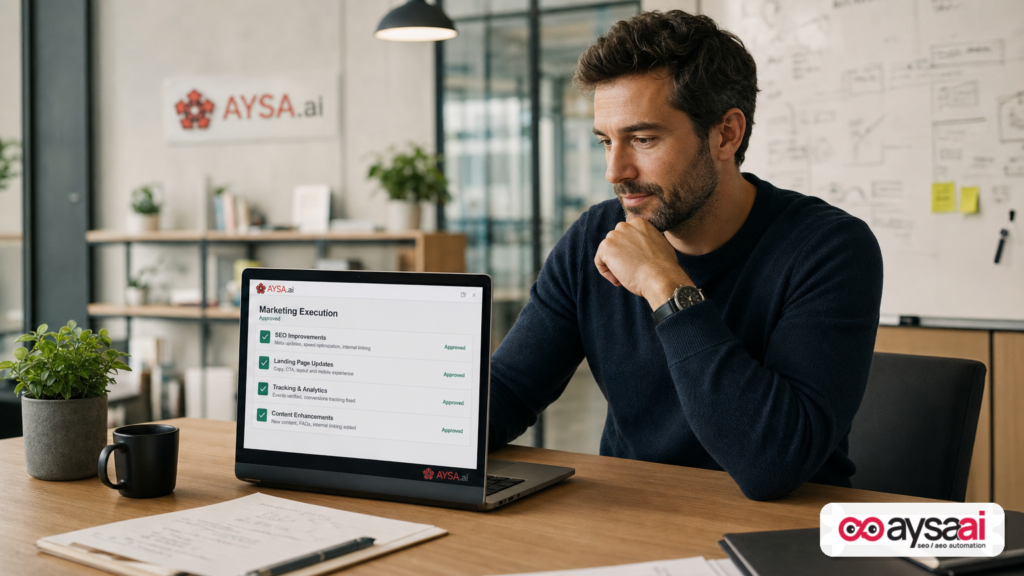
In most organizations, PPC teams can spot what’s wrong—but the business can’t ship fixes fast enough.
Here’s the pattern I’ve seen for years:
- PPC identifies landing page gaps (missing FAQs, weak trust signals, unclear pricing).
- SEO identifies technical issues (internal linking, content decay, crawl issues).
- Analytics reveals drop-offs (mobile speed, form friction).
Then it sits. Because execution is blocked by time, dev queues, uncertainty, or fear of breaking the site.
AYSA is built for that gap: an SEO/AEO/GEO execution system that monitors, prepares recommended changes, asks for approval, and executes accepted website changes—so improvements actually happen.
Where this connects to paid search specifically:
- Better landing pages raise conversion rate (which improves the economics of your ads and gives automated bidding better outcomes to optimize toward).
- Stronger site content supports AI-era discovery as search experiences evolve into AI-mediated summaries and shortlists.
- Faster iteration reduces wasted spend because you fix the cause (on-site friction) rather than endlessly tuning symptoms (bids and targeting).
If you want to see how AYSA approaches visibility beyond classic SEO:
- AI search visibility (how brands show up in AI-mediated discovery)
- AI SEO tools (the toolbox view)
- Monitoring (keep watch as search surfaces change)
If you’re evaluating fit and budget:
My bottom line: the winners won’t be the brands with the fanciest AI. They’ll be the brands that can reliably turn learning into approved execution on the site—week after week.
What to do next
- Audit your goal signals: Are you optimizing to real outcomes (sales, booked appointments, qualified leads) or convenience conversions?
- Write down your constraints: margins, capacity, compliance, brand voice—make them explicit so AI doesn’t “optimize” you into trouble.
- Set a creative cadence: commit to weekly ad iterations driven by hypotheses, not vibes.
- Pick one landing page to improve this month: align it to one high-intent theme, add proof, remove friction, and measure.
- Create an approval workflow: platform recommendations and AI suggestions should be reviewed, documented, and monitored.
- Close the execution gap: if fixes keep stalling, use a system designed to monitor, prepare, request approval, and implement changes—like AYSA.
Sources and further reading
- Search Engine Land: Brad Geddes on 20 Years of Paid Search Evolution
- Search Engine Land: Google’s latest AI ad push shows ads are becoming conversations, not clicks
- Search Engine Land: How to get your Google Ads seen in AI Overviews
- Search Engine Land: The SEO-GEO gap: How AI search traffic differs from organic traffic
- Search Engine Land: Google AI Overviews & AI Mode gain preferred sources, plus new perspectives carousel and highly cited labels
- Search Engine Land: How to structure paid social creative testing for better performance
Note: The links above are included because they were present in the supplied research context and are relevant as research leads. For platform-specific mechanics, validate details using official product documentation and your current account capabilities.
Continue the AI search topic inside AYSA.
Use these pages to connect the article with AI SEO tools, AI visibility monitoring, AI Overviews and approved website execution.
Turn this topic into a website action plan.
Use these AYSA hubs to move from reading to technical fixes, AI visibility monitoring, research, glossary context and approval-first SEO execution.