
Anthropic’s Infrastructure Crisis: What It Means for SEO and Marketing Teams
AI models are becoming operational infrastructure for marketers and SEO teams. Anthropic capacity pressure is a reminder that AI strategy needs resilience, governance and execution systems, not blind dependence on one model.
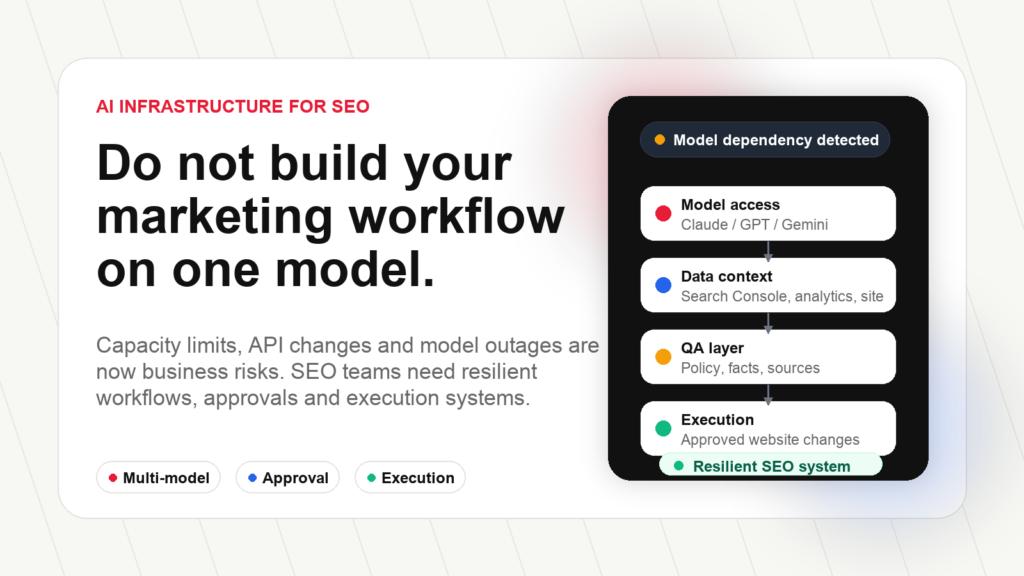
Executive summary: the most important lesson from Anthropic’s infrastructure pressure is not that one AI company had growing pains. It is that AI is becoming operational infrastructure for marketing and SEO. When teams depend on one model, one API, one prompt chain or one SaaS feature to plan, write, optimize and publish, capacity limits and product changes become business risks.
For SEO teams, the response should not be panic or model tribalism. It should be operational maturity: resilient workflows, source discipline, approval gates, fallback providers, clear content policies and a way to turn AI recommendations into approved website changes without losing control.
Why an AI infrastructure story matters to SEO
Search Engine Journal reported on the pressure Anthropic has faced as Claude demand increased, framing the issue as an infrastructure warning for marketers and SEO professionals. The practical point is bigger than one vendor. AI models are moving from experimental tools into the daily operating layer of content, analytics, research, coding, customer support and SEO execution.
That shift changes the risk profile. Five years ago, a marketing team could lose access to a writing assistant and keep operating. Today, many teams are building workflows where AI helps generate briefs, classify queries, cluster keywords, summarize Search Console data, write schema recommendations, create technical audit explanations, rewrite content, prepare social posts and even support product decisions.
When AI becomes part of the workflow, model capacity becomes a workflow dependency. API availability becomes an operational dependency. Output quality becomes a governance dependency. And if the team has no approval system, no source discipline and no fallback process, the AI stack can become fragile very quickly.
This is why the Anthropic discussion matters to SEO. SEO is no longer only a publishing discipline. It is increasingly a system of Monitoring, analysis, prioritization, content improvement, technical validation and execution. If AI sits inside that system, marketers need to design it as infrastructure, not as a novelty.
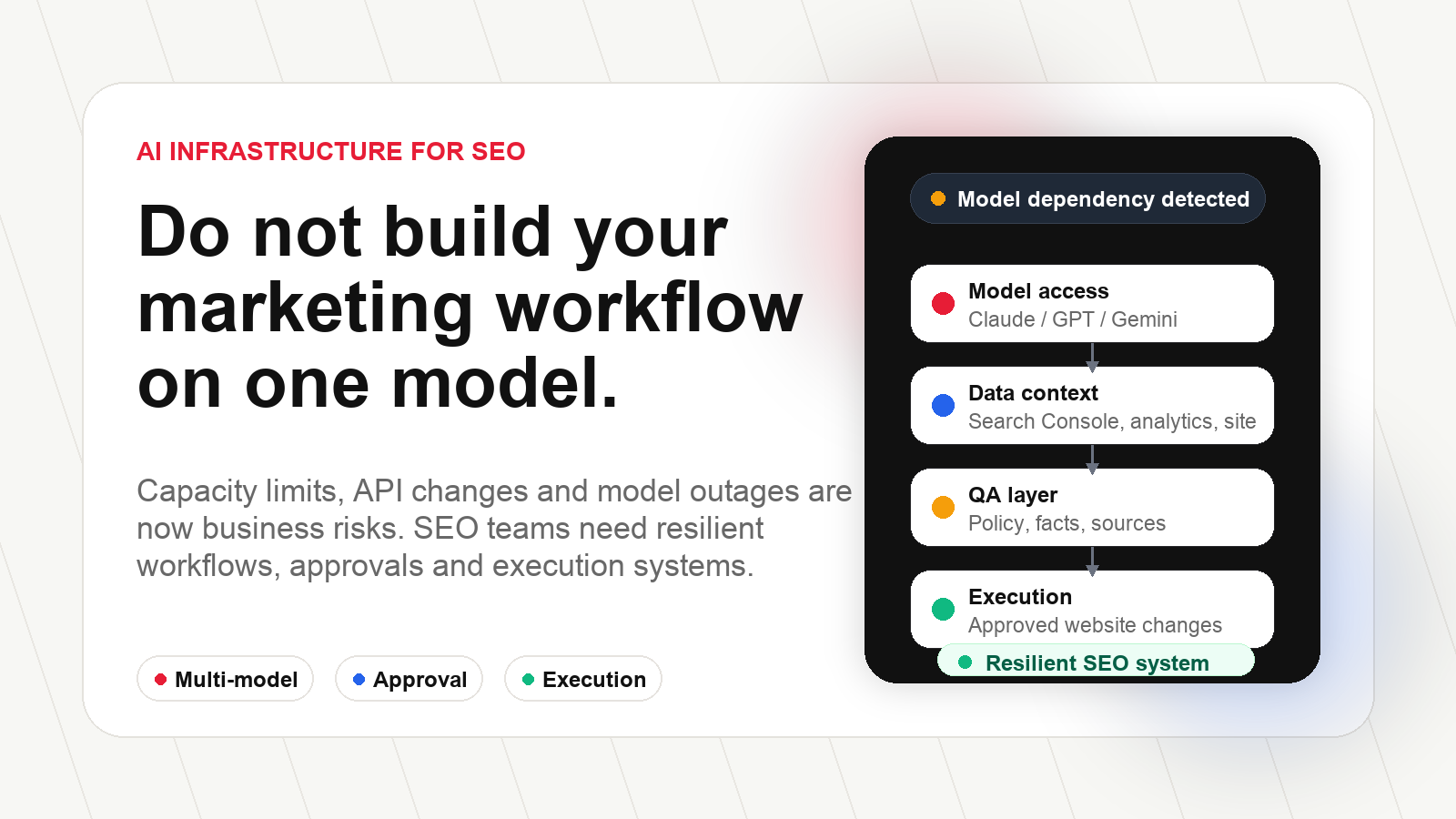
The real risk is not Claude. It is fragile single-model workflows.
The wrong lesson would be: “do not use Claude” or “use another model instead.” Every major AI provider can face capacity pressure, model changes, policy changes, pricing changes, latency issues or temporary outages. The more serious lesson is that marketing teams should not build mission-critical workflows around a single model with no fallback.
A fragile AI SEO Workflow usually looks like this: one person asks one model for a Keyword strategy, copies the output into a document, uses another prompt to create content, manually checks sources, manually pastes the text into a CMS, and then hopes the content is technically sound. It feels fast in the moment, but it has weak controls. The business cannot easily audit what was done, what was approved, what data was used or what changed on the website.
A resilient workflow looks different. It separates model output from source data. It stores website context outside the prompt. It validates recommendations against search performance, Crawlability and business priorities. It asks for approval before publishing. It records actions. It uses AI to reduce work, not to remove accountability.
That distinction matters because search is becoming more complex. Google’s own documentation now explains that website owners should continue applying search fundamentals for AI features: accessible pages, clear content, Structured data where appropriate, useful content and crawlable resources. The job is not to “prompt your way into AI Search.” The job is to make the website consistently easier to understand, evaluate, cite and recommend.
One model, one prompt, manual publishing
- Output depends on a single AI provider.
- Source checks happen manually, if they happen at all.
- Recommendations are copied into documents.
- Publishing depends on someone remembering every step.
Context, QA, approval and execution
- Website data and business context stay connected.
- AI prepares work, but important changes are reviewed.
- Sources, tasks and actions are traceable.
- Approved work can move into website execution.
What marketers and SEO teams should change now
The first change is architectural: treat AI as a layer in the workflow, not as the workflow itself. A model can summarize, draft, classify and reason. But SEO still needs reliable inputs: Search Console data, Analytics data, crawl data, CMS context, internal links, canonical rules, schema status, content history, conversion pages, business priorities and approval rules.
The second change is governance. If AI is used to create or modify content, teams need clear review policies. That does not mean every sentence must be approved by a committee. It means the workflow should define which actions are low risk, which need approval, which require subject matter review and which should never be automated blindly.
The third change is source discipline. AI systems can be useful for exploration, but serious SEO work must be grounded in sources and site data. When a team prepares an article about a medical topic, a financial topic, legal advice, ecommerce claims or technical implementation, it needs verifiable references and a human decision about what belongs on the page.
The fourth change is fallback planning. Teams should avoid building their entire content operation around a single provider, plugin or prompt library. Multi-model evaluation, provider fallback and internal review processes are not enterprise luxuries anymore. They are becoming normal operational hygiene.
The fifth change is execution clarity. The bottleneck in SEO is often not the recommendation. It is implementation. Traditional tools can show reports. AI chat can create drafts. But websites grow when useful changes are prioritized, approved and implemented consistently.
What this means for SMEs and business owners
For SMEs, the danger is different from the enterprise danger. Large companies worry about procurement, infrastructure contracts, governance and internal tooling. Smaller companies worry about time, cost, confusion and dependency on specialists. They do not want to manage AI providers, evaluate model reliability, write prompts, audit outputs and then still manually update WordPress.
That is why “just use an AI chatbot” is not the full answer for most business owners. Claude, ChatGPT, Gemini and other models can help with ideas and drafts. But a business owner still needs to connect the idea to website data, decide whether it is a good SEO action, approve it, publish it, track it and improve it later.
In practical terms, SMEs should ask better questions when choosing AI SEO software:
- Does the system understand my website, or only answer generic questions?
- Does it connect to real performance data?
- Does it prepare actions I can approve?
- Does it keep an action history?
- Does it execute accepted changes inside my website workflow?
- Does it help me avoid risky AI content, thin pages and unsupported claims?
Those questions matter more than which model is fashionable this month. The business outcome is not “we used AI.” The business outcome is less manual SEO work and more organic growth from useful, consistent execution.
AYSA point of view: AI needs an execution layer
In our opinion, the next phase of AI in SEO will not be won by teams that generate the most text. It will be won by teams that build the best execution systems around AI.
That is the reason AYSA is designed as an AI SEO execution agent, not simply as another reporting dashboard or generic writing assistant. The point is to connect website context, SEO research, technical signals, content opportunities, AEO and AI visibility into a workflow where the agent prepares the work, explains why it matters, asks for approval and then executes accepted changes inside the website workflow.
This approach also reduces model dependency risk. The value is not trapped in one prompt or one provider. The value lives in the operating system around the model: business context, site data, approval logic, action history, monitoring, publishing workflow and continuous improvement.
AI infrastructure will continue to evolve. Models will get faster, more capable and more expensive to run. Providers will compete. Search interfaces will change. But SMEs still need the same thing: a reliable way to understand what should be improved, approve the work and get it done without becoming SEO specialists.
AI infrastructure resilience checklist for SEO teams
If your marketing or SEO workflow already depends on AI, use this checklist as a practical audit:
- Model dependency: can the workflow continue if one AI provider is slow, expensive or unavailable?
- Data grounding: are recommendations connected to real website and search data?
- Source quality: are important claims backed by sources, especially in sensitive topics?
- Approval gates: are publishing and technical changes approved before execution?
- Action history: can the team see what was prepared, approved and applied?
- Content quality: does the page answer a real user need better than generic AI output?
- Technical safety: are schema, redirects, canonical tags, internal links and metadata reviewed before changes go live?
- Monitoring: does the system continue watching performance after the work is published?
The future of AI SEO is not a single model. It is a reliable operating layer that helps teams move from search data to approved action.
Sources and further reading
Turn AI research into approved website execution.
AYSA monitors your website, prepares SEO, AEO and AI visibility actions, asks for approval and executes accepted changes inside your website workflow.
Continue the AI search topic inside AYSA.
Use these pages to connect the article with AI SEO tools, AI visibility monitoring, AI Overviews and approved website execution.
Turn this topic into a website action plan.
Use these AYSA hubs to move from reading to technical fixes, AI visibility monitoring, research, glossary context and approval-first SEO execution.

