
Backlinks vs Referring Domains: What Actually Builds SEO Authority in 2026
Backlinks and referring domains are not the same. Here is how SMEs should evaluate link diversity, relevance, risk and approval-first authority building in 2026.
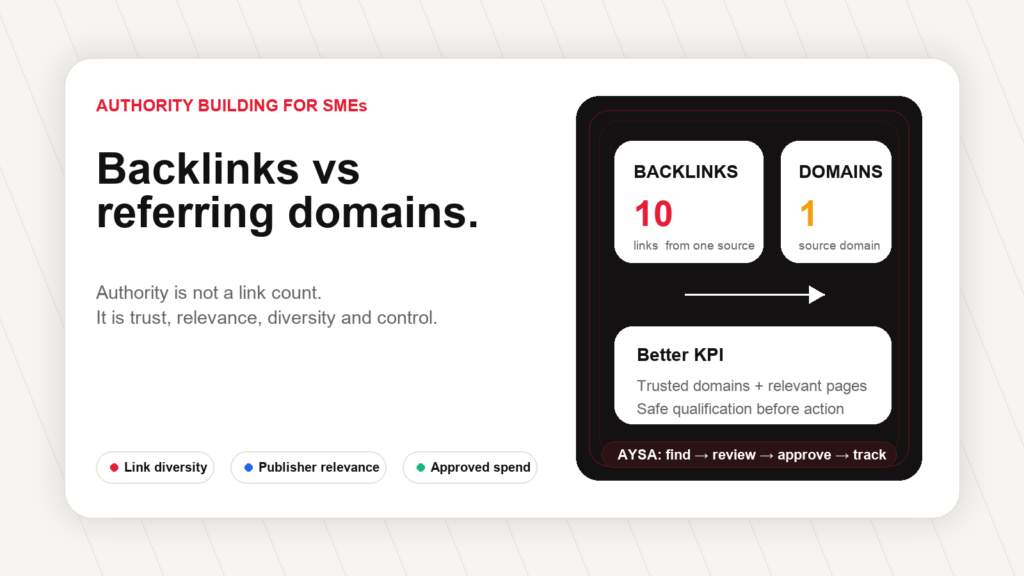
Executive summary: Backlinks and referring domains are related, but they measure different things. A Backlink is an individual link from one web page to another. A Referring domain is a unique website that links to you. Ten links from the same website can increase your backlink count, but they do not mean you earned ten independent sources of authority. For many businesses, referring-domain diversity, Link relevance, placement quality and risk control are more important than raw backlink volume.
This distinction matters even more in 2026 because authority is no longer only about classic Google rankings. Search engines, AI Overviews, answer engines and recommendation systems all need signals that help them understand which brands, websites and pages deserve trust. A healthy authority strategy should therefore focus on relevant publisher coverage, useful citations, clean qualification, natural destination pages and Approval-First Execution. AYSA’s view is simple: Authority Building should be controlled like an operating workflow, not bought mechanically by chasing link counts.
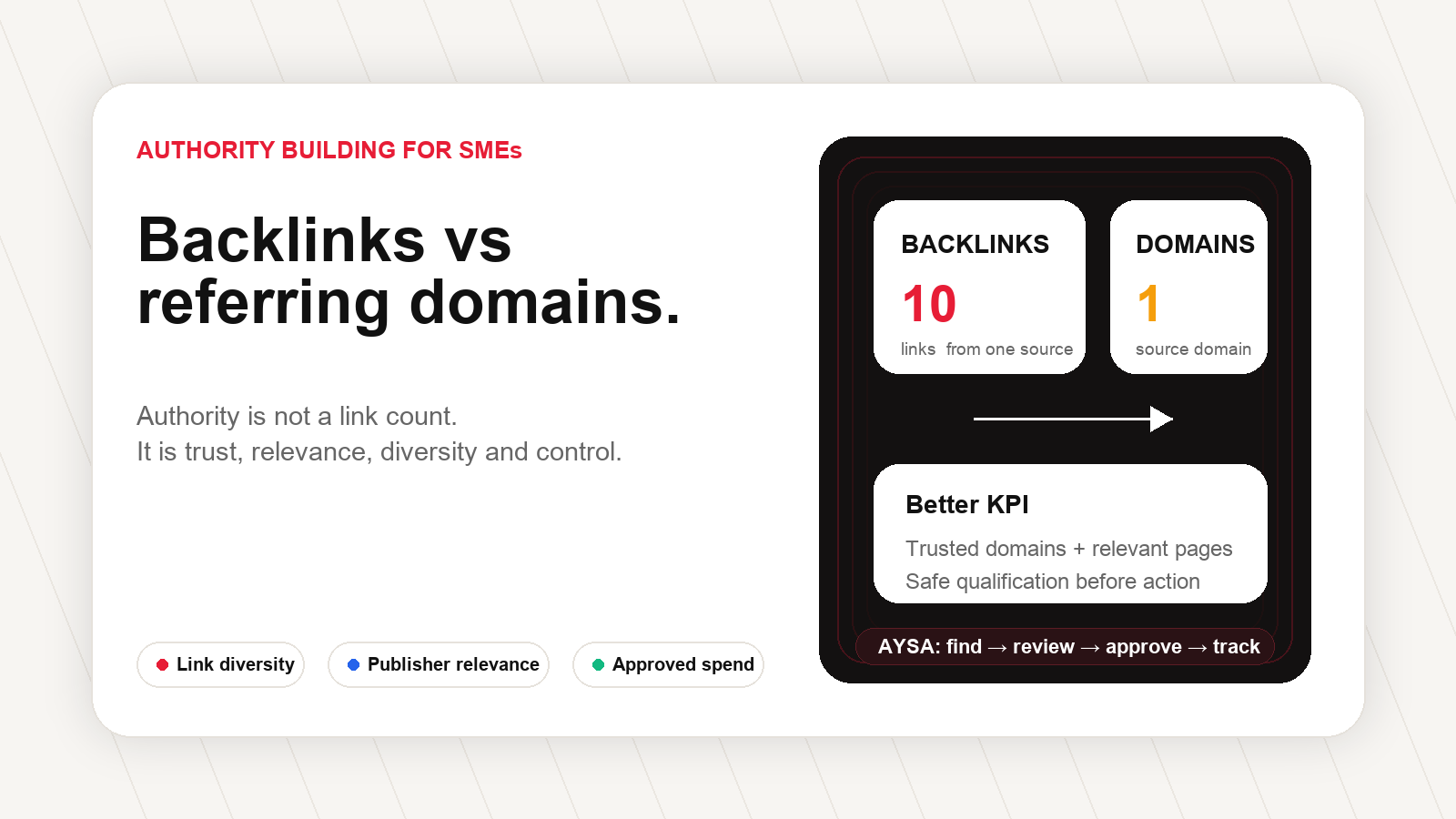
Backlinks vs referring domains: the simple difference
A backlink is a link from an external page to your website. If an article on a publisher site links to your service page, that is one backlink. If the same article links twice to different pages on your website, that can count as two backlinks, depending on the tool. If the publisher has ten pages that each link to your domain, you may see ten backlinks from one source.
A referring domain is the unique domain that sends those links. If example-publisher.com links to your website from one page, five pages or one hundred pages, it is still one referring domain. That is why the two numbers often move differently. A website can have many backlinks but few referring domains. It can also have fewer backlinks but a healthier spread of sources.
The Charles Floate article on backlinks vs referring domains frames the distinction in a practical way: backlinks are individual links, while referring domains are the websites those links come from. That sounds basic, but many SEO decisions become cleaner once the difference is understood.
Imagine two websites:
- Website A has 1,000 backlinks from 12 domains, mostly sidebar, footer or repeated sitewide placements.
- Website B has 120 backlinks from 80 domains, mostly editorial mentions in relevant articles, directories, partners and local publications.
Website A may look stronger in a superficial “backlink count” report. Website B is often the healthier authority profile because more independent websites are referencing it. Of course, that still depends on quality. Eighty weak domains do not magically beat twelve excellent domains. But the principle is important: link diversity often tells you more than raw link volume.
Why this difference matters for SEO, AEO and AI search
Links are not only mechanical ranking signals. They are part of a broader discovery and trust ecosystem. A relevant link can help search engines discover pages, understand relationships, associate a brand with a topic and evaluate whether other websites consider a page worth referencing.
In classic SEO, referring domains have long been used as a proxy for authority diversity. If many relevant websites independently mention a brand, that can be a stronger signal than many repeated links from one website. In AI-assisted search, the same idea becomes even more interesting. Large language model search systems and answer engines do not simply count links like a spreadsheet. They retrieve, compare, summarize and cite information from across the web. A brand that appears in useful, relevant, trusted contexts has more chances to be understood as a credible entity.
That does not mean “buy more links.” It means the web’s independent references matter. A dental clinic mentioned by local health publications, association pages, review sites and relevant guides has a different footprint from a clinic with hundreds of links from unrelated sites. An ecommerce store referenced by niche blogs, comparison guides, product reviewers, supplier pages and industry publications has a different footprint from a store with repeated template links from one low-quality domain.
For SMEs, this is the practical lesson: do not ask only, “How many backlinks do we have?” Ask, “Who is linking to us, why are they linking, where is the link placed, which page receives the link, is the source relevant, and would this mention still make business sense if Google did not exist?”
Weak link thinking
“We need more backlinks.”
The team buys or chases placements without checking source relevance, context, qualification, destination page or business value.
Better authority thinking
“We need more relevant, controlled authority signals.”
The team reviews publisher fit, topic relevance, destination pages, risk, cost, link attributes and expected business value before approval.
Quality beats raw volume: what makes a link worth caring about?
A good authority profile is not built from one metric. Domain Rating, Domain authority, Trust Flow, organic traffic estimates and spam scores can be useful diagnostic signals, but none of them should be treated as truth. They are third-party metrics. Google does not publish a public “domain authority” score for websites. Tools estimate authority differently, and those estimates can be manipulated.
For business owners, the most useful link-quality questions are often more concrete:
- Is the source relevant? A link from a contextually related website is usually more meaningful than a random link from an unrelated site.
- Is the page relevant? A strong domain can still publish a weak or irrelevant page. Page-level context matters.
- Is the placement editorially sensible? A link inside useful content is different from a hidden footer link or a list of paid outbound links.
- Does the source have real audience or visibility? A site with genuine readership, search visibility or community relevance is usually more valuable than a dead domain.
- Is the destination page ready? Sending authority to a thin, slow or unclear page wastes opportunity.
- Is the anchor text natural? Over-optimized exact-match anchors can increase risk.
- Is the relationship disclosed correctly? Sponsored or paid placements should be qualified properly.
- Would you want customers to see this mention? If the answer is no, it is probably not a strong brand signal.
This is where “referring domains” become more useful than backlinks as a starting point. A profile with many unique relevant sources usually suggests broader market recognition. But the word “relevant” is doing a lot of work. Ten strong local or industry references may be better than hundreds of thin, unrelated links.
For example, a florist in Bucharest does not need thousands of random backlinks. It may benefit more from relevant local business citations, wedding planning resources, event venues, flower care guides, local media, ecommerce comparison content and authority-building articles that make sense for its market. A private medical clinic needs an even more careful approach: health-related authority must be trustworthy, compliant and contextually responsible.
Risk and Google policy: paid links, sponsored links and link spam
Google’s spam policies are clear that links intended to manipulate rankings can be considered link spam. Google includes examples such as buying or selling links for ranking purposes, excessive link exchanges, automated link creation and low-quality directory or bookmark links. The important nuance is that advertising, sponsorship and paid placements are not automatically forbidden. The problem is using links in a way that passes ranking credit deceptively.
Google’s documentation on link spam and its guide on qualifying outbound links both matter here. When a link is paid, sponsored, user-generated or otherwise not a normal editorial endorsement, the proper link attributes such as rel="sponsored", rel="nofollow" or rel="ugc" may be appropriate.
This is why “link buying” is the wrong mental model for serious businesses. A better phrase is authority building. Authority building includes PR, partnerships, useful publisher placements, citations, digital reputation, industry mentions, local ecosystem links, helpful resources and reviewable sponsored opportunities where disclosure and qualification are handled responsibly.
There is also a disavow trap. Many business owners panic when they see low-quality links and want to disavow everything. Google’s own guidance has historically advised caution: the disavow tool is for specific situations, especially where there are many spammy, artificial or low-quality links and a manual action or likely manual action risk. In many cases, random low-quality links can be ignored rather than turned into an endless cleanup project.
The goal is not fear. The goal is governance. Know what links you are building, why they exist, where they point, what they cost, whether they are qualified correctly and whether they support the brand’s actual market position.
What SMEs should track instead of only backlink count
If you run an SME, you do not need to become a full-time link analyst. But you do need a small set of authority signals that help you avoid bad decisions. A practical reporting model can include:
- Referring domains: how many unique websites link to you, and whether that number is growing naturally.
- Topical relevance: whether those websites and pages are connected to your market, location, product or expertise.
- Destination pages: which pages receive links and whether those pages can convert or support topical authority.
- Anchor distribution: whether anchor text looks natural, branded and varied rather than aggressively exact-match.
- Link attributes: followed, nofollow, sponsored and ugc links should be understood, not blindly mixed together.
- Publisher quality: real audience, real content, indexed pages, visible authorship and low spam signals matter.
- Lost links: important lost links can signal expired partnerships, removed pages or technical changes.
- Competitor gap: not “copy every competitor link,” but identify legitimate places where competitors are referenced and you are absent.
- Business impact: referral traffic, branded search lift, lead quality, conversions and assisted visibility matter more than vanity metrics.
Google Search Console’s Links report can help website owners see external links, top linked pages, top linking sites and anchor text. It is not a complete commercial link intelligence platform, but it is a reliable first-party view of how Google reports link information for a verified property. Third-party tools can add competitive and discovery layers, but they should not replace judgment.
Backlink report
Shows link counts, source URLs, target pages and anchors. Useful, but easy to misread as a scoreboard.
Authority workflow
The AYSA view: Adverlink, approval and controlled authority building
AYSA treats off-page SEO as authority building, not as a blind backlink purchase machine. That distinction is important. The purpose is not to manufacture a bigger backlink number. The purpose is to help a business understand which external mentions, publisher opportunities and authority actions make sense for its market.
Through the AYSA ecosystem, including the Adverlink publisher network, authority opportunities can be surfaced faster and managed with less manual outreach. But the process should still be controlled. The user should see the opportunity, understand the context, review the recommendation, approve spending or action, and then track delivery. This is especially important for SMEs that do not have an SEO department and do not want to become link-building specialists.
In my opinion, the next mature phase of link building is not “automation at any cost.” It is governed automation. The agent can help discover opportunities, compare relevance, explain why a placement may or may not help, flag risk, connect the opportunity to the right destination page, and keep a history of what was approved. The human remains in control of spending and brand risk. The system handles the operational complexity.
That is the bigger lesson from backlinks vs referring domains. Metrics are useful, but they are only useful when they drive better decisions. A high backlink count can hide concentration risk. A high referring-domain count can hide poor quality. A paid placement can be legitimate advertising if handled correctly. A “free” link can still be risky if it comes from a spam network. The strategy needs context.
For AYSA, the best authority-building workflow is simple:
- Understand the business, market, services and priority pages.
- Audit current backlinks, referring domains, anchors and destination pages.
- Identify competitor and market authority gaps.
- Surface relevant publisher opportunities and explain the recommendation.
- Ask for approval before spending, publishing or executing.
- Track delivery, link attributes, destination pages and impact.
- Use authority signals together with content, technical SEO, internal links and AI visibility work.
Backlinks matter. Referring domains matter. But neither number is the strategy. The strategy is building a web presence that real users, search systems and AI retrieval systems can trust.
Authority building should be controlled, not chaotic.
If your backlink strategy is still “more links”, let AYSA help you review the right opportunities.
AYSA can surface relevant publisher opportunities, explain why they matter, ask for approval before spending and track approved authority-building actions inside your SEO workflow.
Sources and further reading
This article was inspired by Charles Floate’s guide to backlinks vs referring domains. Policy and qualification guidance was cross-checked with Google Search Central’s spam policies on link spam and Google’s documentation on qualifying outbound links. For first-party link reporting, see Google Search Console documentation for the Links report. The AYSA and Adverlink sections are our editorial and product perspective. We do not claim guaranteed rankings, guaranteed AI citations or guaranteed traffic growth from any link or publisher placement.
Continue the AI search topic inside AYSA.
Use these pages to connect the article with AI SEO tools, AI visibility monitoring, AI Overviews and approved website execution.
Turn this topic into a website action plan.
Use these AYSA hubs to move from reading to technical fixes, AI visibility monitoring, research, glossary context and approval-first SEO execution.

