
Inside ChatGPT Search: Fan-Out Queries, Web Runs and the New Rules of AI Visibility
A practical guide to ChatGPT Search, fan-out queries, live web retrieval and what AI visibility now means for businesses that need more than classic rankings.
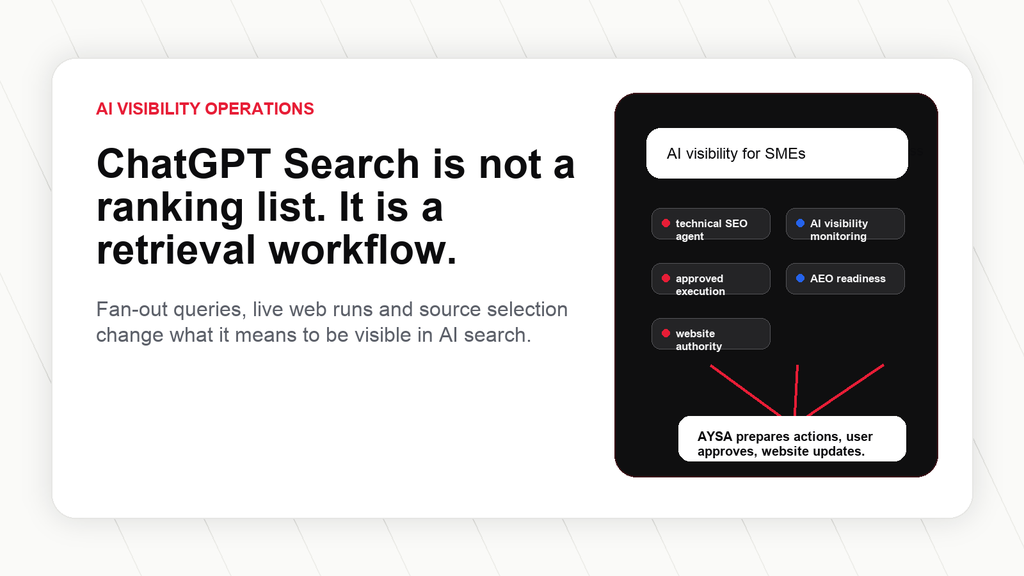
Executive summary: ChatGPT Search is changing how businesses should think about visibility. A user may ask one simple question, but the system can perform multiple retrieval steps, expand the query, inspect different sources and synthesize an answer. This is why AI visibility is not the same as ranking number one for one Keyword.
Search Engine Land’s reporting on ChatGPT Search, web runs and fan-out behavior is important because it points to a larger operational truth: websites need to be understandable, crawlable, specific, trusted and continuously improved. For AYSA, this supports the product thesis we have been building from day one: SEO is moving from occasional reports to ongoing Approved Execution.
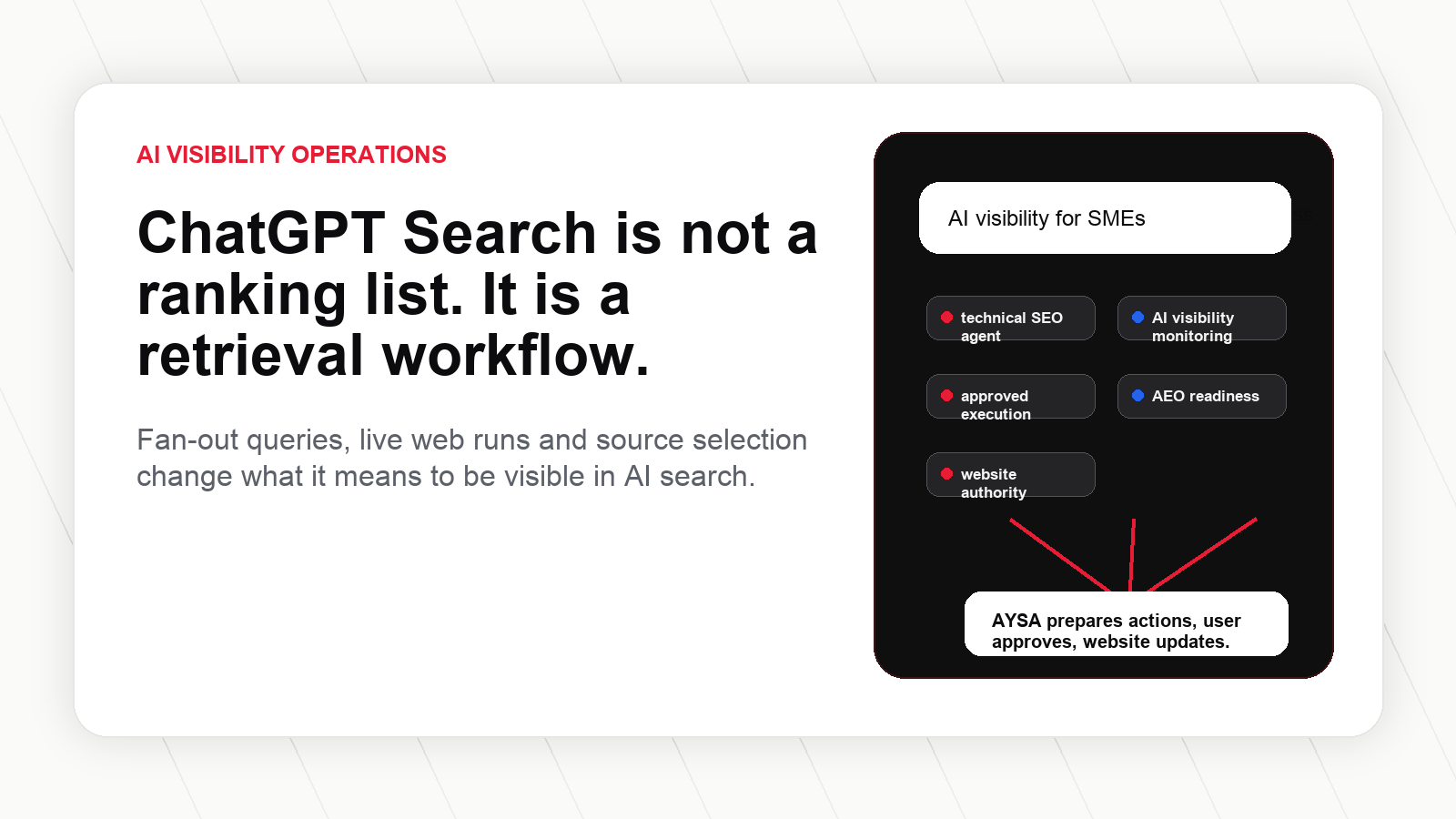
The old SEO model was a list. AI search is a workflow.
Classic SEO taught us to think in lists: a keyword, a search results page, ten blue links, a rank tracker, a traffic estimate and a report. That model still matters. Google Search is not gone. Ranking pages still create business. Technical SEO, content quality, Internal linking, topical authority, crawlability and links are still part of the system.
But AI-assisted search adds a new layer. A user can now ask a question in natural language and receive a synthesized response. The answer may include citations, product suggestions, local recommendations, comparisons, summaries, follow-up prompts or a direct explanation. The result is not simply “position 1 to 10.” It is a generated answer assembled from the model’s understanding, retrieval process and source selection.
That distinction matters because a business can be visible in classic search and still be weak in AI answers. It can have pages indexed by Google, but not have content that is easy for an answer engine to identify, quote or recommend. It can publish many articles, but fail to provide the specific evidence an AI system needs when a user asks a commercial, local or comparison question.
The Search Engine Land article on ChatGPT Search highlights this shift through the language of web runs and fan-out queries. The practical takeaway is simple: when AI search expands a user’s question into several retrieval paths, your website needs to be relevant to more than one exact keyword. It needs to answer the surrounding questions too.
What are fan-out queries?
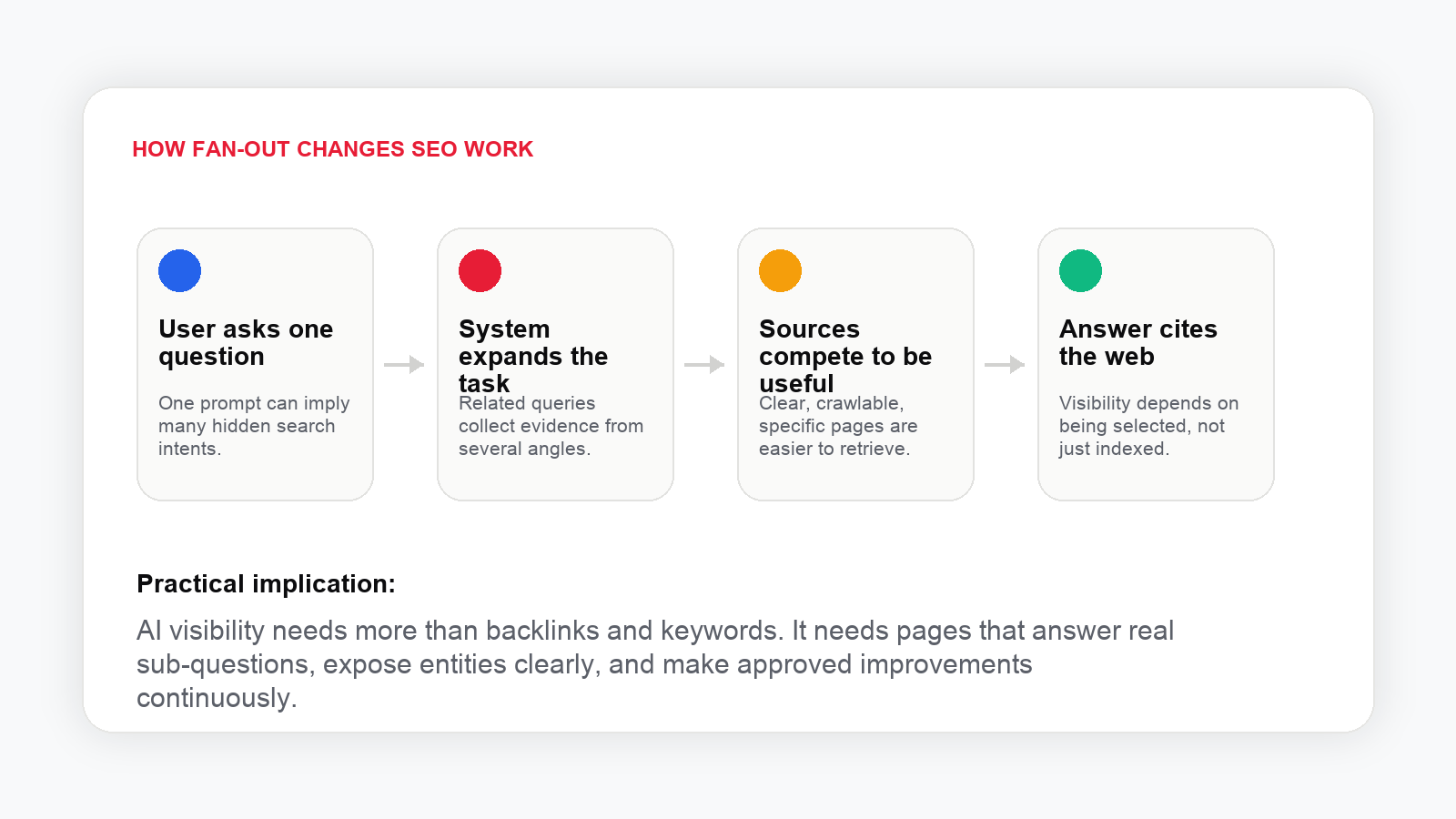
In plain language, a fan-out query is what happens when one user question becomes several related search or retrieval tasks. The user may ask, “What is the best SEO automation platform for a small ecommerce business?” A traditional keyword mindset might reduce that to one phrase: “best SEO automation platform.” But an AI system may need more context before answering.
It may look for information about AI SEO tools, WordPress execution, ecommerce SEO, pricing, content automation, technical SEO, authority building, user approval workflows, AI visibility monitoring and comparisons with traditional SEO tools. It may need to understand whether the user wants software, an agency, a checklist, a plugin or a managed service. It may inspect sources that answer different parts of the same decision.
That is the “fan-out” concept: one prompt can branch into multiple sub-questions. This is not completely new. Search engines have long rewritten queries, interpreted intent and used semantic systems. What is different is the user interface and the level of synthesis. The user may never see all the intermediate retrieval work. They only see the final answer.
For SEO teams, this means the target is no longer only a single keyword. The target is an answer space. A page that wants to be cited or used by AI search needs to be strong across the subtopics that support the answer. It should explain the category, define terms clearly, compare alternatives, answer objections, show examples, and make the business entity easy to understand.
What OpenAI officially says about ChatGPT Search and crawlers
OpenAI’s public documentation separates different crawlers and user agents. That distinction is useful for marketers because not every OpenAI crawler has the same purpose.
OpenAI’s bot documentation describes GPTBot, OAI-SearchBot and ChatGPT-User as separate agents. GPTBot is associated with improving models. OAI-SearchBot is associated with search features. ChatGPT-User is associated with user-initiated actions in ChatGPT and connected products. In practical SEO terms, that means blocking or allowing crawlers should not be treated as one generic “AI bot” decision.
OpenAI also announced Search Engine Land: ChatGPT search officially launches as a way to provide faster, timely answers with links to relevant web sources. The announcement matters because it frames the experience as conversational search, not only chatbot memory. When the system needs current or source-backed information, the web becomes part of the answer layer.
The important business point is not that every website should blindly allow every crawler. The important point is that AI search visibility has crawler, content, entity and authority implications. If your website is technically blocked, unclear, slow, generic or thin, it is harder to be selected as a useful source.
Google’s own documentation for AI features in Search also reinforces the same broad direction: AI experiences rely on the same ecosystem of crawlable, indexable, useful web content. Google does not offer a magic “AI Overview optimization tag.” It points publishers back to fundamentals: helpful content, eligibility for Search features, clear page structure and standard search controls.
AI visibility is not a vanity metric. It is source eligibility plus answer usefulness.
The phrase “AI visibility” is already being overused. Some teams treat it as a new dashboard widget: mentions, citations, share of AI voice, prompts tracked, sources cited. Those metrics are useful, but they are not the whole job.
The real question is: why would an AI system select your page as useful evidence for a specific answer?
That question forces a higher standard than generic SEO copy. A page about “technical SEO audit” should not only define the term. It should explain what is checked, why each check matters, how issues are prioritized, what can be automated, what needs human approval, and what happens after the audit. A page about “best pediatric clinic in Bucharest” should not look like a generic directory. It should help a parent compare options, understand emergency versus private care, evaluate trust signals, and decide what to do next.
This is where many websites will struggle. They have content, but not enough clarity. They have keywords, but not enough context. They have service pages, but not enough proof. They have blog posts, but not enough structure. They have SEO reports, but not enough execution.
AI visibility rewards websites that are easy to understand at multiple levels: the business entity, the page topic, the user intent, the factual claims, the next step and the evidence behind the answer. It also rewards consistency. If your brand, services, pricing, locations, authorship, schema, internal links and external mentions contradict each other, you are asking retrieval systems to do extra work.
What content must do in the fan-out era
Content created for AI search should be written for humans first, but structured so machines can interpret it without guesswork. This does not mean turning every page into a sterile FAQ. It means being explicit.
A strong page should answer the main question quickly, then support the answer with detail. It should use headings that describe real subtopics. It should define important terms. It should include examples, caveats and practical steps. It should make claims that can be verified. It should show where the business fits, without turning every paragraph into a sales pitch.
For commercial pages, the missing pieces are often very basic: who the product is for, what problem it solves, what happens after signup, how pricing works, what is included, what requires approval, what is automated, what is not automatic, what integrations exist and what results should not be guaranteed.
For informational articles, the biggest mistake is generic summarization. AI systems already summarize. A business website needs to add something more useful: experience, examples, process, constraints, local context, industry context, original interpretation and a clear next step.
That is why “quality content” in 2026 is not just polished writing. It is useful decision support. It helps a user move from confusion to action. It gives AI systems a better source to retrieve, cite or synthesize.
Technical SEO becomes AI retrieval infrastructure
Technical SEO is often treated as a separate discipline: speed, crawl, indexation, canonicals, redirects, sitemaps, structured data, internal links. In AI search, those checks become retrieval infrastructure.
If important pages are slow, blocked, noindexed, duplicated, orphaned or buried five clicks deep, they are weaker candidates for retrieval. If pages have broken schema, duplicated metadata, thin tag archives, redirect chains or inconsistent canonicals, the site sends mixed signals. If internal links do not connect related concepts, the site makes topical understanding harder.
Fan-out behavior makes this more important because the system may retrieve from several angles. It may need a definition page, a comparison page, a pricing page, a use case page, a technical guide and an authority signal. If those pages exist but are disconnected, outdated or hard to crawl, the answer layer may not see the full picture.
Authority also changes shape. Backlinks still matter, but brand mentions, citations, publisher references, author credibility, reviews, local profiles and ecosystem proof all help retrieval systems understand that a business exists and is relevant. This is why authority building should be controlled and transparent, not random link buying. The best authority work supports real entity recognition and user trust.
Practical test: take one important commercial query for your business and list five hidden sub-questions an AI system might need to answer it well. If your website does not answer those sub-questions clearly, you do not only have a content gap. You have an AI visibility gap.
What this means for SMEs and non-specialists
For large companies, AI visibility becomes another layer of search operations. For SMEs, it can feel overwhelming. A business owner already has to manage customers, invoices, inventory, staff, ads, suppliers and website changes. Now the SEO conversation includes AEO, GEO, AI Overviews, ChatGPT Search, answer engines, structured content, entity optimization, crawl controls and AI mentions.
The answer cannot be “learn everything and manually execute every recommendation.” That is not realistic. It is also why many SEO reports fail. They identify work, but the work does not get done. The owner does not have time. The agency is busy. The developer waits for a brief. The content writer needs research. The technical fixes require prioritization. Weeks pass.
In the fan-out era, speed matters because the search environment changes quickly. Competitors publish, Google updates systems, AI interfaces change, new answer formats appear and customer questions evolve. A website that waits months between research and execution will always be behind.
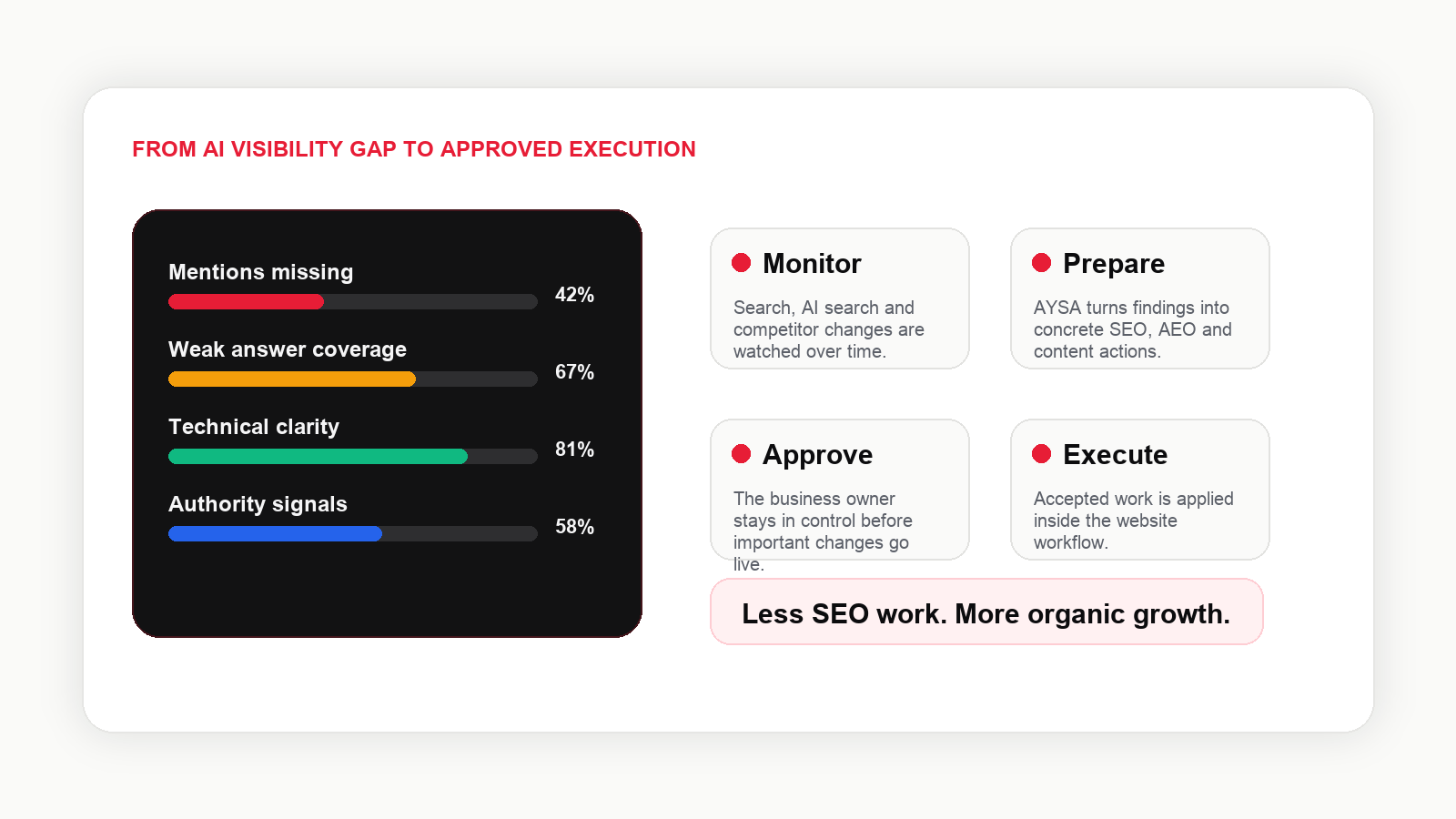
This does not mean blind automation. It means approved automation. The system should monitor, prepare, explain, ask for approval and then execute accepted work. The user should stay in control, but the user should not have to copy-paste SEO tasks across ten tools.
The AYSA point of view: AI visibility needs an operating system
Our view at AYSA is that AI visibility will not be solved by one checklist, one prompt list or one dashboard. It needs an operating system: monitor the website, understand the business, detect opportunities, prepare changes, explain the reasoning, ask for approval and execute accepted actions inside the website workflow.
That is especially important because ChatGPT Search and AI Overviews are not static channels. They are dynamic answer systems. A business needs to keep its website ready for classic search and AI-assisted retrieval at the same time.
In practice, AYSA can help identify pages that receive impressions but do not answer the query well, topics where the business lacks coverage, weak internal links between related pages, service pages that lack process or location clarity, FAQ opportunities, schema opportunities, technical issues that reduce crawlability, authority-building opportunities, and AI visibility gaps where the brand is not easy to identify, cite or recommend.
The key is what happens next. AYSA does not only show the issue. It prepares the work, explains why it matters, asks for approval and can execute accepted changes inside the website workflow. That is the difference between a visibility report and an execution system.
For business owners, this is the practical promise: less SEO work, more organic growth. Not because SEO becomes easy in the abstract, but because the repetitive research, preparation and implementation burden moves from the user to the agent.
How to prepare your website for ChatGPT Search and AI visibility
If you want a practical starting point, focus on these areas:
- Make your core pages explicit. Explain what you do, who you serve, where you operate, what the process is, what pricing looks like and what customers should do next.
- Build topic coverage around real decisions. Do not publish generic articles. Cover the sub-questions a user needs before choosing a solution.
- Strengthen internal links. Connect definitions, service pages, comparisons, examples, case studies, pricing and support content.
- Fix crawl and indexation problems. AI visibility starts with pages that can be discovered, rendered and understood.
- Use structured data where it matches visible content. Schema should clarify the page, not invent claims.
- Monitor AI mentions and source patterns. Look at how your brand and competitors appear across answer systems, but treat monitoring as a starting point, not the final deliverable.
- Turn findings into approved execution. The gap between knowing and doing is where most SEO value is lost.
Final thought
The rise of ChatGPT Search does not kill SEO. It exposes weak SEO. If a website is technically messy, thin, vague, disconnected and slow to improve, AI search makes that weakness more visible. If a website is clear, useful, crawlable, structured and continuously improved, AI search creates a new opportunity to be discovered in more conversational decision journeys.
The companies that win will not be the ones that chase every new acronym. They will be the ones that build a system for search visibility: classic SEO, AEO, GEO, AI visibility, technical health, content quality, authority and approved execution working together.
Turn AI visibility gaps into approved website action.
AYSA monitors your website, prepares SEO and AI visibility work, asks for approval and executes accepted changes inside your website workflow.
Sources and further reading
- Search Engine Land: Inside ChatGPT Search, web runs and fan-out queries
- OpenAI: Crawler and user agent documentation
- Search Engine Land: ChatGPT search officially launches
- Google Search Central: AI features and your website
- Google: AI Mode in Search
Continue the AI search topic inside AYSA.
Use these pages to connect the article with AI SEO tools, AI visibility monitoring, AI Overviews and approved website execution.
Turn this topic into a website action plan.
Use these AYSA hubs to move from reading to technical fixes, AI visibility monitoring, research, glossary context and approval-first SEO execution.

