
Content SEO for Romanian WordPress Websites: Useful Pages, Topic Authority and AEO
A practical guide to content SEO for Romanian WordPress websites: search intent, useful pages, topic authority, AEO, content refreshes and approved execution.
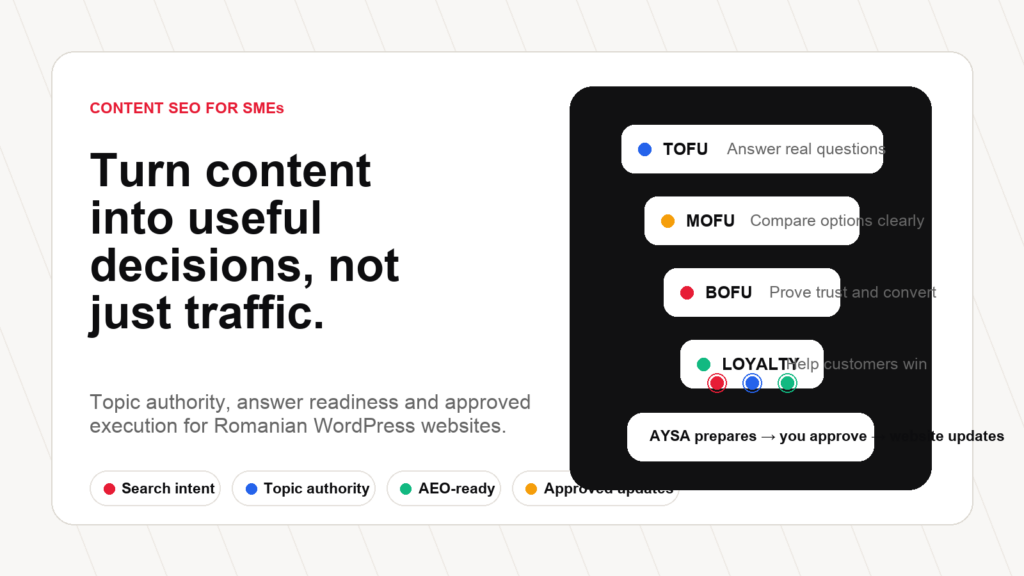
Executive summary: Content SEO for Romanian WordPress websites is not about publishing more blog posts. It is about building pages that solve real user problems, match Romanian Search intent, support business goals, create topical authority, and become easier for search engines and answer engines to understand. The question is not “how many articles should we write?” The better question is: what content would make this website the most useful result for a specific user, at a specific stage of the journey, in a specific market?
This article continues the WordPress SEO in Romania series. We already covered plugins, search intent, Technical SEO, WooCommerce and Local SEO. Now we focus on the editorial layer: service pages, category guides, comparison pages, FAQs, topic clusters, content refreshes, internal links and AEO-ready answers that move a user from confusion to decision.
Romanian SMEs do not have a “content volume” problem. They have a usefulness and execution problem.
Most Romanian WordPress websites do not fail because they lack words. They fail because the words do not help the right user make a decision. A site may have dozens of blog posts, hundreds of category descriptions or service pages full of generic claims, but still miss the questions that matter before a customer calls, books, buys or trusts the business.
This is why I am careful with the phrase “content marketing.” It often becomes too abstract. Business owners hear that they should publish articles, so they publish. Agencies prepare calendars. AI tools generate drafts. Someone adds keywords. The website becomes larger, but not necessarily more useful.
Content SEO is different. Content SEO starts with search behavior and business context. It asks what the user needs, what stage of the journey they are in, what objections block the decision, what proof is missing, what page should answer the query, and what internal links should connect the topic. It also asks what happens after the recommendation is made. If the work stays in a spreadsheet, it does not grow the website.
For Romanian SMEs, the strongest content opportunities are often practical: better service pages, better local pages, better category buying guides, clearer pricing explanations, trust proof, comparison pages, FAQ sections based on real questions, and refreshed old pages that already have Impressions but underperform. This is less glamorous than “publish 100 AI articles,” but it is much closer to organic growth.
Useful content starts with a harder question
The harder question is this: what would make this page the most useful result for a specific user, at a specific stage of the journey, in a specific market?
A page about “best pediatric clinic in Bucharest” should not look like a generic medical directory. It should help a parent compare options, understand when to choose emergency care, see real criteria, evaluate trust signals and decide what to do next. It should explain the difference between routine consultations, urgent care, investigations, specialties, appointment availability and child-friendly communication. It should not only list clinics and repeat “best clinic” several times.
A page about “Technical SEO audit” should not only define the term. It should explain the checks, risks, examples, prioritization and what happens after issues are found. It should tell a business owner why Crawlability, indexability, redirects, canonicals, sitemap quality, Core Web Vitals and internal links matter. It should also explain the next step: which fixes can be executed automatically after approval, which require human review, and which are not worth doing immediately.
A category page for an ecommerce store should not only describe products. It should help the buyer choose. A service page should not only say the business is professional. It should explain process, pricing context, location, timing, evidence, requirements, guarantees, limitations and next steps.
Google’s guidance on helpful content emphasizes creating content for people, not only for search engines. That sounds simple, but it is difficult in practice because it forces the business to be specific. Generic content is easy. Useful content requires judgment.
Romanian search intent is not a translation of English keyword research
This series already has a dedicated article on Romanian search intent, but it matters strongly for content SEO. Romanian users often search with practical modifiers: “pret,” “pareri,” “langa mine,” “Bucuresti,” “sector,” “program,” “ieftin,” “rapid,” “livrare,” “cum aleg,” “merita,” “recomandare,” “comparatie,” “non stop,” “aproape,” “online,” “cu plata ramburs” and many others.
Those modifiers are not decorations. They reveal anxiety, urgency, budget, location, trust needs and stage of decision. A user searching “implant dentar pret Bucuresti” is not asking the same question as “ce este implantul dentar.” A user searching “flori livrare azi Bragadiru” is not reading a generic article about roses. A user searching “parcare aeroport Otopeni pret” wants practical logistics and proof, not a poetic landing page.
This is why Romanian WordPress websites need pages built around real intent. Informational intent needs explanations. Commercial investigation needs comparisons and criteria. Local intent needs location, process, proof and availability. Transactional intent needs clear next steps. Post-purchase intent needs support and reassurance.
Many websites collapse all these intents into one page. That creates weak relevance. A stronger content system maps intent to page type. Some topics deserve glossary definitions. Some deserve guides. Some deserve service pages. Some deserve category pages. Some deserve comparison pages. Some deserve FAQs inside existing commercial pages. The job is to choose the right format.
Answer the question clearly and introduce the right mental model.
Educate
Compare options, trade-offs, risks, prices and practical criteria.
Evaluate
Show proof, process, trust, availability and a clear next action.
Convert
Support customers after purchase and create reasons to return.
Retain
Topic authority is built by coverage, structure and internal links
Topical authority is often used as a buzzword, but the practical idea is simple: a website becomes more convincing when it covers a subject deeply, connects related pages logically, and helps users move through the topic without confusion. A single article rarely creates authority. A cluster of useful pages can.
For example, a pediatric clinic does not build topical authority by publishing one article called “pediatrie Bucuresti.” It needs pages and content around pediatric consultations, neonatology, vaccinations, fever, emergency signs, appointment process, doctor credentials, common investigations, age-specific care, parent FAQs, location and practical preparation. Those pages should link to each other naturally and support the main service pages.
An ecommerce flower store can build topical authority around delivery, occasions, bouquet types, flower care, seasonal flowers, local delivery areas, wedding flowers, corporate flowers, sympathy flowers, roses, preserved flowers and gift guidance. The important part is not volume. It is coherence.
A technical SEO website can build authority around crawlability, indexability, canonicals, redirects, structured data, Core Web Vitals, sitemap, internal linking, JavaScript rendering and content quality. Each topic should have its own useful page, but the pages should not live as isolated islands.
Internal linking is the connective tissue. A guide should link to the relevant service page. A glossary definition should link to the deeper guide. A category page should link to comparison guides and related categories. Blog posts should support commercial pages, not only attract traffic that never converts.
AYSA can help by detecting missing topics, mapping related pages, finding orphan pages, preparing internal links and identifying where a website has content fragments but no real topic structure. This is one of the areas where an agent is more useful than a static keyword export.
AEO-ready content is clear, structured and grounded in visible truth
Answer Engine Optimization does not mean adding random FAQ blocks to every page. It means making the page easier to understand and use as a reliable source. AI-assisted search, AI Overviews and answer engines need clear explanations, entities, relationships, examples and source-level trust. They cannot responsibly recommend what the page does not explain.
For Romanian SMEs, AEO readiness starts with visible content. If the business serves a city, say it clearly. If pricing depends on project size, explain the pricing model. If the service has limitations, say so. If the product fits certain users better than others, explain the difference. If customers ask the same questions repeatedly, answer them on the page.
Structured data can help describe visible content, but it should not be used as a shortcut for missing content. Google’s documentation around structured data repeatedly emphasizes that markup must reflect what is visible and valid on the page. A website should not hide the real answer in JSON and leave the user-facing page weak.
AEO-ready content also needs concise answers. A page can be deep and still contain clear answer blocks. For example, a service page can include a short answer to “How long does this service take?” followed by a fuller explanation. A category page can answer “Which option should I choose?” with criteria. A comparison page can explain differences in a table and then add nuance below.
The goal is not to chase every AI feature. No website can guarantee inclusion in AI Overviews or answer engines. The goal is to improve eligibility, clarity, structure, authority and usefulness. That is within the business’s control.
Weak page
Generic intro, repeated keywords, no examples, no decision criteria, no trust proof, no next step.
Result: the page exists, but it does not help much.
Useful page
Content refresh is often faster than publishing new content
Many Romanian websites already have pages with impressions. The problem is that these pages are not good enough to earn clicks, satisfy the query or convert the visitor. Before publishing more content, a business should look at the pages that Google already tests in search.
Search Console can show pages with impressions and low CTR. It can reveal queries where the page ranks but does not answer the intent well. It can show content decay: pages that used to perform but lost visibility. It can show topic opportunities around existing pages. A content refresh can often be more valuable than a new article because the page already has some history.
A good refresh is not just changing the date. It may include rewriting the title, improving the introduction, adding missing sections, answering current questions, adding examples, updating screenshots, adding internal links, improving schema, removing outdated claims, adding comparison criteria, improving the CTA and making the page easier to scan.
This matters because AI-generated content has made generic publishing cheaper. If everyone can publish more words, the advantage moves toward better judgment and faster improvement. The website that refreshes real pages based on real data has a stronger chance than the website that publishes generic drafts forever.
What a content SEO system should monitor
A content SEO system for WordPress should monitor more than rankings. It should watch query impressions, CTR gaps, pages losing traffic, pages with thin sections, pages without internal links, pages that answer outdated questions, categories without buyer guidance, local pages missing proof, FAQs that do not match real user concerns, and content clusters with missing support pages.
It should also detect whether important commercial pages are supported by informational content. A service page about technical SEO should be supported by explanations of crawlability, indexation, redirects, canonicals, schema and Core Web Vitals. A local clinic page should be supported by practical health topics and patient decision guides. A WooCommerce category should be supported by buying guides and comparison content.
The system should not recommend content only because a keyword has search volume. It should recommend content because it has a role: educate, compare, convert, support, retain or build authority. Volume without role creates noise.
Where AI content goes wrong for SMEs
AI can help a small business produce drafts faster, but speed alone can make the content problem worse. If the prompt is generic, the page becomes generic. If the business context is missing, the article sounds correct but does not help the actual customer. If the page has no role in the website architecture, it becomes another isolated URL. If nobody reviews the claims, the content may drift into vague promises or unsupported advice.
The safer and more useful model is not “let AI publish everything.” The better model is “use AI to prepare work that is grounded in the business, the website, the market and the approval workflow.” This distinction matters especially for Romanian SMEs because many do not have internal editors, SEO specialists or compliance teams. They need assistance, but they also need control.
For example, an AI draft about a medical topic should not invent medical certainty. It should help structure visible information, clarify the patient journey, prepare questions for review and leave sensitive claims for professional approval. An ecommerce guide should not invent product benefits or availability. It should use real catalog data, buyer questions and approved commercial positioning. A local service page should not create fake location relevance. It should explain real service areas and real process.
This is why AYSA’s approach is approval-first. The agent can prepare content improvements, but the business still reviews important claims, tone and positioning. The automation should reduce manual work, not remove responsibility.
The approved execution workflow
The biggest mistake in content SEO is separating strategy from execution. A keyword map is useful, but it is not growth. A content brief is useful, but it is not a published page. A recommendation is useful, but it is not a shipped improvement. The work must move through a workflow.
A modern content SEO workflow should look like this:
- Find the opportunity. Use Search Console, competitor analysis, business context, customer questions and page performance to identify where content is missing or weak.
- Prepare the work. Draft the update, brief, page structure, FAQ, internal links, title, meta description and supporting sections.
- Explain the reason. The business owner should understand why the work matters, what page it affects and what outcome it supports.
- Ask for approval. Sensitive messaging, pricing, service claims and medical/legal/financial content should not publish blindly.
- Execute accepted changes. Approved work should become website updates, not another forgotten task.
- Monitor results. Track impressions, clicks, rankings, engagement, leads and follow-up opportunities.
This is where AYSA fits naturally. AYSA is not just a writing assistant. It is an SEO execution agent. It learns the business, reads website and Google data, prepares approval-ready actions, asks for approval and can execute accepted changes inside the website workflow. For content SEO, that means less manual planning, fewer forgotten recommendations and more useful pages going live.
A practical 30-day content SEO plan for a Romanian WordPress website
Days 1-5: map the current content. List service pages, category pages, blog posts, local pages, guides and glossary pages. Identify which pages support real business outcomes and which exist only because someone once thought publishing was good.
Days 6-10: analyze Search Console. Find pages with impressions but weak CTR, queries where intent is not fully answered, pages losing visibility and topics where competitors cover more useful angles.
Days 11-15: choose priority pages. Start with pages that already have search demand and business value. Improve commercial pages first, then support them with guides and FAQs.
Days 16-20: prepare refreshes and internal links. Rewrite introductions, add missing sections, improve titles, add answer blocks, add examples, connect related pages and remove outdated fluff.
Days 21-25: build one topic cluster. Choose one commercial topic and create the support structure around it: glossary definitions, guide, FAQ section, comparison page, internal links and CTA.
Days 26-30: approve, publish and monitor. Review the prepared work, approve what is safe, publish updates and measure whether the pages improve. The loop should then repeat monthly.
How this connects to the rest of the series
Content SEO does not stand alone. It depends on the full system. The pillar article explains the main WordPress SEO problems in Romania. The SEO plugin article explains why a plugin is not a strategy. The 90-day plan explains how to execute. Technical SEO protects crawlability and performance. WooCommerce SEO applies the model to online stores. Local SEO applies it to profiles, reviews and service pages.
The content layer ties all of these together because every technical, local and ecommerce opportunity eventually needs a useful page, a clear answer, a better internal link or an approved update.
Final point of view
Content SEO in Romania should become less about volume and more about usefulness, authority and execution. Publishing more shallow articles will not make a business stronger. Building better pages around real questions, real markets and real decisions will.
Old content SEO was “find keywords and write articles.” Modern content SEO is “understand the user, build useful pages, connect the topic, prepare improvements, approve sensitive changes and execute continuously.” That is the model Romanian SMEs need.
Less SEO work. More organic growth. For content, that means fewer generic drafts and more useful pages that help customers choose.
Less SEO work. More organic growth.
Turn content gaps into approved website action.
AYSA monitors your website, prepares SEO, AEO and AI visibility content improvements, asks for approval and executes accepted changes inside your website workflow.
Sources and further reading
Continue the AI search topic inside AYSA.
Use these pages to connect the article with AI SEO tools, AI visibility monitoring, AI Overviews and approved website execution.
Turn this topic into a website action plan.
Use these AYSA hubs to move from reading to technical fixes, AI visibility monitoring, research, glossary context and approval-first SEO execution.

