
Local SEO in Romania for WordPress Websites: Google Business Profile, Reviews and Service Pages
A practical local SEO guide for Romanian SMEs using WordPress: Google Business Profile, reviews, service pages, local structured data, trust signals and approved execution.
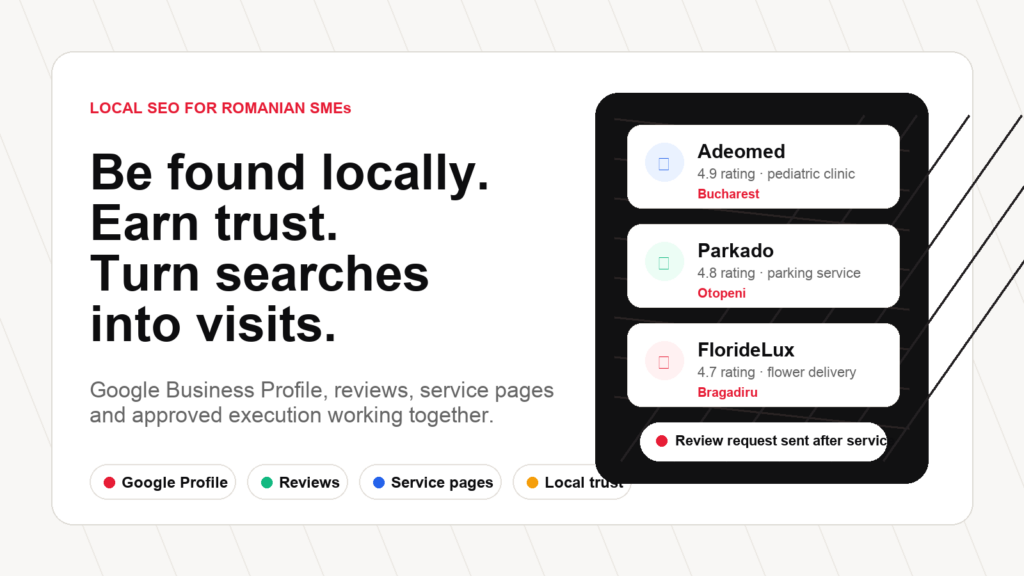
Executive summary: Local SEO in Romania is not only about showing up on Google Maps. It is about making a local business easy to understand, easy to trust and easy to choose across Google Search, Google Business Profile, local results, AI-assisted search and the business website. For WordPress businesses, the biggest gap is usually not knowledge. It is execution: incomplete service pages, weak location signals, inconsistent business details, missing review workflows, slow mobile pages and no system for turning local search data into approved website improvements.
This is another article in our WordPress SEO in Romania series. It connects naturally with Romanian search intent, technical SEO, WooCommerce SEO in Romania and the broader theme of the series: Romanian SMEs do not need more static SEO theory. They need a practical operating model that monitors, prepares, asks for approval and executes.
Local SEO is where Romanian SMEs can still beat bigger competitors
For many Romanian businesses, local SEO is the most practical organic growth channel. A small clinic, dental office, parking service, flower shop, repair company, legal office, beauty salon, restaurant, local store or professional service provider may not need national visibility for every generic Keyword. It needs to be found by the right people in the right area, at the right moment, with enough trust signals to turn a search into a visit, booking, call or purchase.
The problem is that local SEO is often treated too narrowly. Many business owners think the job is done once they create a Google Business Profile. Others add the city name to a Title tag and call it local SEO. Some agencies send monthly ranking reports, but the website still does not explain services clearly, reviews are not requested consistently, location pages are thin, the address is inconsistent, and Search Console data is not used to improve real pages.
Local SEO is not a single asset. It is a system made of Google Business Profile, website service pages, local landing pages, reviews, Structured data, internal links, citations, photos, opening hours, contact details, maps, mobile experience, useful content and authority signals. Each part reinforces the others.
In Romania, this matters because many SMEs still compete with incomplete local SEO systems. That creates opportunity. A business that consistently improves its profile, website and review process can outperform competitors that only have an old website and a passive Maps listing.
How Google explains local ranking: relevance, distance and prominence
Google’s own documentation explains local ranking around three main factors: relevance, distance and prominence. This is useful because it prevents the discussion from becoming mystical. Local SEO is not magic. It is about helping Google and users understand whether a business matches the search, whether it is geographically appropriate and whether it appears trustworthy and well known enough to be a good result.
Relevance is about how well the business matches what the user is searching for. If a user searches for “clinica pediatrie Bucuresti,” Google needs to understand whether the business is a pediatric clinic, what services it provides, where it operates and whether its profile and website explain that clearly. A vague website and incomplete profile reduce relevance.
Distance is about how far the business is from the location used in the search or the user’s known location. A business cannot fake proximity, and it should not try. But it can be clear about service areas, branches, delivery zones and local coverage. A flower delivery business in Bragadiru that also serves Bucuresti should explain delivery areas honestly and specifically. A parking service near Otopeni should make airport proximity and transfer process clear.
Prominence is about how well known and trusted the business appears. Google mentions that prominence can be based on information from across the web, including links, articles and directories, and that review count and review score can factor into local ranking. This is not a license to spam reviews or buy fake links. It is a reminder that local trust must be built visibly and ethically.
For Romanian SMEs, the practical conclusion is simple: you need a better business record, better local pages and better trust signals. You cannot control everything in local ranking, but you can control far more than most businesses actually execute.
Google Business Profile is not a replacement for the website
Google Business Profile is essential for local visibility, but it should not be treated as the whole local SEO strategy. The profile helps the business appear in Google Search and Maps, show hours, location, phone number, categories, photos, reviews and other information. But the website still carries deeper context: service pages, pricing explanations, booking details, trust proof, process, FAQs, policies, specialist information, content depth and conversion paths.
A local business should make sure the Business Profile is accurate and complete. The name should follow Google’s rules. Categories should match the real business. Opening hours should be updated. Phone, website and address should be consistent. Photos should show real business context. Services should be added when relevant. The profile should not be abandoned after setup.
But the website must support the profile. When someone clicks from Google Business Profile to the website, the page should continue the decision journey. If a parent searches for a pediatric clinic, they need to understand services, doctors, appointment process, emergency versus normal consultation context, location, contact options and trust signals. If someone searches for parking near the airport, they need pricing, shuttle information, security, booking process, address and review proof.
That is why local SEO requires both profile management and website execution. A profile can attract attention. A weak website can lose the customer.
Categories, services, hours, phone, address, photos and website link.
Profile layer
Real review requests after service moments, with no fake incentives.
Trust layer
Specific pages for services, locations, process, pricing context and FAQs.
Website layer
Mobile speed, crawlability, schema, internal links and indexation.
Foundation
Relevant mentions, useful content, local citations and authority signals.
Growth layer
Reviews are not decoration. They are local proof.
Reviews are one of the most visible trust signals in local search. Google’s local ranking documentation notes that review count and review score can factor into local ranking, and users clearly use reviews when comparing local options. But reviews should be earned ethically. Google’s policies prohibit fake engagement, review gating and other deceptive behavior. A local business should never manufacture trust.
The practical approach is to build a review request system around real customer moments. If a customer has successfully used the service, ask politely and make the process easy. For example, Parkado can send a review request one day after the customer has used the parking service, when the experience is fresh and the customer can evaluate the service honestly. A medical clinic like Adeomed can use a QR code at reception to invite patients to leave feedback after their visit, without pressuring them or filtering only positive reviews.
The important detail is timing and honesty. Do not ask before the service is delivered. Do not pressure the customer. Do not offer deceptive incentives. Do not ask only happy customers while excluding unhappy ones. Do not write reviews for customers. A review system should create a fair, repeatable opportunity for real feedback.
Reviews also feed the website strategy. If customers repeatedly mention speed, kindness, parking, waiting time, price clarity, professionalism, delivery, communication or problem-solving, those themes should inform service pages and FAQs. Voice of the customer is not only reputation management. It is content strategy.
AYSA can help by identifying where review proof is missing, preparing review request workflows, suggesting FAQ improvements based on customer language and connecting review themes to local landing pages. The business owner still controls the message and approves changes. The agent reduces the operational workload.
Local service pages must answer real local buying questions
Many Romanian WordPress websites have service pages that are too generic. They list the service, add a few paragraphs, include a phone number and hope to rank. That is not enough. A strong local service page should answer the questions that block the customer from contacting the business.
A page for a medical service should explain who the service is for, what symptoms or situations it addresses, what happens during the appointment, who provides the service, what the patient should bring, how appointments work, where the clinic is, whether urgent cases are handled, what trust signals exist and what the next step is.
A page for a parking service should explain distance to the airport, transfer timing, security, booking, cancellation, payment, directions, luggage, night arrivals and what happens if the flight is delayed.
A page for a flower delivery business should explain delivery areas, same-day cut-off time, freshness, substitutions, occasions, bouquet sizes, payment methods, message cards and what happens if the recipient is not available.
This is where quality content becomes concrete. A page about “best pediatric clinic in Bucharest” should not look like a generic directory. It should help a parent compare options, understand when to choose emergency care, see real criteria, evaluate trust signals and decide what to do next. A local SEO page must be useful before it can be persuasive.
Search intent in Romania also needs local nuance. People search with city names, neighborhoods, “aproape de mine,” “pret,” “program,” “non stop,” “pareri,” “ieftin,” “rapid,” “livrare,” “sector,” “langa aeroport,” and many other modifiers. A business should not stuff these terms mechanically. It should understand the intent behind them and create pages that genuinely answer the need.
The technical foundation still matters in local SEO
Local SEO is not only content and reviews. A slow, confusing, technically weak WordPress website will waste opportunity. Mobile performance is especially important because many local searches happen on phones. If the first screen is slow, hard to read or hides the call button, the business loses leads.
The technical checklist for local WordPress sites should include mobile speed, clean navigation, indexable service pages, self-referencing canonicals, no accidental noindex, correct redirects, compressed images, local structured data where appropriate, clean sitemaps, stable contact information and no plugin bloat that harms interaction.
LocalBusiness structured data can help search engines understand details about a business when it matches visible page content. It should not be used as a trick. It should reflect real information: name, address, phone, opening hours, URL and relevant business type where appropriate. The visible page should support the structured data.
Technical work also includes internal linking. Local service pages should not be isolated. They should link to related services, FAQs, case studies, contact pages, location information and relevant blog guides. Internal links help users and search systems understand the relationship between pages.
As covered in our article on technical SEO for Romanian WordPress websites, the biggest technical problems in Romania are often practical: shared hosting, plugin bloat, heavy page builders, images, caching mistakes, indexation chaos and redirect problems. Local businesses are not exempt from these issues. In fact, they often suffer more because they lack technical teams.
Manual local SEO
Check rankings, open Business Profile, export queries, brief content, chase reviews, ask developer, wait.
Risk: the local opportunity is known, but nothing ships fast enough.
AYSA local workflow
Local SEO and AI search: the website must be easy to understand
AI-assisted search does not remove local SEO. It makes clarity more important. When users ask conversational questions like “recommend a pediatric clinic in Bucharest,” “where can I park near Otopeni airport,” or “who delivers flowers today in Bragadiru,” the systems that answer need reliable information from profiles, websites, reviews, maps and broader web signals.
This does not mean a business can guarantee inclusion in AI answers. It cannot. But it can improve the signals that make the business easier to understand, cite and recommend: clear service pages, structured information, strong reviews, local relevance, helpful FAQs, trustworthy content, consistent business details and technical crawlability.
For local businesses, this is also a language problem. AI systems and search engines must understand Romanian service context, local place names, neighborhoods, business categories and customer questions. Generic translated content is not enough. A local page should sound like it understands the market.
This is where AYSA’s continuous learning about the business matters. The agent is not only a text generator. It learns the business profile, services, goals, market, tone, Google data and approved actions. Over time, that creates a stronger SEO memory for the business than a disconnected chat conversation.
A 30-day local SEO plan for Romanian SMEs
A practical local SEO plan should start with execution, not endless analysis. Here is a realistic 30-day loop for a Romanian SME using WordPress.
Days 1-5: local business profile audit. Confirm the business name, category, address, phone, website URL, hours, services, photos and review status. Identify missing information and inconsistencies. Check whether the website page linked from the profile is the right page for the user journey.
Days 6-10: service page audit. Identify the most important services and locations. Check whether each page answers real buyer questions: what the service is, who it is for, price or pricing context, process, timing, location, proof, FAQs and next step.
Days 11-15: review workflow. Define when and how the business asks for reviews. Use real service moments. Parkado can request feedback after the parking experience. A clinic can use a QR code at reception or follow-up message. A florist can ask after successful delivery. The workflow must be ethical and repeatable.
Days 16-20: technical and schema cleanup. Check mobile speed, crawlability, local structured data, contact consistency, sitemap, canonical tags, redirects and internal links. Fix issues that block users or search systems from understanding the business.
Days 21-30: content and authority. Build supporting content around local questions, create links between guides and service pages, improve trust sections, add case examples where appropriate and review local publisher or directory opportunities carefully.
The loop then repeats. Local SEO is not a one-time setup. Reviews continue. Competitors move. Search behavior changes. Services change. Google updates local surfaces. A business that keeps improving will usually build stronger visibility than a business that waits for an annual website redesign.
Where AYSA fits in local SEO
AYSA is designed for businesses that do not want to become SEO specialists and do not want to manage SEO agencies for every small execution task. The agent can monitor the website, understand the business profile, read Google performance signals, prepare local SEO improvements, explain them in plain language, ask for approval and execute accepted changes inside the website workflow.
For local SEO, this means AYSA can help identify weak service pages, missing local FAQs, review workflow opportunities, inconsistent business details, internal link gaps, local content opportunities, technical issues and visibility changes. The important part is the workflow: AYSA does not only show a report. It prepares the work and moves it toward approved execution.
That distinction matters for Romanian SMEs. A business owner should not have to learn every detail of structured data, local ranking, Search Console, internal linking, review policy and technical SEO just to be visible locally. The owner should understand the recommendation, approve what matters and let the system handle the work.
Common local SEO mistakes I still see in Romanian WordPress websites
The first mistake is creating one generic “services” page and expecting it to rank for every service and every city. Search intent is more specific than that. A user searching for “parcare aeroport Otopeni” is not in the same state of mind as a user searching for “parcare lunga durata Otopeni pret.” A parent searching for “clinica pediatrie Bucuresti” is not asking the same question as someone searching for “urgente pediatrie Bucuresti.” One page cannot answer every decision properly.
The second mistake is hiding the practical details that customers actually need. Many local pages avoid pricing, process, waiting time, delivery area, parking, appointment instructions, what is included, cancellation rules or what happens next. Businesses sometimes fear that details will make the page too long. In reality, useful details reduce hesitation. They also help search systems understand the page better.
The third mistake is treating reviews as a campaign instead of an operating habit. A business asks for reviews for two weeks, then stops. Local trust is not built in bursts. It is built through a repeatable process connected to real customer experience. The review request should become part of the service workflow, not a panic reaction when competitors pass you.
The fourth mistake is creating local pages without local usefulness. A page that only swaps the city name is a doorway-page risk and a bad user experience. A real local page should explain service availability, local constraints, examples, directions, timing, proof and context. If the business genuinely serves multiple areas, each important page should justify its existence with useful information.
The fifth mistake is ignoring the website after the Google Business Profile looks acceptable. The profile may bring the click, but the website often wins or loses the customer. Local SEO must connect the profile, the page, the review proof and the conversion path into one coherent experience.
Final point of view
Local SEO in Romania is still full of opportunity because so many businesses are incomplete. Their Google Business Profiles are not maintained. Their service pages are thin. Their reviews are passive. Their websites are slow. Their local content is generic. Their technical layer is fragile. Their SEO work depends on manual follow-up.
The businesses that win will be the ones that treat local SEO as an operating system: profile, website, reviews, technical health, content, authority and execution working together. Not one dashboard. Not one plugin. Not one audit. A loop.
Less SEO work. More organic growth. For local businesses, that means fewer vague recommendations and more approved improvements that help real customers find, trust and choose you.
Content SEO layer: for useful pages, topic authority and AEO-ready content, read Content SEO for Romanian WordPress Websites.
Less SEO work. More organic growth.
Turn local SEO opportunities into approved website action.
AYSA monitors your website, prepares local SEO, AEO and AI visibility improvements, asks for approval and executes accepted changes inside your website workflow.
Sources and further reading
- Google Business Profile Help: How Google determines local ranking
- Google Business Profile Help: Business Profile guidelines
- Google Maps user-generated content policy
- Google Search Central: Local business structured data
- Google Search Central: Creating helpful, reliable, people-first content
- Google Search Central: Crawling and indexing
Continue the AI search topic inside AYSA.
Use these pages to connect the article with AI SEO tools, AI visibility monitoring, AI Overviews and approved website execution.
Turn this topic into a website action plan.
Use these AYSA hubs to move from reading to technical fixes, AI visibility monitoring, research, glossary context and approval-first SEO execution.

