
Romanian Search Intent for WordPress SEO: Why Translation Is Not a Strategy
Romanian WordPress SEO fails when businesses translate keyword lists instead of mapping how local buyers search, compare, trust and decide.
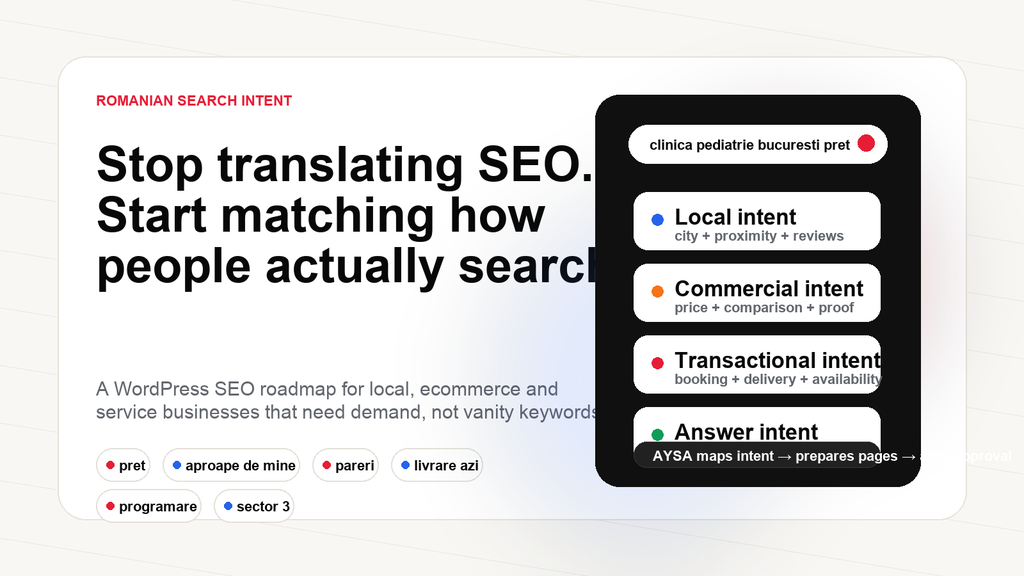
Executive summary: Romanian Search intent is not English SEO translated into Romanian. A customer searching for “pret,” “aproape de mine,” “pareri,” “livrare azi,” “programare,” “sector 3,” “cod reducere,” “comparatie,” or “cat dureaza” is revealing a specific decision stage. WordPress SEO works when those intents become useful pages, internal links, structured content and approved website changes.
This is article 4 in the AYSA WordPress SEO in Romania series. It connects directly to the pillar research, WordPress SEO in Romania: The 20 Problems Holding Entrepreneurs Back, the article on why an SEO plugin is not a strategy, and the practical 90-day WordPress SEO action plan.
Related article: Intent work performs better when the technical foundation is clean. Read Technical SEO for Romanian WordPress Websites to connect demand mapping with crawlable, fast, indexable pages.
Search intent is the difference between traffic and useful demand
Search intent is the reason behind a query. It is what the person wants to understand, compare, buy, verify, book, avoid or solve. In SEO theory this sounds simple. In real business work, it is where many WordPress websites in Romania lose most of their opportunity.
A business owner may say, “I want to rank for florarie,” “I want to rank for dentist,” “I want to rank for SEO,” or “I want to rank for mobila.” These words may have Search volume, but they are too broad to guide execution. The useful question is different: what does the searcher need at this exact stage, and what page should exist on the website to satisfy that need better than the alternatives?
Someone searching “florarie bragadiru livrare azi” is not the same as someone searching “cum se ingrijesc trandafirii.” Someone searching “clinica pediatrie bucuresti pareri” is not the same as someone searching “februa copil cand merg la urgente.” Someone searching “pret implant dentar sector 3” is not the same as someone searching “ce este implantul dentar.” The words reveal urgency, location, comparison behavior, trust anxiety and commercial readiness.
Google’s SEO Starter Guide repeatedly frames SEO around helping search engines understand content and helping users find the right information. Google’s helpful content guidance also emphasizes creating content for people, not content that exists only to attract search traffic. That means intent is not a decorative Keyword exercise. It is the editorial and operational foundation of SEO.
For WordPress websites, intent matters because the platform makes publishing easy. Easy publishing creates both opportunity and risk. You can quickly create service pages, category pages, blog articles, FAQs, location pages and guides. But if those pages are not mapped to real search intent, the site becomes a content pile instead of a search system.
This is especially important in Romania, where many SMEs have limited digital resources. The business cannot afford to publish hundreds of generic articles and hope. It needs pages that answer real buyer questions, support commercial categories, explain local service details, build trust and move visitors toward a decision.
The translation problem: why English keyword lists mislead Romanian SEO
Many Romanian SEO projects start from English templates. The agency or founder looks at international keyword tools, translates terms and creates pages around the Romanian equivalents. This can be useful for orientation, but it is dangerous as a strategy.
Romanian search behavior has its own vocabulary. People mix Romanian, English, brand names, local modifiers, shorthand, diacritics and non-diacritic forms. They search differently depending on age, region, urgency and buying confidence. A parent looking for a pediatric clinic may use “clinica pediatrie bucuresti,” “pediatru bun sector 6,” “urgente pediatrie non stop,” “pareri clinica copii,” or “programare pediatru azi.” Each query implies a different page or page section.
Translation also misses cultural buying behavior. Romanian customers often search for price, reviews, proximity, phone number, delivery details, return policy, payment methods, availability and trust proof. A page that only translates a generic English service description may be grammatically correct but commercially weak.
Another problem is that English SEO content often assumes a mature content ecosystem. In the US or UK, a topic may have many specialized landing pages, comparison pages and editorial guides. In Romania, the SERP may contain marketplaces, directories, thin local pages, Facebook pages, Google Business Profiles, review platforms and old articles. The opportunity may not be to copy the English content model. The opportunity may be to create the clearest Romanian answer for a practical decision.
WordPress amplifies this issue because it is easy to create pages without a map. A business may create one page per service, then blog posts around translated keywords, then categories, then tags, then landing pages. If the intent map is missing, Internal linking becomes random. Some pages compete with each other. Some important intents have no page. Some pages exist but do not answer the query well.
The result is often visible in Search Console. The site may get Impressions for queries it does not fully answer. The page may rank low because it is too generic. CTR may be weak because the title does not match the searcher’s language. Users may land on a page but not convert because the next step is unclear. The owner sees “SEO traffic” but not business growth.
Romanian intent patterns every SME should map
A practical Romanian intent map should start with patterns, not isolated keywords. Patterns help the business understand demand in plain language.
Price intent is one of the most important patterns. Queries containing “pret,” “cost,” “tarif,” “cat costa,” “oferta” or “abonament” indicate that the user is evaluating affordability and seriousness. Many Romanian websites avoid price language because they fear losing leads. That can be a mistake. Even if exact pricing is not possible, the page can explain ranges, factors that influence cost, what is included, when a custom quote is needed and how the customer can get an estimate.
Local intent includes cities, neighborhoods, sectors, counties and “aproape de mine” behavior. Google Business Profile documentation explains local ranking through relevance, distance and prominence. The website should support that with clear service areas, local proof, contact details, directions, opening hours, local content and consistent business information. Local SEO is not only the Google Business Profile. It is the relationship between the profile, the website and customer proof.
Trust intent appears in searches for “pareri,” “recenzii,” “recomandari,” “forum,” “experiente,” “is it safe,” or brand comparisons. A page that ignores trust will often fail even if it ranks. Romanian customers are careful, especially for medical, financial, legal, home services, education, ecommerce and B2B decisions. They want proof, not slogans.
Urgency intent includes “azi,” “non stop,” “urgent,” “rapid,” “livrare azi,” “programare azi,” “deschis acum,” “in weekend.” These queries need pages or sections that answer availability clearly. If a business can serve urgent demand, the website should say so. If it cannot, it should still guide the user honestly.
Comparison intent includes “cel mai bun,” “top,” “vs,” “alternative,” “comparatie,” “diferenta,” “avantaje,” “dezavantaje.” These pages are difficult because they require judgment. But they can be extremely useful when written honestly. A comparison page should not be disguised advertising. It should help the user make a better decision.
Process intent includes “cum functioneaza,” “cum se face,” “ce urmeaza,” “pas cu pas,” “documente necesare,” “durata.” These queries reveal anxiety. The user may want to buy but does not understand the process. A good WordPress page can reduce friction by explaining steps, timelines, responsibilities and what the customer needs to prepare.
Problem intent includes symptoms, errors, failures and obstacles. For WordPress SEO itself, this may look like “de ce nu apare site-ul pe google,” “site lent wordpress,” “pagini neindexate,” “eroare 404,” “scadere trafic organic.” For a business, these problem queries can become educational content that leads naturally to service pages.
Query signal
• “pret implant dentar”
• “florarie livrare azi”
• “pediatru bun pareri”
Page job
✓ Explain pricing factors.
✓ Confirm availability and area.
✓ Show trust criteria and proof.
Execution
✓ Prepare copy blocks.
✓ Add internal links.
✓ Ask for approval before publishing.
How to map Romanian intent to WordPress page types
The fastest way to improve a WordPress site is to map intents to page types. This prevents every question from becoming a random blog post.
Homepage: The homepage should clarify who the business serves, what it does, where it operates, why it can be trusted and what the next step is. It should not try to rank for every keyword. It should route users and search engines toward the right sections.
Service pages: Each important service deserves a page that explains the problem, the service, who it is for, process, price logic, proof, FAQs, related services and next step. A service page should answer commercial and process intent, not only define the service.
Location pages: Location pages should exist only when the business genuinely serves the location and can add useful local information. Doorway-style pages with copied text and swapped city names are risky and usually useless. A strong local page includes service details, area context, proof, contact information, local FAQs and internal links.
Category pages: For WooCommerce and ecommerce sites, category pages are often the real money pages. They should help users choose. That means useful descriptions, buying criteria, filters, related categories, FAQs, delivery details, internal links and product data quality.
Product pages: Product pages should answer specifications, benefits, compatibility, delivery, returns, warranty, stock, images, reviews and common objections. Thin product pages are a major lost opportunity, especially when competitors or marketplaces provide more complete information.
Blog and guide pages: These pages should support informational, comparison, problem and process intent. A guide should not exist only because a keyword has volume. It should support the customer journey and link to the relevant commercial page.
FAQ pages and FAQ sections: FAQs are useful when they answer real objections and clarify decisions. They should not be generic filler. In 2026, FAQ rich results are changing, but visible FAQs still matter for users, internal structure and answer readiness.
Glossary pages: Glossary content can support definitions and topical authority, but a glossary entry should not replace a service page. “Technical SEO” as a glossary term is different from a page selling a technical SEO workflow. The first educates. The second converts.
A good WordPress SEO system assigns every intent to the right asset. This is how a site becomes easier to crawl, easier to understand and easier to use.
Local and ecommerce examples from Romanian reality
Consider a pediatric clinic in Bucharest. A generic page about “pediatric services” is not enough. Parents may search for regular consultations, emergency care, newborn checks, vaccination, weekend schedule, prices, doctors, reviews, proximity and appointment speed. The website should help the parent decide what type of care they need and what to do next. A useful page may include criteria for choosing a clinic, when to go to emergency care, how appointments work, what documents are needed, pricing guidance and trust signals.
Consider a flower shop serving Bragadiru and Bucharest. Search intent includes same-day delivery, funeral flowers, wedding arrangements, bouquets by occasion, seasonal flowers, delivery areas, pickup, payment methods and freshness. A translated “flower delivery” page is not enough. The site needs category pages, local delivery pages, occasion guides, care guides and internal links that connect informational content to buying pages.
Consider a WooCommerce store selling home products. The business may want to rank for generic product names, but buyers often search by problem, room, material, size, color, compatibility, budget and delivery. Category pages should guide choice. Product pages should answer objections. Blog content should support categories, not float independently.
Consider a B2B service company. Search intent may be lower volume but higher value. Users compare providers, look for case studies, pricing logic, process, risk, implementation time, integrations and proof. A generic “services” page will not help enough. The site needs pages that reduce perceived risk.
The pattern is the same across sectors. The best SEO page is not the page that repeats the keyword most. It is the page that helps a specific user at a specific decision stage in a specific market.
How to validate intent without guessing
Intent mapping should not be purely theoretical. The fastest source of evidence is Search Console. Look at queries that already trigger impressions. Which words appear repeatedly? Are users searching for price, location, reviews, urgency, comparison, process or problems? Which pages receive impressions for queries they do not answer well? Which pages have poor CTR even though they appear in search?
Analytics can add behavioral evidence. Do users leave quickly from certain pages? Do mobile users fail to contact the business? Do category pages get traffic but few product clicks? Do blog posts attract visitors who never reach commercial pages? This does not prove intent by itself, but it helps identify friction.
Customer conversations are another source. Sales calls, WhatsApp messages, support emails, reception questions, ecommerce chat logs and review text often reveal the exact language customers use. Many businesses already have this data, but it is not connected to SEO.
Competitor SERPs also matter. Search the query manually. What types of pages appear? Local packs? Directories? Ecommerce categories? Articles? Videos? AI Overviews? Forums? Google’s AI features and answer surfaces make this even more important because the best answer may need to be structured, concise, sourced and easy to summarize.
Finally, test changes. Rewrite a title. Improve a section. Add a FAQ. Link a guide to a service page. Clarify price logic. Add local proof. Then monitor impressions, CTR, engagement and conversions. SEO is not static. It is a feedback loop.
A practical intent workshop for a Romanian WordPress site
If I had to run a two-hour intent workshop with a Romanian SME, I would not start with a keyword tool. I would start with the business. What does the company sell? Who buys it? What makes the buyer hesitate? What questions does the sales team answer every week? What objections appear before purchase? What locations matter? What products or services have margin? Which customers are not worth attracting? These answers shape SEO more than a raw keyword list.
The second step is to collect query evidence. Export Search Console queries for the last 3, 6 and 12 months. Group them manually at first. Put price queries together. Put local queries together. Put brand queries together. Put “pareri” and comparison queries together. Put informational questions together. Put queries that already show impressions but weak CTR into a separate list. This is where the site is already being tested by the market.
The third step is to match each group to a page. If a query has commercial intent and there is no page for it, that is a missing page opportunity. If the query points to an existing page but the page does not answer it well, that is an improvement opportunity. If several pages target the same intent, that may be cannibalization or a need for better internal linking. If the query is irrelevant to the business, do not chase it just because it has volume.
The fourth step is to decide the page job. A page can educate, compare, sell, reassure, explain a process, help choose a product, support local visibility, answer objections or build authority. Trying to make every page do everything creates weak pages. A strong page knows its job.
The fifth step is approval. This is where SEO becomes business work. A page about price may require the founder to approve language. A medical page may require expert review. A local service page may need confirmation about coverage. An ecommerce category may need merchandising input. A comparison page may need brand judgment. If the business owner is not included at the right moment, the SEO work stalls or publishes generic content.
The final step is execution. Update the page, improve the title and description, add the missing section, create the internal links, prepare schema if it matches visible content, publish the new guide, redirect the old weak page if needed and track the result. This is the difference between a keyword workshop and SEO that actually changes the website.
Sales calls, WhatsApp, reviews, reception questions, support tickets.
Queries, impressions, weak CTR, existing pages and missing opportunities.
Service pages, category pages, local pages, guides and FAQs.
Prepared changes reviewed by the business, then published safely.
Where AYSA fits: automated research, human approval and website execution
AYSA is designed for exactly this gap between research and execution. A human can understand the business. A plugin can expose fields. But the hard part is the volume of work: collecting data, reading Search Console patterns, mapping queries to pages, identifying missing content, preparing titles, planning internal links, suggesting FAQs, flagging technical issues and turning all of that into approved website changes.
In AYSA’s research workflow, the agent can extract what people search for, read what the website already ranks for, compare competitors, map opportunities and plan SEO/AEO-friendly content around topical authority. Behind a proper research phase there are many small processes: query discovery, intent grouping, competitor review, keyword mapping, missing-page detection, internal-link planning, content planning and technical validation. Manually, this can take days. In an automated workflow, much of the preparation can happen in about an hour, with the user approving important actions before execution.
This approval layer matters. The business owner should not lose control of positioning, pricing, medical claims, legal claims, local promises or authority spending. AYSA’s role is not blind autopilot. Its role is to prepare the work, explain why it matters, ask for approval and execute accepted changes inside the website workflow.
For Romanian SMEs, this is the practical path forward. The market is competitive, the volume of SEO work is increasing and search is expanding toward AI-assisted answers. The answer is not to publish more random content. The answer is to build a system that understands Romanian search intent, prepares the right work and moves it into approved execution.
My view is blunt: translated SEO is lazy SEO. The businesses that win will be the ones that understand how their customers actually search, decide and trust. WordPress gives them a flexible publishing platform. AYSA helps turn that flexibility into a disciplined execution system.
Next in the series: for ecommerce-specific catalog, product data and filter issues, read WooCommerce SEO in Romania: Categories, Products, Filters and Marketplace Pressure.
Local SEO layer: for Google Business Profile, reviews, service pages and local trust signals, read Local SEO in Romania for WordPress Websites.
Content SEO layer: for useful pages, topic authority and AEO-ready content, read Content SEO for Romanian WordPress Websites.
Less SEO work. More organic growth.
Turn Romanian search intent into approved website execution.
AYSA maps demand, prepares SEO and AI visibility work, asks for approval and executes accepted changes inside your website workflow.
Sources and further reading
- AYSA: WordPress SEO in Romania: The 20 Problems Holding Entrepreneurs Back
- AYSA: Why an SEO Plugin Is Not a WordPress SEO Strategy
- AYSA: The 90-Day WordPress SEO Action Plan for Romanian SMEs
- Google Search Central: SEO Starter Guide
- Google Search Central: Creating helpful, reliable, people-first content
- Google Business Profile Help: Tips to improve your local ranking on Google
- Google Search Central: AI features and your website
- Google Search Console Help: About Search Console
Continue the AI search topic inside AYSA.
Use these pages to connect the article with AI SEO tools, AI visibility monitoring, AI Overviews and approved website execution.
Turn this topic into a website action plan.
Use these AYSA hubs to move from reading to technical fixes, AI visibility monitoring, research, glossary context and approval-first SEO execution.

