
SEO and AEO for Private Medical Clinics: Trust, Local Visibility and Patient-Useful Content
A practical guide to SEO and AEO for private medical clinics: local visibility, Google Business Profile, reviews, doctor pages, service pages, YMYL trust and approved execution.
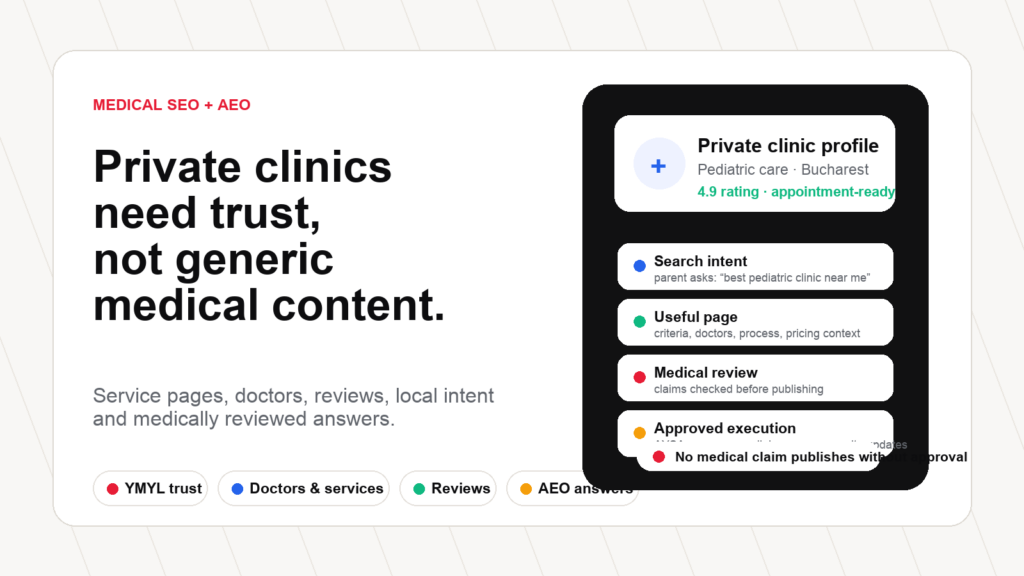
Executive summary: SEO and AEO for private medical clinics is not normal content marketing. Healthcare is a trust category. A clinic is not selling a simple product; it is asking a patient or parent to make a sensitive decision involving health, safety, time, money and confidence. That means clinic SEO must be built around useful medical information, clear service pages, doctor credibility, local visibility, review workflows, technical reliability and medically Approved Execution.
The biggest mistake private clinics make is treating SEO as either “rank for medical keywords” or “publish more blog posts.” The better model is patient-useful visibility: help people understand the service, know when to book, compare options responsibly, see who will treat them, understand location and process, read real trust signals, and take the next step without confusion. For AEO and AI-assisted search, the same principle becomes even more important: the clinic must be easy to understand, cite and recommend without making unsupported claims.
Private clinic SEO is different because the decision is sensitive
A person searching for a medical clinic is rarely in a casual browsing mode. They may be worried, in pain, comparing doctors, looking for a second opinion, searching for a clinic near home, trying to understand symptoms, or deciding whether a child needs a routine consultation or urgent care. The website does not only need to rank. It needs to reduce uncertainty responsibly.
That is why medical SEO cannot be treated like generic Local SEO. A restaurant can be playful. A flower shop can be emotional. A medical clinic needs clarity, evidence, credentials, process and trust. The tone should be accessible, but not careless. The page should help, but not overpromise. It should guide the patient, but not replace a medical consultation.
For private clinics, organic visibility usually depends on a mix of search surfaces: Google Search, Google Business Profile, local packs, Maps, service pages, doctor profiles, review snippets, informational articles, branded searches, AI-assisted search and answer engines. A clinic that only optimizes one layer leaves opportunity on the table.
Clinics also face a difficult operational problem. They need good content, but they cannot publish medical claims casually. They need reviews, but they must request them ethically. They need local visibility, but they should not create doorway pages for every city or neighborhood. They need AI-assisted workflows, but they cannot let an AI publish medical content without human review. The winning system is not blind automation. It is approved execution.
Healthcare is YMYL, so content quality standards are higher
Google’s Search Quality Rater Guidelines describe health and medical topics as part of “Your Money or Your Life” because inaccurate information can affect a person’s health, safety or well-being. This does not mean a small clinic cannot compete. It means the clinic must be more careful. The page must be useful, trustworthy and transparent.
For a medical clinic, trust is not only a design element. It is content architecture. Patients need to see who provides the service, what qualifications matter, what the consultation involves, when the service is appropriate, what limitations exist, how appointments work, where the clinic is, what documentation may be needed and what the next step is.
Medical pages should avoid unsupported claims such as “best treatment,” “guaranteed result,” “instant cure” or “no risk” unless there is strong, visible and appropriate evidence. Even then, the wording must be careful. Healthcare content should make room for nuance. It should guide a patient toward professional evaluation rather than pretending that a web page can diagnose them.
This is also why AI content needs governance in healthcare. AI can help structure a draft, identify missing sections, summarize Search intent or prepare FAQs for review. But AI should not be treated as the final medical authority. A clinic should have a review process where medically sensitive statements are checked before publication.
In practical SEO terms, this means private clinics need content that is both accessible and accountable. Simple language is good. Oversimplification is not. Clear answers are good. Unsupported certainty is not. Examples are useful. Fake case studies are not. Patient education is useful. Medical advice without context is dangerous.
Local visibility starts with Google Business Profile, but it does not end there
For private clinics, local SEO is usually one of the highest-impact channels. Patients often search by city, neighborhood, specialty, doctor type, symptom, service and urgency. Queries like “clinica pediatrie Bucuresti,” “dermatolog sector 3,” “ecografie abdominala pret,” “clinica stomatologica aproape de mine,” or “analize medicale program sambata” combine medical need with Local intent.
Google explains local ranking using relevance, distance and prominence. For clinics, relevance means the profile and website clearly explain the medical services and specialties. Distance means the location or service area must match the user’s context. Prominence includes broader signals such as reviews, links, articles and web mentions.
A clinic’s Google Business Profile should be accurate and maintained: name, primary category, secondary categories, services, address, phone, website URL, hours, photos and review handling. But the website must continue the journey. If the profile says “pediatric clinic,” the landing page should explain pediatric services, doctors, appointment process, conditions handled, location, program, emergency limitations and contact options.
The mistake is treating the profile as the whole strategy. A strong profile can earn visibility, but a weak website can lose the patient. People click because they want more detail. They want to know who will see them, whether the clinic handles their problem, how soon they can book and whether the clinic feels trustworthy.
Medical service pages should answer patient decision questions
A medical service page should not be a thin definition. A page about pediatrics should not only say that the clinic offers pediatric consultations. A page about dermatology should not only list skin conditions. A page about dental implants should not only repeat “implant dentar” in headings.
A useful service page should answer a patient’s real questions. What is the service? Who is it for? When should someone book? What happens during the consultation? Who provides it? What should the patient bring? Are there age limits? How long does it take? Are investigations available? What are the next steps? What does the clinic not handle? When should someone seek emergency care instead?
For AEO, these answers should be visible and structured. A page can include concise answer blocks, FAQs, criteria, process sections and internal links to related services. The goal is not to manipulate search. The goal is to make the page genuinely easier to understand.
Consider the difference between a generic page and a useful page. A generic page says: “We offer pediatric consultations with experienced doctors.” A useful page explains routine consultations, newborn checks, fever evaluation, vaccination questions, growth monitoring, when to call emergency services, how appointments work, and what parents should bring. It also introduces the doctors and links to related pages.
This is the content quality standard private clinics should aim for. Not more words. Better decisions.
What the service includes, who it is for and when it is appropriate.
Core content
Doctors, specialties, credentials, medical review and visible accountability.
Trust layer
Location, schedule, appointment flow, contact, parking and access details.
Local layer
Real questions answered carefully, without replacing medical consultation.
AEO-ready
Clear booking path, phone, form, instructions and expectation setting.
Conversion
Doctor and team pages are not optional credibility assets
In healthcare, the person providing the service matters. Patients often search for doctors by name, specialty, clinic, reviews and availability. A private clinic that hides doctors behind generic service pages misses a major trust opportunity.
A strong doctor page should include the doctor’s name, specialty, credentials, areas of interest, languages, clinic location, appointment options, conditions or services handled, and links to relevant service pages. The page should avoid exaggerated claims. It should be factual, useful and current.
Doctor pages also support entity clarity. Search systems need to understand relationships: doctor, specialty, clinic, city, service, appointment, article author or reviewer. If a doctor medically reviews educational content, the page can disclose that clearly. If a specialist writes or reviews a guide, that is a trust signal for users and a clarity signal for search systems.
Private clinics should also think about author and reviewer models. Not every article needs to be written by a doctor, but sensitive medical content should be reviewed by qualified professionals. The page should show review dates and reviewer identity where appropriate. This is not SEO decoration. It is user trust.
Reviews should be requested ethically and used as patient insight
Reviews influence patient trust and can contribute to local prominence. But medical reviews must be handled carefully. Clinics should never create fake reviews, pressure patients, filter only positive feedback or disclose private health information in responses. Google’s user-generated content policies and business profile rules matter here.
The best review workflow is simple and respectful. Ask after a real service moment. Make it easy. Do not pressure. Do not offer deceptive incentives. Do not ask staff to write fake reviews. Respond professionally without revealing sensitive information.
For example, a clinic can place a QR code at reception asking patients to evaluate their experience. The request should be neutral, not “give us five stars.” The clinic can also send a follow-up message after an appointment, depending on local privacy and consent practices. The key is that the workflow must be ethical and repeatable.
Reviews are also a source of content insight. If patients repeatedly mention waiting time, doctor communication, child-friendly experience, appointment availability, parking or clarity of explanations, those themes should inform website pages. A clinic should not copy patient reviews into medical claims, but it can learn from the language patients use.
AEO for clinics means answer readiness with medical responsibility
Answer Engine Optimization for clinics is not about trying to trick AI systems into recommending the clinic. It is about making the clinic’s website clear, structured and responsible enough to be understood in answer-oriented search environments.
People ask AI systems questions like: “What should I ask before choosing a pediatric clinic?” “How do I know if my child needs urgent care?” “What is the difference between a dermatology consultation and a cosmetic dermatology procedure?” “What questions should I ask before a dental implant?” A clinic’s website can support these journeys by publishing useful, reviewed content.
The website should provide direct answers where appropriate, but also explain limits. A good medical answer often includes context: when to book, when to seek emergency care, what information the doctor needs, what factors influence the recommendation and what cannot be decided without consultation.
Structured content matters: clear headings, concise answer blocks, FAQ sections, internal links, doctor/reviewer information, service descriptions, location details and updated information. The page should be readable by people first and understandable by machines second.
No clinic can guarantee inclusion in AI Overviews or answer engines. What it can do is improve clarity, authority, technical accessibility, structured information and trust. That is the practical AEO opportunity.
Weak medical content
Generic symptoms, broad claims, no doctor proof, no process, no limits, no local context.
Risk: the page may rank weakly and may not earn patient trust.
Patient-useful content
Technical SEO still matters for clinics
A clinic website can have excellent doctors and still lose patients if the site is slow, hard to use on mobile, poorly indexed or technically messy. Medical searches are often urgent or emotionally charged. A parent on a phone will not wait patiently for a heavy page builder to load.
Private clinics should prioritize mobile performance, clear navigation, indexable service pages, clean sitemap, correct canonical tags, stable redirects, compressed images, secure HTTPS, accessible contact information, clear appointment CTAs and structured data that matches visible content.
Many clinic websites are built with heavy WordPress themes, multiple plugins, sliders, tracking scripts and old templates. This creates a gap between the quality of the medical service and the quality of the digital experience. Technical SEO is not only for Google. It is for patients trying to make a decision quickly.
What a private clinic should measure
A clinic should not judge SEO only by generic rankings. Medical visibility needs a more practical measurement model. Track impressions and clicks for service queries, branded searches for doctors and clinic name, local discovery searches, phone clicks, appointment form submissions, directions requests, review growth, review themes, service page engagement and pages that receive impressions but do not earn patient action.
Search Console can show whether Google is testing a page for important queries. Google Business Profile performance can show how patients discover the clinic profile. Analytics and CRM data can show whether organic visits become calls, appointments or form submissions. None of these sources is perfect alone, but together they create an operating picture.
The clinic should also measure execution. How many service pages were improved? How many doctor pages were completed? How many review requests were sent ethically? How many technical issues were resolved? How many medically reviewed FAQ sections were published? Organic growth comes from shipped improvements, not from reports that sit in a folder.
The approved execution workflow for medical clinics
Because healthcare content is sensitive, the workflow matters as much as the recommendation. A clinic should not allow blind publishing of medical content. But it also should not let every improvement get trapped in a slow manual process.
A practical workflow looks like this:
- Monitor: track local queries, service page performance, review themes, technical issues, AI visibility gaps and competitor content.
- Prepare: draft page improvements, FAQ sections, doctor page updates, internal links, metadata, schema recommendations and content refreshes.
- Flag sensitivity: identify claims that require medical review or management approval.
- Approve: clinic staff or designated reviewers confirm what can be published.
- Execute: approved changes are applied inside the website workflow.
- Measure: monitor impressions, clicks, calls, bookings, local visibility and future content opportunities.
This is where AYSA fits. AYSA can help a clinic move from scattered SEO recommendations to an execution system. It can prepare work, explain why it matters, keep the clinic in control and execute accepted changes. For medical clinics, that approval layer is not a nice-to-have. It is essential.
A practical 60-day SEO and AEO plan for a private clinic
Days 1-10: profile and visibility audit. Review Google Business Profile accuracy, categories, services, hours, photos, reviews and website landing page. Check Search Console for service queries, branded queries, doctor searches and local modifiers.
Days 11-20: service page improvement. Select the highest-value services and rebuild pages around patient decision needs: who the service is for, process, doctor proof, FAQs, location, appointment path and responsible medical disclaimers where needed.
Days 21-30: doctor and reviewer trust layer. Improve doctor pages, connect them to services, add reviewer information where appropriate and make the clinic’s expertise visible without exaggeration.
Days 31-40: review workflow and local proof. Build ethical review requests around real patient interactions. Use QR codes, follow-up messages or reception workflows where appropriate. Train staff on neutral language and privacy-safe responses.
Days 41-50: AEO content and internal links. Add answer-ready sections to service pages, create patient guides for common decision questions and link related services, doctors and support articles.
Days 51-60: technical cleanup and measurement. Fix mobile performance issues, sitemap noise, redirects, canonical problems and structured data gaps. Then measure changes and prepare the next approval queue.
Common mistakes private clinics should avoid
The first mistake is publishing thin medical articles that explain symptoms superficially but do not help the patient decide what to do next. These pages often sound like generic health encyclopedias. A clinic should instead create content connected to its real services, doctors and patient journey.
The second mistake is creating many city pages with almost identical text. If the clinic genuinely serves multiple locations, each local page should provide real local usefulness. If it is only a swapped city name, it is weak content and can create trust problems.
The third mistake is hiding doctors and credentials. Patients want to know who will treat them. Search systems also benefit from clear entity relationships between clinic, doctors, services and locations.
The fourth mistake is treating reviews as a one-time campaign. Reviews should be part of the patient experience workflow, requested ethically and handled professionally.
The fifth mistake is letting AI publish without review. AI can help clinics move faster, but medical content must be checked. The goal is not more unchecked content. The goal is better, approved, patient-useful content.
Final point of view
Private medical clinics do not need SEO that sounds clever. They need SEO that helps patients. The clinic must be visible locally, but it must also be trustworthy when the patient lands on the site. It must answer questions, show medical credibility, explain the process, handle reviews ethically, and make booking easy.
AEO and AI search make this even more important. If search becomes more answer-oriented, clinics with vague pages and weak trust signals will struggle. Clinics that build clear, reviewed, useful content around real patient decisions will be easier to understand and more likely to be considered credible sources.
My point of view is simple: medical SEO should be execution-led, but approval-first. Move faster, but do not publish blindly. Use AI to prepare work, not to replace medical judgment. Build pages that help people choose responsibly. That is where organic growth and patient trust meet.
Less SEO work. More organic growth.
Turn medical SEO opportunities into approved clinic website action.
AYSA monitors your website, prepares SEO, AEO and AI visibility improvements, flags sensitive claims for approval and executes accepted changes inside your website workflow.
Sources and further reading
- Google Search Central: Creating helpful, reliable, people-first content
- Google Search Central: Guidance about AI-generated content
- Google Business Profile Help: How Google determines local ranking
- Google Business Profile Help: Business Profile guidelines
- Google Maps user-generated content policy
- Google Search Central: Local business structured data
- Google Search Central: AI features and your website
Continue the AI search topic inside AYSA.
Use these pages to connect the article with AI SEO tools, AI visibility monitoring, AI Overviews and approved website execution.
Turn this topic into a website action plan.
Use these AYSA hubs to move from reading to technical fixes, AI visibility monitoring, research, glossary context and approval-first SEO execution.

