
WooCommerce SEO in Romania: Categories, Products, Filters and Marketplace Pressure
A practical WooCommerce SEO guide for Romanian stores: category strategy, product data, filters, Merchant Center, structured data, speed, out-of-stock pages and approved execution.
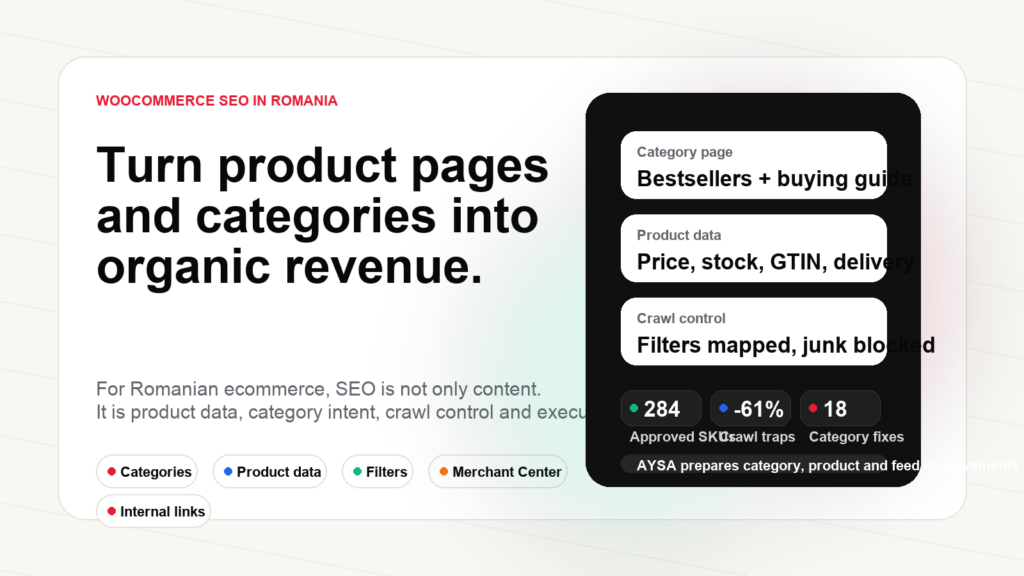
Executive summary: WooCommerce SEO in Romania is not won by installing an SEO plugin and adding a few keywords to product pages. The real work lives in category architecture, product data quality, Faceted navigation, Structured data, Internal linking, speed, Merchant Center readiness, stock logic, out-of-stock decisions, Authority Building and continuous execution.
This article is part of our WordPress SEO in Romania series. The previous articles covered the broad problems, why an SEO plugin is not a strategy, a 90-day action plan, Romanian Search intent and technical SEO for Romanian WordPress websites. Here we go deeper into the ecommerce layer: what a WooCommerce store must fix if it wants organic growth in a market where marketplaces, paid ads and AI-assisted search are all raising the bar.
WooCommerce is flexible. That is both the advantage and the problem.
WooCommerce is powerful because it lets a business owner build a store around their own catalog, brand, payment model, delivery process and content strategy. That flexibility is why many Romanian SMEs choose WordPress and WooCommerce instead of a closed ecommerce platform. A florist, a fashion shop, a parts store, a cosmetics brand, a furniture retailer or a local specialty store can build a site that reflects how the business actually sells.
But the same flexibility creates SEO risk. A WooCommerce store can quickly become a maze of categories, tags, product attributes, filters, variants, duplicate descriptions, out-of-stock pages, imported supplier content, slow templates, plugin conflicts and inconsistent product data. A store can look acceptable to a visitor while search engines see too many similar URLs, too little unique value, unclear canonical signals and product information that is not complete enough for rich ecommerce surfaces.
The Romanian context makes the problem sharper. Local ecommerce is no longer a quiet early market. Industry coverage from MerchantPro and other ecommerce organizations has described Romanian online retail as a multi-billion-euro market with steady growth, but also with stronger competition and more need for strategic adaptation. That means Romanian stores are not competing only with other small websites. They compete with marketplaces, international retailers, paid search advertisers, social commerce, comparison behavior and increasingly AI-assisted discovery.
For a WooCommerce store, SEO is no longer a separate marketing checklist. It is part of the operating system of the store. Products change. Stock changes. Categories change. Search demand changes. Competitors publish new guides. Google updates how product information appears. Merchant Center requirements evolve. AI Search introduces new answer surfaces. The winning store is not the one that gets one perfect audit. It is the one that can keep improving the catalog, the pages and the technical layer every week.
Category pages are the commercial backbone of WooCommerce SEO
Many WooCommerce stores in Romania treat category pages as containers. Products go inside them, maybe a short SEO text appears at the bottom, and the owner assumes the category is optimized. That is too weak for a competitive store.
A strong category page has a job. It must help a buyer choose. It should explain what belongs in the category, who the products are for, what differences matter, which filters are useful, what price ranges mean, what delivery or availability constraints exist and how the buyer should compare options. If the category is local or service-driven, it should also explain coverage, timing, trust signals and next steps.
Take a Romanian flower shop as a simple example. A category page for bouquets should not only say “buchete de flori online.” It should help buyers choose between roses, mixed bouquets, preserved flowers, birthday bouquets, sympathy arrangements, same-day delivery, office gifts and premium arrangements. A buyer searching in Romanian often uses context: “flori livrare azi Bucuresti,” “buchet mireasa,” “flori pentru zi de nastere,” “aranjamente florale Bragadiru,” “buchet trandafiri pret.” The page should guide that intent, not just repeat the main keyword.
The same logic applies to fashion, electronics, medical products, furniture, automotive parts and any niche catalog. A category page should be a buying guide embedded in the store architecture. It should not be a generic paragraph written only for search engines.
From an SEO point of view, category pages are also where internal authority often concentrates. Product pages may come and go, but category pages can remain stable. They can earn links, receive internal links from guides, rank for commercial terms, support product discovery and become answer-ready resources for users who are still choosing.
AYSA’s point of view is simple: if a category has search demand and business value, it deserves a real content and internal linking plan. The system should identify categories with impressions and weak CTR, categories with thin content, categories missing buyer guidance, categories that need FAQ-ready answers and categories that should link to related guides or subcategories. Then the work should be prepared for approval and executed when accepted.
Product data is not only a feed problem. It is an SEO problem.
Google’s ecommerce documentation and product structured data guidelines make one thing clear: ecommerce visibility depends on product information that can be understood by both users and search systems. Product title, description, price, availability, images, ratings, offers, shipping and return information can all influence how a product is understood and displayed across Google surfaces.
In many Romanian WooCommerce stores, product data is inherited from supplier feeds. That creates predictable problems. Titles are duplicated across stores. Descriptions are thin or copied. Images are not optimized. Variants are inconsistent. Attributes are incomplete. Availability changes without a clear strategy. Product pages have little unique value beyond the image, price and “add to cart” button.
This is dangerous because ecommerce search is increasingly data-rich. Google Merchant Center uses product data to understand what is being sold. Product structured data can enable product information to appear in richer search experiences when eligibility requirements are met. Users compare products before clicking. AI-assisted search may summarize options and cite sources based on clarity, completeness and trust.
A WooCommerce store should not blindly accept supplier data as final SEO content. The store needs its own layer of commercial usefulness. Important product pages should explain use cases, compatibility, materials, sizes, delivery details, warranty, care instructions, differences between variants and questions that real customers ask before purchasing. If every retailer uses the same description, the store gives Google little reason to prefer its page.
Product data also affects conversion. A clear product page reduces support questions and hesitation. A page that explains what is included, who it is for and when it ships can convert better than a page with a generic description and a low price. SEO and conversion are connected here.
AYSA can help by detecting weak product data patterns, preparing product title and description improvements, identifying pages where FAQs are useful, checking structured data opportunities, finding missing attributes and prioritizing the products or categories that matter most. The goal is not to rewrite every product blindly. The goal is to focus on the products and categories where better data can improve discovery, trust and sales.
Buyer guidance, FAQs, internal links and commercial clarity.
High impact
Titles, descriptions, attributes, availability and rich result eligibility.
Needs cleanup
Indexable demand pages versus crawl waste and duplicate paths.
Technical risk
Guides, categories, products and support content connected around topics.
Growth lever
Search results where bigger platforms dominate and store proof must improve.
Competitive
Filters can help users and hurt crawlability at the same time
Faceted navigation is one of the hardest WooCommerce SEO problems. Users need filters. They want to sort by size, color, brand, price, availability, location, rating, material or product type. But search engines can see filtered URLs as separate crawl paths. If every combination is crawlable and indexable, the store may create thousands of low-value URLs.
Google has warned for years that faceted navigation can create duplicate content and crawl inefficiency when parameter combinations multiply. The issue is especially relevant for ecommerce stores with many attributes. A filter can be useful for a user but useless as an indexable landing page. Another filter can match real search demand and deserve its own optimized page. The difference is intent.
For example, “red roses Bucharest delivery” may deserve a page if demand and inventory support it. But “sort by price high to low, page 4, blue, discount, in stock” almost certainly does not. A store needs rules, not guesses.
WooCommerce stores often get this wrong because plugins and themes generate URLs automatically. The business owner sees a normal filter interface. Google sees crawl traps, duplicates and low-value paths. The solution is not to block all filters blindly. The solution is to decide which filtered combinations have business and search value, then manage the rest through canonicalization, noindex rules, parameter handling, internal linking discipline and sitemap hygiene.
This is not work that should be done once and forgotten. Catalogs change. Attributes change. Search demand changes. The store may launch new collections or seasonal filters. A modern SEO agent should monitor these patterns continuously and prepare safe recommendations for approval.
Merchant Center and free listings make product clarity even more important
Google Merchant Center is not only for paid Shopping campaigns. Google also supports free listings, and Merchant Center product data can help products appear across Google surfaces when eligible. The official product data specification is detailed because Google needs reliable product information: identifiers, title, description, image link, availability, price, brand, GTIN or MPN where applicable, shipping and other fields depending on product type and destination.
For a Romanian WooCommerce store, this creates an important SEO lesson: product information must be consistent across the website, structured data and feed. If the page says one thing, the feed says another and structured data is incomplete, the store creates trust and eligibility problems. Even when this does not create a visible error immediately, it weakens the reliability of the catalog.
Merchant Center also forces businesses to think more clearly about product quality. Are product titles descriptive but not spammy? Are images high quality? Is availability accurate? Are prices consistent? Are variants represented correctly? Are shipping and return details clear enough? These are not just feed tasks. They are ecommerce SEO tasks.
This is where AYSA can act as an operational layer. It can monitor product pages, identify weak data, prepare changes, point out mismatches, explain what matters and queue work for approval. The store owner should not need to become a Merchant Center specialist to understand what must be fixed.
Out-of-stock and discontinued products need a policy
One of the most common WooCommerce SEO mistakes is treating out-of-stock products randomly. Some products remain live with no useful alternatives. Some are deleted and become 404s. Some redirect to irrelevant categories. Some keep ranking but frustrate users. Some are left in the sitemap even though they no longer create value.
There is no single rule for every product. The right decision depends on demand, stock expectations, backlinks, internal links, seasonality, replacement products and user intent.
If a product is temporarily out of stock and demand exists, the page may stay live with clear availability, expected restock information, alternative products and related category links. If a product is permanently discontinued but has search demand, the page may become a helpful alternative page or redirect to the closest relevant replacement. If the page has no demand, no links and no value, it may be removed carefully from internal links and sitemaps. If many similar products are gone, the store may need a category-level strategy.
Romanian stores often lose traffic during catalog changes because they do not treat these decisions as SEO events. A supplier feed removes products. URLs disappear. Search Console starts showing 404s. Backlinks lose value. Category depth changes. Users land on dead pages. Months later, someone asks why organic revenue dropped.
A system like AYSA should detect these changes, classify risk, prepare redirect or replacement recommendations and ask for approval before sensitive actions. This protects the store from blind automation while avoiding the paralysis of manual spreadsheets.
Marketplace pressure changes how WooCommerce stores must compete
Romanian WooCommerce stores are not only competing with each other. They compete with marketplaces, price comparison behavior and large retailers that have strong domain authority, deep catalogs and big paid media budgets. A small store cannot always win by having more products or lower prices.
It can win by being more useful in a specific niche. That means better category guidance, better product expertise, better local information, better service pages, clearer trust signals, stronger post-purchase content, better internal links and more relevant authority. A marketplace can list products. A specialist store can explain what to buy, why it matters and how to choose correctly.
This is especially important for AI search and answer engines. If a store wants to be recommended, cited or used as a source, it must provide useful, specific and reliable information. Thin category text and copied product descriptions will not be enough. The store needs expertise that is visible on the page.
The execution model: monitor, prepare, approve, apply
The key lesson from WooCommerce SEO is that the work is too broad and too dynamic for occasional manual cleanup. A store needs a recurring execution model.
Monitor: track search queries, category performance, product changes, indexation, technical issues, Merchant Center signals, content gaps, internal links and authority opportunities.
Prepare: create specific changes: better titles, meta descriptions, category copy, product updates, internal links, FAQs, schema recommendations, redirects and content briefs.
Approve: give the business owner or marketing lead control. Sensitive changes should not publish blindly. The user should see what will change and why.
Apply: once approved, the system should execute inside the website workflow. This is the missing link in traditional SEO tools. Reports do not grow a store unless someone turns them into live improvements.
Traditional workflow
Export audit, interpret rows, brief copywriter, brief developer, wait, check again, repeat.
Problem: the store knows what to fix, but shipping takes too long.
AYSA workflow
A practical 30-day WooCommerce SEO plan for a Romanian store
If I were starting with a Romanian WooCommerce store today, I would avoid the temptation to fix everything at once. The catalog is usually too complex. The better approach is a focused 30-day operating loop.
Days 1-7: catalog and indexation diagnosis. Identify indexable categories, product pages, filter URLs, tag archives, pagination, search result pages, out-of-stock pages and sitemap content. Decide which URL types deserve indexing and which are creating noise.
Days 8-14: category improvement. Select the highest-value categories: those with impressions, commercial intent, weak CTR, strong margin or strategic importance. Improve titles, descriptions, headings, buyer guidance, FAQs, internal links and related guides.
Days 15-21: product data and structured data. Review important product templates, schema eligibility, availability, price consistency, image quality, variant logic and Merchant Center fields. Do not rewrite the entire catalog manually. Start with priority products and repeatable templates.
Days 22-30: authority, content and monitoring. Build support content for category decisions, compare options, answer buyer questions, connect guides to categories, review publisher opportunities and create the next execution queue.
This loop should repeat monthly. WooCommerce SEO is not a one-time migration project. It is a living system.
How this connects to the rest of the WordPress SEO Romania series
This WooCommerce article should be read together with the broader series. The pillar article, WordPress SEO in Romania, explains the full landscape of problems Romanian entrepreneurs face. Why an SEO Plugin Is Not a WordPress SEO Strategy explains why plugin settings are not enough. The 90-Day WordPress SEO Action Plan for Romanian SMEs gives a practical execution roadmap. Romanian Search Intent for WordPress SEO explains why translation is not a strategy. Technical SEO for Romanian WordPress Websites covers the infrastructure problems behind speed, crawl and indexation.
WooCommerce sits on top of all of that. It needs WordPress health, search intent, technical control and execution speed at the same time. That is why ecommerce SEO is not a plugin feature. It is an operating discipline.
Final point of view
Romanian WooCommerce stores have a real opportunity. Many competitors still treat SEO as a checklist. Many category pages are weak. Many product feeds are messy. Many filters are unmanaged. Many stores do not connect content to buyer decisions. Many businesses still wait for monthly reports instead of building an execution loop.
That gap is the opportunity. A store that becomes faster at identifying and shipping useful improvements can outperform larger competitors in specific categories and niches. It does not need to become an enterprise SEO department. It needs a system that understands the website, prepares the work, asks for approval and executes accepted changes consistently.
Less SEO work. More organic growth. For WooCommerce, that means fewer dashboards, fewer generic recommendations and more approved improvements that actually reach the website.
Local SEO layer: for Google Business Profile, reviews, service pages and local trust signals, read Local SEO in Romania for WordPress Websites.
Content SEO layer: for useful pages, topic authority and AEO-ready content, read Content SEO for Romanian WordPress Websites.
Less SEO work. More organic growth.
Turn WooCommerce SEO problems into approved website action.
AYSA monitors your store, prepares SEO, AEO and AI visibility actions, asks for approval and executes accepted changes inside your website workflow.
Sources and further reading
- Google Search Central: Ecommerce SEO documentation
- Google Search Central: Product structured data
- Google Merchant Center: Product data specification
- Google Merchant Center: Free listings overview
- Google Search Central: Canonicalization and duplicate URLs
- Google Search Central: Managing crawl budget for large sites
- Google Search Central: Faceted navigation best practices
- MerchantPro Compass: Romanian ecommerce market context
Continue the AI search topic inside AYSA.
Use these pages to connect the article with AI SEO tools, AI visibility monitoring, AI Overviews and approved website execution.
Turn this topic into a website action plan.
Use these AYSA hubs to move from reading to technical fixes, AI visibility monitoring, research, glossary context and approval-first SEO execution.

