
Ecommerce SEO Survey 2026: Technical SEO, AI Search and the Execution Gap
A deep AYSA analysis of SEOFOMO’s Ecommerce SEO and AI Search Optimization Survey: why technical SEO remains essential, AI search is mainstream and execution is the real bottleneck.
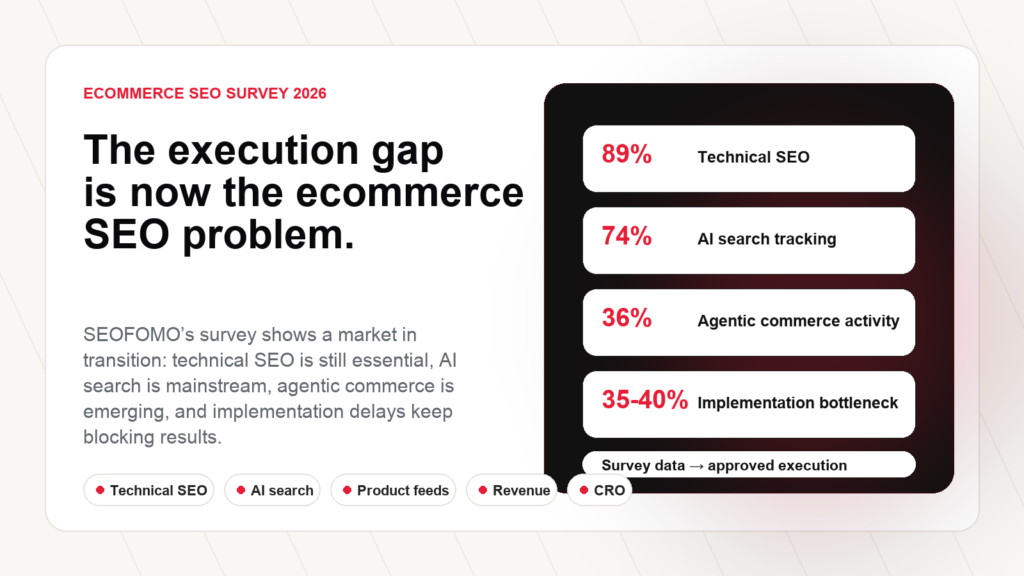
Executive summary: SEOFOMO’s 2026 Ecommerce SEO and AI Search Optimization Survey is one of the clearest snapshots of where ecommerce SEO is heading. More than 40 experienced ecommerce SEO professionals from 24 countries responded. The results show a market that is not abandoning SEO fundamentals. It is expanding them: 89% of respondents said Technical SEO is part of their ecommerce SEO and AI Search work, 74% reported AI Search Optimization activity, and 36% already include Agentic Commerce Optimization.
The most important finding is not a new tool or tactic. It is operational: strategy is not the main problem, execution is. Respondents repeatedly pointed to development backlogs, limited engineering bandwidth, CMS constraints, slow implementation and incorrectly deployed technical work. From the AYSA point of view, this is exactly the gap ecommerce teams must solve: not more dashboards, but a faster path from findings to approved Website Execution.
What the survey shows
The 2026 SEOFOMO Ecommerce SEO and AI Search Optimization Survey gathered responses from more than 40 experienced ecommerce SEO professionals across 24 countries. The survey asked what activities teams are doing, whether AI search and agentic commerce are being integrated, what blocks performance, what tools are used, and which KPIs matter.
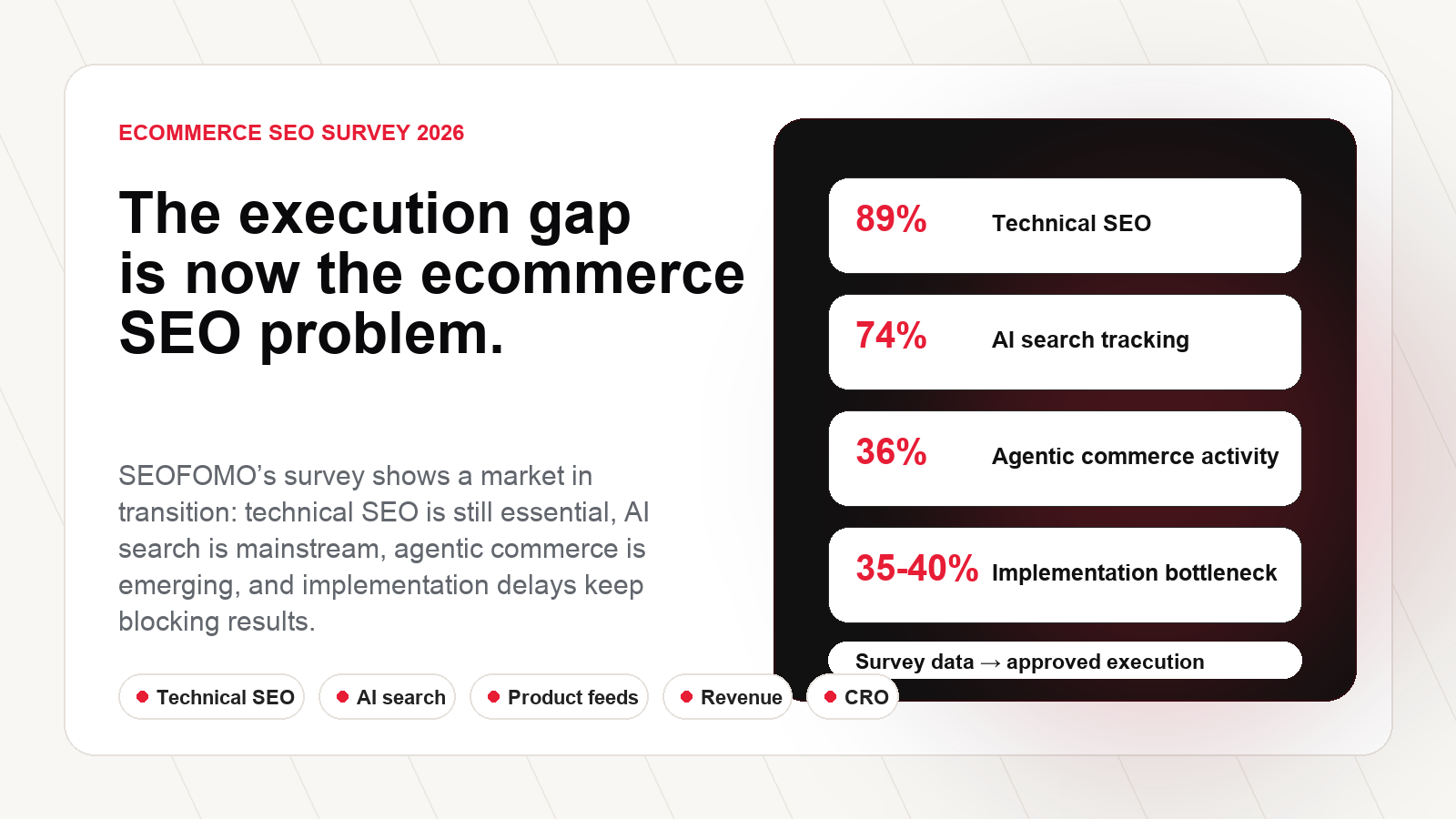
The accompanying infographic summarizes the mood well: technical SEO remains essential, AI search is now mainstream, agentic commerce is emerging, implementation bottlenecks are a major constraint, revenue is still the ultimate metric, and established tools continue to dominate while AI visibility tooling fragments.
This is an important correction to the lazy narrative that AI has made SEO irrelevant. The survey shows the opposite. AI makes the fundamentals more important, not less. Ecommerce sites still need crawlability, indexability, Structured data, clean architecture, feed quality, product content, internal links, performance, conversion paths and reliable measurement. The difference is that these foundations now support more surfaces: Google SERPs, organic shopping, AI Overviews, AI Mode, LLM recommendations, shopping assistants and agentic commerce protocols.
In other words, ecommerce SEO is not shrinking. It is becoming more operational, more technical, more data-dependent and more connected to revenue.
Technical SEO is still the backbone
The survey reports that 89% of respondents include technical SEO in their ecommerce SEO and AI search optimization work. This is not surprising. Ecommerce websites are usually technically complex: category hierarchies, product variants, filters, faceted navigation, pagination, out-of-stock products, product feeds, canonical rules, JavaScript rendering, internal search pages, duplicate URLs, review widgets, tracking scripts and third-party integrations.
AI search does not remove these problems. It increases the penalty for ignoring them. If a website is difficult to crawl, slow, inconsistent or messy, it becomes harder for both classic search systems and AI retrieval systems to understand it. A product page with poor structured data, unclear availability, weak canonicalization and thin content is not magically saved because AI search exists.
Google’s own guidance for AI features points back to the same foundations: create helpful content for people, make it accessible to Google, use structured data where appropriate, and ensure the page can be crawled and indexed. This is not a secret AI trick. It is technical and editorial hygiene applied to a more complex search environment.
For ecommerce teams, the practical technical priorities are clear: fix crawl waste, control indexation, clean canonical rules, improve Core Web Vitals, validate product schema, maintain accurate XML sitemaps, optimize internal linking, reduce JavaScript bloat, keep product feeds consistent with website data, and prevent broken pages from staying live.
AI search is mainstream
The survey shows that AI Search Optimization is no longer a fringe activity. In the activity breakdown, 74% of respondents include AI Search Optimization. In a separate question, 89% said they have started integrating AI Search Optimization into ecommerce SEO efforts, while another 11% plan to start. No respondents said they do not plan to do it.
That is a strong market signal. Ecommerce teams may not have perfect measurement yet, but they are not ignoring the shift. They are tracking AI citations, brand mentions, AI referral traffic, share of voice, AI Overview presence and LLM visibility. They are also trying to understand how AI-driven answers influence product discovery and buying decisions.
This matters because ecommerce journeys are naturally comparison-heavy. Users ask which product is best, which size fits, which brand is reliable, which alternative is cheaper, whether shipping is fast, whether returns are safe and whether reviews are trustworthy. These are exactly the kinds of questions AI systems can synthesize.
As we covered in our article on ecommerce AI search citations, product pages are not enough by themselves. Guides, category pages, reviews, policies, comparison pages, external mentions, product feeds and business profiles can all influence how a brand or product is understood.
Agentic commerce is emerging
The survey reports that 36% of respondents include Agentic Commerce Optimization activities, while 32% say they have already started integrating agentic commerce actions and 47% plan to do so. On protocol implementation, only 15% report that Google’s Universal Commerce Protocol or ChatGPT’s Agentic Commerce Protocol has been implemented in ecommerce projects they work with, while 53% plan to implement and 26% are unsure.
This is exactly what an early market looks like: awareness is rising faster than implementation. The language is still new, the tooling is immature, and many merchants do not yet know what “agent-ready” means in practice. But the direction is clear.
Google’s Universal Commerce Protocol is intended to make interactions between agents and merchants more structured. For SEO, this matters because ecommerce visibility may increasingly depend on whether products, policies and checkout capabilities are understandable enough for agents to recommend and act on. Product feeds, Merchant Center data, structured product information, return rules, shipping data, stock status and merchant trust become even more important.
That is why agentic commerce should not be treated as a science-fiction topic. It is a practical readiness layer. Can your store expose accurate product data? Can it explain delivery and returns clearly? Can it keep feeds synchronized? Can it be trusted by humans and machines? Can it handle the next step after discovery?
The execution gap is the real bottleneck
The most useful part of the survey is the section on why ecommerce SEO and AI search projects missed expected goals. The dominant pattern was implementation bottlenecks and development constraints, estimated at around 35–40% of responses. Respondents mentioned development backlogs, lack of developer capacity, slow implementation, complex CMS architecture, internal workflows, and technical implementations applied incorrectly.
This is the part many businesses do not want to hear: knowing what to do is often easier than getting it done. A crawl report may show canonical issues. A content audit may show thin category pages. A feed audit may show missing product data. An AI visibility check may show that competitors are cited more often. None of that creates value until the website changes.
For ecommerce, the execution gap is especially painful because sites are large and dynamic. A store may have thousands of products, hundreds of categories, seasonal collections, out-of-stock items, filters, product variants and multiple markets. Every technical recommendation competes with development priorities, merchandising requests, paid media tracking, CRO tests and platform limitations.
This explains why many SEO projects underperform even when the strategy is reasonable. The bottleneck is not always expertise. It is throughput. The team cannot ship enough of the right improvements quickly enough.
That is also why AI search creates pressure. If Google SERPs, AI Overviews, AI Mode and shopping experiences evolve quickly, a slow implementation model becomes weaker. Static audits age fast.
Measurement: AI is new, revenue is still the boss
The survey shows that 74% of respondents are tracking ecommerce visibility and revenue from AI platforms. But measurement is still messy. Teams use GA4, Looker Studio dashboards, Search Console, Semrush, Ahrefs, Profound, Peec AI, RankScale, LLM Pulse, LLM Watcher, log analysis, custom prompt testers and internal dashboards.
The most tracked AI-related KPIs include referral traffic from AI platforms, conversions and revenue, mentions and citations in AI responses, AI share of voice, AI Overview visibility, engagement metrics and attribution models. This confirms the same pattern we discussed in our AI search measurement framework: teams need to separate presence, readiness and business impact.
But the survey also makes one thing very clear: revenue remains the metric that matters most. Respondents emphasized ecommerce revenue, orders, purchases, conversion rate, average order value and ROI. One response summarized the sentiment: teams care less about organic metrics than revenue.
This is healthy. AI visibility can become another vanity metric if it is disconnected from business outcomes. A brand mention in an AI answer is interesting. A citation in a high-intent buying journey is more interesting. A measurable lift in revenue, orders or qualified demand is what leadership will care about.
The difficult part is attribution. The survey shows that traditional organic search still brings meaningful revenue share for many ecommerce projects, while AI platform revenue share is still mostly below 5% for 62% of respondents. That does not mean AI is irrelevant. It means AI visibility is early, measurement is incomplete, and ecommerce teams should avoid overclaiming impact before the data supports it.
Tools are fragmented, and that creates another problem
The survey lists Semrush, Ahrefs, Screaming Frog and Google Search Console as core tools, with AI visibility platforms and custom tools emerging around them. This is realistic. Established SEO tools still solve many problems better than new AI visibility tools. Crawling, backlinks, keyword research, competitive research, technical diagnostics and Search Console data remain essential.
At the same time, AI visibility tracking is fragmented. Teams are experimenting with prompt tracking, brand mentions, citations, LLM visibility and AI Overview monitoring. Some build internal tools because the market is still immature.
The risk is that ecommerce teams end up with more tools and still no execution. One tool finds technical issues. Another tracks rankings. Another tracks AI mentions. Another shows backlinks. Another tracks conversions. Another monitors feeds. The business owner or SEO lead receives more dashboards but still has the same bottleneck: what should we change, who approves it, and when does it go live?
This is why the next competitive advantage may not be tool count. It may be workflow quality. The winning teams will connect data, prioritize by business value, prepare changes, approve them and ship.
What ecommerce teams should do next
First, treat technical SEO as AI readiness infrastructure. Crawlability, indexability, internal linking, schema, speed, canonical rules and feed consistency are not old-school chores. They are the foundation that makes a store understandable.
Second, audit product feeds and Merchant Center data. Product feeds are becoming critical infrastructure for shopping results and agentic commerce. Titles, attributes, identifiers, availability, price, shipping, images and category mapping should be accurate and complete.
Third, build content around real buying decisions, not only keywords. Category pages should help users compare. Product pages should answer objections. Guides should explain use cases. Support content should reduce uncertainty. UGC and reviews should inform improvements.
Fourth, create an AI search measurement layer, but label confidence. Track mentions, citations, share of voice, AI referrals and AI Overview presence, but do not pretend every mention equals revenue. Connect AI signals to readiness gaps and business outcomes.
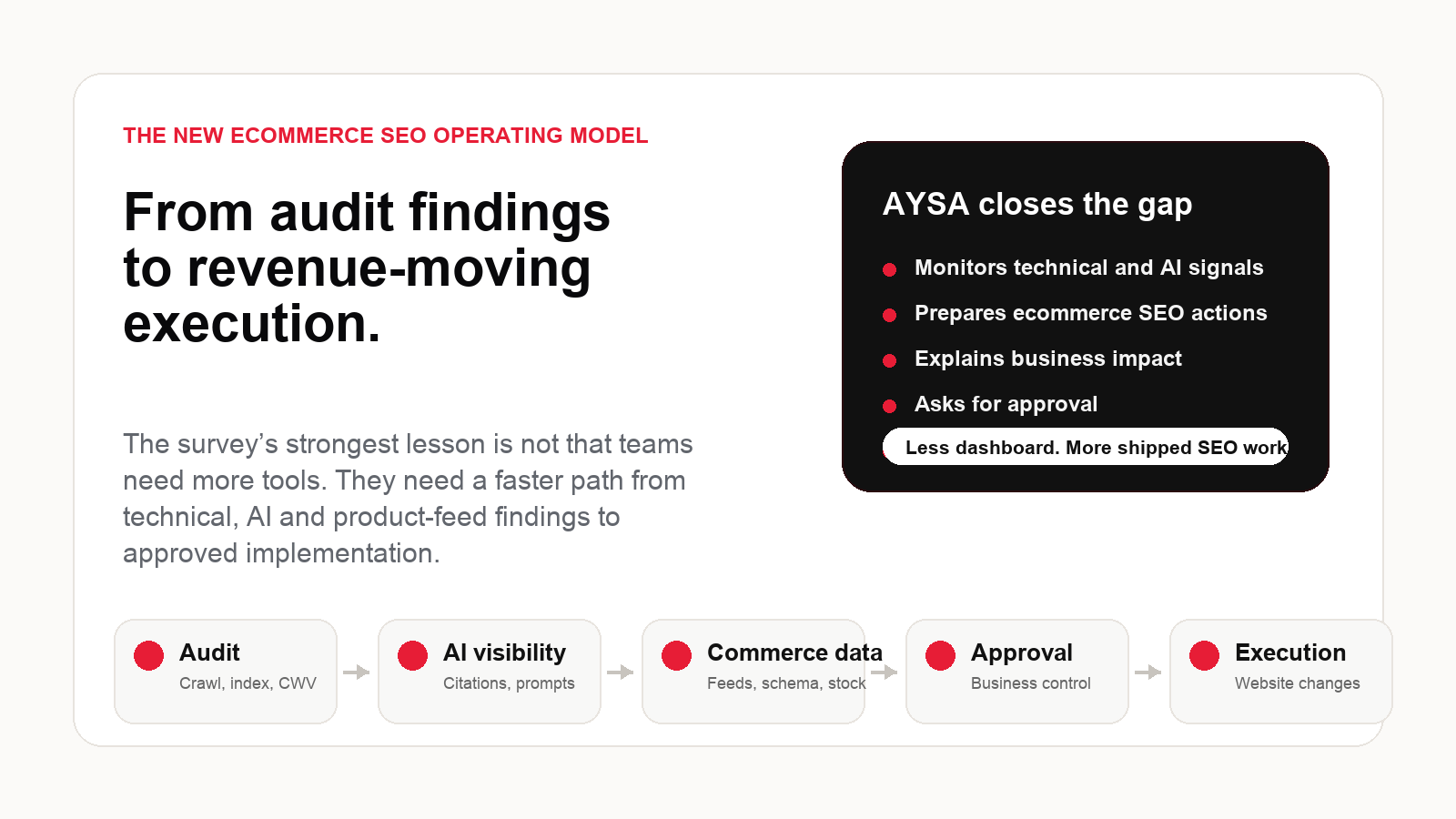
Fifth, reduce the implementation gap. This is the most important operational recommendation. If a team knows what to fix but cannot ship, SEO performance will suffer. Create a process where findings become approved actions, not forgotten tickets.
Sixth, connect SEO with PPC, merchandising, CRO and development. The survey shows coordination with PPC happens in some ecommerce SEO processes, but not universally. In a world of ads, shopping, AI answers and agentic commerce, ecommerce SEO cannot sit alone.
The AYSA view: ecommerce SEO needs execution, not more noise
AYSA is built for the operational gap this survey exposes. Ecommerce SEO teams already know that technical SEO matters. They know AI search matters. They know revenue matters. They know product feeds, schema, content and authority matter. The hard part is doing the work fast enough, consistently enough and safely enough.
AYSA can help monitor search, technical and AI visibility signals, prepare SEO and AEO actions, explain why they matter, ask for approval and execute accepted changes inside the website workflow. For SMEs, this is important because the business owner should not need to become a technical SEO, AI search analyst, feed specialist and developer coordinator at the same time.
In my opinion, the survey confirms the future of ecommerce SEO: technical foundations plus AI readiness plus agentic commerce infrastructure plus revenue measurement plus execution velocity. The companies that win will not be the ones with the longest audit decks. They will be the ones that can turn useful findings into shipped improvements.
Ecommerce SEO should move from reports to shipped work
Tired of finding ecommerce SEO issues faster than your team can implement them?
Try AYSA: an AI SEO agent that monitors technical, content and AI visibility signals, prepares ecommerce SEO actions, asks for approval and executes accepted changes inside your website workflow.
Sources and further reading
This article cites and builds on SEOFOMO’s 2026 Ecommerce SEO and AI Search Optimization Survey, including its infographic and detailed survey results, Google Search Central’s AI features optimization guide, Google Merchant Center product data documentation, and Google’s Universal Commerce Protocol developer announcement. The AYSA sections are our author and product perspective. We do not claim guaranteed rankings, guaranteed AI citations, guaranteed AI recommendations or guaranteed ecommerce revenue.
Continue the AI search topic inside AYSA.
Use these pages to connect the article with AI SEO tools, AI visibility monitoring, AI Overviews and approved website execution.
Turn this topic into a website action plan.
Use these AYSA hubs to move from reading to technical fixes, AI visibility monitoring, research, glossary context and approval-first SEO execution.

