
Google Ads Smart Bidding Isn’t “Broken” — Your Conversion Architecture Is (Primary vs. Secondary, Done Right)
If Smart Bidding is optimizing toward the wrong users, the culprit is often your conversion column—not your bid strategy. Here’s a business-first framework for separating primary (optimization) from secondary (observation) conversions so Google learns what actually drives revenue, not what’s easiest to trigger.
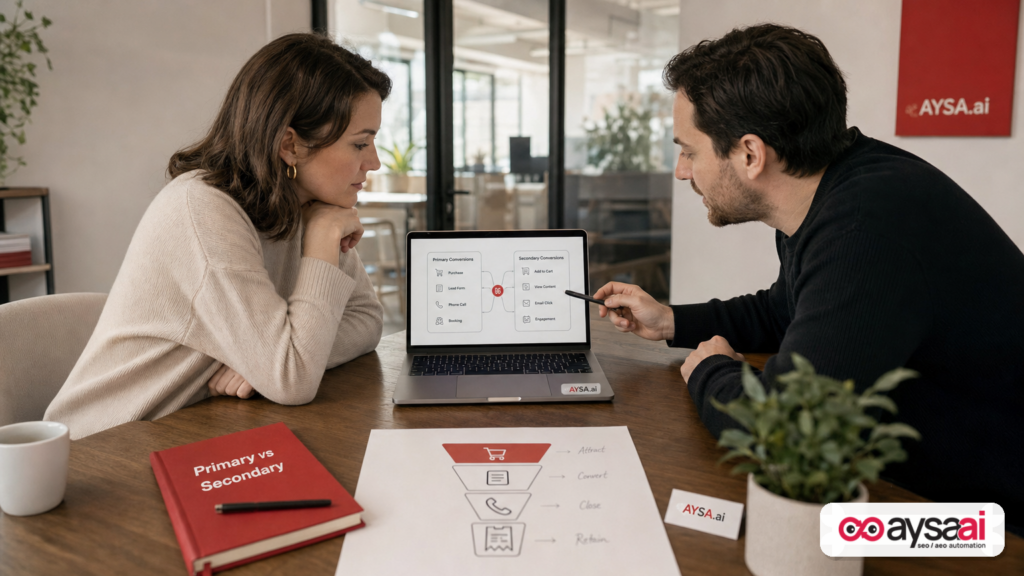
Smart Bidding doesn’t “go rogue” for no reason. In most Google Ads accounts I review, when automation starts sending the wrong kind of traffic, the root cause isn’t the bid strategy. It’s the definition of success you fed into the system.
Or said more bluntly: Smart Bidding isn’t broken—your conversion architecture is.
This editorial is inspired by Sarah Stemen’s excellent breakdown on Search Engine Journal about fixing Smart Bidding through a primary vs. secondary conversion framework (source). I’m expanding that idea into an operator-grade playbook for SMEs, ecommerce teams, and agencies—because the real challenge isn’t understanding the toggle. It’s designing a measurement system that aligns the platform’s machine learning with your revenue reality.
Concise summary
If you only read one section, read this:
- Primary conversions are training data. They populate the “Conversions” column and actively teach Smart Bidding what a “good user” looks like.
- Secondary conversions are instrumentation. They populate “All conversions” so humans can diagnose funnel friction without polluting bidding signals.
- Mixing micro-actions (Clicks, add-to-carts, begin checkout) into primary conversions trains the algorithm to chase the easiest outcomes. You end up with “great” dashboards and disappointing bank accounts.
- Custom goals can override your primary/secondary tagging. If you don’t audit them, you can do everything right and still optimize toward the wrong thing.
- Expect a relearn window after cleanup. You’re changing the model’s curriculum. Plan for volatility and interpret KPIs correctly.
Key takeaways (for busy operators)
- Fewer primary conversions = better automation. Most accounts need stricter primary signals, not more signals.
- “More data” is not the goal; better training data is. Micro-conversions inflate volume and reduce meaning.
- Make conversion architecture a business decision. Sales, finance, and operations must agree on what counts as success.
- Use secondary conversions to debug the funnel. Keep them meaningful (pricing view, add-to-cart, checkout start), remove vanity events.
- Execution on the website is what makes measurement reliable. If the site breaks Attribution or fires events incorrectly, Smart Bidding will learn from bad labels.
Table of contents
- The real problem: Smart Bidding is a pattern-matching engine (and you’re feeding it mixed signals)
- What changed: why conversion architecture matters more as automation expands
- The primary vs. secondary conversion framework (what it is, what it is not)
- The “conversion soup” failure mode: how good-looking reports produce bad business
- An SME scenario you can recognize: the ecommerce store that “wins” in Ads but loses in the bank account
- A lead-gen scenario: the clinic that optimizes to calls but can’t tell good calls from bad calls
- Signal engineering: designing training data the algorithm can actually learn from
- How to choose primary conversions that map to revenue (not activity)
- How to build a secondary layer that informs without polluting
- The hidden override: custom goals and campaign-level goal selection
- Learning and relearning: what to expect after you fix the architecture
- Edge cases you must architect for: phone calls, GA4 imports, low volume, and “qualified” conversions
- What agencies should rethink: reporting, incentives, and accountability
- Where AYSA fits: approved execution that keeps your training data clean
- What to do next: a conversion architecture audit you can complete this week
- Sources and further reading
The real problem: Smart Bidding is a pattern-matching engine (and you’re feeding it mixed signals)
Smart Bidding is often described like it’s a “bid optimizer.” That language is too small for what’s actually happening.
In practice, Smart Bidding behaves like a pattern-matching engine trained on your historical conversions. As Stemen explains in the SEJ piece, it evaluates signals we can’t fully see (audience patterns, queries, device, time, behavior) and tries to reproduce the conditions that led to “success.”
Here’s the part that changes how you operate an account:
Every primary conversion you send into Google Ads is a label for the machine learning model. It says: “This user is what I want more of.”
If you label button clicks, add-to-carts, and purchases as equal “success,” the model doesn’t gain insight—it loses contrast. You’ve told it that a browser and a buyer are effectively the same outcome.
Why Smart Bidding “chases the easiest conversion”
You’ll hear practitioners say: “Google just chases the easiest conversions.” That’s usually true in the symptoms, but the mechanism is worth understanding.
Micro-actions happen more often than purchases. They’re easier to trigger and occur earlier in the funnel. When you count them as primary, you flood the training set with low-intent labels. The model then finds more users who match that pattern.
This isn’t Google being malicious. It’s the system doing exactly what you instructed it to do.
A quick operator test
Ask yourself one question:
If I doubled the number of reported “conversions” next month, would I confidently double revenue or qualified pipeline?
If your honest answer is “not necessarily,” your conversion architecture is not a measurement layer. It’s a fiction layer.
What changed: why conversion architecture matters more as automation expands
Paid search has been moving toward broader automation for years. Even if you’re not using every automated feature, the trend is clear: more black-box bidding logic, more automated targeting, more automated creative selection, more blended inventory.
That shift has a business implication most teams underestimate:
As manual levers shrink, measurement architecture becomes a primary lever.
When you had more manual control, you could “override” poor signals with human intervention—tight keywords, tight placements, tighter budgets, more hand-tuned audiences. As platforms absorb more decisions, the input that remains reliably human-controlled is the definition of success and the rules that govern what the model is allowed to learn from.
That’s why the SEJ article hits: the fix is not “try another bid strategy.” If you trained the model on the wrong labels, a different bidding wrapper still optimizes to the same flawed definition of success.
My point of view: architecture is strategy now
In 2026, the paid search strategist’s value isn’t moving bids by hand. It’s making sure the account’s automation is trained on truth.
Truth is uncomfortable because it often lowers reported Conversion rate. But truth is the only thing that compounds in the right direction.
The primary vs. secondary conversion framework (what it is, what it is not)
The core framework is simple (and powerful): designate a small set of conversions as primary and move everything else into secondary.
Per the SEJ source, the distinction is not cosmetic:
- Primary (Optimization): populates the “Conversions” column and is used by Smart Bidding for training and bidding decisions.
- Secondary (Observation): populates “All conversions” and is intended for diagnostics without becoming a bidding target.
Primary conversions: strict, revenue-linked, defensible
Primary conversions should be events you can defend in a finance meeting. If you can’t draw a clean line from the action to revenue (or qualified pipeline with a known close rate), it does not belong in primary.
Typical primary conversions:
- Ecommerce: purchase (and ideally purchase value)
- Lead gen: booked consultation, qualified lead submission, demo scheduled
- Subscriptions: paid signup (not free trial unless it’s proven to correlate strongly with revenue)
Secondary conversions: meaningful funnel telemetry
Secondary conversions are how you retain funnel visibility. They are not junk drawers for vanity events. Done right, they show where intent strengthens or collapses.
Good secondary conversions:
- Pricing page view (for lead gen)
- Add to cart (for ecommerce)
- Begin checkout
- Shipping step view (if it’s a consistent step)
- Account creation (if it’s a real step toward purchase)
Bad secondary conversions (usually vanity):
- Scroll depth on generic pages
- Clicks on navigation elements (menu, logo click)
- Time-on-site proxies
- Random “interaction” events that don’t map to buying behavior
What this framework is not
- Not a hack to “get more conversions.”
- Not a permission slip to track everything and hope the model figures it out.
- Not a one-time cleanup. It’s ongoing governance—especially when teams add new tags, import GA4 events, or launch new campaign types.
The “conversion soup” failure mode: how good-looking reports produce bad business
The most common configuration problem in Google Ads isn’t missing tracking. It’s over-inclusive tracking—everything is labeled a conversion, and all conversions are treated as equal outcomes.
Stemen’s SEJ article gives a representative pattern: micro-actions (button clicks, begin checkout) crowd out purchases in the primary conversion pool. That can create superficially strong metrics: high conversion rates, “efficient” CPA, and ROAS that seems to support scaling—until you compare it to the actual business.
Why this setup looks good in-platform
Because the platform is faithfully reporting what you asked it to report.
- If you count add-to-cart as a conversion, conversion rate rises.
- If you count begin checkout as a conversion, CPA falls.
- If you count button clicks as conversions, you can create the illusion of “massive improvement” with no improvement in revenue.
And once Smart Bidding sees those actions as “success,” it will increasingly target the people most likely to produce them—often a different audience than actual buyers.
Business symptoms that show up first (outside Google Ads)
SMEs notice conversion soup not through charts—but through operational pain:
- Inventory and fulfillment: fewer real orders than Ads “conversions” imply
- Sales: more unqualified leads, lower close rate, more wasted follow-up time
- Support: higher volume of low-intent calls and chats
- Finance: marketing spend rises without a proportional rise in gross profit
If you’re an owner, you don’t need to know every Google Ads feature to detect this. You just need to trust the simplest truth: bank accounts don’t get confused.
An SME scenario you can recognize: the ecommerce store that “wins” in Google Ads but loses in the bank account
Let’s make this tangible for a real-world operator.
Imagine an ecommerce brand selling high-margin, consideration-heavy products (home fitness, premium skincare, specialty coffee gear—pick your category). The marketing team reports:
- “Conversion rate is up.”
- “CPA is down.”
- “Performance Max is scaling.”
But the founder’s weekly review looks different:
- Orders are flat.
- Abandoned carts are rising.
- Returning customers aren’t increasing.
- Cashflow is tighter even though Ads performance “improved.”
You audit the conversion actions and find something like:
- Purchase marked as a conversion (good)
- Add to cart marked as a conversion (useful telemetry, dangerous as primary)
- Begin checkout marked as a conversion (useful telemetry, dangerous as primary)
- “Continue” button click marked as a conversion (often noise)
Now ask: what will Smart Bidding learn fastest?
- People who buy (rare, hard outcome), or
- People who click and start checkout (common, easy outcome)
If you allow micro-actions in primary, you’ve effectively told the algorithm: “We value checkout starters as much as buyers.” The model responds by finding more checkout starters.
What changes after you fix the architecture
When you move add-to-cart and begin checkout to secondary and keep purchase as the primary conversion:
- Reported conversion rate drops (because it becomes real).
- CPA rises (because you’re paying for actual outcomes).
- Traffic quality often improves over time because the model starts learning buyer patterns again.
It feels worse before it gets better. But it’s the only direction that compounds correctly.
A lead-gen scenario: the clinic that optimizes to calls but can’t tell good calls from bad calls
Not every business has ecommerce purchases to train on. Many SMEs live in lead gen: clinics, law firms, home services, local contractors, B2B service providers.
Here’s a scenario I see constantly:
- The account uses calls, form fills, and chats as conversions.
- Everything is primary because “we need more leads.”
- Smart Bidding gets efficient—at producing activity.
Meanwhile, the front desk or sales rep says:
- “We’re getting tons of calls asking for hours.”
- “People want free advice.”
- “They’re price-shopping and not booking.”
Calls are a perfect example of what the SEJ source notes: classification is context-dependent. A call can be a macro conversion or a low-intent question. If you can’t evaluate call quality, you can’t architect conversions responsibly.
Practical approach: classify calls with evidence
- Pull a sample of recent calls.
- Ask the team answering the phone to categorize: booking intent vs info request vs wrong number/spam.
- If possible, connect the call to outcomes: booked appointment, quote requested, deal won.
Then decide:
- Primary: calls that consistently represent the main business outcome (e.g., booked consultations).
- Secondary: calls that are useful but not reliably revenue-linked (hours, directions, general questions).
The key is not the label “phone call.” The key is the post-call data, exactly as the SEJ article emphasizes.
Signal engineering: designing training data the algorithm can actually learn from
The best line in the SEJ source is the reframing: this is signal engineering, not tag management.
Tag management is a technical activity: “Did the event fire?” Signal engineering is a strategic activity: “Should this event be allowed to train our bidding?” Those are different questions with different owners.
Two surfaces, two audiences
Think of your conversion setup as serving two audiences:
- The machine learning model: needs a strict definition of success (primary conversions).
- Humans: need a full-funnel view to diagnose and improve (secondary conversions).
When you blend these two, you don’t get “more insight.” You get a confused model and a misled team.
Primary conversions are the model’s curriculum
If primary conversions are the curriculum, then micro-actions in primary are like grading students on attendance instead of mastery. Yes, you’ll see more “A’s.” No, you won’t see better outcomes.
How to choose primary conversions that map to revenue (not activity)
This is where most accounts fail—not because people are careless, but because organizations confuse activity with outcomes. The cure is a clear standard.
A strict standard for primary conversions
For an action to be primary, at least one of these must be true:
- Direct revenue event: purchase completed, payment received, subscription paid.
- Revenue-proximate outcome you can validate: booked appointment that historically closes at a known rate; qualified lead that sales confirms is in-market.
If you can’t validate it, keep it secondary.
One objective → one primary conversion
The SEJ source recommends strict macro goals. I’ll go further: most campaigns should have a single primary conversion for their objective. That doesn’t mean you can’t measure other things—it means you don’t let other things steer the model.
Examples:
- Purchase campaign: primary = purchase
- Lead campaign for a service line: primary = booked consult (or qualified lead)
- Trial campaign (only if it’s proven): primary = trial that meets qualification criteria, not every trial start
Don’t “upgrade” micro-actions just because you want volume
Stemen notes that promoting secondary actions to primary should be rare. I agree. Volume is not intent.
If you promote add-to-cart to primary because you “need more conversions,” you are not solving a data problem. You are changing what success means to make the dashboard feel better.
If your macro conversion volume is too low for stable automation, the real fixes usually live elsewhere:
- Offer clarity (pricing, shipping, returns, financing)
- Landing page intent match
- Checkout friction reduction
- Lead qualification and routing improvements
How to build a secondary layer that informs without polluting
Secondary conversions are a gift—when you treat them as funnel telemetry, not vanity.
What to track as secondary (examples that help you debug)
Ecommerce secondary ideas:
- Product view (if your site has meaningful product pages)
- Add to cart
- Begin checkout
- Shipping step / payment step (if stable and meaningful)
Lead gen secondary ideas:
- Pricing page view
- Service detail page view
- Form start (not submit)
- Call click (if calls are not reliably qualified)
The SEJ article also cautions that even observation events should be meaningful steps. That’s a good standard: don’t create “signals” that don’t represent real intent progression.
How to use secondary conversions in weekly decision-making
Secondary conversions should answer questions like:
- Are we driving the right traffic to the right pages?
- Did a creative test increase add-to-cart rate but not purchase rate (suggesting mismatch or friction)?
- Are specific campaigns generating high-intent steps but failing late funnel (suggesting price/shipping surprise)?
- Are mobile users starting checkout but failing to complete (suggesting UX issues)?
This is where secondary conversions become operational intelligence instead of algorithmic pollution.
Remove vanity secondary events to protect human judgment
Even if secondary conversions are “ignored” for bidding, they can still contaminate decision-making. If you track “scroll 50%” as a conversion, you’ll end up optimizing content, budgets, and creative around scrolls instead of outcomes.
Measurement systems don’t just train algorithms—they train teams.
The hidden override: custom goals and campaign-level goal selection
The SEJ source includes an important landmine: custom goals can override the primary/secondary tagging.
In other words, you can have a clean account-level architecture and still accidentally optimize toward a micro-action if:
- a campaign is using a custom goal, and
- that goal includes actions you thought were “secondary-only.”
Why this is so dangerous
Because it creates “phantom correctness.”
You audit conversion actions, see that add-to-cart is secondary, and assume you’re safe. But at the campaign layer, a custom goal pulls add-to-cart into bidding signals again. The model learns micro-intent, and you wonder why it’s finding the wrong audience.
What to audit (minimum viable checklist)
- List every custom goal in the account.
- List every action included in each custom goal.
- For each campaign, confirm which goal it’s optimizing to.
- Confirm the goal contains only actions that should train bidding for that campaign’s objective.
If you’re an owner and you outsource PPC, this is a great “trust but verify” request: ask your team/agency to show you the primary conversion, the secondary telemetry, and the custom goal map.
Learning and relearning: what to expect after you fix the architecture
Conversion architecture changes are not “simple settings updates.” You are changing the label that defines success for the model.
Stemen notes Smart Bidding learning phases can run 7–14 days after strategy changes, and longer with low volume. The key operational truth: cleaning conversion architecture often triggers a form of relearning because the model has to rebuild its understanding based on the new, stricter signals.
What will change immediately (and why it’s not failure)
- Your conversion rate will likely drop. That’s not bad performance; that’s honest measurement.
- Your CPA will likely rise. Because you’re now paying for outcomes that matter.
- Some campaigns may look “worse” before they look better. The model needs time to re-anchor on the new success definition.
If you didn’t warn stakeholders, they will panic. If you did warn them—and you can explain what changed—this becomes a moment of maturity: you’re upgrading from activity metrics to business metrics.
How to evaluate performance during relearn
During the relearn window, don’t overreact to daily swings. Instead:
- Annotate the change date in your reporting.
- Review purchase/qualified lead volume, not total “conversions.”
- Use secondary conversions to diagnose funnel friction without letting them become success criteria.
The biggest mistake I see is teams “fix the conversions,” then immediately flip bid strategies, budgets, creatives, and landing pages all at once. You can’t interpret anything if you change everything.
Edge cases you must architect for: phone calls, GA4 imports, low volume, and “qualified” conversions
The SEJ article calls out several edge cases that separate experienced operators from checkbox marketers. Let’s extend them with practical guidance.
Phone calls: the most context-dependent conversion
Phone calls can be:
- High intent (booked consult, inbound sales-ready), or
- Low intent (hours, directions, support), or
- Noise (spam, wrong number).
The correct classification depends on your business’s post-call outcomes, not on what Google calls the conversion.
Rule: If you can’t evaluate call quality, treat calls as secondary until you can—or create a different primary conversion you can validate.
GA4 imports: don’t assume your macro event is primary
The SEJ source notes that GA4 imported events default to secondary. That’s exactly the kind of quiet configuration detail that creates big strategic drift.
Operational guidance:
- After importing GA4 events, manually verify which are primary vs secondary.
- Make sure your true macro event (purchase, lead, booking) is actually primary for the campaigns that need it.
If you miss this, your bidding may optimize toward some other leftover primary action—often a micro conversion someone set years ago.
Low-volume accounts and the cold-start temptation
Small accounts often struggle to generate enough macro conversions to make Smart Bidding stable. The temptation is to “help” by promoting micro-actions to primary.
My view: this is usually a trap.
Instead, treat low volume as a constraint that demands tighter fundamentals:
- Focus on intent alignment: fewer, sharper landing pages.
- Improve conversion rate on-site so each click has a higher chance of producing a macro outcome.
- Use secondary conversions as diagnostics—not as substitute success labels.
If you absolutely need a proxy primary conversion (for example, qualified leads), define qualification criteria that sales agrees with and that you can audit over time. Don’t choose a proxy just because it’s abundant.
Qualified leads: the only “upgrade” path that usually makes sense
One of the few legitimate reasons to change primary conversions over time is improving lead quality measurement. For example:
- You used to count every form fill as a lead.
- You realize many are junk.
- You introduce a qualification step (e.g., sales-accepted lead) and make that the new primary conversion.
This is hard because it often requires CRM integration and disciplined sales processes. But it’s the kind of hard that makes the business stronger, not just the dashboard prettier.
What agencies should rethink: reporting, incentives, and accountability
This framework isn’t just a technical fix; it’s a governance standard for agencies and internal teams.
The uncomfortable incentive problem
When “conversions” include micro-actions, it becomes easy to show improvement without delivering business outcomes. That’s not always intentional—but it is structurally likely.
If an agency is paid to improve conversions and CPA, and conversions include easy micro-actions, the system rewards the wrong work.
Strong agencies should proactively insist on:
- Primary conversions that map to revenue or qualified pipeline
- Secondary conversions for diagnostics
- Clear stakeholder briefings on why reported conversion rate may drop after cleanup
The owner’s check: one slide that prevents months of waste
If you’re a founder or GM, request one simple deliverable from your marketing team:
- What is the single primary conversion this campaign optimizes toward?
- What are the secondary conversions you track for funnel diagnostics?
- How do you validate that the primary conversion correlates with revenue?
If the answers are vague, don’t blame the platform. Fix the architecture.
Where AYSA fits: approved execution that keeps your training data clean
Conversion architecture in Google Ads is only as reliable as the website and measurement layer underneath it.
If your checkout breaks cross-domain tracking, if your thank-you page doesn’t load consistently, if your forms double-fire events, or if your landing pages don’t match intent, Smart Bidding will learn from compromised signals. You can’t “bid strategy” your way out of a broken foundation.
That’s where AYSA fits in a modern growth stack—not as a replacement for paid search management, but as an execution system that keeps the website aligned with what the business is trying to measure and grow.
What AYSA does in this workflow
- Monitors site pages and signals so issues that hurt conversion integrity don’t linger (AYSA Monitoring).
- Prepares website updates that improve intent match and conversion pathways (content, technical fixes, page structure) using our AI SEO tooling (AI SEO Tools).
- Asks for approval before executing changes—so owners and teams stay in control (this matters when you’re adjusting conversion-related pages like checkout steps, forms, or high-intent landing pages).
- Executes accepted changes so improvements ship instead of dying in a backlog. That’s the difference between “we found the problem” and “we fixed the problem.”
Why this matters specifically for paid search
Paid search is increasingly sensitive to:
- Landing page relevance (does the page match the intent you’re buying?)
- Funnel friction (does checkout or lead capture fail for certain devices?)
- Content clarity (do you answer pricing/shipping/returns/eligibility questions early?)
When you tighten your primary conversions, you remove the illusion of “success.” That’s good—but it also exposes where the website needs work to turn clicks into outcomes. AYSA helps teams execute those website improvements safely and consistently.
If you want to see how we think about the broader visibility and execution system beyond Google Ads, start with:
- AI Search Visibility (how modern visibility is earned and maintained)
- AYSA Blog (playbooks and operator perspectives)
- AYSA Pricing (how teams adopt AYSA in practice)
The action plan: a conversion architecture audit you can complete this week
You don’t need a quarter-long measurement project to fix conversion soup. You need discipline, clear ownership, and a checklist.
Step 1: Export your conversion actions and categorize them
Create four buckets:
- Revenue events: purchase completed, payment received
- Pipeline events: booked consult, qualified lead
- Funnel steps: add to cart, begin checkout, pricing view, form start
- Vanity/noise: button clicks, scroll, time on site, generic engagement
If you can’t explain what a conversion action means in plain English, it doesn’t belong in primary—and may not belong at all.
Step 2: Choose one primary conversion per campaign objective
Pick the event that most directly maps to business success.
- Ecommerce: purchase
- Lead gen: qualified lead or booked appointment
- Calls: only if calls reliably represent revenue-proximate intent
Write the decision down. This becomes your governance rule.
Step 3: Move micro-actions to secondary (keep meaningful telemetry)
Move funnel steps to secondary so you can still diagnose performance. Remove vanity events entirely if they exist only to pad reporting.
Step 4: Audit custom goals (the hidden override)
Per the SEJ source, custom goals can override the primary/secondary tagging. Audit them aggressively:
- What’s in each custom goal?
- Which campaigns use which goals?
- Is any micro-action being used for bidding unintentionally?
Step 5: Verify GA4 imported events (don’t assume)
If your macro conversion is imported from GA4, confirm it’s primary. The SEJ source flags that imports can default to secondary. Don’t let this become a silent failure.
Step 6: Decide on phone calls with evidence, not assumptions
Sample calls. Talk to the people answering them. Categorize and decide primary vs secondary based on real business value.
Step 7: Plan for the relearn window
- Annotate the change date.
- Set stakeholder expectations: reported conversion rate may drop, but truth increases.
- Give the model time to stabilize before making further major changes.
Step 8: Use secondary conversions to prioritize website fixes
Once measurement is honest, secondary conversions reveal where the funnel breaks. Typical priorities:
- If add-to-cart is strong but purchase is weak: checkout friction, shipping surprise, payment options, trust signals.
- If pricing views are high but lead submit is low: unclear offer, too much form friction, mismatch between ad promise and page.
- If begin checkout is strong on desktop but weak on mobile: mobile UX, Page speed, autofill, payment options.
This is where execution systems matter. Insights without shipping changes don’t compound.
What to do next (tight list)
- Run the conversion action inventory and categorize every action by revenue relevance.
- Choose one primary conversion per objective and defend it in business language.
- Move micro-actions to secondary and delete vanity events that only pad reporting.
- Audit custom goals and campaign-level goal selection to ensure nothing overrides your architecture.
- Verify GA4 imports and promote your true macro goal to primary if needed.
- Expect a relearn period; do not interpret falling conversion rate as failure.
- Use secondary telemetry to fix the website so your primary outcome increases for real.
Sources and further reading
- Search Engine Journal — How To Fix Google Ads Smart Bidding With A Primary Vs. Secondary Conversion Framework
- Search Engine Journal — PPC News
- Search Engine Journal — SEO Coverage (useful context for landing page quality and measurement)
- Search Engine Journal — Latest Marketing News
- Search Engine Journal — Subscribe
Continue the AI search topic inside AYSA.
Use these pages to connect the article with AI SEO tools, AI visibility monitoring, AI Overviews and approved website execution.
Turn this topic into a website action plan.
Use these AYSA hubs to move from reading to technical fixes, AI visibility monitoring, research, glossary context and approval-first SEO execution.