
Google-Agent and the Agentic Web: What SMEs Need to Know About AI Visitors
Google-Agent gives agentic browsing a clearer identity. Here is what SMEs should understand about AI visitors, logs, robots, forms, content and approved SEO execution.
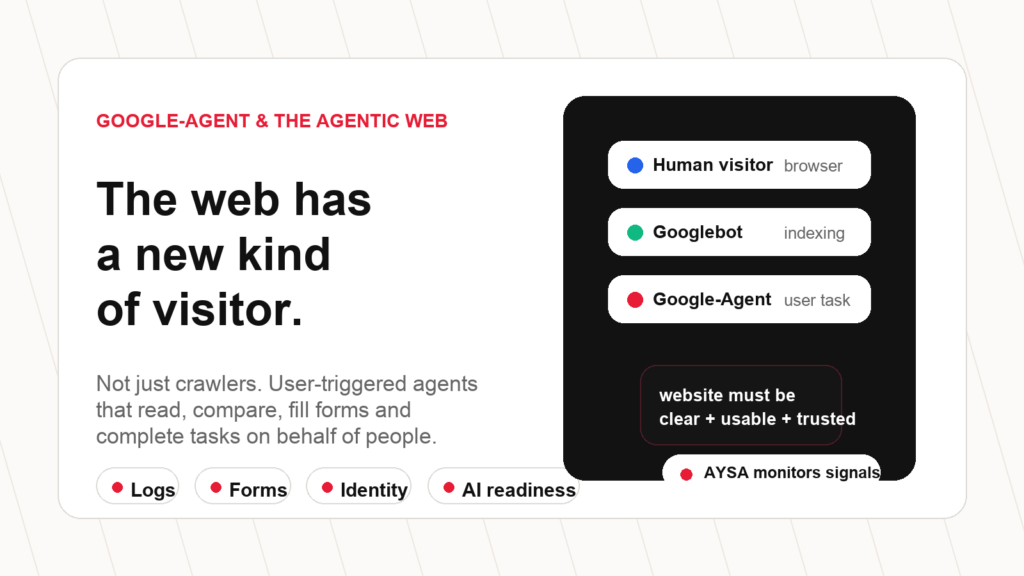
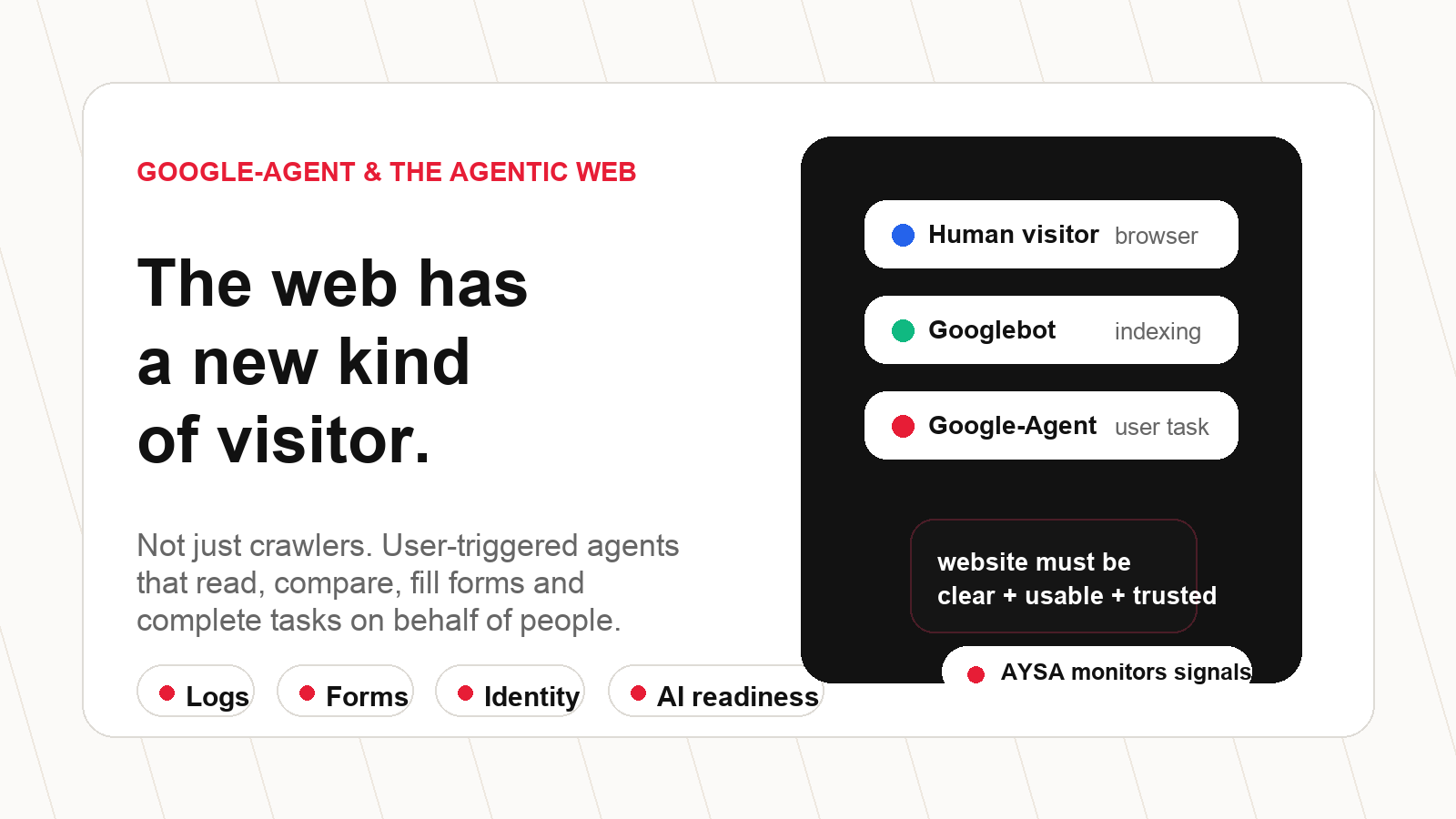
Executive summary: Google-Agent is a signal that the web is moving beyond the old model of “human visitors plus crawlers.” We are entering a phase where user-triggered agents can visit pages, read information, compare options and complete parts of a task on behalf of a person. This does not replace Googlebot, and it does not create a magic new ranking factor. But it does change what a serious website must prepare for: clean access rules, clear content, usable forms, trustworthy business information, resilient Technical SEO and Monitoring that separates useful AI traffic from noise.
For SMEs, the point is practical. You do not need to become a log-file engineer overnight. But you do need a website that agents can understand without compromising security, privacy or commercial control. AYSA fits here as an Approved Execution layer: it monitors SEO, AEO and AI visibility signals, prepares website improvements, asks for approval and executes accepted changes inside the website workflow.
What is Google-Agent?
Google-Agent is part of a broader shift toward agentic browsing: systems that access the web in response to a user task, not only to build a search index. Google’s crawler documentation separates classic crawlers such as Googlebot from user-triggered fetchers and agent-related identities. Googlebot crawls for Google Search Indexing. User-triggered fetchers and agentic systems can fetch pages because a user requested something through a Google product or AI-powered experience.
That difference is important. A crawler is usually trying to discover, render and understand pages for indexing. An agent is closer to a task assistant. It may need to read a page, compare details, understand prices, check availability, extract structured information or interact with a user journey. The task might be simple, like retrieving a page preview. It might be more complex, like helping a user compare options or complete a workflow.
Search Engine Journal framed this as the web getting a new visitor with a clearer identity. I think that is the right headline, as long as we do not exaggerate it. This is not the end of SEO. It is the expansion of SEO into website operations. A website that is technically blocked, vague, slow, full of broken flows or unclear about what it offers will struggle not only with search engines, but also with AI systems that try to help users take action.
Why this matters for SEO, AEO and AI visibility
SEO used to be discussed mostly as a visibility discipline: rank higher, get more clicks, bring traffic. That is still part of the work. But the agentic web adds a second question: can the website be understood and used by systems that help people make decisions?
For a hotel, this may mean the agent needs to understand room types, location, parking, cancellation rules, pet policy and booking options. For a clinic, it may need to understand specialties, doctors, appointment options, insurance, emergency limitations and location details. For an ecommerce store, it may need product availability, delivery terms, returns, stock status, price clarity and trustworthy reviews. For a SaaS product, it may need pricing, integrations, use cases, security information and onboarding steps.
This is where AEO and AI visibility become operational. Answer Engine Optimization is not only about writing FAQs. Generative Engine Optimization is not only about being mentioned by a chatbot. The real work is making the website easier to retrieve, cite, compare and act on. If important details are hidden in images, locked behind broken scripts, inconsistent across pages or missing entirely, the agent has less to work with.
Old website assumption
A person arrives, reads a page, clicks a button and figures out the next step manually.
New website reality
Googlebot vs Google-Agent: do not mix them up
One of the worst mistakes businesses can make is to treat every automated visitor the same. Googlebot is central to Search indexing. If you block it accidentally, you can remove your own pages from discoverability. Google’s documentation also explains how site owners can verify Googlebot and other Google crawlers, because user-agent strings can be spoofed.
Google-Agent and user-triggered fetchers sit in a different operational category. They are not a replacement for Googlebot. They are not the same as generic scrapers. They are part of the wider ecosystem of AI-assisted browsing and user-requested fetches. That means access decisions should be deliberate. Blocking everything with “bot” in the name can break useful discovery and product experiences. Allowing everything blindly can create security, privacy and performance risks.
The practical rule is simple: public, indexable, useful content should be accessible in a clean, fast and understandable way. Private areas, checkout steps, dashboards, admin URLs and sensitive endpoints should be protected properly. That sounds obvious, but many WordPress, WooCommerce and custom websites blur the line. They expose strange parameter URLs, duplicate pages, internal search pages, staging remnants, admin assets or weak forms while accidentally hiding useful public content behind scripts or aggressive bot protection.
Server logs become more important
Most SMEs never look at server logs. That is understandable. Logs are technical, noisy and easy to misread. But in the agentic web, logs become a valuable signal. They can show whether Googlebot can crawl important pages, whether AI-related fetchers are hitting public content, whether bad bots are wasting resources, whether important pages return 200, 301, 404 or 5xx, and whether security rules are blocking the wrong traffic.
The goal is not to obsess over every visit. The goal is governance. A business should know the difference between useful search crawling, user-triggered AI access, spammy scraping, broken internal URLs and actual human visits. Without that distinction, teams make blunt decisions: they block too much, open too much, or ignore the issue until rankings, conversions or server performance suffer.
For AYSA, this is exactly the kind of work that should be automated as much as possible. The business owner should not manually inspect log files every week. The agent should monitor patterns, detect anomalies, prepare recommendations, explain risk in plain language and ask for approval before sensitive changes are applied.
Robots, WAF and access control: be careful with “block all AI bots” advice
There is a growing temptation to block every AI crawler or agent. Sometimes that is the right decision for specific content, especially if a publisher has licensing, paywall or commercial concerns. But for an SME that wants customers to find, compare and contact the business, blanket blocking can be self-defeating.
Robots.txt, meta robots, canonical tags, firewall rules, CDN bot controls and application-level permissions all have different jobs. They should not be treated as interchangeable. Robots.txt can guide compliant crawlers, but it is not security. A WAF can protect resources, but misconfigured rules can block legitimate traffic or critical rendering assets. Meta robots can control indexing behavior on a page, but it does not fix duplicate architecture. Canonical tags help consolidate duplicate signals, but they are not a substitute for clean internal linking.
The correct approach is layered. Keep private resources private. Keep public commercial content clear and accessible. Avoid exposing useless crawl traps. Monitor what is happening. Verify important Google crawlers when needed. Use robots directives intentionally. And do not make access decisions based on fear alone.
Forms, booking flows and task completion are now SEO-adjacent
Agentic browsing makes a quiet but important point: websites are not only documents. They are workflows. A user may want to book an appointment, request a quote, compare products, reserve parking, check delivery, contact support or register for a service. If those flows are broken, confusing, blocked, slow or inaccessible, the website loses business even if it technically ranks.
For SMEs, this is where the discussion becomes very real. A medical clinic can write excellent content, but if appointment booking is unclear or the location page lacks practical details, users and agents both struggle. A parking company can rank for airport parking, but if pricing, shuttle time, opening hours and booking steps are vague, the page is less useful. An ecommerce store can publish category content, but if availability, return policies and delivery information are messy, AI-assisted comparison may favor competitors with clearer data.
Modern SEO has to include flow quality. Can a user understand what to do next? Can the page be read without relying on a broken script? Are labels clear? Are forms accessible? Are error states understandable? Is contact information visible? Are policies crawlable? Are reviews and proof connected to the right service pages? This is not “extra UX work.” It is part of being selected in a search environment that increasingly helps users complete tasks.
Content readiness for AI visitors
Content written only for old keyword matching is weak in an agentic environment. The better question is: what would make this page the most useful result for a specific user, at a specific stage of the journey, in a specific market?
A page about “best pediatric clinic in Bucharest” should not look like a generic directory. It should help a parent compare options, understand when emergency care is needed, evaluate trust signals, see parking and booking details and decide what to do next. A page about “technical SEO audit” should not only define the term. It should explain checks, risks, examples, prioritization and what happens after issues are found.
For AI visitors, the same principle applies. Clear definitions, headings, examples, structured sections, visible FAQs, direct answers, internal links and consistent entity information make content easier to retrieve and summarize. But the writing still needs to be for humans first. If a page reads like a schema dump or a generic AI-generated wall of text, it may be technically parseable but commercially useless.
A practical checklist for SMEs
If you run a small or medium-sized business, here is the practical version of the Google-Agent discussion:
1. Keep public commercial pages accessible. Do not hide core service, product, pricing, location or contact information behind unnecessary scripts, popups or blocked resources.
2. Protect private flows properly. Admin, dashboard, checkout, customer data and internal tools should be protected by authentication and application logic, not by wishful robots.txt rules.
3. Monitor crawl and agent patterns. Watch for Googlebot, user-triggered fetchers, AI-related visitors, 404 spikes, redirect chains, blocked resources and server strain.
4. Make forms and booking journeys usable. Clear labels, accessible controls, visible errors, stable buttons and simple next steps matter more as agents try to help users complete tasks.
5. Clean the content architecture. Remove or noindex thin pages, connect related pages, fix duplicates, create useful topic hubs and keep business information consistent.
6. Avoid panic blocking. Review robots and firewall rules carefully. Block malicious or unwanted behavior, but do not accidentally block useful discovery.
7. Turn recommendations into execution. Reports are useful only if someone acts on them. The winners will not be the businesses with the most dashboards; they will be the businesses that implement improvements safely and consistently.
Where AYSA fits
AYSA is built for this transition because it treats SEO as an execution workflow, not only a reporting exercise. In the agentic web, businesses need continuous work across technical SEO, content clarity, AEO, GEO, AI visibility, internal linking, authority building, monitoring and conversion flows.
The important part is control. AYSA does not need to turn the website into blind autopilot. The better model is approved automation: the agent detects issues and opportunities, explains them in plain language, prepares the work, asks for approval and executes accepted changes inside the website workflow.
That is especially important for SMEs and non-specialists. A business owner should not have to learn log analysis, robots directives, schema, canonical strategy, AI visibility, internal linking and content architecture just to keep up. They should be able to talk to an agent, approve important decisions and let the system handle the execution safely.
Google-Agent is one more sign that the web is becoming more operational. The websites that win will be the ones that are not only visible, but understandable, usable, trusted and ready for task-oriented discovery.
Less SEO work. More organic growth.
Prepare your website for AI visitors with approved SEO execution.
AYSA monitors SEO, AEO and AI visibility signals, prepares website improvements, asks for approval and executes accepted changes inside your website workflow.
Sources
Continue the AI search topic inside AYSA.
Use these pages to connect the article with AI SEO tools, AI visibility monitoring, AI Overviews and approved website execution.
Turn this topic into a website action plan.
Use these AYSA hubs to move from reading to technical fixes, AI visibility monitoring, research, glossary context and approval-first SEO execution.

