Google, Agentic Coding and SEO Execution: What Pichai’s “Bit Behind” Comment Really Means
Sundar Pichai says Google is a bit behind in agentic coding. Here is what that reveals about agentic workflows, SEO automation, approved execution and the future of AI agents.
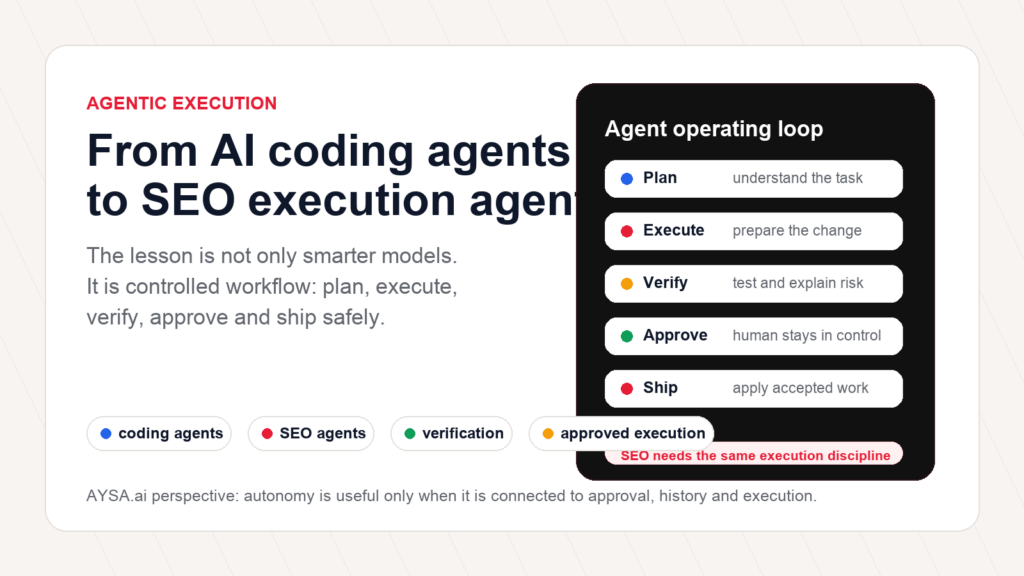
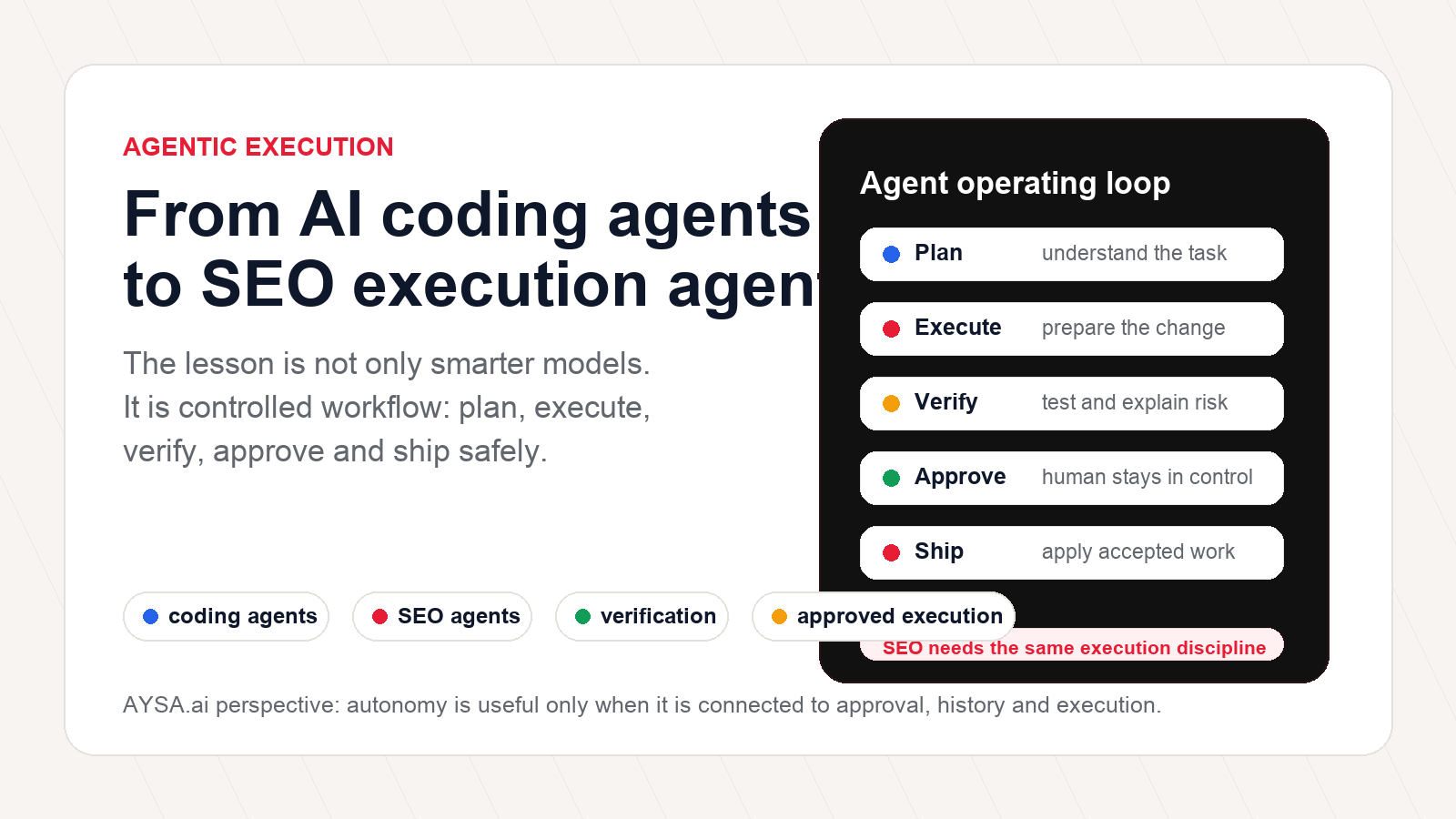
Summary: Search Engine Journal reported that Sundar Pichai said Google is “a bit behind” in agentic coding, partly because Google did not have the same kind of developer-facing product momentum as newer coding-agent tools. The interesting part is not the competitive drama. The interesting part is the pattern: AI is moving from tools that answer to agents that plan, execute, verify and ship work.
AYSA’s perspective is that SEO is entering the same phase. The future is not another dashboard, another chatbot or another PDF audit. The future is controlled execution: an agent understands the website, prepares the work, explains the risk, asks for approval and applies accepted changes inside the website workflow.
What happened
Search Engine Journal reported that Sundar Pichai said Google is “a bit behind” in agentic coding. According to the article, Pichai connected the gap to Google’s lack of developer-facing product momentum in the same way that tools like Cursor, Claude Code and other coding-agent interfaces captured developer attention.
The quote matters because it is unusually direct. Google has enormous AI infrastructure, strong models, distribution across Android, Search, Workspace, Cloud and Chrome, and decades of engineering depth. Yet Pichai’s point, as reported, suggests that having powerful models is not the same thing as owning the workflow where users actually do the work.
That distinction is central to the next phase of AI. The winning layer is not only the model. It is the product interface, context layer, execution environment, verification loop and distribution channel that lets an agent complete useful work with enough control and trust.
Google is clearly moving in that direction across Search. At Search I/O 2026, Google described its AI Mode expansion, agentic features and richer search experiences, saying it is combining the best of a search engine with the best of AI. Google also said AI Mode had surpassed one billion monthly users globally in that broader update. The same direction appears in developer workflows: AI systems are moving from passive answer boxes toward agents that act inside real environments.
Why agentic coding became the signal to watch
Coding is one of the clearest places to see the agentic shift because the work has a visible loop. A developer asks for a change. The agent reads files. It proposes an implementation. It edits code. It runs checks. It sees errors. It patches again. Then a human reviews and decides whether to merge.
That loop is much more powerful than a chatbot that writes a snippet. The value is not “AI can write code.” The value is “AI can operate inside the work system.” It can navigate context, perform actions, receive feedback and move the task toward completion.
This is why developer mindshare shifted so quickly. Tools that feel close to the execution environment are more useful than tools that live outside it. Developers do not want to copy code from a chat window, paste it into an editor, fix syntax, run tests manually and repeat the process ten times. They want the agent to work where the work happens.
The same pattern is coming to every knowledge-work category: marketing, finance, customer support, ecommerce operations, legal operations, analytics and SEO. The categories that look “safe” because they are complex are often the most exposed, because complexity creates a large gap between recommendation and execution.
The SEO parallel: reports are not execution
SEO has had its own version of the coding-agent problem for years. Traditional SEO tools show data: rankings, audits, errors, backlinks, competitors, Keyword gaps, traffic changes, crawl issues and dashboards. Agencies interpret that data. Specialists write recommendations. Business owners receive reports. Then the hardest part begins: implementation.
That implementation gap is where a lot of SEO value disappears. A Title tag is recommended but not changed. Internal links are suggested but not added. A schema opportunity is noticed but not implemented. A page is known to be thin but never rewritten. A redirect map is prepared but delayed. A content plan exists but no one ships the pages.
In classic SEO, slow execution was already expensive. In AI Search, AEO and GEO, slow execution becomes dangerous. Search is changing faster, AI answers can shift visibility, Google’s AI Mode can expand complex queries, and answer engines may rely on more than traditional rankings. Businesses need a way to turn observations into approved changes quickly.
This is the core reason AYSA exists. The product is not built around the idea that another SEO dashboard will save small businesses. It is built around the idea that SEO has to move from research to Approved Execution.
The execution gap is the real moat
When people compare AI products, they often ask which model is smarter. That matters, but it is not the whole question. The deeper question is: can the system do the work safely inside the environment where the work needs to happen?
For coding, that environment is the repository, editor, terminal, test suite and deployment pipeline. For SEO, the environment is the website, CMS, Search Console data, Analytics data, Business Profile, content inventory, internal linking graph, schema layer, redirects, sitemap, review queue and publishing workflow.
A general chatbot can explain a canonical tag. It can draft a meta description. It can produce a keyword list. It can suggest a content outline. That is useful, but it is still disconnected from the website. The user must copy, paste, check, approve, implement, monitor and repeat.
An execution agent needs more. It needs connected context. It needs action history. It needs approval state. It needs to know what has already been changed and what is waiting. It needs to separate safe automatic work from sensitive work that requires explicit approval. It needs to explain risk in plain language.
That is the difference between “AI output” and “AI operations.”
What real agents need before businesses can trust them
Agentic systems sound exciting, but autonomy without control is not a product strategy. It is a liability. Businesses will not trust agents that blindly modify websites, publish content, change redirects or alter technical settings without governance.
A serious agentic workflow needs five layers.
1. Context
The agent must understand the business, website structure, goals, location, market, competitors, products, services, tone of voice and technical constraints. Without context, it produces generic advice.
2. Preparation
The agent should prepare concrete work: page updates, content briefs, internal links, technical fixes, schema recommendations, redirect proposals, monitoring actions and authority opportunities.
3. Explanation
The user needs to understand why the action matters. The explanation should be written for business owners, not only SEO specialists. “This page receives impressions but does not answer the query well” is more useful than jargon.
4. Approval
Important changes should not be published blindly. The user should approve the action, reject it or ask for changes. Approval is the bridge between autonomy and trust.
5. Execution and history
After approval, the system should execute accepted changes and keep a record of what happened. Without history, an agent becomes impossible to manage.
These layers apply to code. They apply to SEO. They apply to AI visibility. They will apply to most agentic products that handle real business operations.
Why SMEs should care
For large companies, agentic coding and agentic SEO may sound like productivity improvements. For small businesses, they can be survival tools.
Most SMEs cannot afford a large SEO team. Many cannot evaluate complex technical recommendations. They do not want to live in dashboards. They also cannot wait months for every improvement. If search changes faster than the business can react, the business falls behind even if it “has SEO.”
This is where execution agents become practical. A small business owner does not need to become a technical SEO expert. They need a system that can monitor the website, identify what matters, prepare the work, explain it clearly and ask for approval before making important changes.
That does not remove the need for expertise. It changes where expertise lives. Instead of requiring every business owner to understand every SEO detail, expertise can be embedded into the agent’s workflow, training, checks and recommendations.
For agencies, the message is different. Agentic SEO does not automatically replace agencies, but it changes the value agencies must provide. Strategy, judgment, positioning, creative thinking and complex decision-making remain valuable. Manual implementation, repetitive audits and slow handoffs become harder to justify.
AYSA’s point of view
Pichai’s “bit behind” comment is useful because it separates AI capability from AI productization. Google has capability. The competitive question is whether users feel that capability inside the workflow where they need help.
SEO is going through the same transition. Many businesses already have access to strong AI models. They can ask ChatGPT, Claude or Gemini for advice. The problem is not lack of answers. The problem is lack of connected execution.
AYSA is built for that gap. It connects to the website, learns the business context, monitors SEO and AI visibility signals, prepares actions, asks for approval and helps execute accepted changes. The goal is not to impress the user with a clever answer. The goal is to reduce the amount of SEO work that remains stuck between “we know what to do” and “it is actually done.”
If coding agents are teaching the software industry anything, it is this: the future belongs to systems that can operate inside the workflow. SEO will not be different. The winners will not be the tools that only generate advice. The winners will be the systems that help businesses safely ship better websites.
Move from SEO advice to approved execution.
If your SEO process is full of reports, recommendations and unfinished tasks, AYSA helps turn website opportunities into approved actions that can be executed inside your workflow.
Sources
- Search Engine Journal: Pichai Says Google Is “A Bit Behind” On Agentic Coding
- Google: Search I/O 2026 updates, AI agents and AI Mode
- Google Search Central: Optimizing for generative AI features on Search
- AYSA: What an AI SEO execution agent actually does
- AYSA: Claude/GPT vs. a connected SEO execution agent
Continue the AI search topic inside AYSA.
Use these pages to connect the article with AI SEO tools, AI visibility monitoring, AI Overviews and approved website execution.
Turn this topic into a website action plan.
Use these AYSA hubs to move from reading to technical fixes, AI visibility monitoring, research, glossary context and approval-first SEO execution.