
Why Marketers Get Stuck in Execution Mode: The SEO Lesson for SMEs
High-performing marketers often get trapped in task execution. Here is why SEO, AEO and AI visibility need operating systems, not more dashboards.
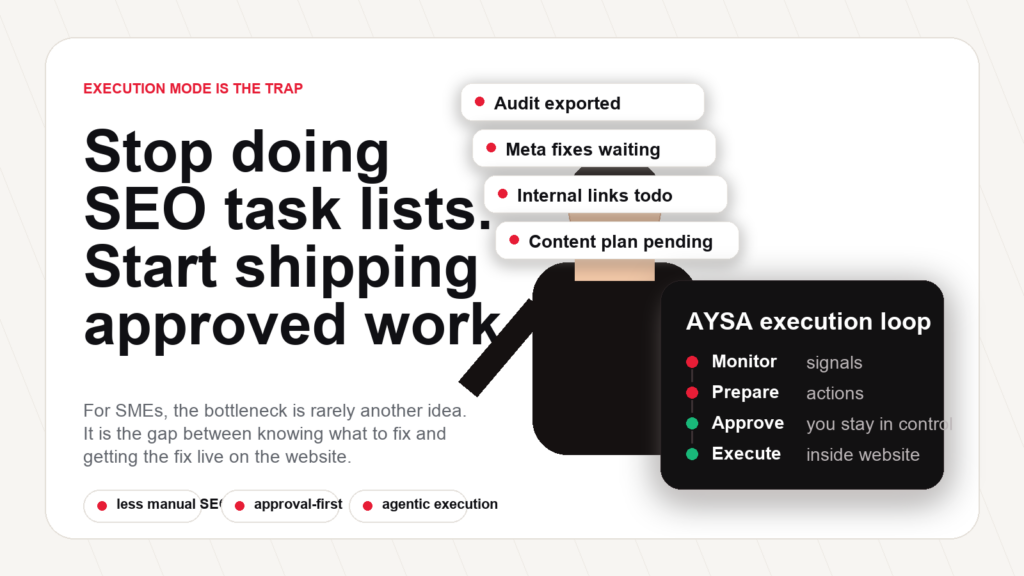
Summary: Search Engine Journal published an article about why high-performing marketers get stuck in “execution mode”: they become known for getting tasks done, but they struggle to move into strategic influence. For SEO, AEO and AI visibility, the same problem appears inside businesses every day. Teams do audits, export reports, collect recommendations and chase task lists, but the work that should change the website often moves too slowly.
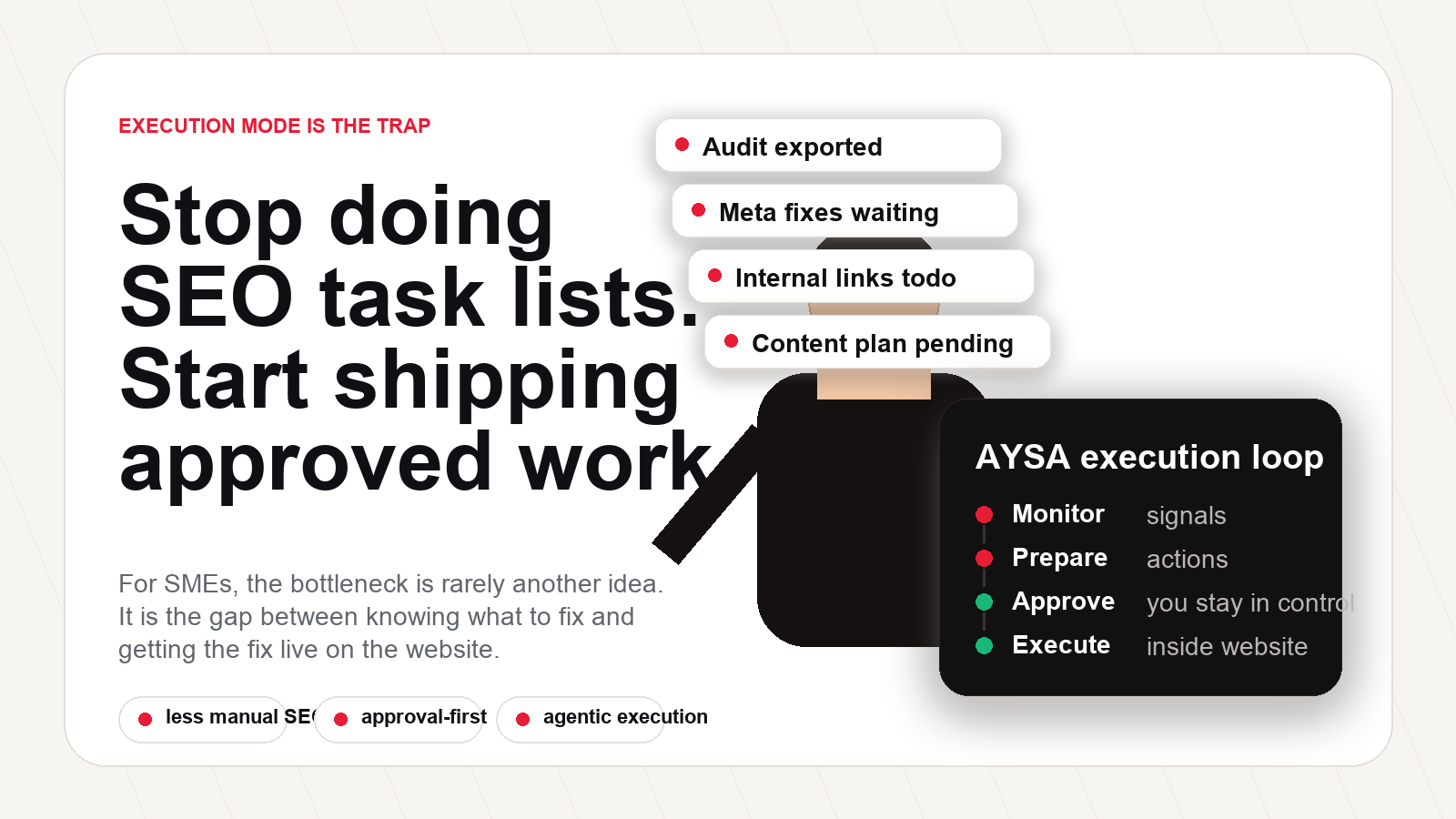
AYSA’s view: the answer is not to shame marketers for being operational. Execution matters. The real issue is that most SEO workflows still depend on manual handoffs. Modern search needs a system that monitors, prioritizes, prepares, asks for approval and executes accepted changes inside the website workflow.
Why this matters
Search Engine Journal’s article frames execution mode as a career problem: marketers who are excellent at completing tasks can become trapped in delivery instead of shaping strategy. The article’s core idea is simple and useful: execution gets people trusted, but strategy gets them heard.
For AYSA, the topic is bigger than career growth. It is also a product and business problem. Many companies, especially SMEs, do not fail at SEO because nobody knows what should be done. They fail because the work does not move through a reliable operating system.
The website needs better titles, clearer service pages, stronger internal links, technical cleanup, schema fixes, content updates, AI visibility improvements, local proof, authority signals and Monitoring. Everyone can agree on the need. Then the work gets stuck.
Someone has to interpret the audit. Someone has to decide what matters. Someone has to brief a writer. Someone has to edit the page. Someone has to ask the developer. Someone has to check the plugin. Someone has to publish. Someone has to verify. Someone has to remember what changed. In small businesses, that “someone” is often the founder, marketing manager or agency account manager who is already overloaded.
This is the execution trap. It is not laziness. It is workflow debt.
What execution mode looks like in marketing
Execution mode is not the same as being productive. It can feel productive because the calendar is full, the task list is active and the dashboards are open. But the output may still be disconnected from business progress.
In a marketing team, execution mode often looks like this:
- checking dashboards before deciding what the next real action should be;
- exporting data but not changing pages;
- writing reports that repeat the same recommendations every month;
- fixing easy tasks because they are easy, not because they matter;
- replying to urgent requests while important content and technical work wait;
- measuring activity instead of shipped improvements;
- treating every audit warning as equal.
Search Engine Land recently made a similar point in an SEO-specific way: “fix everything” is the wrong SEO strategy. Audit tools can flag hundreds or thousands of issues, but SEO growth depends on prioritization. Not every warning deserves the same attention. Not every possible improvement deserves the same budget.
This is where high-performing marketers can get punished by their own competence. Because they are reliable, more execution lands on them. Because they can solve problems, every problem becomes theirs. Eventually, they are too busy moving tasks to design the system that would reduce the task load.
The SEO version of the execution trap
SEO is especially vulnerable to execution mode because the field produces endless tasks. A crawl can produce hundreds of technical warnings. A rank tracker can produce daily movement. Search Console can produce thousands of queries. A content gap analysis can produce hundreds of topics. AI visibility checks can produce a new layer of missing answers, weak entities and Brand mention gaps.
The temptation is to turn all of this into a list. Fix title tags. Rewrite descriptions. Add FAQs. Clean redirects. Add schema. Improve internal links. Publish articles. Compress images. Update old pages. Build authority. Monitor keywords. Track AI citations. Review competitors. Repeat.
A list is not a strategy. A list is inventory. Strategy begins when the business decides what matters first, why it matters, what change should be made, who approves it, how it will be executed and how the result will be measured.
This is also why the comparison between AYSA and general AI tools matters. A user can ask ChatGPT, Claude or Gemini for SEO advice. The answer may be useful. But the answer still lives outside the website. It does not know the action history, approval state, CMS constraints, Search Console context, Internal linking graph, previous recommendations or execution queue. The user still has to copy, paste, interpret, implement and verify.
We covered this distinction in detail in Why Claude or GPT Alone Cannot Execute SEO for Your Website. The short version is this: advice is not execution. Drafts are not publishing. Audits are not implemented fixes.
Why AI search makes execution mode more expensive
In the older SEO world, slow execution was painful but sometimes survivable. A company could run a quarterly audit, publish a few pages, adjust metadata and wait. That pace is becoming weaker.
Search is no longer only ten blue links. Google is expanding AI Mode and AI Overviews. Answer engines synthesize responses. Users compare options through conversational search. Google’s own guidance for generative AI features still points back to fundamentals: useful content, crawlable pages, clear structure and content that helps users. But the speed and surface area of search have changed.
If a business wants to be understandable in classic search, AI-assisted search and answer engines, it cannot rely only on occasional reports. It needs continuous improvement in areas like:
- entity clarity: who the business is, where it operates and what it does;
- answer readiness: whether pages directly answer real user questions;
- technical crawlability: whether important content can be discovered and rendered;
- semantic internal linking: whether related topics are connected;
- topical authority: whether the site covers the subject deeply enough;
- trust signals: whether proof, reviews, authorship, policies and citations are visible;
- freshness: whether important pages are maintained as the market changes.
None of these are one-time tasks. They are operating habits. That is why execution mode is dangerous: it fills the day with work while the website still does not evolve fast enough.
The operator model: from marketer as task owner to marketer as system owner
The solution is not to remove humans. The solution is to move humans to the right layer.
A human should decide positioning, risk tolerance, brand voice, commercial priorities, sensitive claims, legal boundaries, product truth and customer experience. A human should approve important changes. A human should reject bad recommendations. A human should decide when a content opportunity is strategically wrong even if the keyword volume looks attractive.
But a human should not need to manually repeat every operational step forever. The system should monitor, prepare, explain, queue, apply approved changes and keep history.
This is the operator model. The marketer or business owner becomes the operator of an SEO execution system, not the person manually carrying every task from spreadsheet to website.
In practice, that means the workflow should answer:
- What changed in search visibility?
- Which website actions matter now?
- What is the expected impact?
- What is safe to execute after approval?
- What requires manual review?
- What has already been applied?
- What should be monitored next?
This is also the difference between a dashboard and an operating system. A dashboard shows state. An operating system moves work.
A practical playbook for SMEs
If you are a founder, ecommerce owner, local business or small marketing team, the goal is not to become less operational overnight. The goal is to stop confusing motion with progress.
1. Define the business outcome first
Do not start with “fix SEO.” Start with the business outcome: more local appointments, more ecommerce sales, more qualified leads, more non-branded discovery, stronger AI visibility or better conversion from existing impressions.
2. Translate audits into decisions
A crawl report is not a plan. For every issue, ask whether it affects an important page, whether it blocks crawling or conversion, whether it supports a commercial topic and whether it can be fixed safely.
3. Separate tasks by execution type
Some tasks are safe and repeatable: metadata improvements, internal link suggestions, content refresh prompts, broken link cleanup, monitoring alerts. Others need more review: medical claims, legal content, pricing, redirects, schema changes, authority building and page rewrites.
4. Create an approval queue
If every task requires a meeting, nothing moves. If every task is automated blindly, risk increases. The middle path is approval-first execution: the system prepares the action, the user approves what matters, and accepted work moves forward.
5. Measure shipped improvements
Track not only rankings or traffic, but also the number of meaningful approved changes shipped: pages improved, internal links added, content gaps closed, technical issues resolved, authority actions reviewed and AI visibility gaps addressed.
AYSA’s point of view
Execution mode is not a personal failure. It is a design failure in the workflow.
Most SEO systems still assume that humans will connect every dot: interpret the data, decide the priority, write the content, coordinate implementation, check the website and remember the history. That model works when the number of tasks is small and the market changes slowly. It breaks when search becomes more dynamic, more AI-assisted and more operationally demanding.
AYSA exists because we believe SEO needs to become an approved execution layer. The agent learns the business, monitors the website, identifies opportunities, prepares actions, explains them in plain language, asks for approval and executes accepted changes inside the website workflow.
For SMEs, this means less dependence on dashboards and less manual handoff. For agencies, it means more scalable execution without losing strategic control. For non-specialists, it means SEO becomes something they can approve and steer, not a technical maze they have to personally master.
The future of SEO is not “more tasks.” It is better systems. Marketers should not spend their best energy moving recommendations from one tool to another. They should spend it deciding what growth should look like and letting the right execution system carry the approved work forward.
Tired of SEO tasks that never become website changes?
AYSA helps monitor your website, prepare SEO and AI visibility actions, request approval and execute accepted changes inside your website workflow.
Sources
- Search Engine Journal: Why High-Performing Marketers Get Stuck In Execution Mode
- Search Engine Land: “Fix everything” is the wrong SEO strategy
- Google Search Central: Optimizing for generative AI features on Search
- Google Search Central: Creating helpful, reliable, people-first content
- AYSA: What an AI SEO execution agent actually does
Continue the AI search topic inside AYSA.
Use these pages to connect the article with AI SEO tools, AI visibility monitoring, AI Overviews and approved website execution.
Turn this topic into a website action plan.
Use these AYSA hubs to move from reading to technical fixes, AI visibility monitoring, research, glossary context and approval-first SEO execution.

