
846,000 Google Searches Show the New SEO Reality: Users Pause, Scroll and Reconsider Before Clicking
New click behavior data suggests users pause, scroll and compare more before clicking. Here is what it means for SEO, AEO, snippets and approved execution.
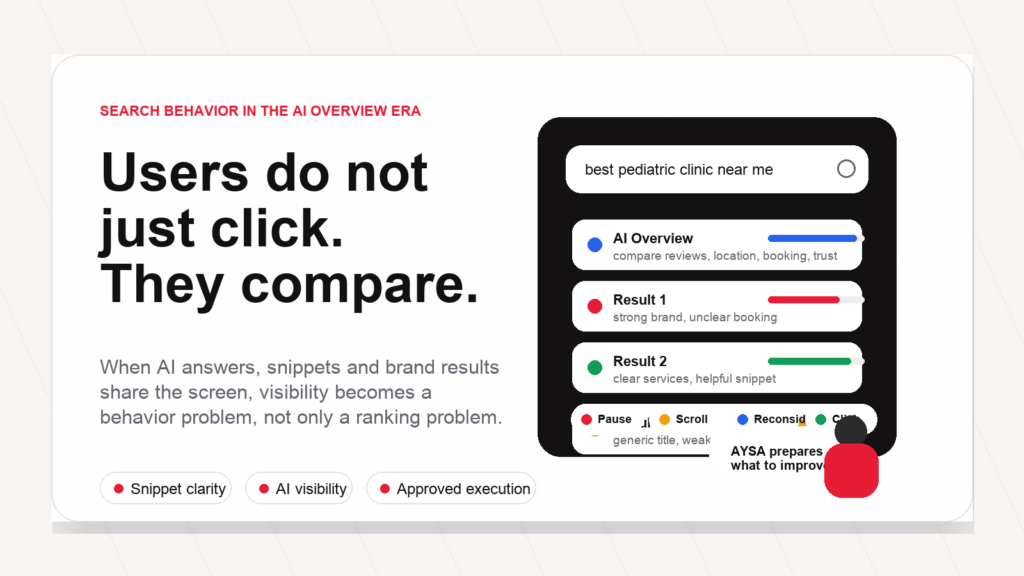
Summary: A new Search Engine Journal article reports on a dataset of 846,000 Google searches and argues that AI Overviews are changing how people behave before they click. The practical lesson is not simply “rank higher.” Users appear to pause, scroll, compare and reconsider. That means your title, description, brand clarity, page promise and answer quality matter before the visit even happens.
AYSA’s view: SEO reporting needs to move beyond rank position and traffic screenshots. In the AI Search era, businesses need to optimize for the visible decision moment: what the user sees, understands and trusts before clicking. That requires continuous Monitoring, better snippets, stronger page intent, clearer entity signals and Approved Execution inside the website.
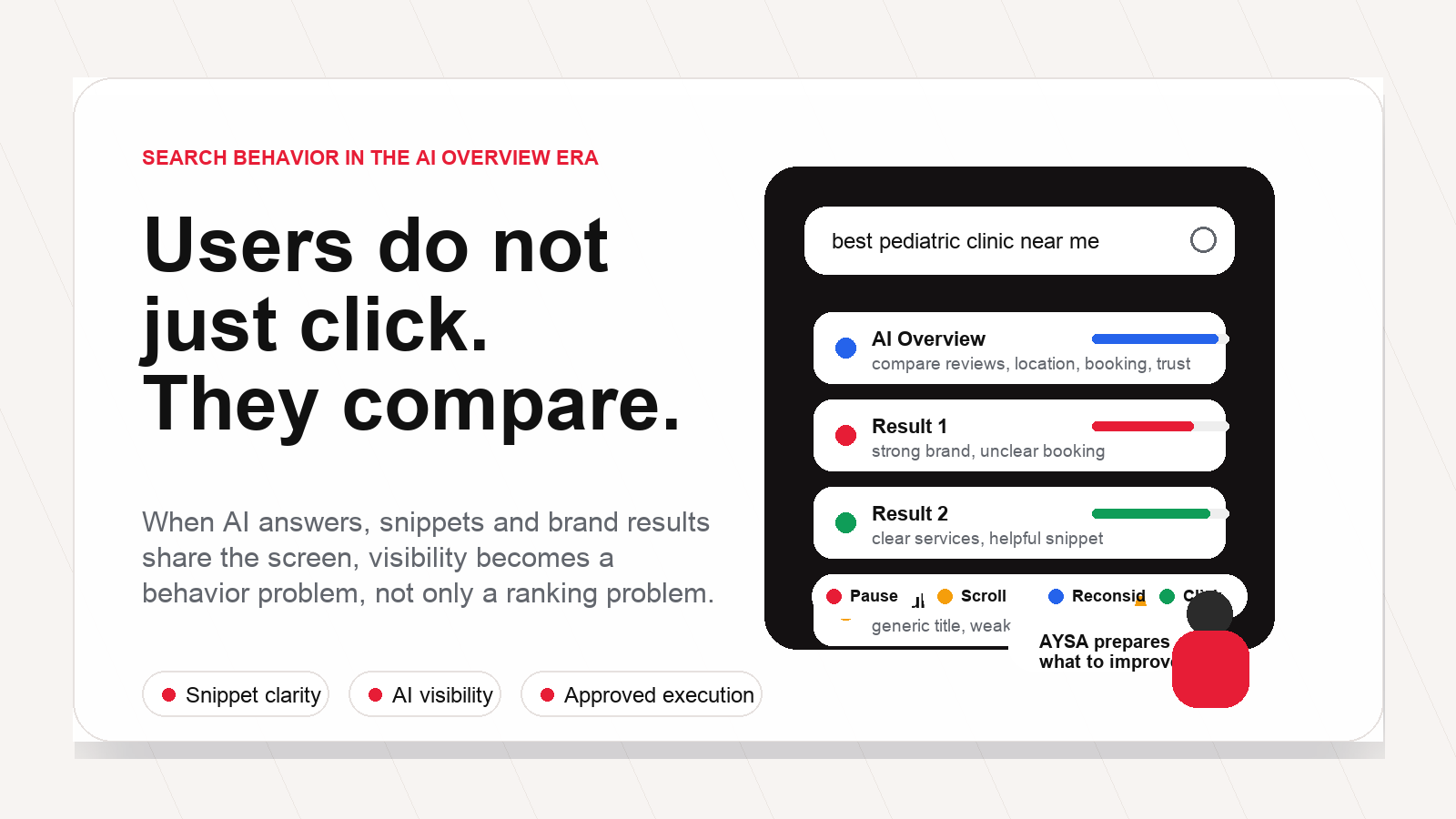
Rank is the start. The decision happens after the user sees the page.
What changed
Search Engine Journal published a data-led article about 846,000 Google search sessions and how AI Overviews appear to influence user behavior. The article’s important point is not that classic SEO is dead. It is that the moment between impression and click is becoming more complex.
For years, many SEO conversations treated rank position as the main proxy for visibility. Position one was assumed to mean attention. A branded query was assumed to mean a quick click. A ranking report was treated as if it explained the user journey. That was never perfectly true, but it was easier to believe when the SERP looked simpler.
The modern SERP is different. A user may see an AI Overview, a Knowledge Panel, local results, shopping units, video results, People Also Ask, images, ads, organic links and brand mentions on one screen or across a short scroll. The user does not merely “see a ranking.” The user sees a decision environment.
That distinction matters for SMEs because many businesses still optimize pages as if Google were a simple list of links. They ask: “Where do I rank?” The better question is now: “When a real person searches, what do they see, what do they understand, and why would they choose me instead of the next visible option?”
Pause, scroll, reconsider: why the click is slower
The SEJ article argues that users are traversing the results page more thoroughly before making a decision. That is consistent with what many marketers feel in Search Console: impressions can exist without proportional clicks, and branded or semi-branded discovery can become less predictable when AI-generated summaries and richer search features answer part of the question upfront.
This does not automatically mean users hate organic results. It means users may be using the SERP itself as a comparison interface. They pause over an AI Overview. They scan the snippets. They check whether a result sounds specific. They notice brand familiarity. They scroll back. They reconsider. Then they click.
For a business owner, this changes the job of SEO. The job is not only to make the page rank. The job is to make the search result earn enough confidence to deserve the click. That is a different standard.
Imagine a parent searching for a private pediatric clinic in Bucharest. The user may not click the first result immediately. They may compare review language, location, online booking, services, parking, opening hours and whether the clinic appears to understand the real concern: a child with recurring fever, urgency, trust and convenience. A generic title like “Pediatric Clinic Bucharest” may appear, but a clearer result can win the decision if it better matches the user’s anxiety and intent.
The same applies to ecommerce, hotels, parking near airports, car rental, legal services, floristry and local services. The user is not only searching. The user is evaluating risk.
Why title tags and descriptions matter more, not less
Google’s own documentation explains that title links and snippets are generated from page content and signals, and that Google may rewrite them when it believes another representation is more useful. That does not make title tags and meta descriptions irrelevant. It makes clarity more important.
If the page title is vague, over-optimized or disconnected from the visible page, Google and users both receive weak signals. If the description is generic marketing copy, it may not help the user choose. If the page itself does not quickly deliver what the snippet promises, the click can become a disappointment.
In a world where users pause and compare, the snippet becomes a mini sales conversation. It should answer:
- What is this page about?
- Who is it for?
- What decision does it help the user make?
- Why should this result be trusted?
- What is different from the other visible options?
For SMEs, this is often where the gap appears. They have pages, but the pages do not express the business clearly. They have services, but the service page title is generic. They have local proof, but the snippet does not reflect it. They have FAQs, but the page does not answer the real buying question. They have reviews, but the page does not translate them into decision support.
This is why snippet optimization should not be reduced to “write a catchy meta description.” It is a page alignment task. The title, H1, intro, structured content, internal links, visible proof and snippet promise should support the same intent.
AI Overviews and brand clicks
AI Overviews create another layer in the user journey. Google’s guidance for generative AI features still points back to durable fundamentals: helpful content, crawlable pages, clear structure, good page experience and content that people find useful. But the user experience is changing because AI summaries can frame the decision before the organic click.
This is especially important for branded and navigational searches. A brand query used to be a more direct path. Now, depending on the query and SERP composition, users may still encounter additional context, alternatives or AI-generated explanations before clicking. Brand demand does not always convert into instant traffic if the SERP answers part of the need or introduces comparison behavior.
That should not push businesses into panic. It should push them into better content operations. If AI systems and users are both evaluating the business from multiple signals, then the website must make those signals easy to understand:
- clear entity information: name, location, services, products, authors, policies;
- specific pages that answer specific intents;
- strong internal linking between related pages;
- updated content that reflects the real business;
- visible proof: reviews, case studies, comparisons, examples, media mentions;
- structured information that can be parsed reliably;
- technical accessibility for crawlers and users.
We have written before about how Google AI Mode expands queries beyond keywords. This behavior data fits the same direction: search is becoming less linear. Users express broader needs, Google rewrites or expands the task, and the visible result must support comparison, not just keyword matching.
The move from rank tracking to true visibility
Traditional rank tracking is still useful. You still need to know where pages appear. But rank alone is no longer enough to explain performance. A page can rank and still be visually buried. A page can receive impressions and still fail to earn clicks. A page can appear for the right query but communicate the wrong promise.
True visibility should combine several layers:
- Position: where the result appears.
- Pixel visibility: whether the result is actually visible without deep scrolling.
- SERP context: what appears above and around it.
- Snippet strength: whether the title and description are specific and trustworthy.
- Intent match: whether the result solves the real user task.
- Brand clarity: whether the business is recognizable and credible.
- Click quality: whether the page delivers on the promise after the click.
Google Search Console remains essential because it shows impressions, clicks, CTR and average position, but those metrics need interpretation. Google’s documentation for Search Console performance reporting explains how clicks, impressions, CTR and position are counted. The challenge is that the numbers tell you what happened, not always why it happened.
That is where SEO work needs to become more operational. If CTR falls, the next step is not only to stare at the chart. The next step is to inspect the query, SERP, snippet, page intent, competitor result, AI Overview presence and page promise. Then someone has to prepare an improvement, approve it and ship it.
A practical SME playbook
For SMEs, this topic can sound technical, but the practical playbook is simple.
1. Audit pages by search promise, not only keyword
Look at important pages and ask what promise they make in the SERP. Does the title describe the page clearly? Does the description help the user decide? Does the page immediately satisfy the promise?
2. Use Search Console to find impression-rich, click-poor pages
Pages with impressions but weak CTR deserve review. Sometimes the issue is ranking position. Sometimes it is SERP layout. Sometimes the title, description or page intent is weak. Sometimes the query is informational and the page is commercial. Do not guess; inspect.
3. Rewrite around decision criteria
A user comparing clinics, hotels, parking services, car rental options or ecommerce products is not only looking for a keyword. They are looking for criteria: price, availability, trust, distance, speed, proof, risk, terms, reviews, guarantees and next step. Bring those criteria into the page where they are true and helpful.
4. Strengthen internal links around the user journey
If a page answers one part of the decision, link it to the next part. Service page to pricing. Category page to buying guide. Blog article to product comparison. Local landing page to reviews and booking. Internal linking helps users and crawlers understand the path.
5. Monitor AI visibility separately from classic rank
AI visibility is not the same as blue-link ranking. Track whether your brand, products, services and expert pages are easy to cite, explain and recommend. This is why AYSA treats SEO, AEO, GEO and AI visibility as connected workflows, not separate buzzwords.
AYSA’s point of view
The biggest mistake SMEs can make is to respond to this shift by adding more dashboards. More reports will not fix weak snippets, unclear pages or unshipped recommendations. The work has to move into the website.
AYSA is built for that operating model. The agent can monitor Search Console signals, identify pages that get impressions but underperform, detect opportunities for clearer titles and descriptions, prepare on-page changes, connect related pages, suggest answer-ready sections and queue improvements for approval. After approval, accepted changes can move into the website workflow.
This matters because user behavior is becoming more demanding. If people pause, scroll and reconsider, the page result must earn the click. If AI Overviews frame the answer, the website must be clear enough to be understood. If the SERP is crowded, the business must communicate specific value before the visit.
In my opinion, the SEO winners of the next stage will not be the companies with the longest task lists. They will be the companies that can translate search behavior into approved website improvements faster than competitors. Not blindly. Not with hype. With monitoring, preparation, approval and execution.
Are your pages getting seen but not chosen?
AYSA helps turn impressions, weak snippets and AI visibility gaps into approved website improvements your team can actually ship.
Sources
- Search Engine Journal: 846,000 Google Searches Reveal How AI Overviews Are Changing User Behavior
- Google Search Central: Control your title links in search results
- Google Search Central: Control your snippets in search results
- Google Search Central: Optimizing for generative AI features on Search
- Google Search Console Help: Performance report metrics
- AYSA: How Google AI Mode Expands Queries Beyond Keywords
Continue the AI search topic inside AYSA.
Use these pages to connect the article with AI SEO tools, AI visibility monitoring, AI Overviews and approved website execution.
Turn this topic into a website action plan.
Use these AYSA hubs to move from reading to technical fixes, AI visibility monitoring, research, glossary context and approval-first SEO execution.

