Nick Fox: Deeper Content Wins in AI Search
Google's Nick Fox says AI Search can help users go deeper into content. Here is what that means for SEO, AEO, topical authority and approved execution for SMEs.
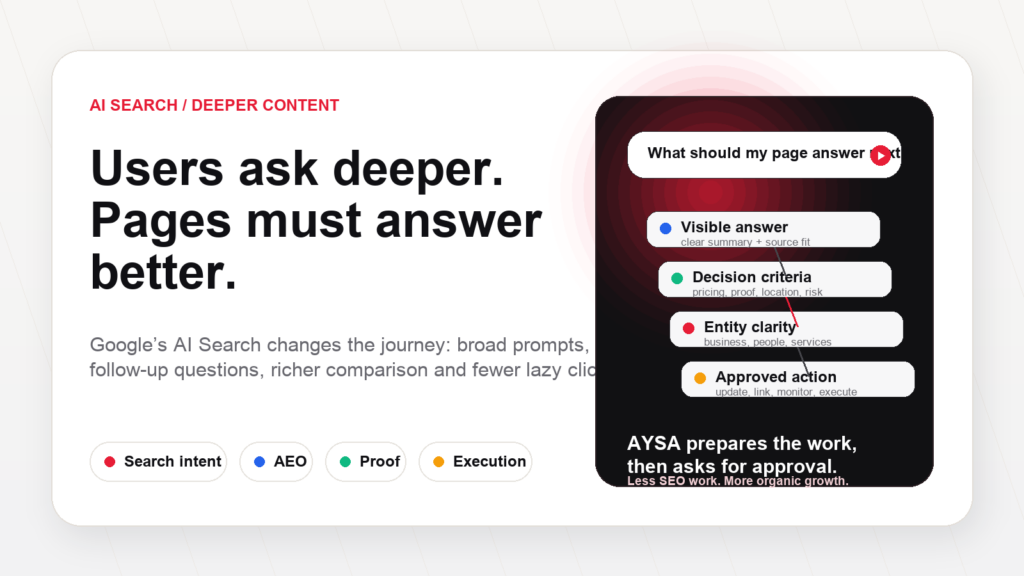
Summary: Search Engine Land covered Google Search executive Nick Fox’s view that AI Search is not simply taking users away from websites. In Google’s framing, AI-assisted search can help people ask richer questions and then go deeper into the web when the content deserves that next step.
AYSA’s view: this is not a free pass for every website. AI Search raises the standard. Thin pages, generic SEO copy and “we also offer this service” content become easier to ignore. The winners will be pages that answer real questions, show real expertise, provide decision support and can be updated quickly when search behavior changes.
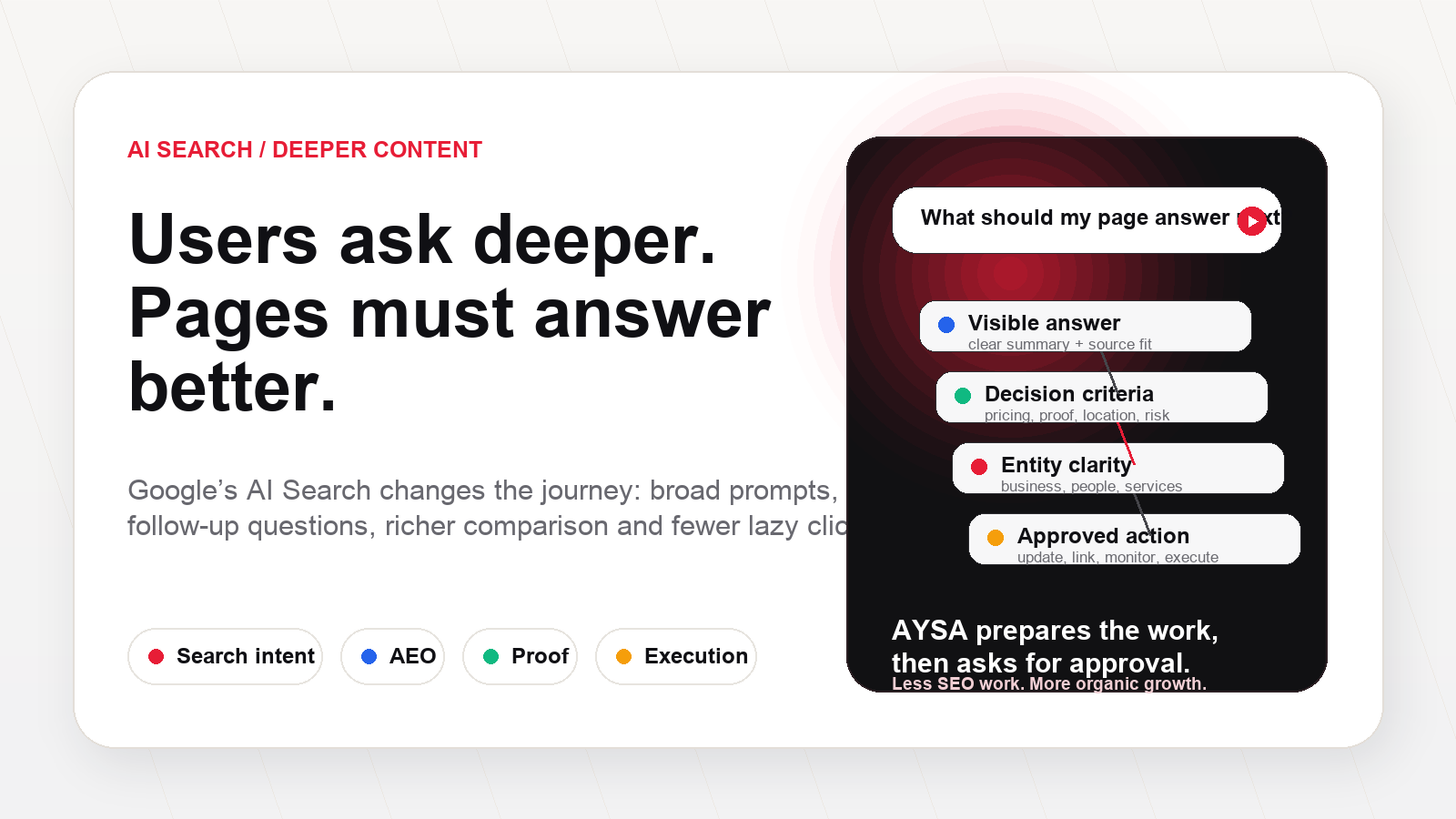
The result that wins is not always the shortest answer. It is the page that helps the user decide.
What Nick Fox said, and why the nuance matters
Search Engine Land reported on comments from Google’s Nick Fox about AI Search and the relationship between AI-generated answers and publisher content. The important nuance is that Google is not presenting AI Search as a simple replacement for the web. The argument is that AI Search can help users explore more complicated needs and, in some cases, continue into deeper source material.
That matters because the SEO conversation often collapses into two extreme reactions. One side says AI answers will kill Organic traffic. The other side says nothing has changed and everyone should keep doing old SEO. Both are too simple.
The more useful interpretation is this: AI Search changes the shape of the journey. Users can begin with broader prompts, refine with follow-up questions, compare options inside the search experience and then click when they need depth, proof, tools, transactions or a specific business. That means the website is still important, but the page must earn a more demanding click.
Google’s own AI optimization guidance does not recommend a separate magic trick for AI Search. It points back to durable fundamentals: helpful content, accessible pages, structured information, page experience, clear snippets and content created for people. But the standard for “helpful” is moving upward because users now ask better questions and receive more context before they land on a website.
Deeper content does not mean longer content
The most dangerous misunderstanding is to hear “deeper content” and translate it into “write 4,000 words every time.” That is not the point.
Deeper content means the page goes below the surface of the Keyword. It helps the user understand the problem, compare choices, identify risks, evaluate proof and take the next step. Sometimes that requires a long guide. Sometimes it requires a better table, a clearer process, better images, pricing context, local details, examples, FAQs, source citations or a simple decision framework.
A page about “Technical SEO audit” should not only define the term. It should explain what is checked, what can break, what matters first, which issues are safe to automate, which issues need review and what happens after the audit. A page about “best pediatric clinic in Bucharest” should not behave like a generic directory. It should help a parent compare symptoms, urgency, booking, parking, reviews, services and trust signals.
This is where AI Search creates pressure. If a page only repeats definitions already available everywhere, the AI layer may satisfy the user before the click. If the page provides real decision support, lived examples, Entity Clarity and credible next steps, it has a stronger reason to be cited, opened, bookmarked or chosen.
Why thin SEO pages are more vulnerable now
Thin content was already a problem before AI. Google’s helpful content documentation has long pushed site owners toward people-first content that demonstrates usefulness, expertise and trust. AI Search makes the weakness easier to expose.
For SMEs, thin pages usually appear in predictable forms:
- service pages that list services but do not explain the process, price factors, timing or decision criteria;
- location pages that swap city names without adding local proof or context;
- ecommerce category pages that have products but no buying guidance;
- blog posts that define a term but do not help the reader make a decision;
- AI-generated articles that sound fluent but contain no operational insight;
- FAQ blocks that answer generic questions but not the questions real customers ask before buying.
In traditional SEO, some of these pages could still attract traffic through keyword matching, domain strength or weak competition. In AI-assisted search, they become less compelling because the search experience itself can summarize the generic part. The page needs to offer something the summary cannot fully replace: specificity, trust, proof, comparison, tools, examples, data, local context, product detail or execution.
This is why “SEO content” can no longer be treated as a commodity. The page has to do a job.
How this connects to users pausing, scrolling and reconsidering
This article connects directly with our previous analysis: 846,000 Google Searches Show the New SEO Reality: Users Pause, Scroll and Reconsider Before Clicking. That piece looked at the idea that modern search users may compare more before committing to a click.
Nick Fox’s point and the user-behavior point are two sides of the same problem. If AI Search gives users more context, then users can become more selective. They may click fewer weak pages, but they may click better pages when they need depth. The SEO goal is not only to appear. The goal is to be the page worth continuing to.
This changes what marketers should measure. Rank position still matters, but it is not enough. You also need to inspect the visible SERP, AI Overview context, snippets, competitor promises, Brand Mentions, internal page quality and post-click satisfaction. Google Search Console can show impressions and clicks, but teams still need to interpret why a page is visible but not chosen.
For a business owner, the practical question becomes: “When a user reaches my page after an AI-assisted journey, does this page continue the conversation better than the search result did?” If the answer is no, the page is exposed.
A practical content-depth model for SMEs
SMEs do not need to become media companies. They need to make their most important pages more useful for real decisions. A good page in the AI Search era usually includes five layers.
1. The direct answer
The page should answer the main question quickly. Do not hide the useful part behind a long introduction. If the user asks what to compare, what it costs, how it works or what to do next, say it clearly.
2. The decision criteria
Help the user evaluate options. For a clinic, that may mean symptoms, specialties, reviews, booking and location. For parking near an airport, it may mean transfer time, security, pricing, cancellation and distance. For ecommerce, it may mean use case, compatibility, materials, delivery and returns.
3. The proof layer
Add real signals: reviews, examples, case studies, photos, author experience, business history, certifications, media mentions or customer scenarios. Do not invent proof. Use what is true.
4. The semantic structure
Use headings, internal links, related pages, glossary links and structured content so both users and retrieval systems can understand what the page covers. This is where SEO, AEO and semantic SEO overlap.
5. The execution path
Tell the user what to do next. Book, compare, request a quote, read a related guide, check pricing or start a plan. Useful content should reduce uncertainty, not leave the user stranded.
The technical layer still matters
AI Search does not remove technical SEO. It makes technical clarity more important. If pages are slow, blocked, poorly linked, duplicated, hidden behind broken scripts or difficult to crawl, then deeper content may not be discovered or understood reliably.
Google’s guidance keeps returning to crawlability, indexability, helpful content and page experience for a reason. AI systems cannot cite, summarize or recommend what they cannot access or parse. Clean HTML, stable rendering, good internal links, canonical consistency, useful snippets and structured data are still part of the foundation.
For WordPress sites, this is often where execution breaks. The business may have useful knowledge, but the website is slow, overloaded with plugins, full of thin tags, missing internal links, carrying duplicate metadata or publishing content without a clear semantic structure. The problem is not a lack of SEO ideas. The problem is that the work does not get shipped consistently.
AYSA’s view: content depth has to become an operating system
My view is simple: AI Search will punish lazy SEO faster than classic search did. Not because Google hates websites, but because users now have more help before they click. The page must deserve the next step.
This is exactly why AYSA is built as an execution agent, not another reporting dashboard. The useful workflow is not “generate a report and hope someone fixes it.” The useful workflow is:
- monitor pages with impressions, weak CTR, poor snippets or low AI visibility;
- detect whether the page answers the real user task deeply enough;
- prepare concrete improvements: titles, descriptions, headings, sections, internal links, FAQs, schema and content updates;
- explain why the change matters in plain language;
- ask the business owner to approve important actions;
- execute approved changes inside the website workflow.
That is the difference between reading another article about AI Search and actually adapting the website. SMEs do not need ten more dashboards. They need a system that watches search behavior, translates it into website work and helps them ship approved improvements.
If Nick Fox is right that AI Search can lead users deeper into the web, then the opportunity is real. But only for pages worth going deeper into.
Tired of shallow SEO pages that do not earn clicks or citations?
AYSA helps find pages that need deeper answers, prepares SEO and AEO improvements, asks for approval and executes accepted changes inside your website workflow.
Sources
- Search Engine Land: Google’s Nick Fox on AI Search and deeper content
- Google Search Central: Optimizing for generative AI features on Search
- Google Search Central: Creating helpful, reliable, people-first content
- Google Search Central: Control your title links in search results
- Google Search Central: Control your snippets in search results
- AYSA: 846,000 Google Searches Show the New SEO Reality
- AYSA: How Google AI Mode Expands Queries Beyond Keywords
Continue the AI search topic inside AYSA.
Use these pages to connect the article with AI SEO tools, AI visibility monitoring, AI Overviews and approved website execution.
Turn this topic into a website action plan.
Use these AYSA hubs to move from reading to technical fixes, AI visibility monitoring, research, glossary context and approval-first SEO execution.