
Google Search, AI Agents and Tools Are Becoming One Product. What That Means for SEO.
Sundar Pichai says Google Search, AI agents and tools are converging into one product. Here is what that means for SEO, AEO, AI visibility and SMEs.
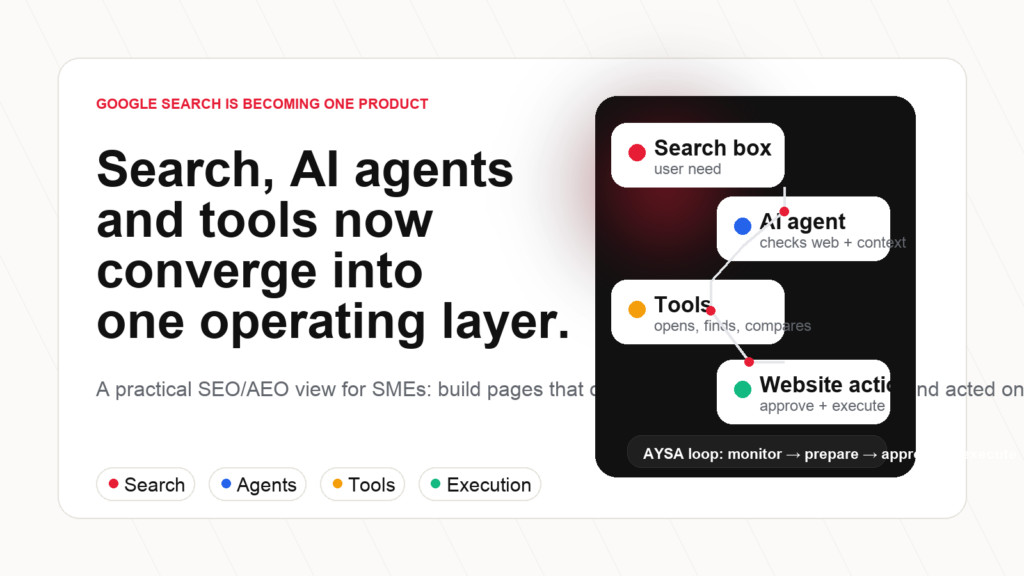
Executive summary: Sundar Pichai’s latest comments about Search, AI agents and tools becoming one product are not a small product note. They describe the direction of Google Search: less like a static results page, more like an AI-assisted operating layer that can understand a task, use tools, inspect sources, keep context and help users move toward action. For SEO, that means ranking reports are no longer enough. Websites need to be readable, useful, trustworthy, connected and ready for execution.
For SMEs, the practical lesson is simple: do not panic about “SEO being dead.” Instead, accept that the work has changed. Your website must answer real decisions, expose business facts clearly, support AI-assisted retrieval and change quickly when the market changes. AYSA fits this shift because it is built around the loop that most businesses lack: monitor, prepare, approve and execute.
What Sundar Pichai actually said
Search Engine Land reported a short but important answer from Sundar Pichai. Asked whether Google Search, AI agents and AI tools become one product, Pichai’s answer was direct: “It will.” The article points to a broader interview on The Verge’s Decoder, where Pichai discussed Google’s AI direction, Search, Gemini and the future of product surfaces.
That sentence matters because it compresses the next strategic phase of Search. Google is not only adding AI answers on top of search results. It is connecting search, assistant-like behavior, agentic workflows, multimodal inputs and task completion. In other words, Search is no longer only where users find pages. It is increasingly where users explain a problem, preserve context, compare options, use tools and ask the system to help them move forward.
We should be careful here. This does not mean websites disappear. It does not mean Google can answer every commercial, local, medical, legal or ecommerce question without sources. It does not mean SEO is finished. It means the gateway is changing. The visible results page is only one part of the discovery process. The invisible process behind the answer is becoming more important: retrieval, source evaluation, query expansion, tool use, entity understanding and action readiness.
Google’s own announcements around AI Mode and I/O 2026 support the same direction. Google described AI Mode as a more powerful way to search with longer and more complex questions. It announced a major Search box upgrade, multimodal inputs, continuation from AI Overviews into AI Mode, information agents and richer agentic experiences. It also connected Search with shopping, local decisions, ads and tools that can help users complete tasks.
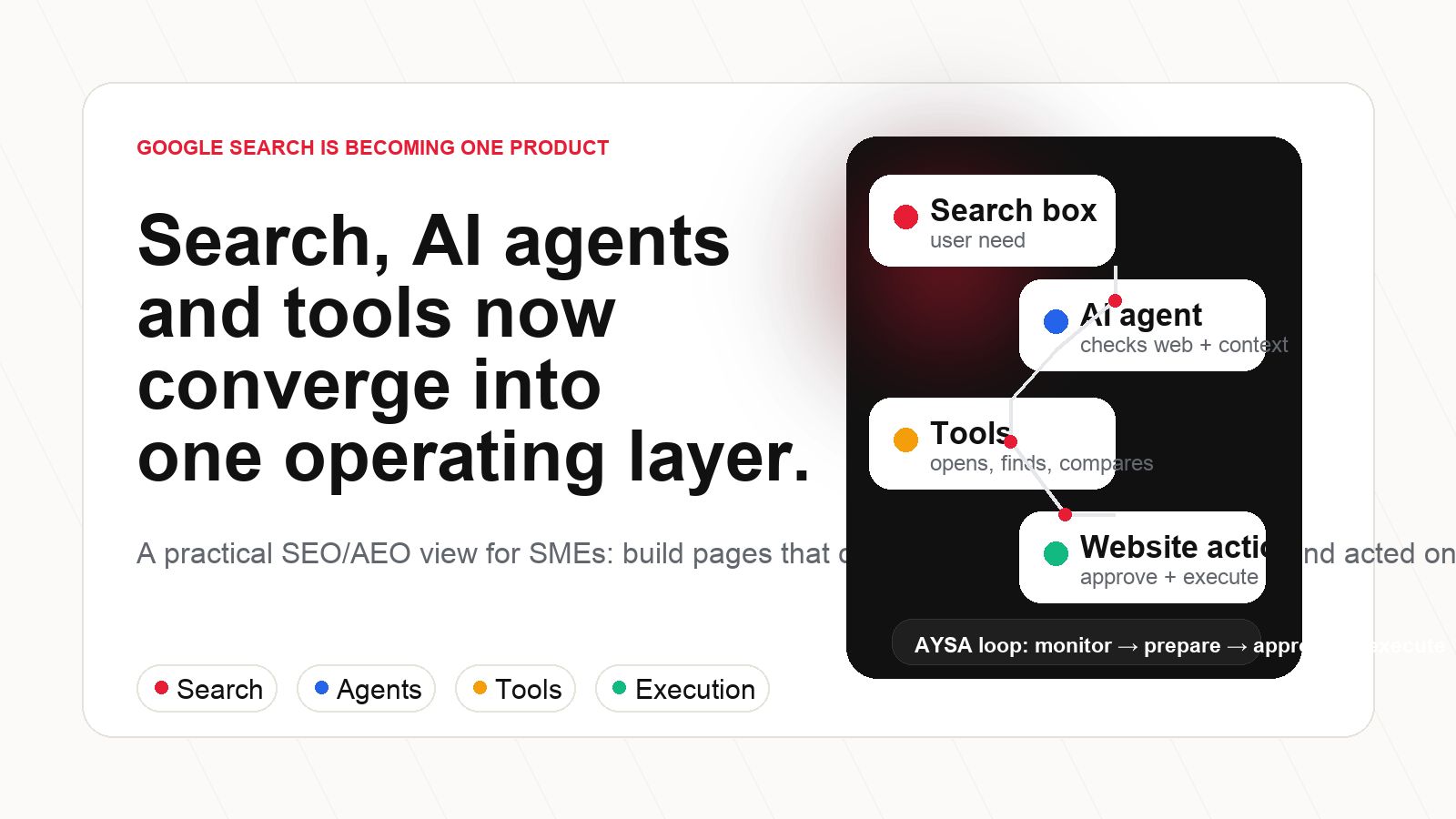
The big idea is this: Search is becoming software. The query box is becoming a command surface. The result is becoming a synthesized experience. The user’s intent is becoming a task, not only a Keyword.
Search + agents + tools
Why “one product” is the phrase SEOs should not ignore
The phrase “one product” changes the frame. For years, search marketers could separate surfaces: classic organic results, paid ads, Google Business Profile, Shopping, YouTube, Discover, Maps, featured snippets, People Also Ask and, more recently, AI Overviews. That separation is becoming weaker. Google is moving toward a world where the user journey crosses those surfaces inside one AI-assisted flow.
A user might ask a broad question, receive an AI Overview, continue into AI Mode, add a photo, ask for comparisons, inspect reviews, evaluate nearby options, see ads, open a merchant result, ask a follow-up and eventually take an action. From the user’s point of view, that is not “SEO versus AEO versus PPC versus local.” It is one journey.
That is the uncomfortable part for traditional SEO reporting. A ranking position tells you something, but it no longer tells the whole story. You also need to understand whether your business is legible inside an AI-assisted comparison, whether your pages answer the supporting questions, whether your brand has enough external proof, whether your business facts are consistent, whether your local or product data is clear, and whether the website can be trusted as a source.
In a one-product Search environment, the website is not only competing for a blue link. It is competing to be part of the system’s working memory. That sounds abstract, but it becomes very practical quickly.
If someone asks for a pediatric clinic, the system needs services, doctors, reviews, location, appointment process, parking, insurance, emergency limitations and parent-friendly explanations. If someone asks for airport parking, it needs transfer time, security, cancellation policy, distance, price transparency and booking details. If someone asks for a florist, it needs delivery areas, cut-off times, bouquet types, event use cases, payment methods and proof of reliability. If someone asks for SEO Automation, it needs to understand whether the product only reports issues or actually helps execute work.
Search becoming one product means your website must support the whole decision, not only the main keyword.
What changes for SEO, AEO and AI visibility
The fundamentals do not vanish. Google still needs to crawl pages, understand content, evaluate quality, detect spam, process links, interpret entities and serve useful results. But the emphasis changes. The more Search behaves like an agentic product, the more important it becomes to make the website useful for tasks, not just rankings.
1. Query fan-out becomes normal
AI-assisted systems do not need to stick to the exact words in the user’s first query. They can expand the task into many supporting checks. A simple commercial question can become dozens of sub-questions about features, availability, trust, alternatives, location, constraints and next steps. This is why thin landing pages are fragile. They may match a keyword but fail the task.
2. Source usefulness matters more than keyword density
Pages need to provide evidence. The best pages explain criteria, show examples, name limitations, include current details and make the next step obvious. A page that only repeats “best service” language gives the AI layer very little to work with. A page that helps a human make a decision gives the system a stronger reason to retrieve, cite or recommend it.
3. Entity clarity becomes operational
It is not enough to have a brand name and a logo. Search systems need to understand the business entity: what it does, who runs it, where it operates, what it is known for, which products or services it offers, how people talk about it and how it connects to other entities. This is where About pages, author pages, press mentions, glossary definitions, product pages, local pages and consistent profiles all matter.
4. Technical SEO becomes AI readiness
A website that is slow, blocked, inconsistent or hard to crawl is not ready for AI-assisted discovery. Technical SEO is not a specialist luxury. It is the foundation that lets Search access and interpret the website. Canonicals, sitemaps, redirects, indexability, internal links, Structured data, page speed and clean templates all become part of AI readiness.
5. Execution speed becomes a moat
The most important change may be operational. Google is shipping faster. User behavior is changing faster. AI interfaces are evolving faster. Competitors can publish and test faster. A business that waits three months to implement an obvious page improvement is not only slow. It is giving the market time to move around it.
Report, discuss, delay.
The business receives rankings, dashboards and recommendations. Implementation depends on manual copy, developers, meetings and repeated follow-up.
Monitor, approve, execute.
The system detects opportunities, prepares the work, explains the impact, asks for approval and applies accepted changes inside the website workflow.
The practical SME playbook
For small and mid-sized businesses, the answer is not to hire five new specialists or chase every AI acronym. The answer is to build a better operating loop around the website.
Start with business facts
Make the business easy to understand. What do you sell? Who do you serve? Where do you operate? What problems do you solve? What are your prices, process, limitations, locations, service areas and trust signals? Many websites skip these basics because the owner assumes everyone already knows. Search systems do not know unless the information is visible, consistent and crawlable.
Turn money pages into decision pages
A service page should not only say that the service exists. It should help the buyer choose. Add criteria, examples, questions, process, proof, comparisons and next steps. In the AI Search era, “useful enough to decide” is a stronger target than “optimized enough to rank.”
Build topic clusters around real journeys
Do not publish random blog posts. Build clusters that support the buyer journey. A florist needs delivery pages, event pages, bouquet category pages, freshness guides, local pages and review proof. A clinic needs service pages, doctor profiles, parent questions, location pages and appointment guidance. An ecommerce site needs category guides, comparison pages, shipping/returns clarity and product data. Each page should link naturally to the next useful page.
Keep proof current
Search is not only reading your claims. It is interpreting the web around you. Reviews, press, partnerships, social profiles, citations, publisher mentions and case studies all help. This is also why authority building should be controlled and relevant, not random outreach. AYSA’s integration with Adverlink exists for exactly this reason: to make publisher opportunities easier to find, review, approve and track.
Measure more than rankings
Rank tracking still matters, but it is incomplete. You should also monitor impressions, clicks, query changes, page opportunities, AI visibility, mentions, content gaps, technical issues, conversions and the quality of pages that support commercial decisions. The question is not only “where do we rank?” It is “are we visible and useful in the journey that now happens across Search, AI Mode, Maps, Shopping, YouTube and answer engines?”
Create a weekly execution rhythm
A modern SEO program needs a cadence. Detect opportunities. Prepare changes. Review risk. Approve important work. Execute. Measure. Repeat. This is not glamorous, but it is where growth comes from. The winners will be the businesses that can keep improving while everyone else is still debating the latest announcement.
Where AYSA fits in this new Search reality
AYSA was not built as a chat model that gives advice and leaves the owner with more work. It was built as an AI SEO execution agent for websites. That distinction matters more as Search becomes more agentic.
Claude or GPT can help brainstorm, draft or explain. Traditional SEO tools can show dashboards, alerts and keyword data. Agencies can interpret and recommend. But the operational gap remains: who turns the recommendation into an approved website change, consistently, safely and without requiring the business owner to become an SEO specialist?
AYSA’s answer is the execution loop: it learns the business, connects to the website, monitors SEO/AEO/AI visibility opportunities, prepares approval-ready actions and executes accepted work inside the website workflow. The owner stays in control. The system handles the repetitive operating work.
In my opinion, that is the direction SEO has to take for SMEs. Not more dashboards. Not more PDFs. Not more “we should do this someday.” The new Search environment rewards websites that can adapt. If Google Search, AI agents and tools become one product, then SEO also has to become one operating system: data, recommendations, approvals and execution connected in one workflow.
What to do this week
- Review your top five commercial pages and ask whether they answer the real buyer decision, not only the keyword.
- Check whether your business facts are visible: services, location, process, prices, proof, contact, booking and limitations.
- Fix obvious crawl and indexation issues: broken internal links, redirects, canonical mistakes, slow templates and sitemap waste.
- Add internal links between commercial pages, guides, glossary terms, case studies and help content.
- Start monitoring AI visibility and answer-engine readiness, but do not treat it as separate from SEO fundamentals.
- Create a system for approved execution, because recommendations without implementation do not compound.
Sources and further reading
- Search Engine Land: Sundar Pichai on Search, AI agents and tools becoming one product
- The Verge Decoder: Sundar Pichai interview on AI, Search and Google’s product direction
- Google: Search I/O 2026 announcements
- Google: AI Mode updates in Search
- Google Search Central: Guide to optimizing for generative AI features on Google Search
Tired of reading AI Search updates without knowing what to change?
AYSA monitors your website, prepares SEO, AEO and AI visibility actions, asks for approval and executes accepted changes inside your website workflow.
Continue the AI search topic inside AYSA.
Use these pages to connect the article with AI SEO tools, AI visibility monitoring, AI Overviews and approved website execution.
Turn this topic into a website action plan.
Use these AYSA hubs to move from reading to technical fixes, AI visibility monitoring, research, glossary context and approval-first SEO execution.

