Google Preferred Sources in AI Overviews and AI Mode: What SMEs Should Do Next
Google is adding Preferred Sources to AI Overviews and AI Mode, plus Perspectives and Highly Cited labels. A deeper AYSA analysis of what this means for AI visibility, SEO, publishers and SMEs.
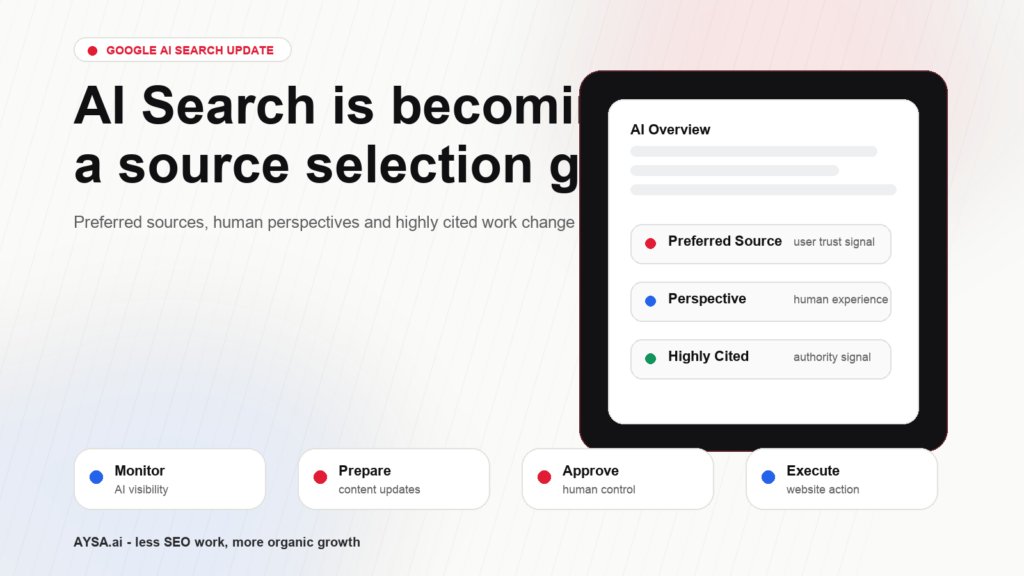
Executive summary: Google’s latest AI Search update is bigger than another feature rollout. Preferred Sources are moving into AI Overviews and AI Mode. Google is adding more visible article and perspective surfaces around AI answers. Highly Cited labels are expanding beyond their original news-focused context. Together, these changes point to a new visibility problem: brands are no longer competing only for rankings. They are competing to become sources people choose, sources Google can trust, and sources AI systems can use when synthesizing answers.
For SMEs, this is both a threat and an opportunity. The threat is that generic websites will become easier to ignore. The opportunity is that smaller businesses can still win if their pages are specific, useful, technically accessible, locally grounded, cited, and updated. In my opinion, as Marius Dosinescu, this is exactly why SEO must move from slow reporting into Approved Execution. The winning website will not be the one with the prettiest dashboard. It will be the one that keeps improving its clarity, authority, usefulness and source-worthiness every week.
What happened
On May 27, 2026, Search Engine Land reported that Google AI Overviews and AI Mode are gaining three important source-oriented features: Preferred Sources, a new perspectives carousel, and expanded Highly Cited labels. Google’s own announcement describes these changes as part of a larger effort to help people discover original, high-quality content across Search and Discover.
Preferred Sources already existed in relation to Top Stories in some markets. Google’s help documentation says users in the United States and India can add preferred sources in English to see more content from those sources in Top Stories. The new development is that this preference layer is now being connected more directly with AI Overviews and AI Mode. That matters because AI Search is not a simple list of blue links. It is a synthesized answer surface that chooses which sources deserve to support the response.
The perspectives carousel is also important because it pushes more human and community context into the AI Search experience. Google has been under pressure from publishers, creators and users who worry that AI answers flatten the web into a generic summary. Surfacing perspectives from forums, social discussions and other firsthand sources is one way Google can make answers feel less detached from lived experience.
The Highly Cited label is not brand new. Google introduced Highly Cited in 2022 to help users identify original reporting that was frequently referenced by other outlets. The 2026 update expands the label to more article links in Search and puts the idea of citation value back into focus. In plain English: Google wants users to notice when a page is not just ranking, but being used as a source by others.
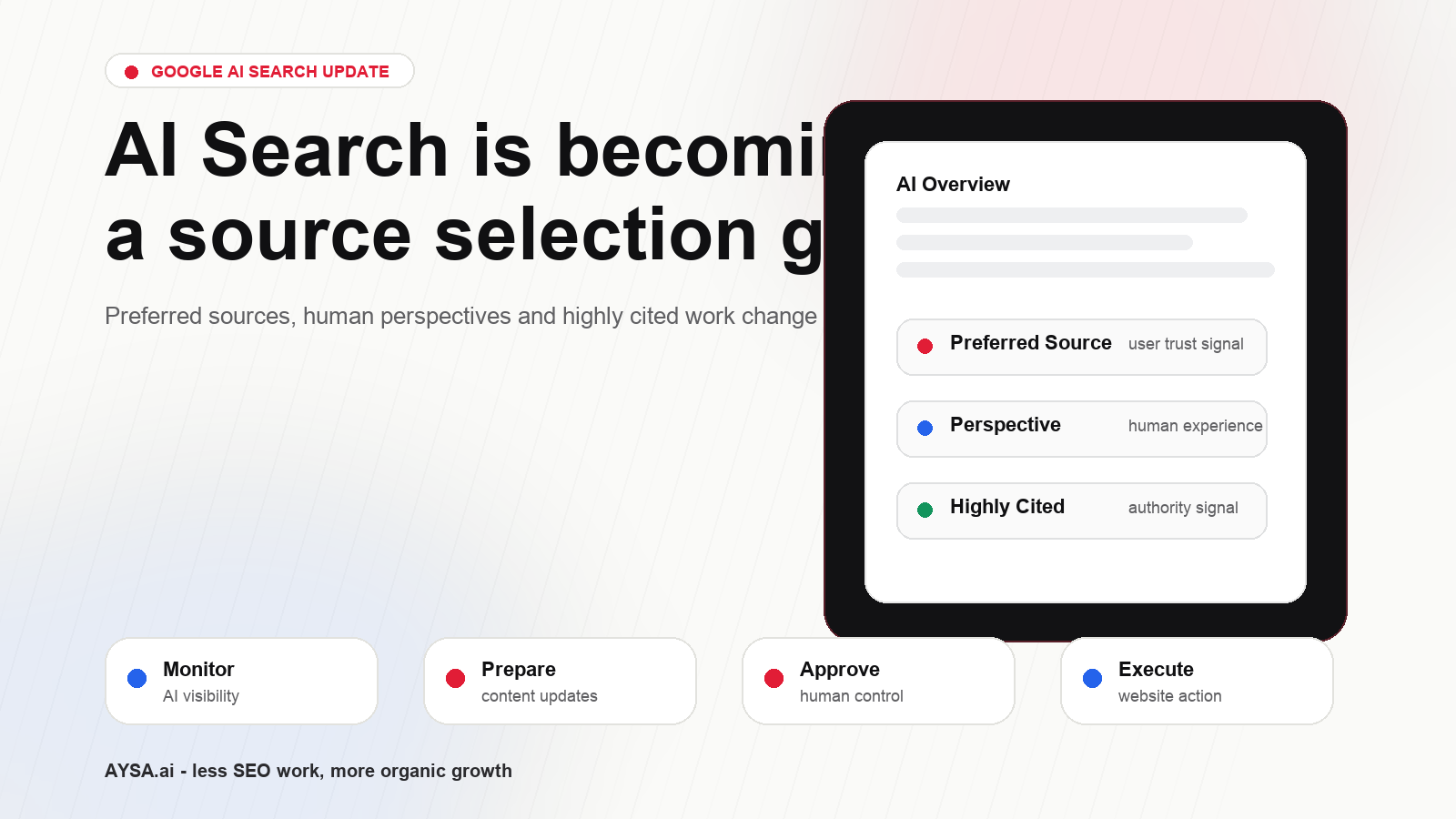
These features are not all the same. Preferred Sources are about user affinity. Perspectives are about human experience and diverse viewpoints. Highly Cited is about reference value and authority. But together they show the same direction: Google is trying to make source quality more visible inside and around AI-generated search experiences.
Why this is bigger than a UI update
It would be easy to dismiss this as a publisher feature or another cosmetic change in Google’s interface. That would be a mistake. This update lands in the middle of a much larger shift: Search is becoming more conversational, more agentic, more multimodal and more source-selective.
Google’s Search Central guide for generative AI features says that AI Overviews and AI Mode are rooted in Search systems. Google still points site owners toward useful content, Crawlability, Indexability, page experience, technical hygiene and people-first value. That means SEO is not dead. But the way SEO output appears is changing. Visibility may happen inside an AI answer, inside a citation panel, through a carousel, through a preferred-source label, through a forum perspective, through a linked article, through a product surface, or through a follow-up AI Mode session.
This is why I do not like the lazy phrase “AI killed SEO.” It did not. It made SEO harder to measure and more operational. Ranking number one for one Keyword is no longer enough if the user never sees that result because the visible area is occupied by AI answers, carousels, ads, videos, forums, local packs or source panels. At the same time, being cited or preferred in an AI experience can create value even when the click path is different from old SEO.
For businesses, the real question becomes: is your website a strong enough source? Can Google understand the business? Can AI systems extract useful passages? Are the claims supported? Is the content specific? Is the author credible? Are other sources referencing the brand? Are users likely to prefer this source again? Is the website technically clean enough to be crawled and interpreted?
Those are not one-time checklist items. They are continuous execution problems.
Preferred Sources: user trust becomes a visibility signal
Preferred Sources are especially interesting because they turn source trust into an explicit user action. Instead of relying only on Google’s systems to decide which publications or sites deserve more visibility, users can indicate which sources they want to see more often. When that preference connects with AI Overviews and AI Mode, source loyalty becomes part of the AI Search experience.
For large publishers, the immediate implication is obvious: build a loyal audience that actively chooses you. But SMEs should not ignore this. A small business may not become a Preferred Source for breaking news, but the same logic applies to every niche. Would customers prefer your clinic, ecommerce site, local service business, SaaS product or expert blog as a trusted source in its category?
A florist that writes generic “best flowers” content is not a preferred source. A florist that explains delivery windows, seasonal flower availability, event-specific arrangements, freshness, local constraints, care instructions and real customer decisions has a stronger chance to become useful. A medical clinic that publishes generic healthcare pages is not differentiated. A clinic that explains appointment pathways, doctor expertise, symptoms, urgency criteria, parking, booking and parent concerns becomes a more useful source.
This is the practical lesson: source preference is earned through repeated usefulness. You do not become a preferred source because you publish more words. You become one because users repeatedly find your pages clearer, safer, more specific and more helpful than alternatives.
For AYSA, that means Preferred Sources should be treated as an editorial and operational goal. The website should ask: which pages would a user actually want to see again? Which guides deserve to be bookmarked? Which pages are strong enough to be recommended by a human, not only parsed by a machine?
Perspectives carousel: generic content is becoming weaker
The perspectives carousel matters because it recognizes a problem created by AI summaries: answers can become too smooth. They can be correct in a basic sense, but they often lack context, tradeoffs and real experience. Perspectives help Google bring more human texture back into the search experience.
This is where many AI content strategies will fail. If a company uses AI to generate hundreds of pages that merely restate existing content, those pages may be grammatically clean but strategically empty. They do not contain lived experience. They do not contain a real viewpoint. They do not explain what actually happens in a market. They do not help users make a messy decision.
Perspectives reward content that sounds like somebody knows the topic from the inside. That can come from experts, founders, practitioners, community discussions, customers or journalists. It can come from original tests, case studies, operational details, mistakes, comparisons and examples.
For SMEs, this is good news. A small business can often produce better perspective than a giant generic website because it sees real customer problems every day. A parking operator near an airport knows what travellers ask before a 4 a.m. flight. A pediatric clinic knows what worries parents before booking. A florist knows what goes wrong with last-minute delivery. An ecommerce founder knows why customers abandon checkout. Those details are not “content filler.” In AI Search, they can become source differentiation.
My opinion is that SMEs should stop trying to sound like large corporate publishers. They should sound more like informed operators. That does not mean sloppy writing. It means useful, grounded, specific content with a real point of view.
Highly Cited labels: authority becomes more visible
The expanded Highly Cited labels push another important idea forward: authority is not only about a backlink count. It is about whether a page, brand, article or piece of research becomes a reference point in the wider web.
When Google first introduced Highly Cited in 2022, the focus was original reporting. The idea was to help people identify the source behind a developing story. In 2026, as AI Search grows, citation value becomes even more important because AI systems need reliable sources to ground answers. If many credible sources reference a page, that page has a stronger claim to being part of the knowledge layer around a topic.
This does not mean every SME needs to become a newsroom. But it does mean authority building should mature. Thin directory submissions and irrelevant links do not build a credible source profile. Strong authority comes from relevant references: industry mentions, local press, case studies, expert commentary, partner pages, useful data, real comparisons, interviews, reviews and publisher placements that make sense.
This is why AYSA’s integration with Adverlink is strategically relevant. Authority building should not be a chaotic spreadsheet of outreach tasks. It should be a controlled workflow: identify relevant publisher opportunities, explain the value, estimate cost, ask for approval and track delivery. For SMEs, speed matters, but approval matters too. Automated or semi-automated authority building should never mean blind execution.
The Highly Cited direction also reinforces the need for original assets. A page is more likely to be cited when it contains something worth referencing: a useful framework, a clear analysis, a data point, a strong opinion, a comparison, an example or a practical checklist. Generic content does not attract citations because there is nothing to cite.
What this means for publishers, brands and SMEs
Publishers will focus on the traffic and visibility impact, and they should. AI Overviews and AI Mode can compress the search journey. If Google gives users an answer and only some sources get prominent visibility, publishers need to understand how source selection works. Preferred Sources and Highly Cited labels may help strong publishers defend visibility, but they also create a winner-takes-more dynamic for trusted sources.
Brands face a different but related challenge. They need to become recognizable entities. If a brand is not clearly described on its own website, not referenced elsewhere, not associated with a topic, not supported by useful content and not technically accessible, it becomes harder for AI systems to include it confidently.
SMEs face the most practical version of this problem. They usually do not have editorial teams, SEO departments, PR teams and developers waiting to update pages every week. Yet they still need to compete in an environment where Google is rewarding source quality, perspective and authority.
This is where the old SEO workflow breaks down. A monthly report saying “improve E-E-A-T” is not enough. The business needs specific actions: improve the clinic service page, add a comparison section, write a real FAQ, fix schema that does not match visible content, update opening hours, add internal links, refresh a stale guide, request a relevant publisher placement, fix broken redirects, improve author information, monitor AI mentions.
In other words, this update is not only about content strategy. It is about execution capacity.
Weak reaction
Publish generic AI-written articles, repeat the same keyword, chase random backlinks and wait for rankings to recover.
Stronger reaction
The SME playbook: how to become more source-worthy
If you run an SME, this is the checklist I would use after this update.
1. Upgrade your money pages first. Start with pages that can generate leads, bookings, sales or trust: core service pages, location pages, product categories, comparison pages, pricing pages, case studies and support pages. These pages should not be generic brochures. They should answer the real questions people ask before buying.
2. Add a clear answer layer. Each important page should contain concise answers that can be understood quickly: what you offer, who it is for, how it works, what it costs, what happens next, what risks exist and what makes you credible.
3. Add perspective that only you can provide. Explain what customers misunderstand, what tradeoffs matter, what examples you have seen, what mistakes to avoid and what you would recommend in real situations. This is where SMEs can outperform generic content farms.
4. Strengthen author and company identity. Add author pages, founder pages, clear company history, social proof, press mentions, case studies and real contact information. AI systems need entity clarity. Users need trust.
5. Build citation-worthy content. Create guides, frameworks, checklists, local research, industry observations or examples that others can reference. Do not only write “what is” content. Write “how to decide,” “what to compare,” “what changed,” and “what we see in the market.”
6. Fix technical discoverability. Crawlability, indexability, canonicals, internal links, schema, performance and sitemap quality still matter. AI Search does not reward websites it cannot understand.
7. Monitor AI visibility, not only rankings. Track whether the brand appears in AI Overviews, AI Mode, ChatGPT, Perplexity, Gemini and other answer environments. Track mentions, citations, competitors, source panels and pages that are being used or ignored.
8. Turn recommendations into approved execution. The final step is the one most companies miss. A list of recommendations is not growth. Approved, published, measured improvements are growth.
How to measure this without fooling yourself
Preferred Sources, Perspectives and Highly Cited labels make measurement more complicated. Traditional rank tracking still matters, but it is not enough. You need a wider visibility model.
Search Console remains useful because it shows queries, impressions, clicks and pages. But Google does not give perfect separation for every AI feature. You should use Search Console as one signal, not the entire truth.
AI visibility checks are needed because you want to know when your brand appears in AI answers, citation panels, AI Mode sessions or competitor comparisons. This cannot be measured only by ranking number one for a keyword.
Source-quality KPIs matter: branded searches, returning readers, direct traffic, mentions, citations, backlinks from relevant sources, author recognition, press mentions, review quality and engagement with useful pages.
Content operations KPIs matter: pages updated, internal links added, technical issues fixed, schema corrected, FAQs improved, stale content refreshed, authority actions approved, and important pages reviewed after search changes.
Business KPIs still decide the winner: leads, calls, bookings, sales, assisted conversions, qualified traffic and customer acquisition cost. AI visibility is not valuable if it never supports business outcomes.
The mistake is to chase one metric. The better approach is to connect visibility signals to execution and revenue. That is what most dashboards still fail to do.
The AYSA execution framework for this new source layer
AYSA is built around the idea that SEO should not stop at diagnosis. The agent should monitor, prepare, explain, ask for approval and execute. This update is a perfect example of why that matters.
If Google is rewarding preferred, perspective-rich and highly cited sources, then the work is ongoing. AYSA can help identify pages that are too generic, pages that lack answer-ready sections, pages without enough internal support, technical issues that reduce crawlability, topics where the brand lacks authority, and content that should be refreshed for AI Search.
For example, AYSA can help a business prepare:
- clearer summaries for important service pages;
- FAQ sections that match visible content and real customer questions;
- internal links between related pages and glossary terms;
- technical fixes for canonical, indexation, sitemap and redirect problems;
- content refreshes when AI Search behavior changes;
- authority-building opportunities that require approval;
- monitoring tasks for AI visibility and answer engine mentions;
- case study or example sections that add real perspective.
The user stays in control. AYSA does not need to publish sensitive changes without review. The point is to reduce manual SEO work while keeping approval where it belongs: with the business.
That is the difference between a report and an operating system. A report says, “you should improve source authority.” AYSA prepares the actual work, explains the reason, asks for approval and helps execute the change.
Practical examples: how different SMEs should react
The danger with AI Search advice is that it can become abstract. “Build authority” and “create helpful content” are true, but not useful enough. Here is how I would translate this update for a few real-world SME categories.
A pediatric clinic should not only publish a generic page for “pediatric clinic in Bucharest.” It should answer the parent’s decision: when should a fever become urgent, what symptoms require emergency care, what appointment options exist, which doctors handle which age groups, how online booking works, what parking or location constraints matter, what reviews say, what insurance or payment options exist, and what happens during the visit. That kind of page has a better chance of being useful in AI answers because it helps the user compare and decide.
A florist should not only write “best flowers for birthdays.” It should explain freshness, same-day delivery constraints, seasonal availability, care instructions, event timing, bouquet size, delivery zones and what to choose when the customer does not know flowers. These are the details a generic AI paragraph cannot invent responsibly. They are also the details users may prefer from a real operator.
A car rental or airport parking business should explain pickup flow, shuttle timing, cancellation rules, deposits, fuel policy, parking security, flight delay handling, late-night arrivals and what happens if the customer’s travel plan changes. AI Search surfaces become more useful when they can compare operational facts, not only brand slogans.
An ecommerce store should make product categories easier to evaluate: use cases, comparisons, sizing, availability, delivery, return logic, warranty, compatibility, reviews and buying mistakes. In a world of AI Mode and agentic shopping, product pages must become machine-readable and decision-ready at the same time.
A SaaS company should clarify integrations, use cases, pricing, security, onboarding, workflows, limitations and proof. AI systems do not only need your brand name; they need enough structured, visible context to recommend you responsibly.
A 30-day action plan after this Google update
If I had to turn this update into a practical month of work, I would not start by writing 50 new blog posts. I would start with the pages that already matter.
Week 1: audit source readiness. Review your top service, category, pricing, comparison and guide pages. Ask whether each page clearly answers who it is for, what problem it solves, how it works, what evidence supports it and what the user should do next. Identify pages that sound generic, outdated or incomplete.
Week 2: improve answer-ready sections. Add concise summaries, visible FAQs, comparison tables, examples, process explanations and internal links. Do not hide key information behind tabs that are difficult to parse. Make the page useful for humans first, then easier for AI systems to extract.
Week 3: strengthen authority and perspective. Add author context, founder perspective, case examples, press mentions, customer proof, relevant references and original observations. If the page makes claims, support them. If the topic is competitive, explain what most websites get wrong.
Week 4: monitor and execute. Check Search Console, rankings, AI visibility, mentions, citations, competitor appearances and technical issues. Then turn the findings into approved actions. The important part is not the audit. The important part is what gets improved on the website.
What not to do
There will be a wave of bad advice around Preferred Sources and AI visibility. Some of it will sound attractive because it promises shortcuts. Most of it will create risk.
Do not mass-produce low-effort AI content and expect it to become a preferred source. AI Search already has enough generic text. Your advantage is specificity, expertise, examples and operational truth.
Do not add fake FAQ schema or fake reviews. Google’s structured data guidance is clear that markup should match visible content. Schema should clarify reality, not decorate weak pages.
Do not chase every citation surface blindly. A mention only helps when it is relevant, credible and connected to the topic you want to be known for.
Do not confuse AI visibility with guaranteed AI Overview inclusion. No platform can responsibly guarantee inclusion in Google AI Overviews or AI Mode. The realistic work is improving eligibility, clarity, authority, technical access and monitoring.
Do not leave execution to the end of the month. In fast-changing search environments, slow implementation is itself a ranking and visibility risk.
The Marius Dosinescu point of view
My opinion is that this update is one of the clearest signals that the next SEO advantage will belong to businesses that can become trusted sources, not just optimized pages. That does not mean classic SEO disappears. It means classic SEO becomes the foundation for a broader visibility system.
For years, many SMEs were told to publish more content, buy more links, run more ads and wait. That model is too slow now. Search is moving faster. AI answers are changing the visible surface. Google is giving users more source control. Publishers are fighting to remain visible. Brands are trying to become citable. Small businesses are confused.
The answer is not panic. The answer is execution. Build better pages. Add real perspective. Earn relevant references. Fix technical problems. Monitor AI visibility. Approve the right changes. Execute consistently.
This is the future AYSA is built for: less SEO work, more organic growth, with the business owner still in control.
Turn Preferred Sources, Perspectives and AI visibility into approved website execution.
AYSA helps SMEs monitor SEO, AEO and AI visibility, prepare useful improvements, request approval and execute accepted changes inside the website workflow.
Sources and further reading
- Search Engine Land: Google AI Overviews and AI Mode gain Preferred Sources, Perspectives and Highly Cited labels
- Google: Helping people discover original, high-quality content
- Google Search Help: Top Stories and Preferred Sources
- Google Search Central: Optimizing your website for generative AI features on Google Search
- Google Search Central: AI features and your website
- Google Search Central: Creating helpful, reliable, people-first content
- Google: Search I/O 2026 preferred sources and AI updates
- AYSA: AI SEO tools
- AYSA: AI search visibility
- AYSA: AI search monitoring platform
- AYSA: AI Overviews SEO
- AYSA: SEO automation tools
Continue the AI search topic inside AYSA.
Use these pages to connect the article with AI SEO tools, AI visibility monitoring, AI Overviews and approved website execution.
Turn this topic into a website action plan.
Use these AYSA hubs to move from reading to technical fixes, AI visibility monitoring, research, glossary context and approval-first SEO execution.