
The SEO/GEO Gap: Why AI Search Traffic and Organic Traffic No Longer Match
AI search visibility is not the same thing as organic search traffic. This AYSA analysis explains the SEO/GEO gap, what SMEs should measure and how approved execution closes the distance.
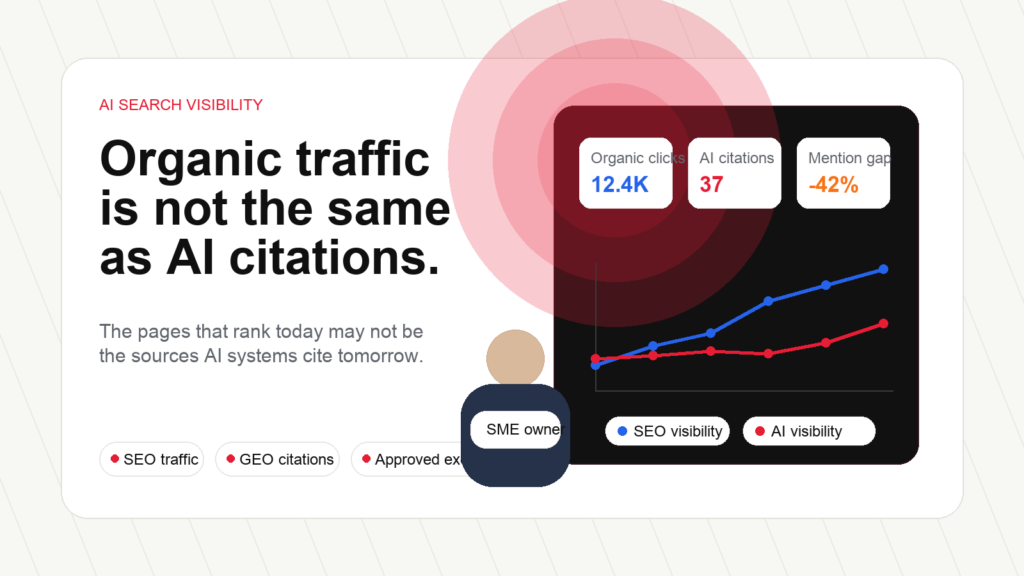
Executive summary: The SEO/GEO gap is the distance between the pages that win classic Organic traffic and the pages that AI Search systems cite, summarize or recommend. The same website can have strong Google traffic and weak AI visibility. It can also be mentioned in AI answers without receiving the same click pattern it expects from traditional search. That is not a small reporting problem. It is a strategic visibility problem.
Search Engine Land recently covered this gap through the lens of AI search traffic versus organic traffic. The practical takeaway for SMEs is simple: ranking reports are no longer enough. Businesses need to understand which pages attract Clicks, which pages become sources, which topics AI systems can confidently understand, and which actions should be approved and executed next. In my opinion, this is where SEO moves from dashboard work into operating-system work.
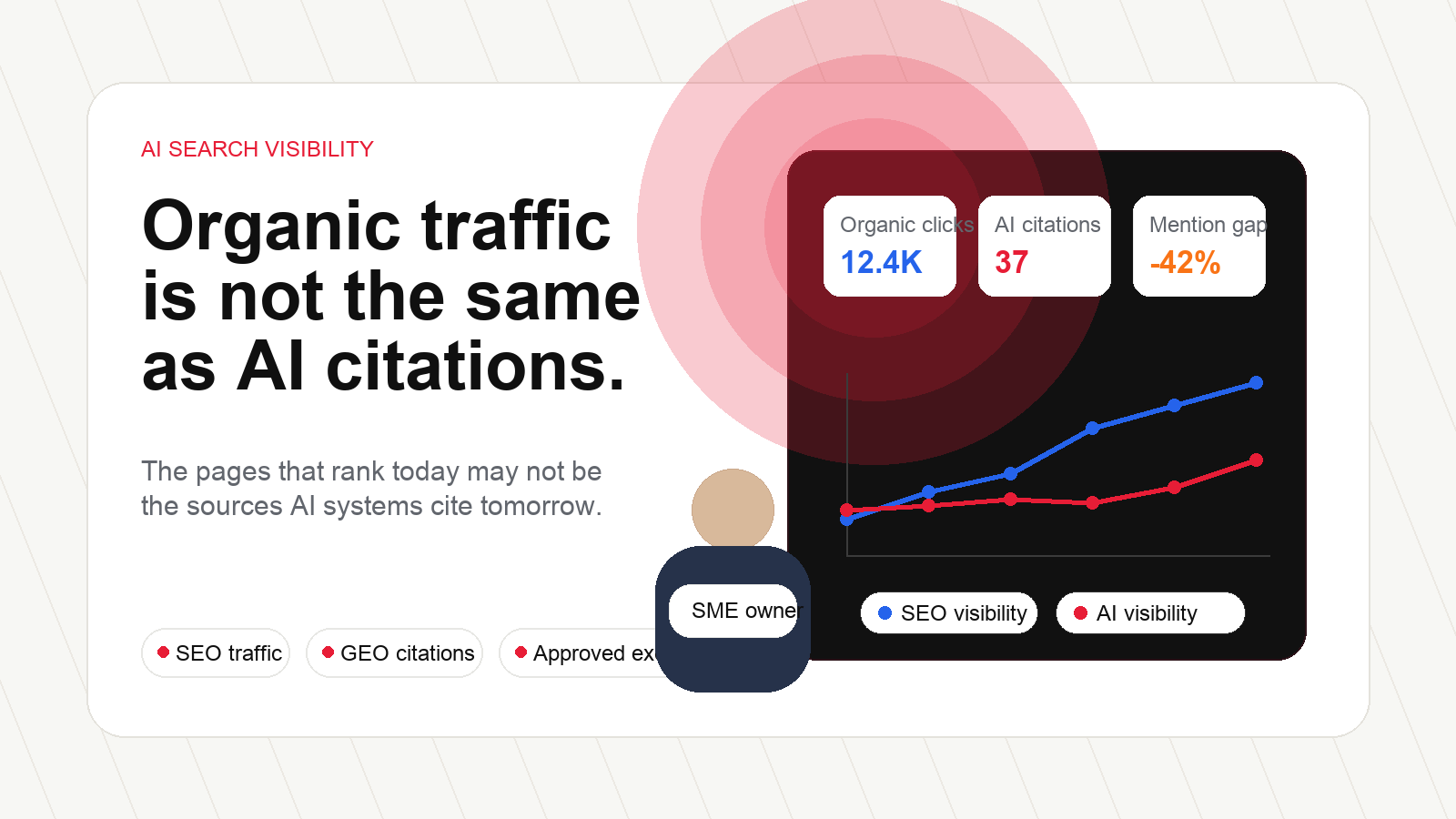
What the SEO/GEO gap actually means
For years, the default SEO measurement model was relatively simple: track rankings, track Impressions, track clicks, track conversions. There were always complications, of course. SERP Features, ads, local packs, maps, images, videos and zero-click behavior all changed the shape of the results page. But the general idea remained familiar: if a page ranked well, it had a chance to earn traffic.
AI search changes that model. AI Overviews, AI Mode, ChatGPT Search, Perplexity, Gemini and other answer engines can use web pages as sources without behaving like a traditional ranked list. A page may be cited, summarized or used to ground an answer. Another page may still rank organically but never become the source the AI system chooses. A third page may influence the answer indirectly through entity recognition, citations, structured information, reviews or external mentions.
This is the SEO/GEO gap. SEO, in the classic sense, is about being discoverable and competitive in search engines. GEO, or generative engine optimization, is about being understandable, retrievable, citable and useful inside AI-generated answers. They overlap, but they are not the same discipline.
A company can have strong organic pages that are weak sources for AI. That often happens when pages are optimized for keywords but not for extraction, clarity or trust. A company can also appear in AI answers without seeing a proportional click increase. That happens when the AI interface answers the user’s question before the click. Both situations are real, and both require a better measurement model.
In practical business language: organic traffic tells you how often users came to your website from search. AI visibility tells you whether AI systems can find, understand, trust and use your brand when answering a user’s question. Those are related outcomes, but they answer different questions.
Why the gap happens
The gap appears because AI search systems do not select sources in exactly the same way a classic search results page ranks links. Google has repeatedly said that its AI features are grounded in Search systems and that website owners should still focus on helpful, reliable, people-first content, crawlability and technical quality. That matters. It means SEO fundamentals still count. But AI answers also need information that can be synthesized safely and confidently.
Several patterns create the gap.
First, many high-traffic pages are built for clicks, not answers. A page can rank because it targets the right query, has enough authority and matches search intent. But if the page does not contain concise, specific, well-structured information, AI systems may choose a different source for answer generation.
Second, AI systems prefer clarity over cleverness. Marketing copy that sounds impressive to humans can be difficult for machines to parse. If a page uses vague claims, unclear entities, missing definitions, weak headings or buried answers, it may be less useful as a source.
Third, external context matters. AI systems may rely on brand mentions, citations, reviews, publisher references, product feeds, local listings, structured data and other signals beyond the page itself. A website that performs well in organic search may still have weak entity clarity across the wider web.
Fourth, the user journey is different. In AI Mode or conversational search, the query may expand into multiple hidden or explicit sub-questions. The system may compare options, pull examples, ask follow-ups or recommend actions. That means one keyword ranking does not fully describe the visibility opportunity.
Fifth, traffic attribution is incomplete. Analytics tools are improving, but referral data from AI assistants is still messy. Some visits may show as referrals, some as direct, some not at all. AI mentions can influence demand without creating a clean click path. A business that looks only at GA4 sessions may miss part of the story.
What businesses should measure now
Classic SEO measurement is still necessary. I would not advise any serious business to stop tracking Search Console impressions, clicks, ranking movement, landing pages, conversions or revenue. But the measurement model needs another layer.
Measure organic demand. Keep tracking Google Search Console queries, pages, impressions, clicks and click-through rate. This remains one of the most reliable views into how Google Search surfaces your site.
Measure AI mentions and citations. Check whether the brand appears in AI Overviews, AI Mode, ChatGPT Search, Perplexity, Gemini and other answer engines. Track the prompt, the answer, cited sources, competitors mentioned and whether your site is used as a source or merely exists in the background.
Measure source quality. Identify which pages are actually citation-ready. A citation-ready page is clear, specific, technically accessible, useful for a real decision and supported by evidence. It usually has strong headings, concise summaries, examples, definitions, updated information, author or company context and relevant internal links.
Measure the branded layer. AI systems need to understand who the business is. Track branded search, direct traffic, author pages, founder pages, company profiles, press mentions, review profiles, third-party citations and partner pages.
Measure execution velocity. How long does it take to turn an insight into an approved change? This is the metric most businesses ignore. In fast-moving search, slow execution is a visibility risk. A monthly report that is never implemented has no organic value.
Measure business impact. Do AI mentions lead to more branded demand? Do better answer-ready pages produce more qualified leads? Do refreshed pages improve conversions? Does authority building reduce the gap between being known by users and being cited by AI systems?
What the SEO/GEO gap looks like for SMEs
This topic can sound abstract until you look at real SME situations.
A pediatric clinic may rank for “pediatric clinic Bucharest” but fail to appear in AI answers when parents ask for a private clinic with easy parking, online booking, good reviews and experience with recurring fever. The ranking page may have the keyword, but not the decision criteria. To close the gap, the clinic needs pages that explain services, doctors, age groups, booking process, parking, urgent symptoms, reviews and real parent concerns.
A florist may rank for local delivery terms but fail in AI answers about “best flowers for a same-day anniversary delivery in Bragadiru.” Why? The site may not explain delivery cutoffs, bouquet freshness, local zones, seasonal availability or what to choose when the buyer is unsure. GEO visibility requires operational detail, not just category text.
An ecommerce store may get organic traffic to product categories but be invisible when AI systems compare product options. Many ecommerce pages are thin: product grid, generic intro, filters and little decision support. AI search needs structured comparisons, use cases, compatibility, return policy clarity, reviews, delivery information and unique buying advice.
A car rental or parking business near an airport may rank locally but fail to appear when users ask AI for the best option for a late-night flight, shuttle timing, luggage, child seats, deposits or cancellation flexibility. The business needs pages that answer practical travel questions, not only “car rental airport” keywords.
A local service business may depend on Google Maps and reviews but have weak website content. In AI search, the website and the wider entity profile need to work together: Google Business Profile, reviews, service pages, local context, FAQs, schema, citations and clear contact details.
The pattern is the same: SEO brings the business into the old search surface. GEO helps the business become a useful answer source. The strongest strategy does both.
Why reports alone will not close the gap
Many SEO tools will show more AI visibility dashboards over the next year. That is useful. But a dashboard does not close the gap by itself. If a tool says a competitor is cited more often in AI answers, the business still needs to know why and what to change.
Maybe the competitor has better category pages. Maybe it has stronger founder signals. Maybe it has more useful guides. Maybe it has clearer pricing. Maybe it has more relevant publisher mentions. Maybe its technical structure is easier to crawl. Maybe its internal links make the topic cluster clearer. Maybe it simply answers the user’s question in a more concrete way.
The work is not “track AI visibility” as an isolated task. The work is to connect measurement to execution: improve the page, add missing context, strengthen internal links, update schema, publish better examples, build relevant authority, refresh stale content, remove thin pages and monitor the result.
This is why I believe the SEO/GEO gap is actually an execution gap. The companies that win will not only know where they are missing. They will improve faster.
Old measurement habit
Track rankings, clicks and traffic. Send a monthly report. Hope the recommendations get implemented later.
New operating habit
Where AYSA fits
AYSA is built for the layer between insight and execution. The agent can monitor SEO, AEO, GEO and AI visibility signals, but the important part is what happens next. It prepares work, explains why it matters, asks for approval and helps execute accepted changes inside the website workflow.
For the SEO/GEO gap, AYSA can help identify pages that get impressions but are weak answer sources, topics where the business lacks enough coverage, pages with unclear entities, missing internal links, thin service pages, technical crawl issues, schema opportunities, AI visibility gaps and authority-building opportunities.
Then AYSA can turn those findings into approved actions:
- rewrite a service page summary so it answers the user’s decision faster;
- add practical FAQ content that is visible on the page;
- create internal links between related product, service, glossary and blog pages;
- prepare schema recommendations that match visible content;
- refresh stale articles when AI search behavior changes;
- surface publisher opportunities through integrations such as Adverlink, with approval before action;
- monitor competitors that appear in AI answers when the brand does not.
AYSA does not promise guaranteed inclusion in AI Overviews or answer engines. Nobody serious should promise that. The realistic promise is better readiness: clearer pages, stronger entities, better technical access, more useful content, relevant authority and faster approved execution.
A practical 30-day plan
Week 1: map the gap. Take your top organic landing pages and test the related AI search questions. Are you cited? Are competitors cited? Which pages are used? Which topics are missing?
Week 2: improve decision pages. Start with pages that make money: services, categories, pricing, locations, comparisons and case studies. Add direct answers, examples, proof, FAQs, process details and internal links.
Week 3: strengthen entity and authority. Improve About, author, founder, press, review and partner signals. Build or update pages that explain who the business is, what it does, where it operates and why it can be trusted.
Week 4: connect measurement to execution. Track what changed in Search Console, rankings, AI mentions, citations and conversions. Approve the next actions. Repeat the cycle.
The businesses that treat this as a one-off project will fall behind. The businesses that treat it as an operating rhythm will learn faster.
The Marius Dosinescu point of view
My view is that the SEO/GEO gap is one of the clearest signs that old SEO reporting is becoming insufficient for SMEs. The problem is not that SEO is dead. The problem is that search visibility now has more surfaces, more source selection, more hidden query expansion and more AI interpretation.
Most small businesses do not need another complicated dashboard. They need a system that explains what matters, prepares the work and keeps implementation moving. A clinic, florist, ecommerce store or airport parking company should not have to become an AI search expert to keep its website useful and visible.
That is why AYSA exists. Less SEO work. More organic growth. Not because the work disappears, but because the system should carry more of the operational burden.
Close the gap between organic traffic and AI search visibility with approved execution.
AYSA monitors SEO, AEO, GEO and AI visibility, prepares website improvements, asks for approval and executes accepted changes inside your workflow.
Sources and further reading
- Search Engine Land: the SEO/GEO gap between AI search traffic and organic traffic
- Google Search Central: Optimizing your website for generative AI features on Google Search
- Google Search Central: AI features and your website
- Google Search Central: Creating helpful, reliable, people-first content
- Google Analytics Help: traffic acquisition and source/medium concepts
- AYSA: AI SEO tools
- AYSA: AI search visibility
- AYSA: AI search monitoring platform
- AYSA: AI Overviews SEO
- AYSA: SEO/GEO audit essentials
Continue the AI search topic inside AYSA.
Use these pages to connect the article with AI SEO tools, AI visibility monitoring, AI Overviews and approved website execution.
Turn this topic into a website action plan.
Use these AYSA hubs to move from reading to technical fixes, AI visibility monitoring, research, glossary context and approval-first SEO execution.

