
How Google AI Mode Expands Queries Beyond Keywords
Google AI Mode changes search behavior by turning one query into a broader research task. Here is what query expansion, context and fan-out mean for SEO, AEO and AI visibility.
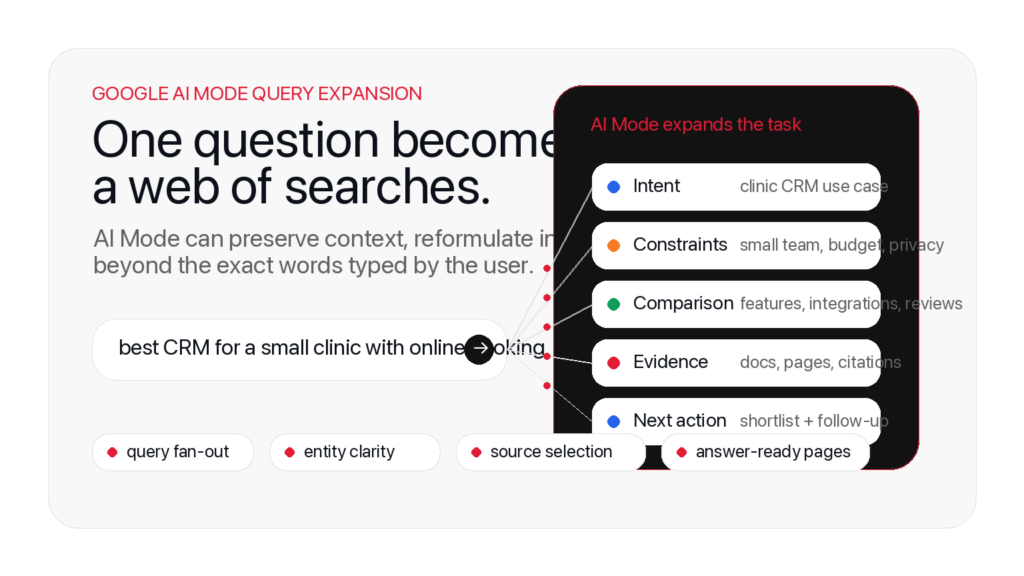
Summary: Google AI Mode changes the search box from a Keyword input into a task interface. Instead of treating a query as one phrase to match against documents, AI Mode can preserve context, understand constraints, reformulate the need, explore related subtopics and continue the journey through follow-up questions. For SEO, this means websites must be useful for the whole decision path, not only for the exact keyword typed by the user.
The practical implication is clear: Keyword research still matters, but it is no longer enough. Pages need Entity Clarity, source-worthy explanations, comparison logic, structured facts, internal links and topical coverage that can survive query expansion. AYSA’s point of view is that this creates an execution problem for SMEs: somebody has to continuously translate new search behavior into website improvements.
One question can become many searches, comparisons and follow-up paths.
What Google changed: the search box becomes a task interface
The classic search box was built around keywords. Users learned to compress a need into a few words: “best CRM,” “pediatric clinic Bucharest,” “Technical SEO audit,” “running shoes wide foot.” Google then returned a search engine results page where users clicked, compared, revised the query and tried again.
AI Mode changes that interaction model. Google has described AI Mode as a more powerful way to ask complex, multi-part questions and continue exploring through follow-ups. Google also announced a redesigned AI-powered Search box that can expand as users describe what they need in more detail, suggest better ways to ask questions, support multimodal inputs and allow users to continue from AI Overviews into AI Mode.
That matters because the input is no longer only a keyword. It can be a problem statement, a purchase constraint, a file, an image, a page, a comparison task or a chain of follow-up questions. In other words, the search box starts behaving less like a doorway to ten links and more like a workbench for discovery.
We covered the broader Search box change in Google’s AI Search Box Changes SEO More Than Rankings. This article goes deeper into one specific mechanism behind the shift: query expansion beyond keywords.
What query expansion means in practical language
Query expansion is the process of broadening or reformulating a user’s original query so the system can retrieve better information. In classic search, query expansion could include synonyms, spelling corrections, related terms, Entity Recognition or intent matching. In AI search, the idea becomes more powerful because the system can work with the whole task, not only the exact phrase.
Imagine a user asks: “I need a private pediatric clinic in Bucharest for a toddler with recurring fever, good reviews, parking and online booking. What should I compare?” A keyword engine might focus on “pediatric clinic Bucharest.” AI Mode can treat this as a richer task. It can infer that the user needs comparison criteria, medical trust signals, location convenience, reviews, booking options, parking, child-friendly service and maybe emergency vs routine care distinctions.
That means the system may need sources that answer more than one question:
- Which clinics serve toddlers?
- Which locations have strong parent reviews?
- Which offer online booking?
- Which mention parking or access?
- Which pages explain when urgent care is needed?
- Which sources are credible enough for a sensitive medical-adjacent decision?
This is why keyword-only SEO becomes fragile. A page can rank for a short query and still fail the expanded task. If the page does not explain comparison criteria, trust, process, location, pricing, availability or next action, it gives AI systems fewer reasons to use it as a source.
Query fan-out: one question, multiple retrieval paths
The SEO industry often describes this behavior as query fan-out. The phrase is useful: one user question fans out into several related searches or retrieval tasks. We wrote about the same idea in the context of ChatGPT Search in Inside ChatGPT Search: Fan-Out Queries, Web Runs and the New Rules of AI Visibility.
Google AI Mode is not identical to ChatGPT Search, and we should not pretend we know every internal step. But the direction is clear from Google’s public product descriptions: AI Mode is designed for more complex questions, follow-up exploration and richer context. That naturally pushes SEO away from “rank for a keyword” and toward “be useful across the entire expanded task.”
A fan-out pattern might include:
- Entity expansion: identifying products, brands, places, people, services and attributes.
- Intent expansion: separating informational, commercial, local, comparison and transactional needs.
- Constraint expansion: budget, location, urgency, availability, size, language, platform or audience.
- Evidence expansion: reviews, policies, documentation, case studies, data, expert commentary and cited sources.
- Follow-up expansion: what the user may need after the first answer.
For SMEs, this is both intimidating and useful. It means there are more ways to be discovered, but it also means weak pages are easier to ignore. A business page that only says “best SEO services” is less useful than a page that explains who the service is for, what problems it solves, how approval works, how pricing works, what evidence supports it and what the next step looks like.
The SEO impact: pages must answer the expanded task
The biggest mistake is to treat AI Mode as a separate SEO channel with magical optimization tricks. Google’s Search Central AI guidance is clear that the fundamentals still matter: make unique, valuable content for people, ensure Google can access it, provide a good page experience and use structured data where it matches visible content. There is no hidden markup that guarantees inclusion in AI answers.
But the way those fundamentals are evaluated through an AI-assisted journey can feel different. A page is no longer competing only for a single keyword position. It may be competing to become one of the sources used to answer a broader question. That raises the standard for usefulness.
For example, a page about “technical SEO audit” should not only define the phrase. It should explain what the audit checks, what problems matter most, how issues are prioritized, what can be automated, what needs approval and what happens after the audit. A page about ecommerce SEO should not only mention product pages and category pages. It should explain product feeds, Merchant Center, structured data, thin product pages, internal links, reviews, shipping, returns and AI shopping journeys. We expanded that model in Ecommerce SEO in the AI Search Era.
This is where the old keyword map needs an upgrade. You still need primary topics. You still need search demand. You still need title tags and internal links. But the content plan must map the decision path, not only the exact query.
A better content model for AI Mode
A practical AI Mode content model starts with a harder question: what would make this page the most useful result for a specific user, at a specific stage of the journey, in a specific market?
That question forces better content decisions. It pushes you to include comparison criteria, examples, limitations, pricing context, process details, entity clarity, evidence and next steps. It also prevents generic content from pretending to be useful just because it contains many keywords.
Useful pages for AI Mode tend to have these qualities:
- Clear entity definition: the page makes it obvious what business, product, service, location or concept it is about.
- Task coverage: it answers the related sub-questions a real user would ask next.
- Evidence: it uses examples, data, policies, reviews, documentation or expert reasoning where relevant.
- Comparability: it helps users understand differences, trade-offs and decision criteria.
- Structured clarity: headings, lists, tables and concise sections make extraction easier.
- Internal context: it links to related pages that complete the journey.
- Freshness: it is updated when the market, product, policy or search behavior changes.
This is also why glossary pages, category hubs and deep guides matter. A single article rarely carries the whole semantic burden. Strong sites build clusters. We discussed the retrieval side in Why AI Search Cites Some Websites and Ignores Others: AI search is more likely to use sources that are crawlable, extractable, semantically clear and trusted.
Examples: how one keyword becomes a broader SEO job
Let’s take a few examples.
Keyword: “SEO automation tools.” In classic SEO, you might create a landing page that compares features, pricing and benefits. In AI Mode, the system may expand the query into: tools for small businesses, tools that execute changes, reporting tools vs execution platforms, WordPress integration, approval workflows, agency alternatives, AI visibility monitoring and pricing. A strong page should handle the larger task, then link to deeper pages where needed.
Keyword: “best pediatric clinic Bucharest.” The expanded task may include reviews, parking, online booking, child-friendly doctors, urgency, insurance, private vs hospital care, location, opening hours and parent trust signals. A generic listicle is weaker than a page that helps a parent compare responsibly.
Keyword: “technical SEO audit.” The expanded task may include crawlability, indexability, redirects, canonical tags, structured data, PageSpeed, internal links, sitemaps, robots.txt and execution priority. A definition page is not enough. The user needs to know what to fix and why.
Keyword: “ecommerce SEO.” The expanded task may include product feeds, product schema, thin product pages, category pages, product reviews, Merchant Center, AI shopping, UCP/AP2 and buyer agents. That is why we created a hub article rather than another short “what is ecommerce SEO” piece.
The pattern is the same: AI Mode rewards pages that understand the job behind the query.
How to measure whether you are ready
There is no single “AI Mode ranking report” that solves this. Measurement has to combine classic SEO, AI visibility and execution readiness.
Useful checks include:
- Do your most important pages answer the full task, not only the keyword?
- Do they define entities clearly enough for a machine to understand?
- Do they link to supporting pages that complete the journey?
- Are they technically crawlable, indexable and fast enough?
- Do they include visible facts that structured data can support?
- Are you monitoring AI citations, brand mentions and answer-engine visibility?
- Do findings become approved website changes, or do they stay in reports?
In our view, the last question matters most. AI search changes quickly. A static audit is useful for a week. A living execution loop is useful every month.
Where AYSA fits: from expanded query to approved execution
AYSA is built around the idea that SEO should move from research to approved action. AI Mode makes that more important, not less. If one user query can expand into many related retrieval paths, then a website needs continuous work: better pages, stronger internal links, clearer facts, updated content, stronger authority and technical cleanup.
For SMEs and non-specialists, the challenge is not only understanding AI Mode. The challenge is keeping up with it. Business owners do not want to live inside SEO tools, dashboards and endless chat prompts. They want to know what has to be improved, approve the important work and let the system execute safely.
AYSA can help by monitoring search and website signals, identifying gaps, preparing approval-ready actions and applying accepted changes inside the website workflow. That might mean improving a service page so it answers more of the expanded task, adding internal links between related pages, preparing FAQ-ready sections, fixing crawl/indexation issues or updating content based on changing AI search behavior.
The future of SEO is not “keywords are dead.” The future is that keywords are no longer the full unit of work. The unit of work is the user task. And the winning websites will be the ones that can understand that task, answer it clearly and execute improvements faster than the market changes.
Tired of chasing keywords while search keeps expanding the task?
AYSA monitors your website, prepares SEO, AEO and AI visibility actions, asks for approval and executes accepted changes inside your website workflow.
Sources and further reading
Continue the AI search topic inside AYSA.
Use these pages to connect the article with AI SEO tools, AI visibility monitoring, AI Overviews and approved website execution.
Turn this topic into a website action plan.
Use these AYSA hubs to move from reading to technical fixes, AI visibility monitoring, research, glossary context and approval-first SEO execution.

