
Ecommerce SEO in the AI Search Era
Ecommerce SEO now has to serve classic search, AI answers, product feeds, merchant trust and buyer agents. This guide explains what changes, what stays the same and how SMEs can execute without drowning in manual SEO work.
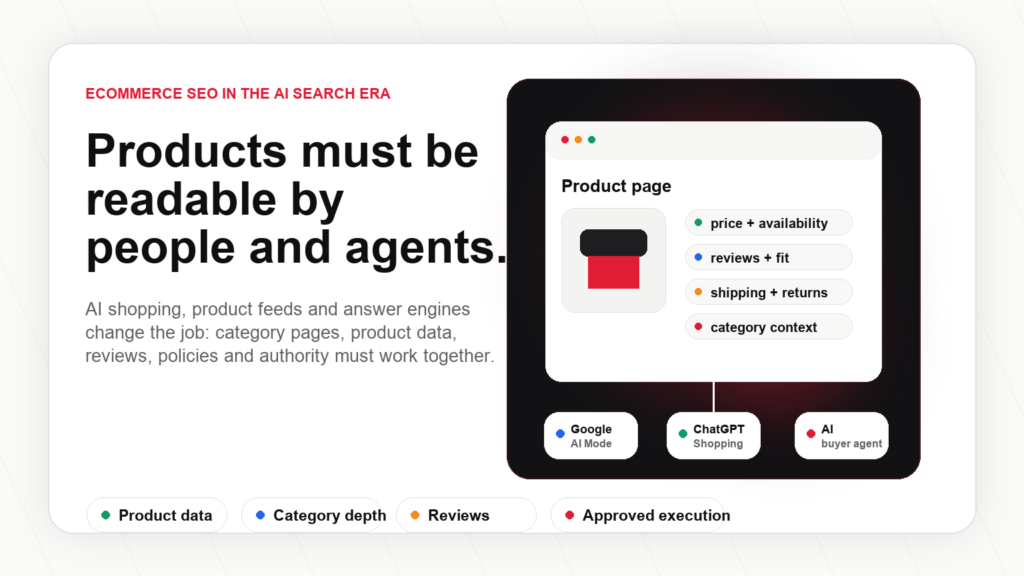
Summary: Ecommerce SEO is no longer only about ranking category pages and product pages in Google. In the AI Search era, online stores also need clean product data, Answer-ready content, structured product information, reliable merchant signals, fast technical execution and enough topical authority to be understood by search engines, AI assistants and buyer agents.
The old ecommerce SEO model was mostly page-first: optimize titles, descriptions, category copy, product descriptions and backlinks. That foundation still matters. The new model is system-first: product feeds, Structured data, crawl control, review signals, shipping and return policies, internal links, authority, content coverage and AI visibility all have to work together. The winner is not the store with the most SEO reports. It is the store that can detect the opportunity, prepare the work, approve the right action and execute quickly.
Human buyers, search engines and AI agents need the same store to be readable.
What changed: ecommerce discovery is no longer one search box
For many years, ecommerce SEO was built around a predictable journey. A buyer searched Google, scanned blue links, clicked a category page, filtered products, compared prices and maybe returned later through ads, email or direct traffic. That journey still exists, but it is no longer the only one that matters.
AI search changes the shape of discovery. A customer can now ask a longer, more specific question: “I need waterproof hiking shoes for a wide foot, under 120 euros, available in Europe, with good reviews and fast delivery.” Instead of simply returning a list of pages, AI systems may compare options, synthesize product attributes, cite sources, include merchants, ask follow-up questions and shorten the path between research and purchase.
Google has been explicit that its AI experiences are built on the same general search foundations: helpful content, crawlable pages, indexable pages, good page experience and search-friendly technical implementation. Its own AI guidance says there are no special secret tricks for Google AI experiences; the fundamentals of making content accessible and useful still apply. The difference is that ecommerce websites now need those fundamentals to be much cleaner, much faster and much more consistent across pages, feeds and structured data.
OpenAI has also moved product discovery forward. Its documentation for improved shopping results explains that ChatGPT may use product information such as pricing, reviews, descriptions, images and links when helping users compare products. That means ecommerce visibility is not only about a ranking position. It is also about whether your product information is understandable, trustworthy and useful enough to be selected, summarized or cited inside an AI-assisted buying journey.
This is why we should stop treating ecommerce SEO as a collection of isolated tasks. A title tag here, a product description there, a few backlinks, a technical audit once a year. The AI search era rewards systems: structured product information, strong category intent, technical cleanliness, helpful content, authority signals, fresh inventory context and continuous monitoring.
We have already explored parts of this shift in separate AYSA articles about machine-readable products and agentic commerce, preparing product feeds for ChatGPT Shopping, AI search citations for ecommerce pages and Google Universal Cart and AP2. This guide connects those ideas into one operating model for ecommerce teams and SMEs.
What still matters: SEO basics did not die, but weak execution did
It is tempting to say that AI killed SEO. That is not accurate. What AI search is killing is shallow SEO: thin category copy, copied product descriptions, technical debt hidden behind pretty design, random blog posts, unreviewed AI content and dashboards that never become website improvements.
The ecommerce fundamentals are still very real:
- Search engines and AI systems need to crawl and understand important pages.
- Product and category pages need unique value, not only grids and manufacturer text.
- Canonical tags, faceted navigation and pagination need control.
- Structured data should match visible content and business reality.
- Internal links should connect categories, buying guides, products and related intents.
- Reviews, delivery, returns, stock and price information need to be clear.
- Authority and mentions still help establish trust around a brand, store and product category.
What changes is the standard of execution. A small ecommerce business cannot wait three months for a PDF audit, two weeks for a content brief and another month for technical fixes to be passed between people. Search has become too dynamic. AI Overviews, AI Mode, shopping integrations, product feeds, merchant listings and buyer agents all increase the need for faster iteration.
In Romania and in many SME markets, the biggest ecommerce SEO problem is not that business owners lack ambition. It is that the operational layer is fragmented. One person handles ads, one agency handles SEO, one developer handles theme changes, another plugin handles schema, product data sits in WooCommerce or Shopify, Merchant Center has separate errors, and nobody has a clean approval workflow for what should happen next.
That is where the distinction between an SEO tool and an SEO execution system becomes important. A tool can show you the problem. An execution system prepares the solution, explains the impact, asks for approval and moves the website forward.
Product data becomes an AI visibility layer
Product data used to be treated as a feed-management task. In the AI search era, it becomes a visibility layer. If a system cannot reliably understand the product, it cannot confidently recommend it. If it cannot compare your price, availability, shipping, return policy, image, variant or merchant trust signals, your store may be invisible even when your pages are technically indexed.
Google’s product structured data documentation shows how product pages can qualify for richer presentation when they provide accurate details such as price, availability, reviews, ratings, shipping and returns where applicable. Google’s ecommerce documentation also emphasizes ways to share product data with Google, including structured data and Merchant Center. These are not “nice to have” details anymore. They are part of the language commerce platforms use to communicate with search systems.
OpenAI’s shopping documentation points in the same direction. Product discovery systems work better when they can read product names, descriptions, prices, images, reviews and links. Even when an AI system does not use your feed directly, the same principle applies: the clearer and more consistent your product information is across pages and sources, the easier it is to retrieve and compare.
For ecommerce teams, this means product data quality is SEO quality. A product page with missing stock status, weak specifications, unclear images, no delivery information and copied manufacturer text is not just a conversion problem. It is a retrieval problem. A category with filters that create thousands of duplicate URLs is not just a UX problem. It is a crawl and indexation problem.
Practical ecommerce data priorities in 2026 include:
- Accurate product identifiers: SKU, GTIN, brand and variant information where relevant.
- Visible commercial facts: price, availability, delivery, returns, payment options and warranty.
- Consistent structured data: product schema that reflects visible page content, not fantasy markup.
- Clean images: compressed, descriptive, crawlable and useful for both human and machine understanding.
- Feed hygiene: product titles, descriptions and categories that match how buyers search and compare.
AYSA’s view is simple: product data should not live as a disconnected spreadsheet exercise. It should be part of the SEO workflow. When AYSA detects missing product data, weak category context, schema gaps or feed-related opportunities, the work should become approval-ready website action.
Category pages are still strategic, but they need to stop being thin grids
In classic ecommerce SEO, category pages often carried the highest commercial value. That remains true. “Women’s running shoes,” “birthday flowers Bucharest,” “office chairs for small spaces,” “organic dog food,” “electric bikes under 2000 euros” and similar queries usually map to category or collection pages, not individual products.
But many category pages are weak. They show products, filters and a short block of generic SEO text. That might have worked in a less competitive search environment. It is much less convincing in a world where AI systems can compare options and users ask more specific questions.
A strong category page should answer the questions a buyer has before choosing a product. It should explain differences, buying criteria, use cases, delivery constraints, size or compatibility issues, return policy considerations and related categories. For a flower shop, a category page should not only list bouquets. It should help a buyer choose by occasion, delivery time, city, freshness, budget and message. For a medical ecommerce store, it should handle trust, safety, regulation and suitability. For fashion, it should handle sizing, fabric, fit, returns and care.
This is also where AEO and GEO start to matter. Answer Engine Optimization is not about adding random FAQs at the bottom of a page. It is about making the page answer real buyer questions directly. Generative Engine Optimization is not about tricking AI systems. It is about making the content easy to synthesize, cite and compare.
Category page improvements that matter in AI search include:
- Clear category intent: who the page is for and what problem it solves.
- Buying criteria: what to compare before choosing.
- Useful internal links: related categories, guides, best sellers and comparison pages.
- Answer-ready sections: practical questions buyers actually ask.
- Semantic clarity: consistent names for products, brands, attributes and locations.
- Freshness: seasonal availability, new arrivals, delivery rules and policy updates.
This is why we previously wrote about fixing thin content across similar ecommerce pages. Thin ecommerce content is not solved by adding more words. It is solved by adding the right useful differences: intent, comparison, evidence, policy, availability and buying logic.
Product pages must be useful to buyers and legible to machines
A product page has two audiences now: the human buyer and the systems that help the buyer decide. The human needs confidence. The AI system needs clarity. The merchant needs conversion. Good ecommerce SEO aligns all three.
The weakest product pages usually fail in predictable ways. They have manufacturer descriptions copied from other sites. They hide shipping and returns. They lack clear specifications. They use poor images. They rely on tabs that bury content. They do not answer compatibility, sizing, usage or care questions. They have inconsistent schema. They disappear when the product is out of stock. They have no internal links to supporting guides or related products.
In the AI search era, product pages should become source pages. A source page is not merely indexable. It is useful enough that a search engine, AI assistant or buyer can trust it as a reference. For ecommerce, that means:
- Clear product name and category.
- Specifications that match real buyer comparison criteria.
- Price and availability that are visible and consistent.
- Shipping, return and warranty information near the buying decision.
- Reviews, ratings or trust signals where real and compliant.
- Images that show the product clearly, not only decorative lifestyle shots.
- FAQs that answer actual buyer objections.
- Internal links to guides, collections, accessories or related items.
There is also an operational question: who keeps this updated? Most ecommerce teams do not have time to manually review thousands of products every month. Agencies can help, but the volume is brutal. This is one reason AYSA exists. The agent can monitor pages, detect missing commercial information, prepare title/meta/content/schema/internal-link improvements and ask the user to approve changes before execution.
Technical ecommerce SEO is now crawl engineering
Technical SEO for ecommerce has always been complex. AI search makes the cost of technical chaos higher. A site with faceted navigation problems, canonical conflicts, slow pages, duplicate URLs, weak internal links and broken products forces crawlers and AI systems to work harder. When the system has many possible sources, it may simply choose a clearer one.
The most common ecommerce technical SEO problems are still painfully familiar:
- Filter URLs that create crawl traps.
- Duplicate category and product URLs.
- Canonical tags pointing to the wrong version.
- Redirect chains after platform migrations.
- Out-of-stock pages handled inconsistently.
- Search pages, tag pages and parameter pages leaking into the index.
- Slow mobile performance due to themes, apps, plugins and scripts.
- Weak internal links from editorial content to commercial pages.
- Product schema that conflicts with visible content.
For WooCommerce stores, this often becomes a plugin and theme problem. We covered this in more detail in WooCommerce SEO in Romania. Many stores are not failing because their owners do not understand SEO. They are failing because the stack creates too many low-value URLs, loads too much JavaScript, duplicates templates and makes every fix depend on manual developer availability.
The technical goal is not perfection. The goal is control. Search engines need clear crawl paths, canonical URLs, useful sitemaps, fast mobile rendering, valid structured data and pages worth indexing. AI systems need the same thing, plus clean semantic content that can be chunked, retrieved and summarized.
A modern technical ecommerce SEO workflow should continuously check:
- Which URLs are indexable and why.
- Which URLs waste crawl budget.
- Which categories and products are orphaned.
- Which product pages have missing or conflicting structured data.
- Which pages have duplicated titles, meta descriptions or content patterns.
- Which pages are slow enough to affect crawling, UX or conversion.
- Which redirects should be fixed before authority is lost.
AYSA turns those checks into work. Not a spreadsheet graveyard. Not a report that sits in a folder. The value is in the execution loop: detect, prepare, approve, apply, monitor again.
Content and topical authority still decide who gets trusted
AI search does not remove the need for content. It changes what content has to do. A blog post written only to target a keyword is weak. A buying guide that helps someone understand options, compare products and choose confidently is useful. A category support article that answers real objections can help both rankings and AI retrieval.
Ecommerce content should be built around decisions, not only keywords. A user does not want “content.” They want to know which size fits, which product works for their use case, what to avoid, which category is better, how delivery works, why one item costs more than another and whether the merchant can be trusted.
Content types that matter for ecommerce AI visibility include:
- Buying guides for real decision moments.
- Comparison pages between product types, not only brands.
- Use-case pages for specific buyer situations.
- Location pages for local commerce and delivery areas.
- FAQ sections tied to visible products and policies.
- How-to content that links naturally to products and categories.
- Editorial explainers that build topical authority around the category.
This is also where authority building matters. Search engines and AI systems look for evidence across the web. Brand mentions, publisher coverage, product references, reviews and relevant links help establish that a store is a real entity, not just a page generator. AYSA is connected to the Adverlink ecosystem for this reason: authority building should be visible, controlled and approval-based, not messy outreach hidden in spreadsheets.
The caution is important. Ecommerce teams should not chase low-quality links or mass-generated content. AI search may make quality gaps more obvious, not less. A website that publishes thousands of weak pages can create more indexation and trust problems than growth.
Useful content has to answer a specific user, at a specific stage, in a specific market. A page about “best pediatric clinic in Bucharest” should help a parent compare options, understand trust signals and decide what to do next. A category page about “flowers for same-day delivery” should help a buyer understand cut-off times, freshness, delivery areas and occasion fit. Generic content does not become strategic just because it is long.
Measurement: rankings are not enough anymore
Ecommerce SEO measurement has to expand. Rankings and organic clicks still matter, but they do not capture the full AI search journey. A product can be mentioned in an AI answer without a classic ranking report showing the opportunity. A brand can be recommended by an assistant, compared in a generated answer or excluded because its product information is incomplete.
Useful ecommerce measurement now includes:
- Organic rankings and click-through rate for category and product queries.
- Merchant Center and feed health.
- Product structured data validity.
- Indexation status of commercial pages.
- AI visibility and brand mention tracking.
- Revenue and conversion by landing page type.
- Internal link depth for high-value categories.
- Content coverage around commercial topics.
- Authority growth through relevant publisher mentions and links.
We explored the citation side in Why AI Search Cites Some Websites and Ignores Others. The short version is that AI visibility is not a single metric. It is the result of being crawlable, useful, entity-clear, trusted and easy to retrieve. Ecommerce stores need dashboards, but they also need a system that translates signals into actions.
This is where many ecommerce teams struggle. They know traffic is changing. They see ads becoming more expensive. They hear about AI Overviews, AI Mode, ChatGPT Shopping, product feeds and agentic commerce. But they do not know which action to take first. That is not a knowledge problem only. It is an operating model problem.
Where AYSA fits: from ecommerce SEO report to approved execution
AYSA is built for the new operating model. The product is not trying to be another dashboard where a business owner must learn every SEO concept before taking action. It is an AI SEO execution agent that learns the business, monitors the website, identifies opportunities, prepares the work, explains the reason, asks for approval and executes accepted changes inside the website workflow.
For ecommerce, that means AYSA can help prepare work such as:
- Improving category titles, descriptions and buying-guide sections.
- Detecting thin product pages and preparing better product explanations.
- Finding internal link opportunities between guides, categories and products.
- Flagging product schema gaps and structured-data inconsistencies.
- Identifying orphaned commercial pages and crawl waste.
- Preparing SEO/AEO-friendly content around category authority.
- Monitoring AI visibility and search performance signals.
- Surfacing authority-building opportunities that require approval before spending.
The important part is approval. Automation without control is dangerous. Manual SEO without execution speed is too slow. AYSA is designed to sit between those extremes: autonomous preparation, human approval for important actions, and automatic execution after approval.
That is the future ecommerce teams need. Not “AI writes product descriptions.” Not “SEO tool shows red warnings.” Not “agency sends a report.” The future is an operating system for organic growth: monitor, prepare, approve, execute and learn.
Practical ecommerce SEO checklist for the AI search era
- Make sure important product and category pages are crawlable, indexable and self-canonical.
- Clean up faceted navigation so filters do not create indexation chaos.
- Use product structured data that matches visible content.
- Keep product feeds accurate and aligned with on-site information.
- Improve category pages with real buying criteria, comparisons and internal links.
- Rewrite weak product pages with unique product usefulness, not generic fluff.
- Add shipping, returns, availability and trust information where buyers need it.
- Create buying guides and comparison content that support commercial decisions.
- Monitor AI visibility, brand mentions and product discovery changes.
- Turn findings into approved actions, not permanent backlog.
Ready to turn product and category opportunities into approved website execution?
If your ecommerce SEO work is stuck between reports, feeds, plugins, developers and content tasks, AYSA helps monitor the website, prepare the work and execute accepted changes after approval.
Sources and further reading
Continue the AI search topic inside AYSA.
Use these pages to connect the article with AI SEO tools, AI visibility monitoring, AI Overviews and approved website execution.
Turn this topic into a website action plan.
Use these AYSA hubs to move from reading to technical fixes, AI visibility monitoring, research, glossary context and approval-first SEO execution.

