
Why AI Search Cites Some Websites and Ignores Others
AI search citations are not random. They depend on crawlability, source selection, extractable answers, entity clarity, topical authority, trust signals and whether the page helps the AI complete the user task.
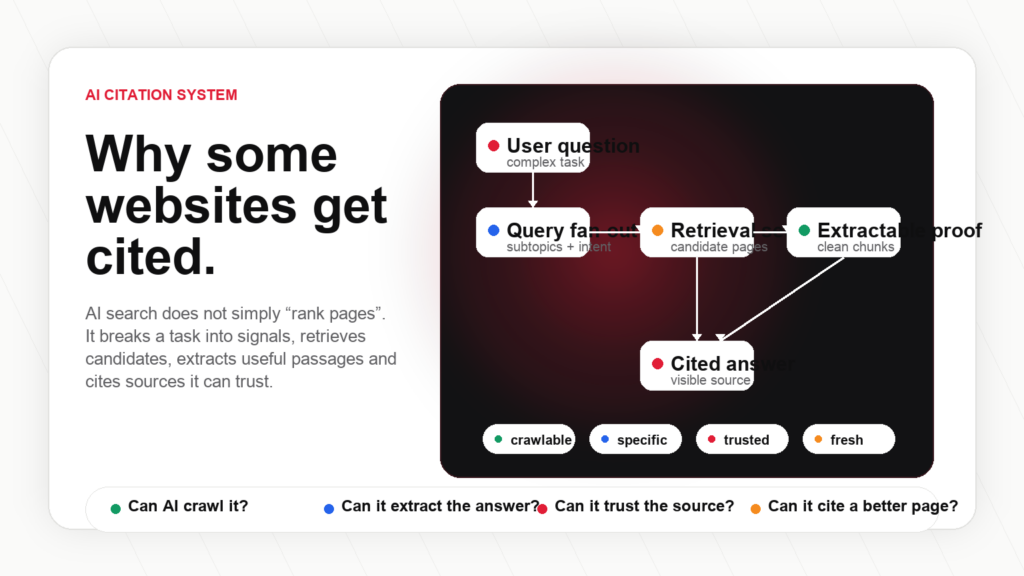
Executive summary: AI Search does not cite websites by magic, and it does not simply copy the old Google ranking order into a new Answer box. AI systems first need to discover pages, understand the user task, retrieve candidate sources, extract useful passages, compare evidence, synthesize an answer and decide which sources are worth showing. That chain creates winners and losers. Some websites are cited because they are clear, crawlable, specific, trusted, current and easy to extract. Others are ignored because they are vague, slow, thin, blocked, generic, disconnected from real entities or useful only to humans who already know what they are looking for.
My view is simple: AI visibility is not a separate trick. It is the next stress test for real SEO. If your content is useful, technically accessible, semantically clear and backed by authority, you have a chance to be retrieved and cited. If your site is mostly generic copy, weak pages, unclear entities and manual SEO tasks nobody executes, AI search will expose that weakness faster than classic rankings did.
AI citations are not random, but they are not classic rankings either
The uncomfortable part of AI search is that many website owners are trying to understand it with an old mental model. They ask: “How do I rank number one in ChatGPT?” or “How do I get into AI Overviews?” Those are understandable questions, but they are too narrow. AI search is not only a new SERP feature. It is a different retrieval and answer-building workflow.
Classic SEO taught us to think in pages and positions. A query produced a list of results. The marketer’s goal was to rank higher. AI search still depends on search infrastructure, Crawling, Indexing and ranking signals, but the output is different. A user asks a task-shaped question, not just a keyword. The system may expand that question, run several searches, retrieve sources, inspect pages, compare passages and synthesize a response. The citation is not always the same thing as a blue-link ranking.
Google has described AI Mode as using a “query fan-out” technique, where the system issues multiple related searches across subtopics and data sources to answer a more complex question. That matters because a page can be ignored even if it ranks for a simple keyword, if it does not answer one of the subquestions well. The reverse can also happen: a page with a strong, specific section can be cited because it answers a narrow part of the user’s task better than a broader page.
Search Engine Land has also reported on the idea of fan-out behavior in ChatGPT Search, where multiple searches and source inspections can be used to build an answer. Whether we talk about Google AI Mode, ChatGPT Search, Perplexity or other answer engines, the direction is similar: AI search is moving from “show me ten links” to “help me complete this task.”
That is why AI citations feel inconsistent to many businesses. They expect the same page to win every time. But an AI answer may cite different sources depending on the prompt, user context, freshness, wording, available sources, query expansion and which passage best supports the synthesized response. AI search citations are probabilistic, but they are not arbitrary. They reward pages that are easy to retrieve, understand, trust and quote.
Old SEO lens
A keyword maps to one ranking page. Success is mostly measured by position, impressions and clicks.
- One query
- One SERP
- One target page
- Click-focused outcome
AI search lens
A task becomes multiple subqueries. The system retrieves, extracts, compares and cites sources that support the answer.
- Query fan-out
- Passage retrieval
- Entity comparison
- Citation-ready evidence
How AI search chooses sources: the practical model
No public source gives us a complete ranking formula for AI citations. Google does not publish the exact weights used by AI Overviews or AI Mode, and OpenAI does not publish a simple “citation algorithm.” That is normal. Search engines have never published the full ranking system either. But we can build a useful, evidence-based model from official documentation, observed behavior and large-scale industry studies.
The model has several layers.
First, discovery and access. If the AI system, search engine or crawler cannot access the content, the page cannot be reliably used. Google’s official guidance for AI features tells site owners to keep using the same technical foundations that make content eligible for Search: crawlability, indexability, useful content, snippets and structured data where appropriate. That sounds basic, but it is exactly where many SME websites fail. They block important pages, rely on heavy JavaScript, publish thin pages, hide answers behind UI components or let technical debt accumulate.
Second, query expansion. AI search often reframes the user’s prompt into several searches. A query like “best pediatric clinic in Bucharest for a toddler with recurring fever, private, good reviews, parking and online booking” is not one keyword. It contains healthcare category, local intent, patient need, trust signals, convenience criteria and comparison logic. A website that only has a generic “Pediatrics” page may not be cited. A website that clearly covers pediatric consultations, fever guidance, booking, parking, location, doctors, reviews and private clinic context has more citation surfaces.
Third, retrieval. The system needs candidate documents or passages. In classic search, the candidate set is largely built from indexed web pages. In AI search, retrieval can include web pages, structured data, product feeds, local data, publisher content, forums, social context or other sources depending on the product. The important point is that AI systems retrieve information before they synthesize an answer. If your content does not match the subquery or cannot be parsed, it may never enter the candidate set.
Fourth, extraction. A page must contain passages that can be pulled into an answer. A beautiful page that says very little may rank for brand queries, but it gives an AI system little to cite. A page with clear sections, direct explanations, examples, criteria, tables, FAQs and evidence is easier to use. This is one reason list-style and comparison content often appears in AI citations: it decomposes information into extractable chunks.
Fifth, confidence and trust. AI systems need to avoid unsupported answers. They may prefer sources that show expertise, authority, freshness, consensus, citations, clear entity identity, author information and reliable external signals. This does not mean every cited source is perfect. It means the system needs enough confidence to attach a source to an answer. In sensitive categories such as health, finance and legal topics, the trust threshold is naturally higher.
Sixth, answer usefulness. A source may be technically available and authoritative but still not useful for the exact user task. AI answers are task-shaped. They need sources that help the answer compare, explain, recommend, warn, summarize or decide. That is why “being generally good” is not always enough. The page must solve a specific part of the prompt.
Why some websites get cited
There are patterns behind websites that appear repeatedly in AI answers. These are not guarantees, but they are practical advantages.
1. They are crawlable, indexable and technically clean
AI visibility begins with basic access. If a page is blocked by robots.txt, canonicalized incorrectly, marked noindex, rendered only after fragile JavaScript, buried behind filters or excluded from a clean sitemap, it is a weak citation candidate. Technical SEO is not glamorous, but it is still the foundation.
For WordPress websites, this often means fixing plugin bloat, redirect chains, duplicate archives, bad canonicals, slow mobile pages, unoptimized images, unnecessary JavaScript and messy internal linking. A crawler that struggles with your site is a warning sign. AI systems do not reward chaos.
2. They answer the expanded task, not only the head keyword
AI search is good at decomposing intent. A page optimized for “technical SEO audit” may not be enough if the user asks: “What should a small ecommerce business check before migrating a WooCommerce site?” The stronger page explains crawl, indexation, redirects, canonicals, speed, product pages, filters, structured data, analytics and post-migration monitoring. It answers the real task, not just the keyword.
This is one of the biggest shifts for content teams. You cannot only produce pages that match keyword labels. You need pages that match decision moments. Good content now needs to include criteria, tradeoffs, examples, steps, risks, limitations and next actions.
3. They are structured into extractable chunks
AI systems can use long-form content, but long-form alone is not enough. The page must be easy to break into meaningful parts. Clear headings, concise definitions, comparison sections, bullets, tables, examples, visible FAQs and summaries help retrieval systems understand what each section does.
This is not about writing for robots instead of humans. It is about writing in a way that helps both. A human business owner also benefits from clear sections. A parent comparing clinics also benefits from visible criteria. An ecommerce manager comparing SEO tools also benefits from tables and examples.
4. They have entity clarity
AI search needs to understand who or what the page is about. A business should be identifiable as an entity: name, location, services, people, products, categories, relationships, social profiles, publisher mentions, reviews and schema where appropriate. If the website does not make the business legible, AI systems may struggle to connect it to a query.
Entity clarity matters especially for local businesses, medical clinics, ecommerce stores, SaaS products and professional services. A page that says “we offer quality services” is vague. A page that identifies the business, city, service area, team, process, categories and proof is much easier to interpret.
5. They demonstrate topical authority across a cluster
A single page can be cited, but clusters build confidence. If a website has one article about “AI search visibility” and nothing else, it may be less convincing than a site with a connected body of work: AI Overviews, answer engine optimization, generative engine optimization, entity SEO, technical accessibility, schema, content quality, internal linking and measurement.
This is where internal linking matters. Semantic links help crawlers and users understand relationships between pages. A glossary term should link to practical guides. A product page should link to examples. A blog article should link to related concepts. A cluster should feel like an organized body of knowledge, not a pile of isolated posts.
6. They have authority outside their own website
AI search does not live only on your domain. Brand mentions, reviews, backlinks, citations, publisher references, social discussions and third-party profiles can all help systems understand whether a brand is real and relevant. This is especially important for SMEs that want to appear in AI answers where the user asks for recommendations.
Authority building does not mean buying random links or publishing low-quality advertorials. It means earning or approving relevant mentions in places that make sense for the business. The quality of context matters. A local clinic mentioned in relevant healthcare/local sources is different from a link placed in a generic, unrelated article.
7. They stay fresh where freshness matters
Freshness is not equally important for every topic. A definition of a canonical tag does not need daily updates. But AI search, Google changes, pricing, product comparisons, medical appointment processes, local availability and technology guidance can become outdated quickly. A page that was accurate two years ago may be a poor source today.
Freshness is not only a date. It is visible maintenance: updated examples, current references, recent screenshots, corrected claims, modern terminology and links that still work. AI systems can surface stale content, but in competitive categories freshness is a real advantage.
The content can be accessed, rendered, indexed and discovered through clean internal links.
Technical foundation
The page answers the real expanded task, not only the generic keyword.
Intent match
Definitions, criteria, examples and comparisons are clear enough to cite.
Passage quality
The brand, author, facts, references and third-party signals create confidence.
Authority layer
Why AI search ignores many websites
The same model explains why many websites disappear from AI answers. It is not always because the website is bad. Sometimes it is because the page is not useful for the AI task. Sometimes it is because the site is technically difficult. Sometimes it is because the information exists but is not written in a way that can be extracted.
Generic content is easy to skip
If your article sounds like every other article, AI has no strong reason to cite it. Generic SEO content was already weak in classic search; AI search makes the weakness more visible. A page that says “quality content is important” without examples, criteria, data, workflow or opinion is not a strong source.
The better question is: what would make this page the most useful result for a specific user, at a specific stage of the journey, in a specific market? A page about “best pediatric clinic in Bucharest” should help a parent compare options. A page about “technical SEO audit” should explain checks, risks, examples, prioritization and what happens after issues are found. Specificity wins.
Thin pages do not provide enough evidence
Many SME websites have service pages that are too thin to cite. They list a service, add a short paragraph, show a form and stop. That might be enough for a brand visitor, but it is not enough for AI search. The page does not explain the service deeply, answer real questions, show proof or connect to related concepts.
Over-optimized pages can look unhelpful
Pages created only to capture keywords often fail the usefulness test. Doorway-style location pages, repeated product descriptions, AI-generated pages with no unique value and comparison pages that are mostly affiliate fluff may enter the index, but they are weak citation candidates. AI search has a strong incentive to prefer sources that help the answer, not pages that merely match words.
Hidden or unstable content is harder to use
If important information is loaded late, hidden behind tabs that are not accessible, rendered only through scripts, blocked by cookie overlays or dependent on fragile page builders, extraction becomes harder. A human may eventually find the information. A crawler or AI retrieval system may not.
No visible proof means low confidence
AI systems can cite a page without perfect proof, but trust signals matter. If a medical clinic page has no doctors, no address, no review context, no author, no medical review process and no clear limitations, it is weaker. If a SaaS page has no examples, no pricing clarity, no help content and no external references, it is weaker. If a local service page has no location evidence, it is weaker.
Authority gaps reduce citation probability
Some websites are ignored because the web outside their domain does not support them. There are no relevant mentions, no meaningful backlinks, no reviews, no publisher references, no social proof and no topical footprint. In classic SEO, this hurts rankings. In AI search, it can also reduce confidence that the brand should be named in an answer.
What SMEs should do now
For small and medium-sized businesses, the AI search opportunity is real, but the work must be practical. SMEs do not need a bloated “AI SEO transformation program.” They need a disciplined operating system for making the website clearer, more useful, more technically accessible and more trustworthy over time.
Start with the pages that matter commercially. Service pages, category pages, location pages, product pages, comparison pages, pricing pages, case studies and help pages are more important than publishing random blog posts. If those pages do not answer real buying questions, AI search has little to cite.
Then build supporting clusters. A clinic should connect services, doctor profiles, symptoms, appointment process, local pages and patient FAQs. An ecommerce site should connect categories, buying guides, product comparison, delivery information, returns, reviews and product feeds. A SaaS business should connect product pages, use cases, pricing, documentation, glossary terms and examples.
Next, improve technical access. Clean canonical tags, remove redirect chains, fix internal broken links, optimize mobile speed, reduce JavaScript bloat, build clean sitemaps and ensure important content is visible in HTML. Do not let plugins and page builders turn the website into a crawling obstacle course.
Finally, invest in authority building. This does not mean chasing spam links. It means earning or approving relevant publisher mentions, industry references, local citations, partner pages, customer stories and expert content. AI systems need context from the web, not only from your own marketing pages.
Where AYSA fits: from AI visibility diagnosis to approved execution
This is exactly why AYSA is built as an SEO execution agent, not just another dashboard. AI visibility problems are rarely solved by one report. They require continuous work: detecting gaps, prioritizing pages, preparing improvements, asking for approval and applying accepted changes inside the website workflow.
AYSA can help identify pages that receive impressions but do not answer the task well; topics where the business lacks coverage; weak internal links between related pages; schema opportunities that match visible content; technical issues that reduce crawlability or indexability; authority-building opportunities that need review; and AI visibility gaps where the brand is not easy to identify, cite or recommend.
The important part is what happens next. AYSA does not only show the issue. It prepares the work, explains why it matters, asks for approval and can execute accepted changes inside the website workflow. That is the difference between an AI visibility report and an AI visibility operating system.
In my opinion, this is the practical future for SMEs. Business owners do not have time to read thousands of SEO recommendations, learn every Google update, compare every AI search study and manually implement technical changes. They need a system that keeps watching, keeps preparing and keeps execution moving with human approval where it matters.
A practical AI citation checklist
If you want a simple checklist, use this:
- Can the page be crawled and indexed? Check robots.txt, noindex, canonical tags, sitemap inclusion, redirects and rendering.
- Does the page answer a real task? Go beyond the keyword. Include criteria, examples, process, limitations and next steps.
- Is the content chunkable? Use clear headings, summaries, definitions, FAQs, tables and comparison blocks where they help the user.
- Is the entity clear? Make the business, author, product, location, service area and relationships easy to understand.
- Is there visible proof? Add relevant sources, examples, reviews, case studies, author information, dates and external validation.
- Is the content fresh where freshness matters? Update pages when the market, pricing, technology or guidance changes.
- Are related pages connected? Build semantic internal links across glossary, product pages, examples, help pages and articles.
- Does authority exist beyond your own domain? Build relevant mentions and publisher relationships, not random link spam.
- Can someone approve and execute the improvements? Reports are not enough. The work must move into the website.
The sites that win in AI search will not be the ones that chase every new acronym. They will be the ones that become easier for machines to understand and easier for humans to trust. That requires SEO, AEO, GEO, content quality, technical discipline and authority building working together.
Sources and further reading
- Google Search Central: AI optimization guide
- Google Search Central: Creating helpful, reliable, people-first content
- Google Search Central: How Search works
- Google Search Central: Introduction to structured data
- Google: AI Mode update and query fan-out explanation
- Search Engine Land: Inside ChatGPT Search, web run and fan-out queries
- Search Engine Land: What 25,000 URLs reveal about AI search citations
- Search Engine Journal: 68 million AI crawler visits and AI search visibility
AYSA monitors SEO, AEO and AI visibility signals, prepares the work, asks for approval and executes accepted changes inside your website workflow.
Continue the AI search topic inside AYSA.
Use these pages to connect the article with AI SEO tools, AI visibility monitoring, AI Overviews and approved website execution.
Turn this topic into a website action plan.
Use these AYSA hubs to move from reading to technical fixes, AI visibility monitoring, research, glossary context and approval-first SEO execution.

