Google AI Overviews Just Crossed a Legal Line: What the German Ruling Means for Brands, SEO, and Reputation Defense
A German court signaled that AI Overviews can be treated as Google’s own statements—not neutral search links—opening a new playbook for businesses harmed by false AI-generated claims. Here’s what changed, why it matters, and what to do next.

By Marius Dosinescu (AYSA.ai)
The moment AI search stopped being “just search”
For 20+ years, most businesses treated Google search as a distribution channel: you publish pages, Google lists them, and customers click. If something false appeared, the common assumption was: “That’s on the website Google linked to.”
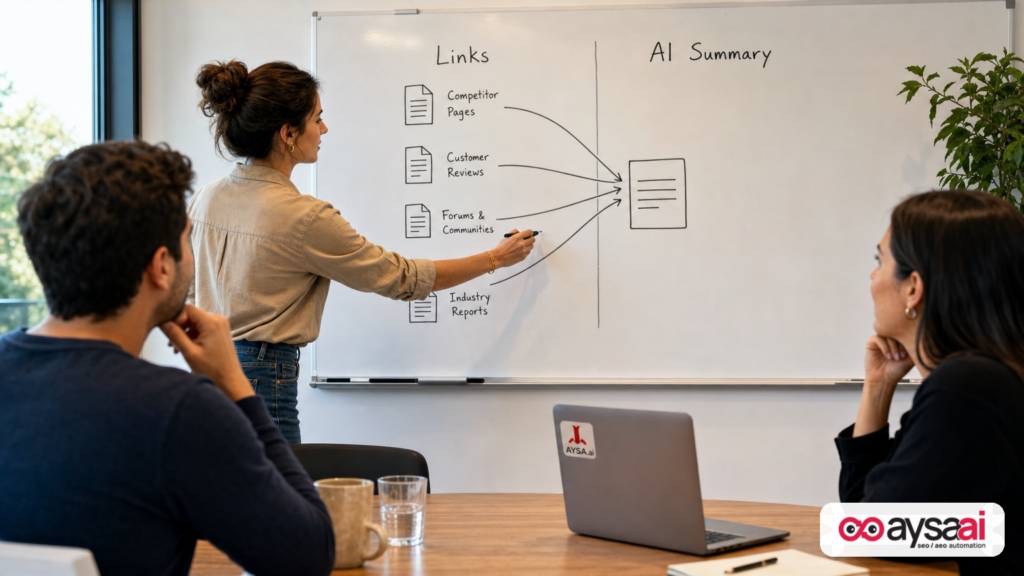
AI Overviews break that mental model. The system doesn’t just point to sources; it synthesizes them into new statements. And when those statements are wrong, the harm happens instantly—often before a user Clicks anything.
A recent German court decision makes this shift explicit: AI-generated Overviews may be treated as Google’s own content, not a neutral set of links. In plain terms, that increases the likelihood that Google can be directly liable for false claims produced by an AI Overview—at least under the legal reasoning applied in that case.
This editorial breaks down what changed, why it matters for brands and publishers, and—most importantly—what you should do operationally, starting this week.
Concise summary (for busy owners)

- A German court indicated AI Overviews can be treated as Google-authored statements, not merely a “search results” function. That can change liability dynamics when AI says something false about a business.
- The risk isn’t only traffic loss. It’s reputational harm at the top of the funnel: scam accusations, safety warnings, “not available,” “subscription trap,” or entity mix-ups.
- Traditional SEO monitoring is not enough. You need claim-level Monitoring: which queries generate AI answers, what claims are made, what sources are cited, and whether those sources actually support the claims.
- Execution speed matters. The best defense is a tight loop: monitor → validate → remediate → re-check. And remediation isn’t just “publish more content.” It’s also Entity Clarity, Structured data, policies, and proof.
- AYSA fits here as an Approved Execution system: it helps monitor AI search visibility, prepare fixes, request approval, then execute accepted changes on your site—so you can respond quickly without losing control.
Table of contents

- What happened (and why it’s different from old search liability)
- The ruling in plain English: AI Overviews aren’t “just links”
- What changed in the risk model for every business (and every SEO team)
- How AI Overviews go wrong in real life
- Why this matters more in a zero-click world
- What SMEs should monitor weekly (not quarterly)
- A concrete SME scenario: the local clinic that gets labeled “a scam”
- What agencies need to rethink: deliverables, liability, and client expectations
- The new basics: entity hygiene, evidence, and “claim-proof” content
- The operational playbook: monitor → validate → remediate → re-check
- Where AYSA.ai fits: approved execution for AI-search-era SEO
- What to do next (action list)
- Sources and further reading
What happened (and why it’s different from old search liability)
Search Engine Land reported on a German court decision involving AI Overviews that allegedly tied two publishers to scams and questionable business practices—claims that were not supported by the pages Google linked to. According to the report, the court treated the AI Overview statements as Google’s own content because the system rewrites, combines, and evaluates information in its own structure and wording.
That distinction matters because traditional search results historically functioned like a map: “Here are the roads; choose where to go.” AI Overviews act more like a tour guide: “Here’s what’s true about this place,” often with a tone of authority, completeness, and confidence.
If a link is defamatory, the publisher is typically the target. If an AI system creates the defamatory statement by synthesizing sources into an unsupported claim, the liability conversation shifts toward the AI publisher—not the linked sites.
Primary research lead: Search Engine Land’s coverage summarizes the Munich Regional Court’s reasoning and the injunction, including that the overview contained claims not present in cited sources and that the overview stood on its own rather than acting as a set of neutral references. (Source: Search Engine Land.)
The ruling in plain English: AI Overviews aren’t “just links”
Here’s the core idea business owners should take away, without the legal jargon:
- A link is a pointer. The search engine says: “This site might answer your question.”
- An AI Overview is a statement. The system says: “Here’s the answer,” and then supports it with citations.
That second behavior—generating standalone claims—is what pushed the court (as described in the reporting) to treat the output as Google-authored content. The report also indicates the court rejected the argument that users could simply verify accuracy by clicking citations, because the AI Overview presented itself as complete.
My view: This is not a minor legal nuance. It’s an operational wake-up call. If AI search results are treated like “publishing,” then any business that depends on Google must plan for misstatements, not just “ranking changes.”
What changed in the risk model for every business (and every SEO team)
When business leaders think about search risk, they usually think in two buckets:
- Traffic risk: “Did our rankings drop?”
- Compliance risk: “Are we violating policies?”
AI Overviews add a third, more immediate bucket:
- Claim risk: “Is an AI system making specific claims about our business, products, pricing, safety, availability, or legitimacy?”
Claim risk is different because it’s not solved by “more backlinks” or “a better title tag.” If an AI Overview says your brand is linked to a scam, your conversion rate collapses before analytics even registers a problem.
And the worst part: claim risk can appear even when your website is accurate, because the AI might conflate entities or misread context across multiple sources.
The Search Engine Land report suggests the court viewed this as especially problematic because the disputed statements did not appear in the cited pages—meaning the harmed parties would have no clear third-party publisher to pursue if Google were treated only as an intermediary.
How AI Overviews go wrong in real life
Let’s get practical. Here are the most common failure patterns I see when generative systems summarize brands (and what you should assume can happen to you):
1) Entity mix-ups (the “wrong company” problem)
A system sees similar names, shared addresses, overlapping founders, copied product descriptions, or even forum chatter and merges entities. The AI then attributes negatives from “Company B” to “Company A.”
Why it’s hard to detect: Your rankings might be stable. Your reviews might be fine. But the top-of-funnel narrative gets poisoned.
2) Unsupported inference (the “it sounds true” problem)
AI models are trained to produce plausible language. If sources discuss scams in a general category, the model may “helpfully” warn users—even when no cited source actually alleges wrongdoing by your specific business.
3) Citation laundering (the “sources” don’t say that problem)
This is exactly what the German case highlights in the reporting: an AI statement appears with citations, but the citations do not support the statement. That’s not merely “a bad snippet.” That’s a new claim presented with borrowed credibility.
4) Stale facts (the “old truth” problem)
Outdated policies, old pricing pages, expired inventory, historic legal disputes, or a years-old forum thread can resurface as if it’s current. Even if your site is updated, the AI may rely on other sources or cached interpretations.
5) Tone and authority (the “complete answer” problem)
When users see an AI Overview, many interpret it as the “official” answer. The Search Engine Land report notes the court rejected the idea that users can simply verify by reading sources; the AI Overview stands on its own. That’s consistent with how people behave: they skim, they trust, they move on.
Why this matters more in a zero-click world
Even before AI Overviews, search behavior was drifting toward fewer clicks. Search Engine Land referenced a separate report about zero-click searches hitting 68% in early 2026. I can’t independently verify the underlying study from the supplied context, but the directional point is important: more answers are being consumed directly on the results page.
If users don’t click, you don’t get a chance to correct misinformation with your own copy, your own trust signals, or your own customer support. The SERP becomes the “front desk” of your business.
Research lead from the provided context: Google zero-click searches hit 68% in early 2026: Study.
Business implication: Your KPI can’t be “sessions” alone. You need to measure visibility and narrative—what AI says about you when customers ask pre-purchase questions.
What SMEs should monitor weekly (not quarterly)
Most small and mid-sized businesses treat SEO like a monthly report: rankings, traffic, top pages. That’s not sufficient in AI search, because harm can appear query-by-query.
Here’s a weekly monitoring list that a non-SEO operator can actually run:
1) Build a “money query” list
Include queries that customers use when they’re trying to decide whether to trust you:
- “Is [Brand] legit?”
- “[Brand] scam”
- “[Brand] reviews”
- “[Brand] pricing”
- “[Brand] cancellation” / “refund policy”
- “[Brand] phone number” / “contact”
- “[Brand] vs [Competitor]”
Also include category queries where AI may recommend vendors without naming you.
2) Capture what the AI Overview says (word-for-word)
Record:
- The query
- Date/time
- The overview text (copy/paste)
- Citations shown
- Any warnings or “red flags” language
Don’t rely on memory. Treat this like incident evidence.
3) Audit citations: do they actually support the claim?
This is the “citation laundering” check. Open each cited source and search within the page for the key allegation. If it isn’t there, you have a stronger case that the AI is inventing or conflating.
4) Entity clarity check: can the machine tell who you are?
Look for common confusion triggers:
- Similar brand names in your market
- Multiple domains (old vs new)
- Franchise vs corporate pages
- Old addresses and phone numbers on directory sites
- Inconsistent legal entity names across your site
5) Set alerts for brand + fraud language
You likely already monitor reviews. Add monitoring for the narratives that fuel AI warnings: “scam,” “fraud,” “subscription trap,” “bait and switch,” “lawsuit,” “unsafe,” and “not available.”
AYSA approach: we treat this as part of ongoing monitoring, not a one-time audit. See: AYSA Monitoring and AI visibility context: AI Search Visibility.
A concrete SME scenario: the local clinic that gets labeled “a scam”
Imagine a local private clinic—cosmetic dermatology, physical therapy, or dental implants. They’re not a global brand. Their growth comes from two sources: referrals and Google.
One day, a prospective patient searches: “Is Northside Skin Clinic legit?” An AI Overview appears and says something like:
- “Users report aggressive phone calls”
- “Subscription trap”
- “Warning signs”
The patient doesn’t click. They don’t call. They book with a competitor.
The clinic owner sees no immediate signal in Google Analytics because the patient never arrived. They just feel “something is off” in bookings.
Now add the twist that matches the court’s reasoning as described in the Search Engine Land coverage: the citations don’t actually contain those allegations. The AI might have mixed up the clinic with a similarly named telehealth subscription service, or it generalized from unrelated complaints about the industry.
What the clinic should do operationally (not legally):
- Capture the AI Overview text and citations.
- Verify whether the citations support the claims.
- Fix entity ambiguity on their site (clear legal entity name, NAP consistency, practitioner pages, policies, contact details).
- Add “claim-proof” content (pricing transparency, cancellation policy, complaint resolution process).
- Re-check over time to see whether the overview changes.
This is exactly the kind of loop where an approved execution system matters: you can’t wait three months for a website sprint to address a reputational narrative that’s forming in the SERP today.
What agencies need to rethink: deliverables, liability, and client expectations
If you run an agency—or if you hire one—AI Overviews force a reset in how you define “SEO work.” The old model was mostly:
- Technical cleanup
- Content plan
- Links/authority
- Reporting
That model is still necessary, but it’s incomplete. You now need a fifth competency: AI narrative management (AEO/GEO), which includes monitoring and remediation when AI answers misrepresent the client.
New deliverables that clients will demand
- Query-level AI monitoring: which prompts produce AI answers about the brand/category.
- Claim audits: what claims appear; are they supported by cited sources.
- Entity cleanup roadmap: on-site and off-site consistency fixes.
- Fast remediation: approved changes shipped quickly, not waiting for a dev cycle.
Why scope creep becomes inevitable (unless you operationalize)
When a client sees a false claim in an AI Overview, they won’t ask for a “content brief.” They’ll ask: “Fix this now.”
Agencies that rely on manual processes will either:
- Burn margin doing emergency work, or
- Delay response and lose trust
That’s why I believe the next wave of agency advantage is not “better prompts.” It’s better execution systems—clear monitoring, an approval queue, and safe, repeatable site changes.
The new basics: entity hygiene, evidence, and “claim-proof” content
Let’s talk about what actually reduces AI confusion over time. This is where many teams get stuck, because they assume the answer is “write more blog posts.”
Often, the fix is simpler—and more operational.
1) Entity hygiene: make it easy for machines to identify you
Your site should remove ambiguity:
- Consistent brand name and legal entity
- Clear address, service area, and phone number
- Dedicated “About” page that explains ownership and history
- Team pages (real humans) where appropriate
- Press or references page (where factual)
This is not “fluff.” It’s disambiguation. AI systems thrive on clarity.
2) Evidence-first content: policies and proofs beat adjectives
If the market is sensitive—health, finance, supplements, ecommerce subscriptions—AI systems and users look for evidence.
Content types that help:
- Refund and cancellation policy pages written in plain language
- Pricing transparency and how billing works
- Shipping/returns, timelines, and contact paths
- Complaint resolution steps
- For clinics: credentials, licensing info, and safety protocols
3) Structured data as an accuracy tool (not a ranking trick)
I’m not going to promise that adding schema immediately changes AI Overviews—it’s not that deterministic. But structured data can reduce ambiguity by labeling:
- Organization details
- Local business details
- FAQ and product attributes
- Reviews (where compliant)
Even when it doesn’t change rankings, it can improve machine understanding.
4) Experience signals: AI can’t replace real operational truth
Search Engine Land’s broader context includes an article titled “AI can write SEO content, but it can’t replace real experience.” That’s not a slogan—it’s strategy. AI summaries increasingly reward brands that demonstrate real-world operations: real staff, real policies, real inventory, real locations, real customer support.
Research lead from provided context: AI can write SEO content, but it can’t replace real experience.
The operational playbook: monitor → validate → remediate → re-check
If there’s one thing I want you to take from this editorial, it’s this: AI search requires a closed loop. You cannot “set and forget” reputational accuracy.
Step 1: Monitor (continuous, query-based)
Monitor the queries that matter—brand queries, “reviews” queries, category queries where AI recommends options, and crisis queries (“scam,” “lawsuit,” “unsafe”).
AYSA supports ongoing monitoring as an operational layer: Monitoring.
Step 2: Validate (is it true, and is it supported?)
Split validation into two tests:
- Truth test: Is the claim factually true?
- Support test: Do the cited sources actually support it?
The German case as reported is essentially about the “support test” failing: the overview contained claims not present in linked pages.
Step 3: Remediate (fix the machine understanding, not just the copy)
Remediation options fall into three buckets:
- On-site clarity fixes: about page, contact, policies, identifiers, structured data.
- Content corrections: pages that directly answer confusion-triggering questions.
- Off-site consistency: directories, profiles, outdated domains (note: not covered by AYSA URLs; treat as an operational task your team owns).
Where AYSA is strongest is turning remediation into a safe, trackable workflow: prepare changes, request approval, then execute accepted changes. See our tools overview: AI SEO Tools.
Step 4: Re-check (did the claim change?)
AI Overviews are not static. The same query can produce different output over time. That’s why you re-check after fixes—weekly at first, then monthly once stable.
Step 5: Document (because escalation may require it)
I’m not offering legal advice here. But operationally, documentation matters. If you ever need to escalate to platform support, counsel, or PR, you’ll want a clear history of what was shown and when.
Where AYSA.ai fits: approved execution for AI-search-era SEO
AI search is accelerating a truth most operators already feel: strategy without execution is just stress.
Here’s the problem inside most SMEs and many agencies:
- Someone notices a SERP problem.
- Someone else writes a doc.
- A developer schedules it.
- Weeks pass.
- The AI narrative keeps evolving.
AYSA’s approach is built around closing that gap.
1) Monitor AI search visibility (not only rankings)
We focus on whether AI systems recommend you, cite you, or misrepresent you for your key queries. Start here: AI Search Visibility.
2) Prepare fixes that are realistic and measurable
Not “rewrite the website.” Practical changes: clarify entity signals, improve key pages, build “claim-proof” sections, strengthen internal linking to authoritative pages, and align messaging with what users actually ask.
For a sense of the system’s scope: AI SEO Tools.
3) Ask for approval (because businesses need control)
In regulated or reputation-sensitive markets, unapproved changes are a liability. AYSA is built to request approval before execution—so owners, compliance, and marketing stay aligned.
4) Execute accepted changes quickly
Speed matters in AI search because the SERP is now the “first impression.” Execution is where most teams fail—not because they don’t know what to do, but because the workflow is broken.
5) Make it predictable to budget
Operationally, monitoring and fast remediation need a predictable model. If you’re evaluating that side, start here: Pricing.
6) Keep learning (because the system keeps changing)
We publish ongoing guidance and playbooks as the market shifts: AYSA Blog.
What to do next (action list)
If you do nothing else after reading this, do these ten steps in order:
- List your top 25 “trust queries” (brand + legit/scam/reviews/pricing/cancel/contact).
- Check which queries trigger AI Overviews and capture the exact text and citations.
- Highlight any negative claim (fraud, scam, unsafe, unavailable, deceptive billing).
- Open every citation and verify whether it actually states the claim.
- Run an entity clarity audit on your own site (About, Contact, policies, identifiers, staff, locations).
- Fix the “top 5 confusion points” with plain-language pages and structured signals.
- Create one authoritative hub page that explains “how we work,” billing, cancellations, support, and guarantees (where applicable).
- Re-check weekly for 4–6 weeks and document changes in AI outputs.
- Operationalize monitoring so this becomes routine—not an emergency.
- Adopt approved execution so the fixes don’t get stuck in a backlog.
Sources and further reading
- Search Engine Land: Google can be directly liable for false AI Overview claims: German court
- Search Engine Land: Google zero-click searches hit 68% in early 2026: Study (research lead)
- Search Engine Land: AI can write SEO content, but it can’t replace real experience (context lead)
- Search Engine Land: How real people actually prompt AI — and what it means for GEO (context lead)
- Search Engine Land: What co-mentions reveal about the AI recommendation gap (context lead)
Related AYSA resources:
Note: This article is an operational and strategic editorial for business owners and marketing teams. It is not legal advice. If you believe an AI-generated result contains defamatory or unlawful statements, consult qualified counsel in your jurisdiction.
Continue the AI search topic inside AYSA.
Use these pages to connect the article with AI SEO tools, AI visibility monitoring, AI Overviews and approved website execution.
Turn this topic into a website action plan.
Use these AYSA hubs to move from reading to technical fixes, AI visibility monitoring, research, glossary context and approval-first SEO execution.