Actionable SEO Reporting in 2026: Turn Findings Into Decisions, Owners, and Approved Execution
Most SEO reports fail for one simple reason: they describe problems but don’t create decisions. Here’s a practical, stakeholder-ready framework to turn keyword research, audits, and technical findings into prioritized actions with owners, timelines, success signals—and an approval-to-execution workflow that actually ships changes.

SEO reporting is supposed to create clarity. Too often, it creates a new meeting.
I’ve reviewed hundreds of SEO audits, monthly updates, and “opportunity decks.” The common failure mode is not that the analysis is wrong. It’s that the report ends at analysis. Stakeholders nod, maybe forward it internally, and nothing ships. Then next month the report repeats itself—slightly updated charts, same recommendations, same blocked execution.
In 2026, this is more dangerous than it used to be. Search behavior is fragmenting. Zero-click experiences are rising. Bots and AI agents crawl more aggressively. And most teams have less patience for “insight” that doesn’t move revenue or reduce risk. Reporting has to become decision-making, not documentation.
This editorial is my practical framework for turning Keyword research, technical findings, and content audits into a decision-ready plan that stakeholders can prioritize and execute—without another round of interpretation. It’s informed by the excellent prompt from Search Engine Land on making SEO reports more actionable, but written as a standalone resource with an execution-first point of view. (Source: Search Engine Land.)
Concise summary

- Most SEO reports fail because they list observations and best practices, not decisions, owners, sequencing, and success signals.
- A decision-ready SEO report answers: What matters now? Why does it matter to the business? What happens next?
- Replace “laundry lists” with a sequenced plan (Now → Next → Later), each item with an owner, dependency, acceptance criteria, and measurement.
- Use “minimum viable forecasting”: expected direction, leading indicators (Indexing, Impressions), and lagging indicators (qualified leads, revenue).
- Execution systems win: Monitoring → recommendations → approval → implemented changes—so the report doesn’t die in a PDF.
Key takeaways
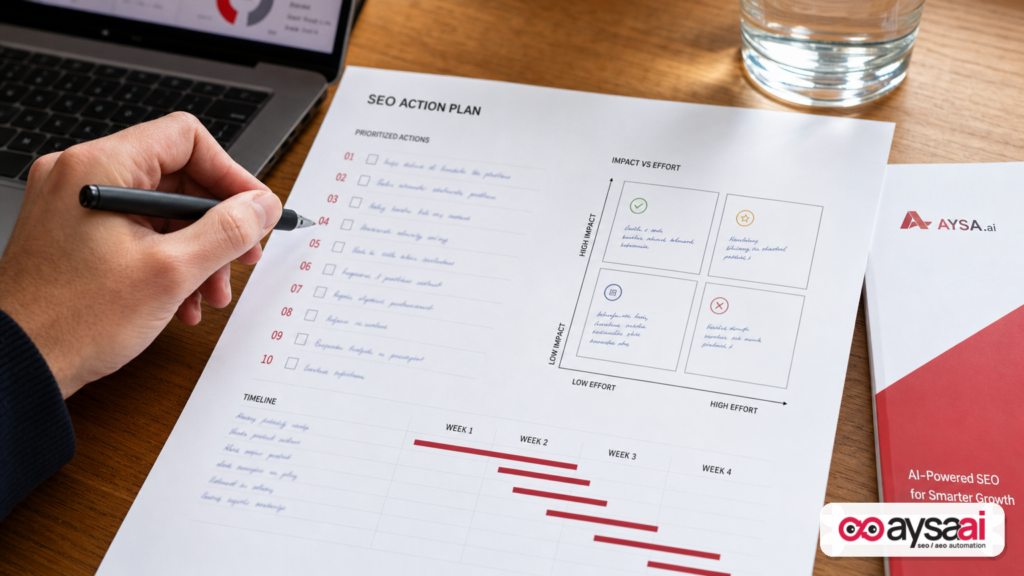
- Research is input. Strategy is choosing what not to do, and what to do first.
- Actionability is specificity. “Improve internal links” becomes “Add 2 links from these 5 pages to these 2 money pages by Friday; measure X.”
- Priorities must be sequenced. A list is not a plan.
- Stakeholders need different translations. Same truth, different decisions: CEO vs marketing vs dev vs content.
- Reports should produce tickets. If it can’t be assigned, scheduled, and validated, it’s not a recommendation yet.
Table of contents

- The 2026 reality: visibility is fragmenting, and “reporting” must become decision-making
- Why SEO reports still fail (even when the SEO work is good)
- The “Decision-Ready SEO Report” framework (what great looks like)
- Translate one truth for four stakeholders (CEO, marketing, content, dev)
- Prioritization that doesn’t lie: impact, effort, confidence, and dependencies
- Turn every finding into a next step: the 3-question rule
- Measurement that executives accept: leading indicators and business outcomes
- What to cut from SEO reports (and where to put it instead)
- A concrete SME scenario: the local clinic that “has traffic” but not appointments
- What agencies should rethink: reporting as a deliverable is a trap
- The operating model: from report → plan → tickets → QA → learning loop
- Where AYSA fits: from monitoring → recommendations → approval → execution
- What to do next (action list)
- Sources and further reading
The 2026 reality: visibility is fragmenting, and “reporting” must become decision-making
SEO used to be a simpler bargain: ship improvements, watch rankings, get Clicks, convert. That’s still true in many categories, but the landscape is noisier:
- More answers happen without clicks (featured snippets, knowledge panels, Rich results, AI-driven summaries).
- More discovery happens outside Google (social feeds, community platforms, marketplaces).
- More “users” are bots and agents (crawlers, scrapers, AI models, QA systems) interacting with your site at scale.
This reality raises the standard for reporting. If the audience is fragmented, you can’t justify work with “traffic went up/down.” You need to answer:
- Which surface improved (classic organic results vs rich results vs Brand Mentions)?
- Which intent stage improved (informational vs commercial vs navigational)?
- What did we change, and what is the next best change?
Search Engine Land’s piece makes the core point: reports should turn findings into clear recommendations stakeholders can prioritize and execute. I’ll take that one step further: in 2026, actionable reporting is not a nicer PDF—it’s a management system for getting SEO work approved and shipped. (Related context and leads from SEL’s ecosystem: zero-click searches, bots as a large share of web requests, and SEL’s practical guide on estimating traffic impact.)
Why SEO reports still fail (even when the SEO work is good)
Most weak SEO reports share a pattern: they’re built like evidence binders. Lots of data, screenshots, exports, and tool scores. The implicit promise is: “If we show enough proof, someone will act.” That’s not how organizations work.
Here are the failure points I see most often—especially in SMEs where time and attention are scarce.
1) The takeaways could apply to any website
“Improve content quality.” “Strengthen internal links.” “Target high-intent keywords.” These are not recommendations; they’re category labels. They don’t explain what is uniquely true about your market, your site, and your constraints.
Actionable reporting is comparative. It answers: compared to whom, where are we weak, where are we strong, and what is the smallest move that changes trajectory?
2) The recommendation stops right before work begins
“Fix internal linking” is not a task. It’s an area. Execution requires specificity:
- Which source pages?
- Which destination pages?
- What anchor approach?
- Who edits, who reviews, who QA’s?
- What is “done”?
If the report doesn’t answer these, the next meeting will—if it happens at all.
3) Priorities are listed, not sequenced
When 20 items are marked “High,” you’ve delegated prioritization to the stakeholder who least wants to do it. Sequencing is the strategist’s job. It requires trade-offs: what comes first, what unlocks other work, and what can wait.
4) Tool output is mistaken for strategy
Automated audits are helpful. They’re also context-blind. A tool can flag 300 missing meta descriptions. That doesn’t tell you whether those pages matter, whether they’re indexed, or whether search demand exists.
Good strategy uses tools to detect patterns, then applies business context: revenue concentration, product margins, lead quality, sales cycle length, seasonality, and capacity.
5) Everyone gets the same report
If you send the same 40-slide deck to a CEO and a developer, you’ve guaranteed that at least one of them will ignore it. The truth can be consistent; the translation must change.
The “Decision-Ready SEO Report” framework (what great looks like)
A decision-ready report is not longer. It’s sharper. It is designed so that after reading it, a stakeholder can do one of three things immediately:
- Approve the plan
- Reject the plan (with a clear reason)
- Adjust the plan (resources, timing, scope)
That’s the bar.
Start with a one-page plan (even if there’s an appendix)
Your first page should stand alone. It should contain:
- Objective: the business outcome you’re optimizing for (leads, pipeline, sales, bookings, retention).
- Current state: 3–6 metrics that actually matter (not 30 charts). Tie to Google Search Console and GA4 where possible.
- Primary constraint: the #1 reason growth is blocked right now (not the list of all reasons).
- Top 3 priorities: sequenced (Now / Next / Later), with owner + timeline.
- How you’ll judge progress: leading indicators and the lagging business metric.
Everything else is supporting evidence.
Identify the constraint before listing fixes
Most sites don’t have one problem; they have many. But they usually have one constraint that’s throttling results:
- Discovery constraint: you don’t cover the topics/queries that matter commercially.
- Relevance constraint: you cover them, but pages don’t satisfy intent or match SERP patterns.
- Authority constraint: competitors dominate because they have brand, links, or market proof you lack.
- Technical constraint: critical pages aren’t being crawled/indexed/rendered correctly.
- Conversion pathway constraint: you get traffic, but users don’t reach money pages or take action.
Pick one primary constraint. If you can’t, your report will become a buffet of tasks.
Define the first move (not the full roadmap)
Stakeholders don’t need your 12-month SEO vision in order to approve the next two weeks of work. A great report defines a first move that is:
- Small enough to ship quickly
- Large enough to change a leading indicator
- Designed to teach you something (a learning loop)
Example first moves that are actually “first moves”:
- Internal link sprint from top traffic pages → top margin product/service pages
- Resolve a canonical/indexing conflict blocking a money category from being indexed
- Publish 2 comparison pages that match competitor SERP patterns, then link to them from existing guides
- Rewrite titles/meta for 10 pages with high impressions but weak CTR (only when you can defend why)
Show sequencing explicitly: Now → Next → Later
Sequencing reduces confusion and organizational drag. Each item needs:
- Owner: single-threaded accountability (one person, not a department)
- Dependencies: what must happen first (dev release, design asset, legal review)
- Acceptance criteria: how you know it’s correct
- Timing: when it ships, when you review
This is how your report becomes a plan.
Translate one truth for four stakeholders (CEO, marketing, content, dev)
The report should contain one shared backbone (the plan), then stakeholder-specific “views” that answer: what do you need to decide and do?
CEO / founder view: money, risk, resourcing
What they care about: revenue impact, risk, timeline, trade-offs.
What to include:
- Where the opportunity is (commercial demand you’re missing)
- What it costs (time, people, spend)
- What could go wrong (dependencies, brand risk, technical risk)
- What “good” looks like in 30–60 days (leading indicators)
What to avoid: crawl screenshots and tool scores.
Marketing lead view: campaigns, positioning, pipeline support
What they care about: demand gen alignment, messaging, content mix, measurement.
What to include:
- Intent-stage map: TOFU pages → MOFU pages → BOFU pages
- Content briefs that map to campaigns and sales objections
- How SEO supports conversion pathways (not just visits)
Content team view: page-level edits, briefs, and “definition of done”
What they care about: exactly what to write/change, examples, and review standards.
What to include:
- Which URLs to update and why
- What sections to add/remove
- Internal links to place (source → destination)
- On-page requirements (FAQs, comparisons, pricing context, media)
Also: be honest about what AI can and can’t do. SEL has a relevant editorial on this theme—AI can draft, but real experience matters for credibility and differentiation (Search Engine Land).
Developer / product view: exact requirement + acceptance criteria
What they care about: clarity, reproducibility, QA checks, and not breaking things.
What to include:
- Exact URLs affected
- Implementation requirements (canonical, robots, redirects, templates)
- Acceptance criteria (rendered HTML, response codes, indexability)
- How to validate (manual checks and monitoring)
Don’t hand them “fix Core Web Vitals” as a vague objective. Provide a specific ticket: what is slow, where, and what change is expected.
Prioritization that doesn’t lie: impact, effort, confidence, and dependencies
Prioritization frameworks are everywhere. The mistake is pretending you can score SEO like a spreadsheet and call it truth. You can’t. But you can prioritize honestly by combining four lenses:
1) Impact: what business lever does this move?
Impact is not “more traffic.” Impact is:
- More qualified leads (not just sessions)
- Higher conversion rate via better pathways
- More revenue per visit (via better intent matching)
- Risk reduction (indexation stability, duplication, site migrations)
When you estimate impact, use directional language and measurable signals. If you want a methodology lead, SEL published guidance on estimating the traffic impact of SEO fixes (Search Engine Land). Use it carefully; avoid over-precision.
2) Effort: real effort, not “small/medium/large” fantasy
Effort includes:
- Cross-team coordination
- QA and release cycles
- Legal/brand review
- Data dependencies (tracking, analytics, feed health)
Two hours of SEO work can become two weeks if it needs a dev release and three approvals. Actionable reporting accounts for that.
3) Confidence: how sure are we this is the real constraint?
Confidence comes from evidence quality:
- SERP patterns: what is Google rewarding for the query type?
- Competitor gap: do competitors with similar authority win with a specific approach?
- Internal data: impressions without clicks, clicks without conversions, pages ranking for the wrong intent
A report that admits confidence levels builds trust. A report that pretends certainty destroys it.
4) Dependencies: what must happen first?
Dependencies determine sequencing. Examples:
- You can’t “optimize category pages” if the platform blocks editing key fields.
- You shouldn’t publish 50 new pages if canonical/indexing issues are suppressing existing money pages.
- You can’t measure conversion impact if tracking is broken or misattributed.
Dependencies are often the real reason SEO “doesn’t work.” Your report should make them explicit so leaders can remove blockers.
Turn every finding into a next step: the 3-question rule
Here’s the simplest operational rule I know for actionable reporting:
- What did we find?
- Why does it matter?
- What happens next?
If your report includes a finding that doesn’t answer all three, it’s not ready for the main narrative. Move it to an appendix or backlog.
Example: internal linking (common, usually poorly specified)
Finding: High-traffic informational pages do not link to relevant commercial pages.
Why it matters: You’re paying (content cost) to acquire attention but not capturing intent progression. Users learn and leave. Search engines may also undervalue money pages due to weak internal signals.
Next step:
- SEO maps top 10 traffic pages → top 3 commercial pages by margin/lead value.
- Content updates 2–3 contextual links per page with descriptive anchors.
- QA verifies links in rendered HTML and checks crawl depth changes.
- Review in 4–6 weeks: impressions and ranking movement for destination pages; assisted conversions in GA4 if configured.
Example: crawl/indexing issue (common, often misprioritized)
Finding: Important pages are non-indexable due to canonical/robots conflicts.
Why it matters: Content investment is wasted if the pages can’t rank. Fixing content before indexation is stable is like renovating a house with no foundation.
Next step:
- Dev ticket: update canonical tags for specific URL patterns and confirm robots directives.
- Acceptance criteria: target canonical returns 200, is indexable, appears in rendered HTML, and matches intended URL in Search Console over time.
- Review: indexing coverage and impressions for affected templates.
Example: content gap (common, but needs intent specificity)
Finding: Competitors rank for comparison/pricing-intent queries; your site ranks mostly for educational queries.
Why it matters: You’re visible, but not where decisions happen. You need a bridge from education → evaluation.
Next step:
- Create 2–3 comparison pages aligned with the actual SERP format.
- Link to them from your top guides (the pages that already have attention).
- Measure early: indexing and impressions; later: qualified leads/purchases.
Measurement that executives accept: leading indicators and business outcomes
Stakeholders don’t hate SEO reporting. They hate reporting that can’t answer: “Is this working?” You can fix that by separating:
- Leading indicators: tell you if the change is being recognized (indexation, impressions, rankings, crawl depth).
- Lagging indicators: tell you if the change created business value (leads, bookings, revenue, retention, pipeline influence).
Leading indicators: what to watch in the first 2–6 weeks
Use metrics that change earlier than revenue:
- Indexing status and coverage for updated templates
- Impressions trend for target query sets (Search Console)
- Ranking movement for a curated set of “decision queries”
- Internal crawl depth shifts for priority pages
- CTR changes when you adjust titles/snippets (only when impressions are meaningful)
These metrics are not “vanity” if they are tied to a hypothesis and reviewed on schedule.
Lagging indicators: what to watch in the next 1–3 months
Lagging indicators depend on the business model:
- Ecommerce: revenue, units sold, add-to-cart rate, product/category page conversions
- Local services: calls, form fills, booked appointments, direction requests
- SaaS: demo requests, trials, sales-qualified leads, pipeline attribution
Use GA4 where possible, but don’t pretend attribution is perfect. The purpose of reporting is to guide decisions, not to win attribution arguments.
Report progress, not activity
Activity is “we published 12 posts.” Progress is “two commercial pages improved impressions by X% and started generating qualified leads.” Even when you can’t quantify precisely, you can show progress as movement toward a goal.
What to cut from SEO reports (and where to put it instead)
Most reports become actionable when you delete 30–60% of them. Seriously.
Cut: tool screenshots as a default
Include a screenshot only when it proves a pattern the stakeholder must believe in to approve the work. Otherwise, move screenshots to an appendix or a shared folder.
Cut: raw keyword exports and crawl dumps
Large exports are not strategy. They are evidence libraries. Keep them available, but do not force decision-makers to read them.
Cut: generic best practices without context
“Add schema,” “improve speed,” and “optimize titles” are not wrong. They’re incomplete. If you can’t explain why it matters now for this site, it doesn’t belong in the top priorities.
Shorten: methodology sections
Methodology matters when trust is low or reproducibility is necessary. Otherwise, stakeholders want conclusions and next steps. Put methodology in an appendix and keep the main narrative focused on decisions.
A concrete SME scenario: the local clinic that “has traffic” but not appointments
Let’s make this real with a scenario I see constantly.
Business: a local physical therapy clinic with two locations.
The complaint: “Our blog gets traffic, but the phone isn’t ringing.”
The typical bad report:
- 50-slide audit
- 200 keywords exported
- Generic advice: “create more local content,” “improve internal linking,” “add schema”
The decision-ready report:
- Objective: increase booked consultations from organic traffic.
- Constraint: informational pages rank, but there’s no conversion pathway to service/location pages.
- Now (2 weeks):
- Add contextual links from the top 8 guides to 2 service pages and 2 location pages.
- Update those service pages with a “Who it’s for / what it costs / what to expect” section matching the questions seen in search results.
- Owner: marketing manager; dependency: dev to update template; acceptance criteria: links present in rendered HTML; service pages remain indexable.
- Next (30 days): publish 2 comparison pages (e.g., “PT vs chiropractor for back pain”) if SERP patterns support it.
- Measure: early—impressions for service pages; later—calls and appointment form completions.
Notice what changed: we didn’t “do more SEO.” We selected a constraint, defined a first move, and assigned it. That’s how SEO reporting becomes operational.
What agencies should rethink: reporting as a deliverable is a trap
If you run an agency, you’ve probably been trained (explicitly or implicitly) to treat reporting as proof-of-work. The client pays; you show deliverables. The problem is that deliverables don’t equal outcomes.
In 2026, clients are increasingly asking a brutal question: “Did this create growth?” If the report doesn’t connect to shipped changes, the agency is set up to lose—even if the work is smart.
Shift from decks to decisions
Agencies should reframe reporting as:
- Decision support: what we recommend, why, and what we need from you
- Execution planning: tickets, owners, acceptance criteria
- Learning loop: what we shipped, what changed, what we learned, what we do next
Protect focus: stop selling “more audits” when execution is blocked
Sometimes the honest recommendation is: “We have enough insight. We’re blocked by resourcing or approvals.” That’s uncomfortable, but it builds long-term trust.
Adapt reporting to multi-surface discovery
Even if your client primarily cares about Google, the discovery environment is broader. SEL’s ecosystem is increasingly covering AI-driven discovery and “GEO” concepts (e.g., how people prompt AI and what it means for visibility: Search Engine Land). Your reporting needs to acknowledge that reality without overpromising what you can measure.
The operating model: from report → plan → tickets → QA → learning loop
Here’s the operating model I recommend for teams that want reports to drive results.
Step 1: Monitoring and baselines (before recommendations)
Before you recommend changes, establish baselines:
- Top revenue/lead pages and their current performance
- Top queries by intent stage
- Indexing status of key templates
- Known seasonality and campaign calendar
This is where continuous monitoring matters more than monthly reporting. (If you’re building a monitoring habit, start here: AYSA Monitoring.)
Step 2: Recommendations written as implementable tickets
A recommendation is only real when it can become a ticket. Every priority should include:
- Scope (URLs/templates)
- Owner
- Dependencies
- Acceptance criteria
- Review date and success signals
Step 3: Approval workflow (the missing link)
Most SMEs don’t fail because they disagree with SEO. They fail because the approval chain is unclear. Who can approve template changes? Who can approve copy changes? Who owns risk?
Decision-ready reporting includes a short “approval map”:
- Content edits: marketing lead approves
- Template changes: product/dev approves
- Legal-sensitive claims: legal approves
Step 4: Execution and QA
Execution includes quality checks, not just “it’s live.” QA should confirm:
- Page remains indexable
- Tags render as intended
- Redirects/canonicals behave correctly
- Internal links are present and crawlable
Step 5: Review and learning loop
Schedule the review date in the report. Don’t wait until “next month.” Many changes can be evaluated with leading indicators within weeks.
Where AYSA fits: from monitoring → recommendations → approval → execution
At AYSA, we built around a simple reality: SEO doesn’t fail at insight. It fails at shipping.
So an actionable report should not be the endpoint. It should be the entry point into an execution system:
- Monitor: track what matters (visibility, indexing health, page-level performance).
- Prepare: turn findings into specific recommended changes.
- Ask for approval: humans stay in control, especially for brand and compliance.
- Execute accepted changes: implement what’s approved; log what changed.
This is the model we call approved execution. It’s the difference between “we recommended” and “we improved.”
If you want to explore how this fits your workflow:
- Start with visibility and modern discovery surfaces: AI Search Visibility
- See our broader tool approach: AI SEO Tools
- Build a monitoring cadence: Monitoring
- Understand packaging and costs: Pricing
- More execution-first guidance: AYSA Blog
What an “AYSA-ready” SEO report looks like
If you want your report to plug into an approval-to-execution workflow, write recommendations in a structure that can be converted into action cards:
- Change type: content update, internal links, metadata, schema, technical, IA/navigation
- Scope: URL list or pattern
- Proposed change: plain English + implementation notes
- Risk level: low/medium/high (with why)
- Owner + approver: who approves and who implements
- Success signals: what moves first and what moves later
This format reduces translation work. It shortens time from insight to impact.
What to do next (action list)
- Rewrite your executive summary as a one-page plan. Objective, constraint, Now/Next/Later, owners, success signals.
- Pick one primary constraint. If you have five “high priority” problems, you have no priorities.
- Turn top 3 recommendations into tickets. Add scope, acceptance criteria, and a review date.
- Define approvals. Who can say yes to content, templates, and claims?
- Set a 4–6 week review meeting now. Judge leading indicators and decide the next move.
- Build a monitoring habit. Don’t wait for monthly decks to notice breakage or opportunity.
- Consider an execution system. If your team repeatedly agrees on priorities but can’t ship, the bottleneck is operational, not strategic.
Sources and further reading
- Search Engine Land: How to make SEO reports more actionable
- Search Engine Land: How to estimate the traffic impact of SEO fixes
- Search Engine Land: AI can write SEO content, but it can’t replace real experience
- Search Engine Land: How real people actually prompt AI — and what it means for GEO
- Search Engine Land: Cloudflare: Bots now make up 57% of webpage requests
- Search Engine Land: Google zero-click searches hit 68% in early 2026: Study
Continue the AI search topic inside AYSA.
Use these pages to connect the article with AI SEO tools, AI visibility monitoring, AI Overviews and approved website execution.
Turn this topic into a website action plan.
Use these AYSA hubs to move from reading to technical fixes, AI visibility monitoring, research, glossary context and approval-first SEO execution.