Prompt Tracking You Can Defend: Turning AI Search Variance Into Measurable Brand Visibility
AI answers change from run to run—but that doesn’t mean you can’t measure progress. Here’s a practical, business-first framework for accurate prompt tracking using repeated runs, confidence intervals, persona panels, and multi-turn journeys—plus how to operationalize it with approved execution.

AI answers are variable. That part is obvious to anyone who has ever run the same prompt twice and watched the response change.
What’s less obvious—and increasingly important for businesses—is that variability does not make AI visibility “untrackable.” It just means we have to stop pretending prompt tracking works like classic Keyword Rank tracking, and start treating it like measurement under uncertainty.
This editorial is a practical playbook for building prompt tracking you can defend to a CFO, a client, or your own team: repeated runs, fixed sampling rules, confidence intervals, persona panels, and multi-turn journeys. It’s inspired by (but not a rewrite of) Kevin Indig’s work on making prompt tracking more accurate, published by Search Engine Land.
Concise summary

- Single-run prompt tracking is noise. If you run a prompt once and record the result, you’re measuring randomness as if it were performance.
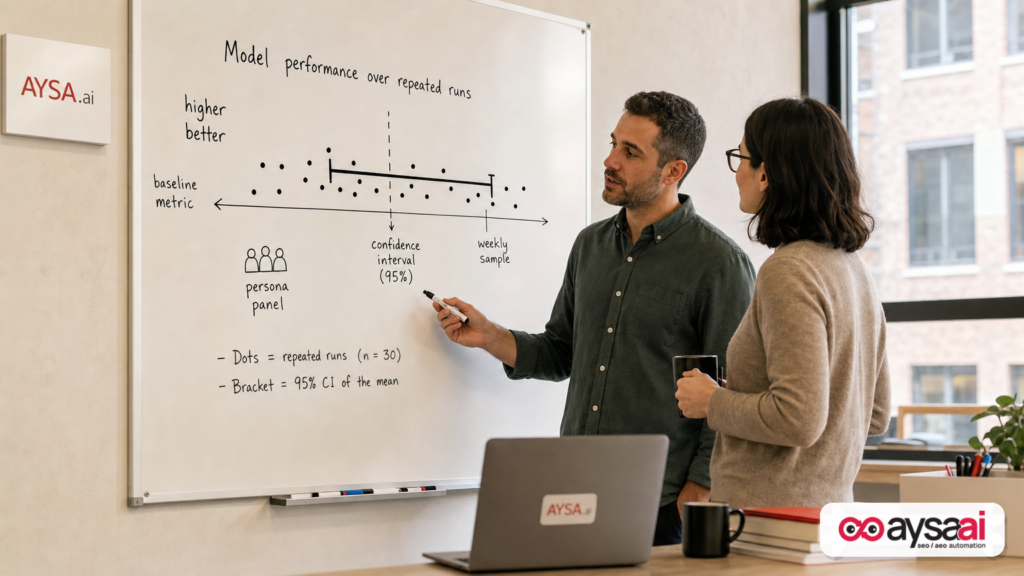
- Prompt tracking can be accurate enough for decisions if you use repeated runs and report uncertainty (confidence intervals), just like polling.
- AI Search is conversational. You should measure multi-turn journeys (Problem → Exploration → Comparison → Validation → Selection), not just Turn 1.
- Platform differences matter. Tracking should be segmented by engine (ChatGPT vs. Gemini vs. Perplexity vs. Google AI experiences), not blended into one vanity score.
- Measurement without execution is theater. The winners will be the teams that can ship improvements quickly and safely—monitor, prepare changes, get approval, and execute.
Table of contents
- What changed (and why prompt tracking suddenly matters)
- Why prompt tracking feels broken (and why ignoring it is worse)
- A quick reality check: keyword tracking was never perfectly deterministic
- Where most prompt tracking breaks in practice
- The polling model: how to make AI visibility statistically defensible
- Sampling rules you should standardize (before you debate tools)
- Persona panels: the missing link between “AI visibility” and revenue
- From Turn 1 to the full journey: measuring what actually drives revenue
- What to measure: beyond mentions into context and attributes
- A concrete SME scenario: local clinic + ecommerce add-on
- What agencies must rethink (and what to promise clients instead)
- Measurement is the easy part—execution is the bottleneck
- Where AYSA fits: monitoring + approved execution for AEO/GEO
- What to do next (action list)
- Sources and further reading
What changed (and why prompt tracking suddenly matters)

For most small and midsize businesses, the historic SEO contract was simple:
- Make pages.
- Rank for keywords.
- Get Clicks.
- Convert.
That loop still exists, but it’s no longer the only loop—and for some industries it’s not even the dominant one.
Two shifts are hitting at the same time:
- More “answers” are happening without a click. Search Engine Land recently highlighted research suggesting zero-click behavior is very high (see their coverage: Google zero-click searches hit 68% in early 2026: Study). Regardless of the exact number, the business implication is real: more users get what they need on the results page or inside an AI interface.
- Discovery is spreading across AI engines and interfaces. Users are asking longer, more specific questions; they refine through follow-ups; they ask for comparisons; they ask what to avoid. This is the exact kind of behavior that creates “AI recommendations” instead of “blue links.”
If your brand is absent (or misrepresented) in AI answers, you may not notice immediately in Search Console, because the loss happens upstream: you stop being considered during evaluation. That’s why prompt tracking—done correctly—matters now.
Why prompt tracking feels broken (and why ignoring it is worse)
Prompt tracking gets criticized for a reason: AI outputs vary. The same prompt can lead to different brands mentioned, different citations, and different “top recommendations.” Kevin Indig notes large within-model variance and highlights how citations can change dramatically across repeated runs in tools like ChatGPT (Search Engine Land).
But here’s the key business distinction:
- Variable doesn’t mean random. It means probabilistic.
- Probabilistic doesn’t mean unmeasurable. It means you need sampling.
We already run businesses this way. Demand forecasts are probabilistic. Conversion rates fluctuate. Paid ads have auction volatility. You don’t quit measurement; you measure with uncertainty.
The real danger isn’t that AI is variable. It’s that teams respond to variability with one of two bad instincts:
- They track one run and overreact. “We disappeared from ChatGPT yesterday.” (Maybe. Or maybe you just sampled noise.)
- They track nothing and stay blind. “It’s not trackable, so it’s not real.” (It’s real. You’re just not instrumented.)
A quick reality check: keyword tracking was never perfectly deterministic
There’s nostalgia in SEO for the era when rank tracking felt precise: keyword → position → traffic.
But classic rank tracking was always a negotiated truce with reality. Rankings changed by location, device, personalization, and constant index updates. The industry “standardized” rank tracking by fixing locations, depersonalizing sessions, and sampling at consistent times.
Prompt tracking requires the same maturity—just at a harder difficulty level because:
- answers are generated (not simply retrieved),
- citations can be reselected,
- interfaces are conversational, and
- platforms differ significantly.
So the goal isn’t to recreate keyword tracking. The goal is to create an AI visibility measurement system that’s stable enough to support decisions.
Where most prompt tracking breaks in practice
Most prompt tracking programs today follow a familiar pattern:
- pick 25–50 prompts,
- run each prompt once per tool/platform,
- score mention/citation/sentiment/position,
- repeat daily or monthly,
- roll it into a single score.
That sounds disciplined. It’s not.
Here are the failure modes I see most often (including issues called out in Indig’s memo on Search Engine Land):
1) Variance gets mistaken for movement
If you sample one run, you can’t distinguish “we improved” from “the model rolled differently.” It’s like judging a coin’s fairness after one flip.
2) “Reasoning mode” and configuration differences get blended together
Different model settings can change how the AI searches, cites, and structures answers. If you mix different configurations into one metric, you’re comparing apples to oranges and calling it “trend.”
3) Persona blindness: you measure generic answers nobody sees
In real life, a CFO and a marketing lead do not ask the same question the same way—and they don’t accept the same proof. Tracking a “neutral” prompt set can miss the contexts that drive pipeline.
4) Cadence that doesn’t match drift
Indig cites research indicating cited sources can change quickly over time across AI experiences. Whether the exact weekly replacement rates are identical for your niche is something you should test—what matters is the principle: AI Source selection can drift fast enough that monthly checks can be too slow to catch meaningful change.
5) Cross-platform aggregation creates vanity metrics
Rolling ChatGPT + Gemini + Perplexity + Google AI experiences into one “AI visibility score” hides the only thing that matters: where you’re winning and why.
6) One-turn measurement ignores the buyer journey
Turn 1 might be informational. Turn 3 is where money happens: comparisons, risks, implementation, alternatives, pricing, compatibility, “what to avoid.” If you only track Turn 1, you’re measuring the least decisive moment of the conversation.
7) Mentions without context can be negative—and you’ll still count them as wins
A mention inside “brands to avoid” is not a win. A citation next to a warning is not brand equity. Context must be part of scoring.
The polling model: how to make AI visibility statistically defensible
The conceptual leap that fixes prompt tracking is simple:
Stop treating AI answers like rankings. Start treating them like survey results.
In polling, no credible analyst reports: “Candidate A has exactly 52% support.” They report ranges and confidence, because sampling introduces uncertainty.
Prompt tracking should do the same:
- Repeated runs per prompt per platform
- Fixed sampling rules (same time window, same persona, same configuration)
- Confidence intervals around mention and citation rates
- Segmentation by platform, persona, and intent stage
- Audits of raw answers, not just scores
This is the heart of Indig’s argument in How to make prompt tracking much more accurate, and it’s the foundation I agree with.
My added point of view: the polling model isn’t just “more accurate.” It’s more governable. Once you can say, “Our mention rate for high-intent journeys on Platform X is 24% ± 7,” you can:
- set realistic targets,
- prioritize investment,
- avoid panic based on day-to-day swings, and
- communicate changes to stakeholders without hand-waving.
Sampling rules you should standardize (before you debate tools)
Tools matter, but methodology matters more. Before you evaluate vendors—or build your own system—write down your sampling rules.
Here’s a practical checklist that works for most SMEs and agencies.
Rule 1: Track platforms separately
Do not blend platforms into one score. Report each engine as its own channel, like you’d report Google Ads vs. Meta vs. email.
At minimum, separate:
- Google’s AI experiences (e.g., AI Overviews / AI Mode behavior as applicable)
- ChatGPT
- Gemini
- Perplexity
Why? Because each has different retrieval behavior, different citation norms, and different UX.
Rule 2: Use repeated runs (and keep the number consistent)
If you run five repetitions this week, run five repetitions next week. Consistency beats “more” when budgets are limited.
If you can’t afford repetitions, your “trend” is likely sampling error. You’re better off tracking fewer prompts with repetitions than more prompts with single runs.
Rule 3: Pick a cadence that matches drift and decision speed
Weekly measurement is a reasonable starting point for most categories if AI answers and citations are changing quickly. Monthly tracking can still be useful for long-term baselines, but it’s often too slow for optimization cycles.
Rule 4: Lock configuration as much as possible
Document:
- model version (when available),
- reasoning setting (when available),
- location/language,
- logged-in vs. logged-out state (if relevant),
- any browsing/search toggles.
The goal is not “perfectly controlled lab.” The goal is “controlled enough that differences mean something.”
Rule 5: Always retain raw answers for auditing
Scores are lossy. When something changes, you need to read the actual output to understand the causal drivers: what sources were cited, what attributes were assigned to brands, and what language was used.
Persona panels: the missing link between “AI visibility” and revenue
If you want prompt tracking to matter to the business, you need to track the prompts that represent real buyers—not just “the category.”
In practice, this means building a persona panel—a small, stable set of persona variations that you repeatedly sample.
For a typical SME, personas might look like:
- Owner/operator: cares about cost, speed, and trust.
- Practitioner/manager: cares about workflow fit and outcomes.
- IT/security-minded reviewer: cares about compliance, integrations, data handling.
For B2B, you might map: finance, IT, ops, and end-user department.
Here’s what persona panels solve:
- They reduce noise by keeping “who is asking” consistent.
- They increase relevance because prompts resemble real evaluation language.
- They expose gaps: you might be strong for marketing prompts and absent for IT prompts, which is exactly where deals die.
In AYSA terms, persona panels are the bridge between AI Search Visibility measurement and work that actually moves pipeline.
From Turn 1 to the full journey: measuring what actually drives revenue
Here’s the most important upgrade you can make: stop measuring isolated prompts as if they were isolated searches.
AI interfaces are conversational. Your buyers don’t just ask:
“What’s the best CRM?”
They ask that, then they ask:
- “What about for my team size?”
- “What are the tradeoffs?”
- “What breaks during onboarding?”
- “Which integrates with X?”
- “Is it compliant?”
- “What should I avoid?”
That sequence is a journey, and journey persistence is more meaningful than a one-off mention.
A practical 5-stage journey framework
Indig suggests measuring across stages (Problem → Exploration → Comparison → Validation → Selection). That’s a strong model because it mirrors buyer intent progression.
Use it like this:
- Problem: “Do I even need this?”
- Exploration: “What types exist?”
- Comparison: “Option A vs. B vs. C”
- Validation: “Is this legit for my constraints?”
- Selection: “How do I implement / buy / get started?”
How to keep the volume manageable: breadth + depth
Most teams can’t run every prompt as a five-turn journey at high repetition across multiple platforms. So scope it:
- Breadth: Track your full prompt list for Turn 1 only (category + brand + problem mix).
- Depth: Convert only the highest-intent “problem” prompts into full journeys.
This keeps your measurement cost sane while still capturing the moment where buyers make decisions.
What to measure: beyond mentions into context and attributes
Many prompt trackers stop at “did we get mentioned?” That’s not enough.
To make this useful for the business, measure at least four layers:
1) Mention rate (with uncertainty)
For each prompt set, persona, platform, and journey stage, measure: “In what percentage of runs does our brand appear?” Then report a confidence interval or range rather than a single number.
2) Citation/source rate (when relevant)
In interfaces that show citations, measure: “In what percentage of runs are we cited?” Mentions without sources can still matter, but citations are a stronger signal that the system is grounded in your assets.
3) Position/ordering (when meaningful)
If the AI lists options, record whether you appear in the top set (e.g., top 3) and whether you’re framed as a default vs. an alternative.
4) Attributes and framing (this is where brand equity lives)
This is the layer most businesses ignore, and it’s the one that decides purchase outcomes.
When your brand is mentioned, capture the attributes attached, such as:
- “best for budget”
- “enterprise-grade”
- “hard to set up”
- “good support”
- “limited integrations”
- “HIPAA-ready” / “SOC2” (only if true—don’t let AI invent compliance)
Then ask: do those attributes match your positioning and reality?
In other words: prompt tracking isn’t just “visibility.” It’s brand interpretation tracking.
5) Persistence across turns
Persistence is the “multi-turn version” of ranking. If you’re mentioned at the Problem stage but vanish in Comparison or Validation, you’re not part of the decision set.
That’s why journey tracking is not optional if you want revenue relevance.
A concrete SME scenario: local clinic + ecommerce add-on
Let’s make this tangible with a scenario that doesn’t require you to be an SEO pro.
Business: A local dermatology clinic that also sells a small line of dermatologist-approved skincare online (common SME hybrid model).
Problem: Organic traffic from informational blog posts looks flat, but the clinic notices fewer “high intent” phone calls and fewer online orders for a key product bundle.
What’s happening: Prospects are increasingly asking AI interfaces questions like:
- “What’s the best skincare routine for adult acne with sensitive skin?”
- “Should I see a dermatologist or try OTC first?”
- “Which ingredients should I avoid if I’m pregnant?”
- “What’s a reputable clinic near me for acne scar treatment?”
Classic SEO might focus on ranking for “adult acne routine” or “acne scar treatment near me.” That still matters. But the new question is: does the AI recommend the clinic, its physicians, or its product line in the journey that leads to action?
How to track it correctly
Step 1: Build 30–50 seed prompts split across:
- brand prompts (clinic name, doctor names),
- category prompts (dermatologist, acne treatment),
- problem prompts (adult acne, pregnancy-safe skincare),
- local intent prompts (near me / in-city).
Step 2: Create persona variants:
- new patient on a budget,
- new parent/pregnancy cautious,
- time-constrained professional who wants fast appointments.
Step 3: Convert the highest-intent “problem prompts” into five-turn journeys. Example journey:
- Problem: “I’ve tried OTC acne products for 6 months. How do I know when to see a dermatologist?”
- Exploration: “What treatments do dermatologists recommend for adult acne?”
- Comparison: “Chemical peel vs. prescription topical vs. oral meds—pros and cons?”
- Validation: “How do I choose a reputable dermatologist clinic, and what questions should I ask?”
- Selection: “What should I expect in the first visit and how should I prepare?”
Step 4: Run each journey multiple times per platform weekly. Record mention/citation/persistence and attributes.
What you learn that keyword tracking can’t tell you
- If the AI keeps recommending generic directories and never mentions local clinics, your “local authority” signals may be weak—or your site may be missing the kinds of evidence AI uses for trust.
- If the AI mentions your clinic but frames it as “cosmetic only” while you want “medical dermatology,” your content and entity signals may be misaligned.
- If you show up in Turn 1 but disappear at “How do I choose a reputable clinic?”, you may lack proof assets: treatment pages, credential pages, patient guides, transparent pricing ranges, or consistent citations.
This is exactly where an execution system matters: you need to turn those insights into website improvements, not just a report.
What agencies must rethink (and what to promise clients instead)
Agencies are under pressure to “offer AEO/GEO” quickly. The risk is overselling measurement and underselling uncertainty.
Here’s what I believe agencies should change immediately:
Stop promising deterministic outcomes
“We’ll get you cited in AI answers” is the new version of “we’ll rank you #1.” It’s an attractive promise and a credibility trap.
Instead, promise:
- a defensible measurement system,
- a documented hypothesis backlog,
- a test-and-ship cadence,
- and governance around changes.
Change reporting from “scores” to “diagnostics”
A single blended score is not strategy. Diagnostics are strategy.
Clients need to know:
- which platform they’re losing on,
- which persona is not seeing them,
- which journey stage they drop out,
- and which asset gaps correlate with the loss.
Treat AI visibility as a cross-functional program
AI answers are influenced by brand, content, reviews, technical accessibility, and trust signals. That means the work spans SEO, content, PR, product marketing, and sometimes compliance.
Operationally, agencies need:
- an intake for approvals,
- clear change ownership,
- and auditable execution.
Measurement is the easy part—execution is the bottleneck
Here’s the uncomfortable truth: most teams don’t fail at AI visibility because they can’t measure it.
They fail because they can’t ship.
Prompt tracking (done well) produces a long list of plausible actions:
- update or expand comparison pages,
- add integration documentation,
- publish “what to avoid” guidance (honest, not spammy),
- create persona-specific FAQ,
- tighten entity signals (authors, credentials, about pages),
- improve internal linking for evaluative content,
- enhance structured data where appropriate (carefully),
- improve review acquisition velocity and reputation assets (when relevant).
But none of that matters if you’re stuck in a loop of:
- PDF reports,
- ticket backlogs,
- stakeholder delays,
- and “we’ll do it next quarter.”
AI search is moving too fast for that cadence. This is why we built AYSA as an approved execution system: monitor, prepare, ask for approval, then execute the changes that are accepted.
Where AYSA fits: monitoring + approved execution for AEO/GEO
AYSA is designed for a reality where:
- search behavior is shifting toward AI answers and conversations,
- measurement needs repeated sampling and segmentation, and
- the constraint is shipping consistent improvements safely.
Here’s how the workflow maps to the framework in this article:
1) Monitor what matters (and keep the audit trail)
Your first step is building visibility into AI-driven discovery and how it changes over time. Start with:
- AYSA Monitoring to keep a steady pulse on performance signals,
- AI Search Visibility to connect optimization work to the reality of AI interfaces.
Monitoring is not the end goal. It’s the trigger for action.
2) Prepare changes that align with your prompt-journey gaps
Once you find: “We vanish at the Comparison stage on Platform X for Persona Y,” the right response is not “write more content.” The response is: which asset is missing or weak?
That could mean:
- creating a comparison page that answers the exact follow-up questions buyers ask,
- publishing integration and implementation docs (for software and services),
- tightening local proof signals (for local services),
- or improving content clarity and structure so AI can extract the right attributes.
For teams that need tools and workflows, start at AYSA AI SEO Tools.
3) Ask for approval (because governance is not optional)
If you’re running a real business, you can’t let automated changes push to production without controls. Compliance, brand voice, medical/financial claims, and legal risk are real.
The “approved execution” model ensures changes are proposed clearly and only executed when accepted.
4) Execute accepted website changes consistently
AI visibility progress compounds when you can ship weekly improvements, not quarterly overhauls. That’s where AYSA’s execution orientation matters: fewer decks, more shipped fixes.
5) Make it budgetable
SMEs need predictability. If you’re evaluating whether this is worth it, pricing transparency matters: AYSA pricing.
6) Keep your team educated and aligned
AI search changes fast. We publish practical updates and playbooks at AYSA Blog.
What to do next (action list)
If you want a practical plan you can start this week, follow this order. Don’t skip steps.
1) Choose one “money” category and define success
- Pick one product line, one service, or one pipeline segment.
- Define what “visibility” should drive: calls, demos, bookings, add-to-carts.
2) Build a prompt set that matches real intent
- Brand prompts (your name and close variants)
- Category prompts (“best X for Y”)
- Problem prompts (symptoms, needs, constraints)
Weight toward problem prompts, because that’s where evaluation happens.
3) Create 2–3 personas
- Write persona context in plain language.
- Use that context consistently across runs.
4) Convert your top 10–20 problem prompts into journeys
- Use the five-stage framework.
- Keep follow-ups natural and specific (not generic SEO phrasing).
5) Sample weekly with repetitions and keep raw outputs
- Run each prompt multiple times per platform.
- Report ranges, not single numbers.
- Store raw answers for audits.
6) Turn findings into a prioritized execution backlog
- What asset gaps correlate with drop-offs?
- What attributes are wrong or missing?
- Where are competitors being positioned better?
7) Ship improvements with approvals, not chaos
Use a workflow that monitors, prepares changes, requests approval, and executes only what’s accepted. That’s how you build compounding gains without risking brand or compliance.
Sources and further reading
- Kevin Indig (republished by Search Engine Land): How to make prompt tracking much more accurate
- Search Engine Land (context on user behavior / SERP changes): Google zero-click searches hit 68% in early 2026: Study
- Search Engine Land (broader AI-first prompting and GEO implications): How real people actually prompt AI — and what it means for GEO
- Search Engine Land (AI + brand perception context): How AI forms opinions about your brand
- Search Engine Land (measurement mindset in adjacent SEO work): How to estimate the traffic impact of SEO fixes
- Search Engine Land (execution and experience signals context): AI can write SEO content, but it can’t replace real experience
Note: This article intentionally avoids adding new numeric claims beyond what’s provided in the supplied research context. Where your business needs precision, run your own repeated sampling and report uncertainty.
Continue the AI search topic inside AYSA.
Use these pages to connect the article with AI SEO tools, AI visibility monitoring, AI Overviews and approved website execution.
Turn this topic into a website action plan.
Use these AYSA hubs to move from reading to technical fixes, AI visibility monitoring, research, glossary context and approval-first SEO execution.