
Google Universal Cart and AP2: Ecommerce SEO Enters the Agentic Commerce Era
Google Universal Cart, UCP and AP2 point to a future where ecommerce SEO must prepare product data, merchant trust and website execution for AI-assisted shopping.
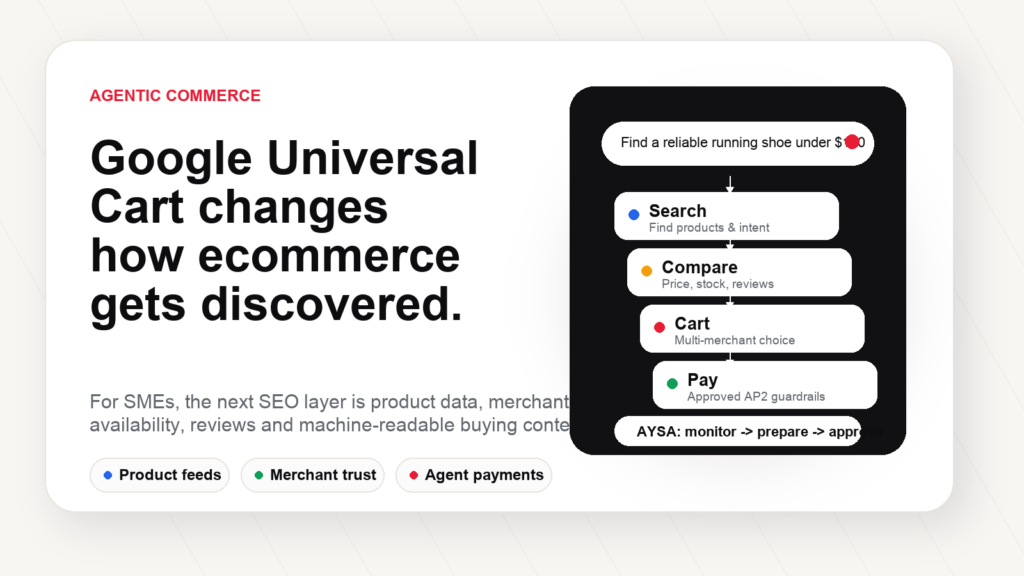
Executive summary: Google is expanding shopping beyond product listings and classic search Clicks. Search Engine Land reported that Google is testing a Universal Cart experience and connecting it to two important commerce ideas: Universal Checkout Protocol (UCP) and Agent Payments Protocol (AP2). In plain English, Google is preparing for a world where a user can discover, compare and eventually purchase products through AI-assisted search flows instead of manually hopping between tabs, product pages and checkout screens.
For ecommerce businesses, this is not only a payments story. It is an SEO, AEO, GEO and product-data story. If AI systems and agentic shopping flows are going to compare merchants, products, prices, delivery, reviews and trust signals, then Ecommerce SEO must become more operational: clean product feeds, structured product data, clear policies, stock accuracy, authority, reviews, and fast execution when something changes.
What happened
Search Engine Land reported that Google is expanding its Universal Cart ambitions in Search, connecting shopping experiences with Universal Checkout Protocol and Agent Payments Protocol. The short version: Google wants shopping to become more continuous across discovery, evaluation and purchase.
This fits a larger pattern. Google has spent years turning Search into a place where users can compare products, see merchant listings, filter options and complete more of the shopping journey without starting from a blank ecommerce website. More recently, AI Overviews and AI Mode have changed the query experience itself. Instead of one short Keyword, users can ask complicated buying questions: “I need a running shoe for wet sidewalks, under $140, available this week, from a trustworthy retailer.” That type of query is not a simple product keyword. It is a task.
Google’s work around agent payments also points in the same direction. The Agent Payments Protocol announcement frames AP2 as an open protocol for authorizing agent-led transactions with clear user intent, authentication and accountability. The technical details matter, but the market signal matters more: AI agents are moving from answering questions to completing parts of commercial workflows.
For ecommerce SEO, this is a major shift. Search visibility is no longer only about ranking a Category page or product page. It is about being eligible, understandable and trustworthy inside buying journeys that may be mediated by AI systems.
The website carries almost the entire conversion journey after the search click.
AI systems may evaluate product data, merchant signals, reviews, stock and policies before sending intent.
Why this matters for ecommerce SEO
Traditional ecommerce SEO has often focused on category pages, product pages, filters, internal links, technical crawlability and content around buying intent. Those are still important. But Universal Cart and agentic checkout concepts add a new question: can a machine understand enough about your offer to include you in a purchase path?
That is a different standard from “does the page contain the keyword?” It requires product data that is accurate, policies that are clear, availability that can be trusted, reviews that make sense, prices that are visible, schema that matches the page, and merchant information that does not create doubt.
For large retailers, this becomes an infrastructure problem. For SMEs, it becomes an execution problem. The smaller business may not have a dedicated feed manager, technical SEO, analytics specialist, developer and merchandising team. A product goes out of stock. A category page has duplicate titles. Shipping information is unclear. A return policy is buried. Product schema is incomplete. Google Merchant Center data does not match the website. Reviews are present in one place but not visible where users and AI systems need them. These small issues accumulate.
The mistake would be to treat agentic commerce as a futuristic topic that only matters to Amazon, Shopify, Stripe or Google. SMEs will feel the impact through traffic quality, comparison visibility, product eligibility, shopping feed performance and the way users ask AI systems for recommendations.
Agentic commerce explained in normal language
Agentic commerce means a user delegates part of a shopping task to an AI system. The agent may not simply show a list of links. It may interpret preferences, compare options, filter constraints, remember context and eventually help complete a transaction if the user authorizes it.
A normal ecommerce search might be: “red running shoes.” An agentic commerce task might be: “Find me waterproof running shoes for winter, under $140, with good reviews, available in size 43, from a merchant that ships to Bucharest in less than three days.” The second query requires reasoning across product attributes, merchant data, delivery constraints, review signals and user preferences.
This is why UCP and AP2 are important. They hint at a future where the shopping layer is not just a web page, but a structured interaction between user intent, AI agent, merchant systems and payment authorization. That future needs guardrails. Users should stay in control. Merchants need accurate representation. Platforms need accountability. But from an SEO perspective, one thing is already clear: messy product information becomes a visibility risk.
The SEO impact: ecommerce websites need to become machine-legible
Machine-legible does not mean ugly, robotic or written for crawlers instead of humans. It means the important commercial facts are easy to extract and verify.
For ecommerce sites, that includes:
- clean product titles and descriptions that match how people compare products;
- accurate prices, stock status and delivery information;
- product schema that reflects visible page content;
- clear return, warranty, payment and support policies;
- strong category pages that explain choice criteria, not only list products;
- merchant information that builds trust;
- reviews and proof that can be understood in context;
- internal linking between related products, guides and categories;
- fast mobile pages and crawlable HTML;
- consistent product feed and on-page information.
These are not new ideas, but AI-assisted shopping makes them more urgent. In classic SEO, a weak shipping explanation might reduce conversion after the click. In agentic commerce, unclear shipping may prevent the merchant from being recommended in the first place.
The same applies to category pages. A category page that only says “Buy shoes online” is not enough. A useful category page should help the user compare use cases, materials, sizing, delivery, returns and best-fit options. If the page is useful for a human buyer, it is also more useful as a source for AI-assisted comparison.
A practical SME playbook
If I owned or operated an ecommerce business today, I would not wait for every protocol to become mainstream before improving the site. I would start with the parts that already matter for SEO and will matter even more in agentic commerce.
1. Audit product data. Titles, descriptions, images, prices, stock, GTINs, variants and product attributes should be consistent across the website, feed and merchant systems. Inconsistent product data is not just annoying. It makes the business harder to trust.
2. Improve category pages. Category pages should answer buying questions. What should a customer compare? Which product is best for which use case? What matters for size, material, delivery, compatibility, warranty or maintenance?
3. Make policies visible. Delivery, returns, payment, warranty and support information should not be hidden in legal pages only. They should be easy to access from the shopping journey.
4. Strengthen merchant trust. Reviews, real contact details, business identity, secure checkout, clear support and external mentions all matter. AI systems need signals that reduce uncertainty.
5. Connect SEO and feed work. SEO teams and feed teams cannot operate separately anymore. Product visibility depends on both website content and structured product data.
6. Monitor continuously. Prices change. Products expire. Pages break. Feeds drift. Redirects appear. Competitors update categories. AI search behavior changes. A one-time audit is not enough.
Where AYSA fits
AYSA.ai is not trying to replace Google Merchant Center, payment protocols or ecommerce platforms. It fits in the operational gap between SEO insight and website execution.
For an ecommerce business, AYSA can help monitor the website, detect SEO and AI visibility opportunities, prepare changes, explain why they matter, request approval and execute accepted updates inside the website workflow. That is valuable because many ecommerce issues are not strategic mysteries. They are execution bottlenecks.
A category page needs a better intro and FAQ. A product page lacks schema alignment. A set of internal links is missing. A shipping claim needs to be clearer. A redirect chain appears after a product migration. A blog guide should link to commercial categories. A product feed mismatch suggests on-page data should be reviewed. These are not tasks that should sit in a spreadsheet for three months.
Agentic commerce raises the cost of slow execution. If AI systems are comparing merchants and product data in near real time, businesses need a way to keep their website and content aligned with what buyers, search engines and AI agents need to understand.
In my opinion, this is the real lesson of Universal Cart and AP2 for SMEs: do not obsess over the protocol first. Fix the operating system. Make the business easy to understand, easy to compare, easy to trust and easy to update.
What to watch next
There are still open questions. How quickly will Universal Cart expand? Which merchants will be eligible? How will user consent work across agents and checkout? How much control will merchants have over representation? How will attribution work when AI systems assist the purchase before the website visit?
Those questions matter. But waiting for perfect clarity is not a strategy. The safer move is to improve the fundamentals that make a merchant usable in any search or AI-assisted buying environment: clean data, useful pages, clear policies, trusted signals and fast execution.
Prepare your store for AI-assisted shopping.
If your product pages, categories, feeds and trust signals are hard to maintain, AYSA can help monitor the website, prepare SEO and AI visibility actions, ask for approval and execute accepted changes inside your website workflow.
Sources and further reading
Continue the AI search topic inside AYSA.
Use these pages to connect the article with AI SEO tools, AI visibility monitoring, AI Overviews and approved website execution.
Turn this topic into a website action plan.
Use these AYSA hubs to move from reading to technical fixes, AI visibility monitoring, research, glossary context and approval-first SEO execution.

