
Reddit, LLMs and AI Search: Why Real User Language Is Becoming SEO Infrastructure
Reddit’s CEO says LLMs would not exist without Reddit data. Here is what that means for SEO, AEO, GEO, AI citations and SMEs that need to understand real customer language.
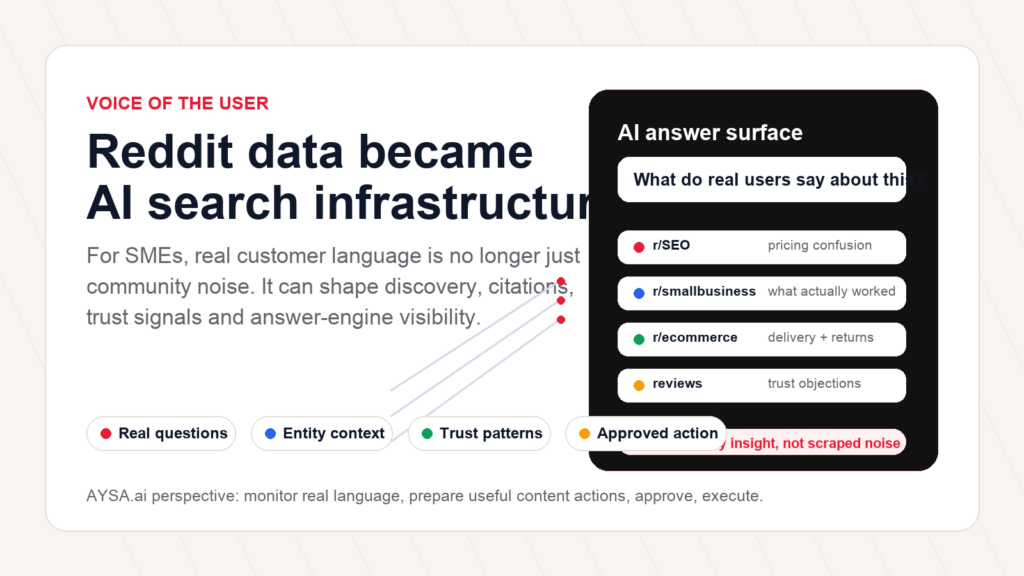
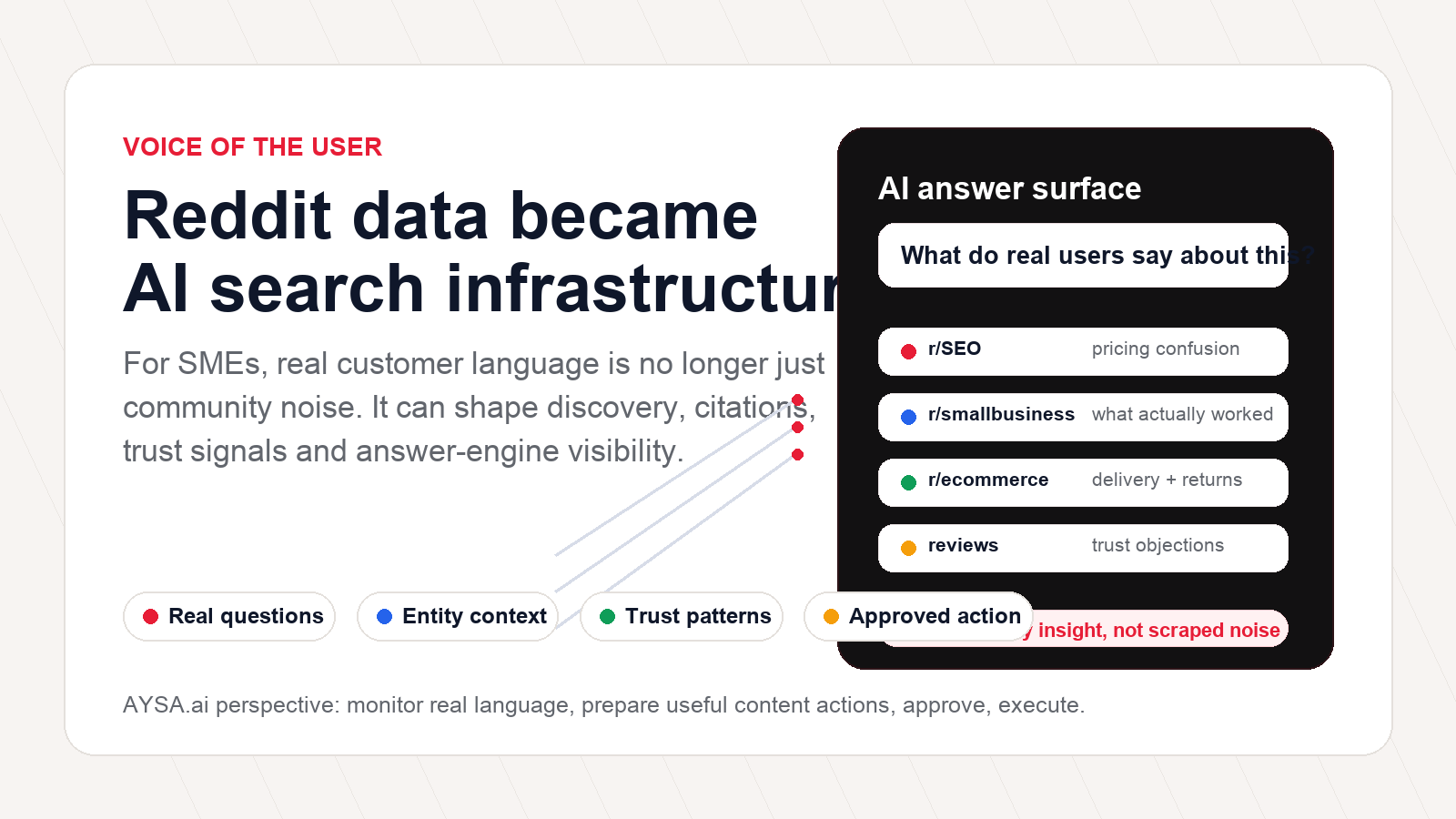
Summary: Reddit CEO Steve Huffman’s argument that modern LLMs rely heavily on Reddit-style human conversation is not only an AI industry story. It is an SEO story. Search is moving from matching documents to understanding real questions, objections, experiences and trust signals. Reddit, forums, reviews and community discussions are becoming part of the language layer that AI systems use to understand what people actually mean.
AYSA’s view: brands should not try to manipulate Reddit or “manufacture” community proof. But they should treat voice-of-the-user data as serious SEO/AEO/GEO input. The businesses that understand how customers speak, compare, complain and decide will write better pages, build better topical authority and become easier for AI systems to identify, cite and recommend.
What happened
Search Engine Journal reported on Reddit CEO Steve Huffman’s comments about Reddit data and AI. The article summarizes Huffman’s position that large language models would not exist in their current form without user-generated conversations from platforms like Reddit, and frames Reddit content as valuable training and grounding material for AI systems.
This is not a random media quote. Reddit has spent the last few years repositioning itself from “forum network” to a source of structured, constantly updated human conversation. The company has signed official AI-related partnerships with major platforms. Reddit announced an expanded partnership with Google, describing Reddit as one of the internet’s largest archives of human-generated conversation. OpenAI also announced a partnership with Reddit to bring Reddit content into ChatGPT and help Reddit build AI-powered features.
Reddit has also moved directly into AI Search Behavior through Reddit Answers, an experience designed to answer questions using relevant Reddit conversations. In other words, Reddit is not only a content source. It is becoming a search and answer layer built around human discussion.
For SEO professionals and business owners, the important question is not whether Reddit is “good” or “bad.” The important question is: why are AI systems so interested in this kind of data, and what does that tell us about the future of search visibility?
Why Reddit-style data matters to AI systems
Brand websites usually describe the world in polished, controlled language. That has value. It gives official facts: products, services, pricing, policies, locations, team information, technical documentation and support pages.
But users rarely think in polished brand language. They ask messy questions. They compare alternatives. They complain. They explain why they did not buy. They describe edge cases. They use slang, local wording, abbreviations and emotional language. They ask “is this worth it?”, “what would you choose?”, “what went wrong?”, “what should I avoid?” and “which option is actually better for someone like me?”
This is why Reddit and similar community platforms are so valuable for AI systems. They contain conversational evidence about how people frame problems. They show the language of uncertainty. They reveal objections that never appear on a landing page. They contain comparisons between brands, tools, products, cities, clinics, agencies, plugins and workflows.
For classic SEO, this kind of material was often treated as Keyword research input. For AI Search, it becomes more important. Answer engines do not only retrieve documents; they synthesize answers. To synthesize a useful answer, they need to understand the user’s real task, not only the formal Keyword.
That is why “voice of the user” is becoming SEO infrastructure. It is not a soft branding exercise. It is one of the best ways to understand what content needs to exist, how it should be structured and what proof must be visible.
What this means for SEO, AEO and GEO
AI search has made one thing obvious: websites are no longer competing only for blue-link rankings. They are competing to be understood, selected, cited and recommended inside generated answers. We have covered this wider shift in our articles about AI search visibility, why AI search cites some websites and ignores others and how Google AI Mode expands queries beyond keywords.
Reddit-style user data matters across three layers.
First: query expansion. AI systems can expand a short query into a broader set of implied needs. If someone searches for a pediatric clinic, the real task may include trust, parking, online booking, insurance, emergency availability, doctor empathy and parent reviews. Community language helps reveal those hidden dimensions.
Second: answer readiness. A website that only says “we provide pediatric services” is weak. A website that explains appointment flow, age ranges, fever guidance, parking, online booking, doctor credentials, reviews and when to choose emergency care is much stronger. It answers the real user task.
Third: entity confidence. AI systems need to know what a brand is, what it does, where it operates and why it is credible. Community mentions, reviews, publisher citations, official pages and consistent structured content all help build that picture. No single signal is enough. The system looks for coherence.
This does not mean Reddit is a magic ranking factor. It means the public web is teaching AI systems the language of demand. If your website does not reflect that language, your content may be technically correct but practically invisible.
The wrong lesson: spam Reddit and hope AI notices
There is a dangerous shortcut here. Some marketers will hear “Reddit data matters” and decide to flood forums with fake recommendations, synthetic threads, thin affiliate answers or disguised brand mentions. That is the wrong move.
Reddit users are unusually sensitive to manipulation. Many communities have strong moderation norms, and obvious promotional behavior can damage the brand more than it helps. Google’s own guidance for generative AI features still points back to fundamentals: create unique, valuable, people-first content and make it accessible to Google. The Google Search Central AI optimization guide does not recommend artificial forum manipulation. It recommends making useful content crawlable and understandable.
The right lesson is not “post everywhere.” The right lesson is “listen better and execute better.”
If people repeatedly ask the same question in communities, your website should probably answer it. If users compare your product with a competitor, your website should explain the difference clearly. If customers complain about pricing confusion, delivery timing, support, parking, booking or setup, your website should reduce that uncertainty. If people ask whether your category is safe, reliable, worth it or suitable for a specific use case, that should become content, not a hidden insight in a spreadsheet.
AI search rewards clarity. Manipulation creates noise. The brands that win will be the ones that convert real user language into real website usefulness.
A practical playbook for SMEs
Most small and medium businesses do not have a research department. They also do not have time to read hundreds of Reddit threads, reviews, comments, support tickets and competitor pages. But they still need the output of that work.
Here is a practical way to think about it.
1. Collect real questions
Start with the places where customers already speak: Google reviews, Reddit threads, Facebook groups, industry forums, support emails, live chat, sales calls, competitor reviews and marketplace comments. Look for repeated wording. The goal is not to copy anyone. The goal is to understand how people describe the problem.
2. Turn questions into page sections
If customers ask about parking, add parking details. If they ask about delivery, add delivery details. If they compare alternatives, create comparison sections. If they ask whether something is safe, explain risks, constraints and when to seek professional help. These sections are useful for humans and easier for AI systems to extract.
3. Build proof where the user needs proof
AI answers often need evidence. That evidence can come from reviews, case studies, certifications, real examples, product details, clear policies, author expertise, publisher mentions, local citations and consistent entity information. Proof should be visible on the page, not hidden in a sales deck.
4. Link the semantic cluster
A single page rarely carries the whole answer. Connect related pages: service pages, guides, glossary definitions, comparisons, pricing, FAQs, case studies and location pages. Internal linking helps users and crawlers understand the topic map.
5. Keep improving
User language changes. AI search behavior changes. Competitor pages change. This is why “one audit per year” is not enough. The website needs continuous monitoring and approved execution.
How to measure whether this is working
Traditional SEO metrics still matter: rankings, impressions, clicks, conversions and revenue. But AI search adds extra measurement questions.
- Does the brand appear in AI answers for important category questions?
- Is the website cited, summarized or ignored?
- Which competitors are mentioned more often?
- Are customers asking questions that your site does not answer?
- Do pages cover the comparison criteria that real users mention?
- Are reviews and community objections reflected in website content?
- Are glossary, guide and product pages connected semantically?
Tools will continue to evolve here. Microsoft Clarity, Google Search Console, third-party AI visibility trackers and manual prompt testing all give partial views. None of them is perfect. The most important habit is to connect measurement to execution. If you discover a gap, what changes on the website?
Where AYSA fits
AYSA is built around a simple operating principle: less SEO work, more organic growth. That does not mean less thinking. It means less manual dashboard work, less copy-paste execution and fewer recommendations that never become website changes.
In the context of Reddit, LLMs and AI search, AYSA’s role is to help businesses turn scattered signals into approved actions. The agent can monitor SEO and AI visibility, identify missing topics, prepare page improvements, recommend internal links, surface answer-readiness opportunities, highlight authority-building needs and help execute approved changes inside the website workflow.
For a business owner, the value is not “Reddit tracking.” The value is knowing what customers actually care about and turning that knowledge into better pages, better structure and better visibility. For an agency, the value is scale: turning voice-of-the-user research into repeatable execution without drowning the team in manual implementation.
Reddit’s importance to LLMs is a reminder that the web is not only made of official pages. It is made of human questions. The next SEO advantage will belong to brands that can listen to those questions, answer them clearly and keep improving faster than the market changes.
Turn customer language into approved website action.
If your customers are asking better questions than your website answers, AYSA helps you find the gaps, prepare useful SEO and AI visibility improvements, approve the work and execute it inside your website workflow.
Sources
Continue the AI search topic inside AYSA.
Use these pages to connect the article with AI SEO tools, AI visibility monitoring, AI Overviews and approved website execution.
Turn this topic into a website action plan.
Use these AYSA hubs to move from reading to technical fixes, AI visibility monitoring, research, glossary context and approval-first SEO execution.

