
Google AI Mode Across Languages: Why Multilingual SEO Is Becoming an Execution Problem
Google says AI Mode can scale faster across languages. Here is what that means for multilingual SEO, AEO, GEO, local context, hreflang and approved website execution.
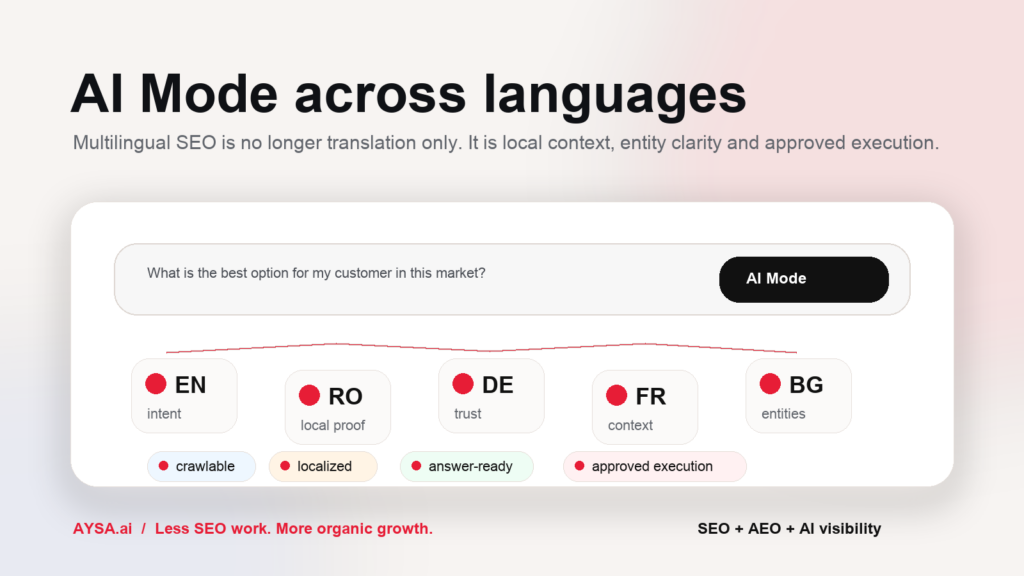
Summary: Search Engine Journal reported that Google’s Liz Reid said AI Mode can expand faster across countries and languages because the underlying models are more multilingual by design. That does not mean every market will behave the same. It means Multilingual SEO is becoming an execution problem: websites need language-specific clarity, local proof, entity consistency, Hreflang discipline, technical accessibility and content that answers real user tasks in each market.
AYSA’s point of view is simple: AI Mode makes translation-only SEO weaker. The websites that win across languages will not be the ones that translate pages mechanically. They will be the ones that turn local search behavior, business context and AI visibility gaps into approved website changes quickly and safely.
What happened
Search Engine Journal reported on a post-keynote interview in which Google’s Liz Reid said AI Mode can scale faster across countries and languages than earlier Search features. According to the report, Reid connected that speed to multilingual model architecture and said Google uses existing Search ranking systems to help ground AI Mode responses based on location.
That is important, but it should be read carefully. Google did not publish a country-by-country rollout benchmark in that interview. It also did not say that every language, country or vertical will receive identical behavior at the same time. The practical message is more measured: AI Mode is designed to move across languages faster than some previous Search experiences, and location-aware grounding remains part of the system.
Google’s own Search I/O 2026 announcement gives the broader context. Google said AI Mode has surpassed one billion monthly users globally, and announced Gemini 3.5 Flash as the default model in AI Mode globally. Google also presented a redesigned Search experience where people can ask more complex questions, continue from AI Overviews into AI Mode and use richer inputs than classic keywords.
For SEO teams, this is not a small interface update. It is a sign that AI-assisted search behavior will not stay concentrated in one language or one market. If your business serves more than one language, region or country, multilingual SEO is about to become more dynamic.
Why faster language expansion matters
Classic International SEO already had a long checklist: language targeting, regional targeting, hreflang, localized URLs, translated content, canonical rules, local keywords, local backlinks and market-specific conversion signals. Many businesses did only the visible part: translate the page, publish it, add a language switcher and hope Google understands the rest.
AI Mode raises the bar because the search journey becomes more conversational and task-based. A user may not search “best accountant Germany” or “private pediatric clinic Romania.” They may ask a full question with constraints, context, urgency, budget and comparison criteria. The AI system may then retrieve and synthesize information from multiple pages, sources and local signals.
That shift matters for three reasons.
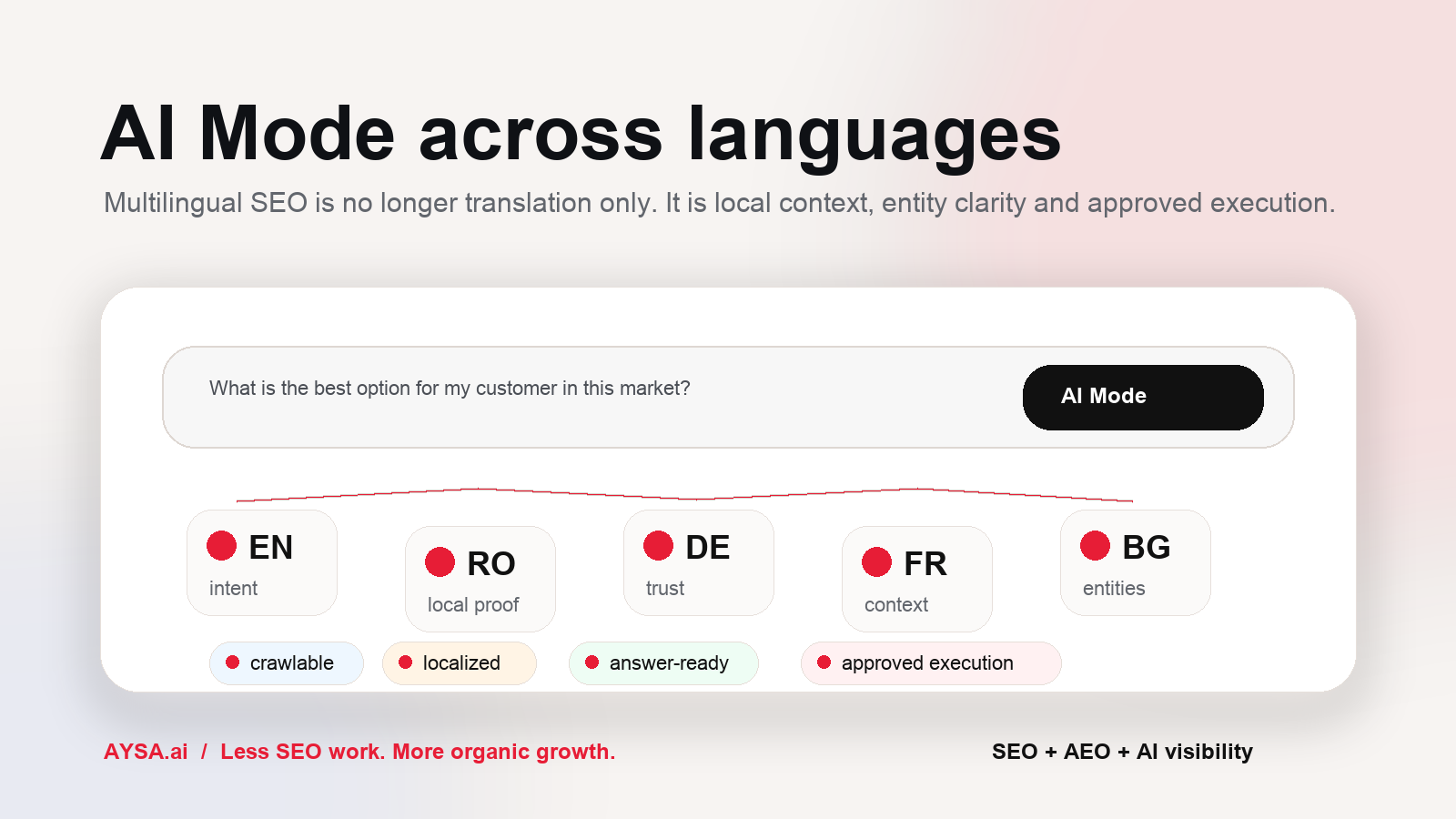
First, language carries intent. People do not ask the same question in Romanian, English, German, French or Bulgarian. Even when the literal topic is similar, the vocabulary, expectations, trust signals and buying process can differ. A direct translation can miss the search task.
Second, location changes usefulness. Google has localized Search for years, but AI Mode can make location-aware grounding more visible in the answer itself. A service page that is useful in one market may be incomplete in another if it lacks local pricing, service areas, reviews, legal context, opening hours, delivery conditions or proof.
Third, AI answers need extractable clarity. A translated page hidden behind heavy JavaScript, unclear headings, mixed-language content or conflicting canonicals is harder to trust and retrieve. The page may exist, but it may not be a strong source.
Translation is not multilingual SEO
The biggest trap is thinking that multilingual SEO means “take the English page and translate it.” That can work for simple documentation. It usually fails for commercial SEO, Local SEO, ecommerce and AI search.
A strong multilingual page needs to answer the task in that market. A Romanian ecommerce category page may need delivery details, payment methods, local brand alternatives and customer expectations. A German B2B page may need more precise compliance language and documentation. A French service page may require different examples, tone and proof. A Bulgarian landing page may need local entity references and market-specific objections.
In AI search, this matters because the system is not only matching words. It is trying to satisfy a need. A page that says the same generic thing in five languages gives the system little local evidence. A page that explains the local market, the business, the process, the proof and the next step gives the system something more useful to work with.
Google’s guidance for generative AI features on Search reinforces the same direction: focus on unique, valuable, people-first content, make sure Google can access the content, and avoid chasing artificial “AEO/GEO hacks.” That advice becomes even more important across languages. If the content is generic in the original language, translation will not make it authoritative.
The technical layer: hreflang, canonical and crawl clarity
Before discussing content, the technical base has to be clean. Multilingual SEO breaks easily when hreflang and canonical signals are inconsistent.
Google’s localized versions documentation says each language version should list itself and the other language versions, and alternate URLs should be fully qualified. Google also explains that hreflang helps it understand localized variations, while language detection itself is algorithmic.
In practice, multilingual sites often fail in predictable ways:
- language pages canonicalize to the wrong version;
- hreflang points to redirected or non-indexable URLs;
- some languages link back, others do not;
- the same content appears under multiple regional paths;
- language switchers create query parameters instead of clean URLs;
- translated pages are published before they are complete;
- sitemaps include noindex, redirected or duplicate URLs.
These are not academic issues. If AI Mode uses search ranking and grounding systems, then the same crawl and indexation quality problems can reduce visibility in AI-assisted experiences. A page that cannot be crawled, indexed or understood cleanly is a weak candidate for retrieval.
For WordPress websites, the risk is higher because multilingual plugins, SEO plugins, page builders and caching systems can conflict. A business may think it has five clean language versions, while Google sees canonical mismatches, thin translated pages, duplicate title tags and broken internal links.
The content layer: answer the market, not just the keyword
A multilingual AI search strategy should start with user tasks, not translated keywords.
For each market, ask:
- What does the user actually need to decide?
- What proof do they expect in this language?
- What local objections block conversion?
- Which competitors or alternatives appear in this market?
- What regulations, payment methods, delivery rules or booking expectations matter?
- What terms do customers use naturally, not literally?
- What internal pages complete the journey?
This is where semantic SEO becomes practical. A strong page should make the business, service, product, location and use case clear. It should explain differences, criteria, examples, risks and next actions. It should use headings, lists and structured sections that make the content easy for humans and machines to parse.
We have written before about how Google AI Mode expands queries beyond keywords. Multilingual SEO adds another layer: the expanded task may differ by language. “Cheap,” “affordable,” “trusted,” “premium,” “near me,” “urgent,” “private,” “family-owned,” “certified” and “official” can carry different expectations across markets.
This is why a static keyword spreadsheet is not enough. Businesses need a living process that discovers gaps, prepares improvements and updates pages as search behavior changes.
The local layer: grounding needs local proof
SEJ’s report noted Reid’s comment that Google uses existing Search ranking work to help ground AI Mode responses based on location. That should make every local and multi-market business pay attention.
Local proof can include:
- clear service areas and location pages;
- Google Business Profile consistency;
- reviews and review themes;
- opening hours, booking options and contact data;
- delivery, pickup, parking or appointment details;
- local case studies and examples;
- local publisher mentions and authority signals;
- content that answers local decision criteria.
For example, a Romanian florist targeting Bucharest, Bragadiru and nearby towns should not only translate product pages. It should clarify local delivery areas, same-day delivery conditions, payment methods, seasonal intent, wedding/event services, pickup options and trust signals. A pediatric clinic should clarify location, booking, emergencies, pediatric specialties, insurance or private payment, parking and parent reviews. A parking business near an airport should explain distance, shuttle, security, booking, operating hours and what happens when flights are delayed.
AI Mode may make this more visible because users can ask richer local questions. The business that provides the clearest local answer has a better chance of becoming useful.
How to measure multilingual AI readiness
Traditional international SEO reporting usually tracks rankings, clicks, impressions and indexed pages by country or language. That still matters. But AI Mode requires a broader measurement model.
Useful checks include:
- Index governance: are only useful language URLs indexable?
- hreflang health: do alternates reciprocate and point to 200, self-canonical pages?
- Language quality: is content native and market-specific, not machine-flat translation?
- Entity consistency: is the business named consistently across languages and sources?
- Local proof: do pages contain the facts users need in that market?
- AI visibility: is the brand mentioned or cited in AI answers for market-specific questions?
- Execution speed: how fast do findings become approved website changes?
That last metric is underrated. AI search does not wait for quarterly SEO roadmaps. If Google can scale AI Mode faster across languages, businesses need to scale website improvements faster across languages too.
AYSA’s view: multilingual SEO is becoming an operating system problem
AYSA is built for the gap between knowing what should be done and actually getting it done. AI Mode across languages makes that gap bigger.
A business owner does not want five dashboards for five markets. They do not want to manually compare Search Console, Analytics, rankings, content gaps, hreflang errors, local reviews and AI visibility mentions. They want an agent that understands the business, detects opportunities, prepares the work, asks for approval and executes accepted changes inside the website workflow.
That is the practical future of multilingual SEO. Not “translate everything.” Not “write more AI content.” Not “add one schema snippet and hope.” The real work is continuous:
- detect local-language opportunities;
- compare pages against local search tasks;
- fix technical language signals;
- improve entity clarity;
- prepare market-specific page updates;
- strengthen internal links between related topics;
- monitor AI visibility by language and market;
- execute approved changes safely.
For SMEs, this is where AI should be useful. Not as another chat window that gives advice, but as an execution layer that turns changing search behavior into controlled website improvements.
The takeaway: If AI Mode can scale faster across languages, multilingual SEO has to become faster too. The winners will be the businesses that localize meaning, proof and execution, not only words.
Sources and further reading
- Search Engine Journal: Google Says AI Mode Can Now Scale Faster Across Languages
- Google: A new era for AI Search
- Google: AI Mode update in Search
- Google Search Central: Guide to optimizing for generative AI features
- Google Search Central: Localized versions and hreflang
- Google Search Central: Managing multi-regional and multilingual sites
- AYSA: Google AI Mode SEO guide
- AYSA: How Google AI Mode expands queries beyond keywords
Continue the AI search topic inside AYSA.
Use these pages to connect the article with AI SEO tools, AI visibility monitoring, AI Overviews and approved website execution.
Turn this topic into a website action plan.
Use these AYSA hubs to move from reading to technical fixes, AI visibility monitoring, research, glossary context and approval-first SEO execution.

