
Why GPeC Summit Matters For Romania’s Ecommerce Map
A grounded view on why GPeC Summit matters for Romania’s ecommerce visibility: not as a trophy, but as market infrastructure that should turn ideas into execution.
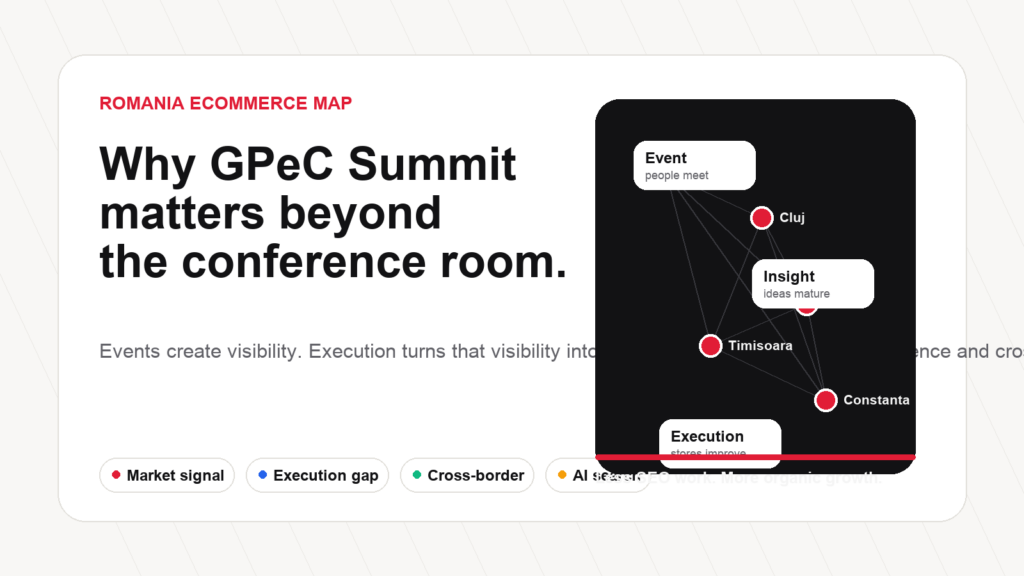
On May 26, 2026, GPeC Summit takes place in Bucharest, at the National Theatre. The official event page presents it as a major ecommerce and digital marketing event, with a conference, expo area, networking, practical content and the 21-year anniversary edition of GPeC.
That is the easy part to say.
The more interesting question is what an event like this can actually do for Romania.
I do not think Romania needs another reason to congratulate itself for “having potential.” We have said that for twenty years. What Romania needs is market infrastructure: places where ecommerce people meet, compare work, disagree with each other, expose operational gaps, learn from international speakers, understand how the market is moving and leave with a sharper execution agenda.
This is why I think GPeC Summit matters. Not because it should be treated like a monument. Not because one conference can transform a market. It matters because serious markets need recurring industry rituals. They need moments where the market looks at itself in the mirror.
If Romania wants to be taken seriously on the European ecommerce map, it cannot only have stores, agencies, platforms and payment providers working in isolated bubbles. It also needs events, research, case studies, shared benchmarks, public conversations, practical disagreement and a culture of execution.
GPeC can contribute to that. But the value depends on what happens after the event.
Why an ecommerce event matters for a country
An ecommerce market is not built only by merchants.
It is built by a full ecosystem:
- online stores that understand customer behavior;
- technology providers that reduce operational friction;
- logistics companies that make delivery reliable;
- payment providers that improve trust and conversion;
- agencies and consultants that translate strategy into work;
- founders who share what actually happened, not only what looked good in a presentation;
- media and industry platforms that make the market visible;
- events that force the ecosystem to gather around the same conversation.
That last point is more important than it looks.
Countries that become visible in ecommerce usually have more than transactional activity. They have a public market conversation. They have conferences, reports, communities, standards and recognizable examples. They create a sense that “something is happening here.”
Romania has strong entrepreneurs, technical talent, performance marketers, ecommerce operators and regional ambition. But visibility does not appear automatically. It must be organized.
An event like GPeC Summit can help because it creates a shared context. It gives the market a calendar moment. It brings international attention. It gives Romanian businesses a reason to compare themselves with broader ecommerce standards. It creates new relationships. It gives smaller operators access to ideas that otherwise remain trapped inside large companies, agencies or closed communities.
That does not mean every speech will be useful. That does not mean every exhibitor will change the market. That does not mean the event should be praised uncritically.
It means the existence of a serious ecommerce event is part of the infrastructure a market needs if it wants to mature.
The mistake: treating events as trophies
The wrong way to talk about GPeC would be to say: “Romania has a big ecommerce event, therefore Romania is an ecommerce power.”
That is not how markets work.
An event is a signal, not proof. It shows that a community exists, that there is commercial energy, that people want to learn and that companies are willing to invest in visibility. But the market still has to prove itself in the daily work:
- Can stores improve conversion, not only traffic?
- Can they compete on customer experience, not only discounts?
- Can they build brands that AI systems, Google, customers and partners understand?
- Can they reduce dependency on paid ads?
- Can they improve product data, category architecture and internal search?
- Can they produce useful content without flooding the web with low-value pages?
- Can they expand cross-border without losing operational quality?
This is where the conversation becomes more interesting.
Romanian ecommerce has always had a strong “hustle” side. Fast decisions. Strong founders. Performance mindset. Good engineers. Fast adaptation. But the next phase is not only about hustle. It is about systems.
The market needs stronger systems for SEO, AI search visibility, customer retention, product data, conversion optimization, logistics transparency, Review Management, consent and measurement.
A conference can start these conversations. It cannot execute them.
Romania’s real ecommerce gap is not talent. It is execution at scale
European ecommerce is still growing, but unevenly. The European E-commerce Report 2025, published through Ecommerce Europe and EuroCommerce and listed by the European Commission’s transition pathways platform, describes a European market that returned to growth in 2024 after a difficult period. It also highlights differences between regions and countries, especially around maturity, digital adoption and market conditions.
For Romania, the opportunity is clear: ecommerce still has room to grow, and Romanian operators can move faster than older, more saturated markets in some areas. But the risks are also clear: if the market grows mainly through short-term advertising, discounting and marketplace dependency, it becomes fragile.
In my opinion, the gap is not that Romanian founders are not smart enough. The gap is that too much of the work remains manual, reactive and disconnected.
Look at what a serious ecommerce business now has to manage:
- classic SEO and technical indexation;
- category and product page quality;
- Structured data and feed quality;
- Google Shopping and paid media efficiency;
- AI Overviews and AI Mode readiness;
- product discoverability in Conversational search;
- reviews, trust signals and local signals where relevant;
- content for research, comparison and purchase intent;
- inventory, delivery, returns and customer support information;
- analytics quality and Attribution gaps;
- authority building and publisher mentions;
- brand consistency across the web.
This is too much for most SMEs to manage with spreadsheets, dashboards and occasional agency calls.
That is why I believe the next step for Romanian ecommerce is not simply “more marketing.” It is operational discipline. The stores that win will be the ones that can turn market information into approved execution faster than competitors.
What should happen after the conference
What I would watch at GPeC Summit
If I were going to GPeC Summit only to collect inspiration, I would probably leave with too many ideas and too little action.
Instead, I would watch for five things.
1. Are speakers talking about execution, or only trends?
Trends are easy to describe. Execution is harder.
A useful ecommerce conversation should answer questions such as: what should a store change on Monday morning? Which pages should be improved? Which measurement problem should be fixed? Which customer journey creates friction? Which technical issue is blocking growth? Which content should not be created at all?
The more practical the conversation, the more valuable the event becomes.
2. Are Romanian examples visible enough?
International speakers are useful. They bring perspective and standards. But Romania also needs more public local examples.
Not vanity case studies. Real examples.
What did a Romanian store change? What worked? What failed? How did logistics, SEO, paid media, product data or customer experience affect results? What did the team learn?
Markets mature when operators share more than slogans.
3. Is AI discussed as execution, not decoration?
AI is now everywhere in ecommerce conversations. That creates a risk: the word becomes decoration.
The useful question is not “Do you use AI?” The useful question is “Which work does AI actually help execute better?”
For ecommerce, AI can support product descriptions, category improvements, search analysis, review mining, support automation, personalization, product feed cleanup, SEO recommendations, AI search monitoring and content planning. But it can also create low-quality pages, hallucinated claims, duplicated content and brand inconsistency if used badly.
So the discussion must move from AI hype to governance and execution.
4. Is cross-border treated realistically?
Romanian ecommerce businesses often like the idea of international expansion. The idea is attractive. The work is brutal.
Cross-border ecommerce is not only translation. It means payment preferences, delivery expectations, returns, legal requirements, local search behavior, local trust signals, local content, customer support and competitive positioning.
If Romania wants to appear on the European ecommerce map, cross-border ambition must become operationally serious.
5. Is SEO discussed as growth infrastructure?
Many ecommerce teams still treat SEO as a content channel or a monthly report.
That is too small.
Ecommerce SEO in 2026 is website architecture, crawl control, internal linking, category strategy, product data, structured data, page speed, reviews, brand authority, product feed consistency, AI search visibility and conversion support.
SEO is not only ranking. It is the way a store becomes understandable, trustworthy and discoverable across search surfaces.
The AI search layer changes the stakes
The ecommerce conversation is changing because search is changing.
Google has been expanding AI Overviews, AI Mode and agentic search experiences. Users are also asking ChatGPT, Gemini, Perplexity and other answer engines for product recommendations, service comparisons and buying advice.
This does not mean classic SEO is dead. That phrase is usually lazy. It means the job of SEO is expanding.
A store now has to be ready for:
- classic Google rankings;
- Google Shopping and product surfaces;
- AI-generated summaries;
- conversational comparison queries;
- local and map-based discovery;
- listicles and publisher citations;
- review-driven recommendations;
- structured product and merchant information;
- machine-readable content that supports retrieval.
This is exactly why a Romanian ecommerce event should not remain only in the world of digital marketing presentations. It should help merchants understand how search, advertising, product data, customer experience and AI discovery are converging.
In AI search, a store that is technically messy, semantically unclear, hard to crawl, weak on authority and inconsistent across the web will struggle to be understood. The problem will not always look like a ranking drop. It may look like silence: the brand simply does not appear in the answers that matter.
The AYSA view: events create awareness, agents create follow-through
My point of view is not that events are enough. My point of view is that events are useful only if they increase the quality and speed of execution after the event.
That is also why we built AYSA.
AYSA is an AI SEO execution agent. It connects to a website, learns the business context, monitors SEO, AEO and AI visibility opportunities, prepares the work, asks for approval and helps execute accepted changes inside the website workflow.
For ecommerce businesses, this matters because the work does not stop after someone says “you should improve technical SEO” or “you need better content” or “AI search is coming.” The store still has to decide what to do, prioritize the task, write or improve the page, update the website, build internal links, monitor results and repeat the process.
That is where most businesses lose momentum.
The event gives you the signal. The operating system must turn that signal into work.
For a Romanian SME, the difference can be decisive. A large enterprise may have a team for SEO, analytics, content, UX, paid media and development. A small business usually does not. It may have one founder, one marketing person, one agency and too many dashboards.
If we want Romania to be visible in ecommerce, we cannot only celebrate the best-funded players. We need tools and workflows that help smaller businesses execute at a higher level.
That is the bridge between a market event and market progress.
Five questions Romania’s ecommerce market should ask after GPeC
Here is the practical part.
After GPeC Summit, Romanian ecommerce operators should not ask only “Was the event good?” They should ask:
- What did we learn that changes our next 90 days? A useful event should create a sharper execution plan, not only inspiration.
- Which customer problem did we underestimate? Delivery, trust, reviews, product comparison, support, returns and payment friction often matter more than another campaign.
- Which search surface are we ignoring? Google, Maps, AI answers, product feeds, publisher lists and local signals now work together.
- Which technical problem blocks growth? Slow pages, bad indexation, weak category architecture, duplicate content and poor structured data are not glamorous, but they compound.
- Who owns execution? If nobody owns the next action, the insight dies.
These questions are more important than applause.
What would make GPeC even more valuable for Romania
If I had to suggest where Romanian ecommerce events can become even more valuable, I would focus on three areas.
First, more public operating benchmarks. Romanian ecommerce needs more practical benchmarks around conversion, delivery experience, customer support, technical SEO, product data, AI visibility and retention. The more specific the benchmarks, the better.
Second, more honest case studies. Not just success stories. Also “this failed,” “this took longer than expected,” “this technical problem hurt us,” “this attribution model was misleading,” “this agency relationship worked because of these operating rules.”
Third, more bridges between ecommerce and AI search. AI is not a separate topic anymore. It touches search, ads, content, product discovery, support, analytics and customer experience. Romanian ecommerce should not wait until this becomes obvious to everyone else.
That is how an event can help put Romania on the map without becoming self-congratulatory.
Not by saying “we are important.”
By helping the market become harder to ignore.
Final thought
GPeC Summit matters because Romania needs credible ecommerce meeting points. It needs rooms where the market can see itself, compare standards, import useful ideas, export Romanian ambition and build stronger relationships.
But the event is not the destination.
The destination is better ecommerce execution: stores that load faster, explain products better, convert more honestly, earn trust, prepare for AI search, monitor what changes and keep improving.
If GPeC helps move more Romanian businesses in that direction, then it is not just an event. It is part of the market infrastructure.
And that is a much more useful compliment than applause.
Turn ecommerce ideas into approved website action.
AYSA helps SMEs monitor SEO, AEO and AI visibility, prepare practical website improvements, ask for approval and execute accepted changes inside the website workflow.
Sources and further reading
Continue the AI search topic inside AYSA.
Use these pages to connect the article with AI SEO tools, AI visibility monitoring, AI Overviews and approved website execution.
Turn this topic into a website action plan.
Use these AYSA hubs to move from reading to technical fixes, AI visibility monitoring, research, glossary context and approval-first SEO execution.

