
Digital PR In AI Search: Why The Fundamentals Matter More Than Ever
AI search has not killed digital PR. It has made credible mentions, original evidence, expert commentary and entity clarity more important for SEO, AEO and AI visibility.
Every time search changes, the industry looks for a shortcut.
When links became important, businesses looked for link shortcuts. When content became important, they looked for content shortcuts. When AI answers became visible in search, the new shortcut became “How do I get cited by AI?”
That question is understandable, but it is incomplete.
AI search has not made Digital PR less important. It has made the fundamentals of Digital PR more important, more measurable and more connected to Technical SEO, entity SEO, brand visibility and Website Execution.
The recent Search Engine Journal article “Digital PR Hasn’t Changed. AI Search Just Made The Fundamentals More Important” makes a useful point: AI search does not remove the need for credible stories, expert sources and authority. It raises the cost of weak PR because AI systems are designed to synthesize information from multiple signals, sources and contexts.
In my opinion, this is the part many small and medium businesses need to understand: Digital PR in the AI search era is not a press release machine. It is an authority-building system.
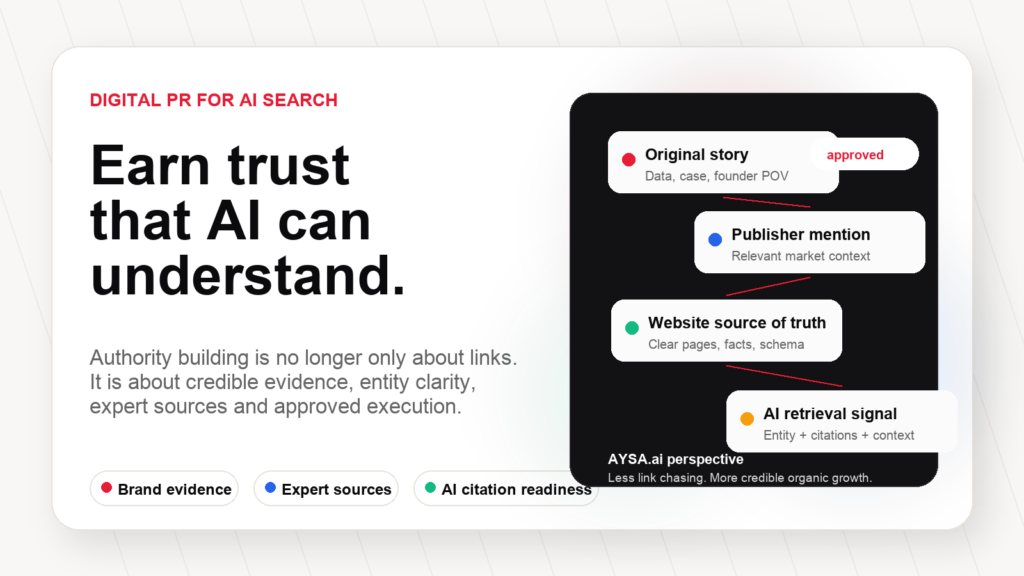
And an authority-building system only works when the website, the story, the sources, the mentions and the execution all support each other.
What changed: search is no longer only a list of blue links
Classic SEO used to be easier to explain. A user typed a keyword. Google returned a list of results. The user clicked a result. Ranking higher usually meant more visibility.
That model still exists, but it is no longer the whole search experience.
Users now discover businesses through Google Search, Google Maps, AI Overviews, AI Mode, ChatGPT Search, Perplexity, Gemini, social platforms, publisher articles, listicles, forums and review ecosystems. In many cases, the user does not start with a short keyword. They start with a complex task:
- “Find a private pediatric clinic in Bucharest with online booking, good reviews and easy parking.”
- “Which SEO automation tool is best for a small WordPress ecommerce business?”
- “What flower delivery company in Bucharest is trustworthy for premium bouquets?”
- “Which airport parking service is safest near Otopeni for a week-long trip?”
These are not only keywords. They are decision journeys.
An AI answer system trying to respond well needs more than one optimized page. It needs evidence. It needs a clear business entity. It needs consistent facts. It needs enough context to understand why one brand should be recommended over another. It may use search results, webpages, product information, local data, reviews, publisher mentions and structured content to form an answer.
Google’s own guidance for AI features in Search is careful, but the message is clear: the same search fundamentals still matter. Content must be helpful, accessible, technically sound and available to Google’s systems. AI features are not a separate internet where the old rules disappear.
That is why Digital PR matters. It creates external evidence around a brand, product, service, founder, category or point of view.
Why Digital PR still matters more than ever
Digital PR is often reduced to “getting links.” That is too small.
A good link can help. A relevant mention can help. A strong publication context can help. But the real value of Digital PR is broader: it helps the market understand who you are, what you know, what you have done, why you matter and where your expertise fits.
For AI search, that matters because answer systems do not only need pages. They need confidence.
Confidence is built from patterns:
- your brand is mentioned in relevant contexts;
- your expertise is associated with a specific topic;
- your website explains the topic clearly;
- other sources reference your work, data, products or point of view;
- your entity information is consistent across the web;
- your content is crawlable, structured and easy to quote;
- your business has real proof, not just generic claims.
This is not magic. It is the same trust-building discipline that serious brands have always needed, but AI search makes it more visible.
Google’s helpful content guidance asks site owners to create content primarily for people and to demonstrate experience, expertise, authoritativeness and trustworthiness. Google’s older high-quality site guidance also emphasized original information, reporting, research and analysis. Those ideas are not new, but they are newly urgent.
Weak PR does not create those signals. Strong Digital PR can.
From story to citation readiness
Old PR mindset
Goal: publish something somewhere and hope it includes a link.
Problem: weak relevance, weak evidence and no connection to the website’s source-of-truth pages.
AI search authority mindset
Goal: create evidence that humans, search engines and AI systems can understand, verify and connect to the brand.
Outcome: better entity clarity, stronger trust signals and more useful content for both classic SEO and AI visibility.
How AI search changes the role of mentions and authority
AI search does not simply copy the classic ranking page. It can summarize, compare, synthesize and cite.
That means a brand may need to be visible in more places than its own website:
- expert articles;
- publisher mentions;
- industry lists;
- credible interviews;
- review ecosystems;
- local business profiles;
- case studies;
- third-party comparisons;
- original research;
- structured product or service data.
But more mentions do not automatically mean better AI visibility.
The quality of the context matters. A mention in an irrelevant article does not explain what the brand should be trusted for. A vague press release does not create a strong source. A purchased placement with no editorial value may create a URL, but it may not create understanding.
For AI search, the useful question is:
If an answer engine had to decide whether this business belongs in the answer, what trustworthy evidence would it find?
That evidence can include classic SEO signals, but it also includes brand clarity, topical consistency and the quality of external references.
This is why I believe “link building” is becoming too narrow as a business term. The better phrase is authority building. You are not just buying links. You are building a trail of credible, relevant, explainable evidence around the business.
The fundamentals that now matter more
Digital PR for AI search is not complicated in theory. The challenge is execution.
Here are the fundamentals that matter most.
1. A real story, not a manufactured angle
A weak story is usually generic: “Company launches new service.” “Business offers high-quality solutions.” “Brand is innovative.” These do not give journalists, customers or AI systems much to work with.
A real story has tension, proof or usefulness:
- new market data;
- a clear trend;
- a founder’s experience;
- a case study;
- a customer problem explained better than others explain it;
- an operational insight from the business;
- a local market observation;
- a contrarian but defensible point of view.
For example, an ecommerce florist should not only publish “we deliver flowers.” It can publish useful insight about delivery behavior, seasonal demand, same-day logistics, wedding bouquet decisions, local search intent or how customers compare premium floral services.
A medical clinic should not only publish “we offer pediatric services.” It can explain how parents compare clinics, what signals matter when choosing care, what online booking changes, what review patterns show and what should not be decided by search results alone.
Useful stories create useful citations.
2. A clear source-of-truth page on your website
Digital PR often fails because the external mention is stronger than the website page behind it.
If a publication mentions your research, your service, your product or your founder, your website should have a page that supports the story. That page should be easy to crawl, easy to read and easy to cite.
It should include:
- the clear topic;
- the facts behind the claim;
- methodology if data is used;
- author or expert context;
- examples;
- dates where relevant;
- structured headings;
- internal links to related pages;
- clear next steps.
This is where semantic SEO and Digital PR meet. The website must help search systems understand the entity and the topic.
3. Expert commentary with a real point of view
AI search makes generic expert comments easier to ignore.
A quote such as “businesses should adapt to change” is not useful. A quote that explains a specific pattern, risk, tradeoff or example is much better.
For AYSA, my view is simple: many SMEs do not fail at SEO because they lack information. They fail because they cannot turn that information into consistent execution. Digital PR has the same problem. A business may get mentioned, but if the website does not support the story, if the page is not updated, if internal links are missing and if the authority work is not connected to monitoring, the value is left on the table.
Expertise needs execution.
4. Relevance before volume
AI search does not reward noise.
A hundred weak mentions on irrelevant websites may not create a strong authority signal. A few strong mentions in relevant contexts can be more useful because they help define what the brand is about.
For a local business, relevance may mean local publications, industry sites, niche directories, professional associations, customer stories and credible partner mentions. For ecommerce, it may mean product comparisons, category guides, reviews, buying guides, supplier relationships and original data. For SaaS, it may mean documentation, use cases, technical explainers, product comparisons and founder commentary.
The key is not only “where can we get a link?” It is “where would a human or AI system reasonably expect to find evidence about this business?”
5. Entity consistency across the web
AI systems struggle when a business is described inconsistently.
If your name, category, location, founder, product, pricing, services or target market change from page to page, you create ambiguity. That ambiguity can reduce confidence.
Entity consistency includes:
- consistent brand name;
- consistent business category;
- consistent founder or author references;
- consistent product names;
- consistent location and service area;
- consistent external profiles;
- consistent schema markup where appropriate.
This is why Digital PR should not live separately from SEO. The PR team, SEO team, content team and website team are working on the same entity whether they realize it or not.
What does not work in the AI search era
The AI search era will not be kind to lazy authority building.
These tactics are especially fragile:
- mass press releases with no real story;
- thin guest posts written only for anchor text;
- irrelevant placements that do not match the business category;
- AI-generated “research” with no methodology;
- fake expertise;
- unreviewed statistics copied from other articles;
- link schemes disguised as editorial work;
- brand mentions that point to weak, outdated or irrelevant pages;
- publisher pages with no real audience or editorial standard.
Some of these tactics may still create short-term metrics. They may create a backlink. They may create a report line. But they do not create durable trust.
And AI search is pushing the web toward durable trust.
What SMEs should do instead
Small and medium businesses do not need enterprise PR departments to benefit from this shift.
They need a simpler operating model.
For example, a parking company near an airport could publish a real comparison guide about long-term parking, shuttle times, security, booking, airport access and common customer mistakes. That guide can support Digital PR, local SEO, AI answers and conversion.
A private clinic could publish a helpful guide explaining how parents should compare pediatric clinics, when emergency care is more appropriate, what reviews can and cannot tell you, what online booking changes and what questions to ask before choosing a provider.
A florist could publish seasonal demand data, delivery guidance, wedding flower planning, local buying guides and transparent service pages.
These are not “SEO articles” in the cheap sense. They are business assets. Digital PR amplifies them. AI search can discover and synthesize them. Customers can actually use them.
How to measure Digital PR for AI search
Measurement is also changing.
Classic Digital PR measurement often focused on links, domain metrics, referral traffic and placements. Those still matter, but they are not enough.
A modern measurement model should include:
- Relevant mentions: where is the brand mentioned and in what context?
- Backlinks: which mentions include useful links to relevant pages?
- Source quality: is the publication relevant, trustworthy and indexed?
- Entity clarity: does the mention reinforce what the brand should be known for?
- Search visibility: do branded and non-branded queries improve?
- AI visibility: does the brand appear in AI answers, summaries or comparison-style responses?
- Referral quality: do visitors from mentions engage and convert?
- Website execution: were supporting pages updated after the PR work?
- Internal linking: did the new authority flow into the right pages?
Tools are starting to surface AI assistant traffic and AI citation context, but measurement is still early. The safest approach is to combine classic SEO data, brand monitoring, referral analysis, AI visibility checks and manual review.
Do not measure Digital PR only by whether one tool reports one backlink. Measure whether it strengthens the brand’s evidence layer.
The AYSA view: authority building must become an execution workflow
My strongest opinion on this topic is that Digital PR will fail for many SMEs for the same reason SEO fails: the work is not connected to execution.
A business owner does not need another dashboard showing that “authority matters.” They need a system that can identify what is missing, explain the opportunity, prepare the action, request approval and move the work forward.
This is where AYSA fits.
AYSA is not positioned as a generic PR tool. It is an AI SEO execution agent. But authority building is part of the SEO execution layer. Through the AYSA ecosystem and integrations such as Adverlink, the product direction is to make relevant publisher opportunities easier to find, evaluate, approve and track without messy outreach, spreadsheets and disconnected manual work.
The important word is approve.
Authority actions should not run blindly. A business should see the context, understand the recommendation, approve the opportunity and keep control of spending and publishing decisions.
After approval, the work should be operational:
- prepare or improve the source-of-truth page;
- strengthen related internal links;
- connect the mention to the right entity and topic cluster;
- monitor the placement;
- track whether the brand becomes easier to find, cite and recommend;
- continue improving the website when market or Google behavior changes.
That is the future of Digital PR in SEO, in my opinion. Not more random placements. Not more generic AI content. Not more dashboards. A connected system that turns authority building into approved website execution.
Practical checklist: making a brand more citation-ready
If you run an SME and want a practical starting point, use this checklist:
- Define what your brand should be known for in one sentence.
- Create or improve source-of-truth pages for your main services, products and topics.
- Add real examples, not generic claims.
- Make founder or expert context visible where relevant.
- Use clear headings, FAQs and comparison criteria.
- Keep Google Business Profile and external profiles consistent.
- Earn mentions from relevant websites, not random websites.
- Link PR stories to pages that actually support the topic.
- Monitor brand mentions, AI answers, rankings and referral traffic.
- Update pages when external mentions create new proof.
This is not glamorous. It is work. But it is the kind of work that compounds.
Final thought
AI search did not invent authority. It exposed how weak many authority strategies were.
If a brand is vague, unsupported and disconnected across the web, AI search will not magically understand it. If a brand has clear pages, useful content, relevant mentions, expert context and consistent execution, it has a much better foundation for both classic SEO and AI visibility.
Digital PR has not changed at the level that matters most. The fundamentals are still credibility, relevance, expertise, usefulness and proof.
What changed is the operating environment. Search engines and AI systems now need to understand, retrieve and synthesize those signals faster and in more complex contexts.
That means the winners will not be the businesses shouting the loudest. The winners will be the businesses that make themselves easiest to understand, trust and recommend.
Turn credible mentions into approved SEO execution.
AYSA helps SMEs monitor SEO, AEO and AI visibility, prepare authority-building and website actions, request approval and execute accepted changes inside the website workflow.
Sources and further reading
- Search Engine Journal: Digital PR Hasn’t Changed. AI Search Just Made The Fundamentals More Important
- Google Search Central: AI features and your website
- Google Search Central: Creating helpful, reliable, people-first content
- Google Search Central: More guidance on building high-quality sites
- AYSA: How AI Decides Which Brands To Trust
- AYSA: AI Search Visibility
Continue the AI search topic inside AYSA.
Use these pages to connect the article with AI SEO tools, AI visibility monitoring, AI Overviews and approved website execution.
Turn this topic into a website action plan.
Use these AYSA hubs to move from reading to technical fixes, AI visibility monitoring, research, glossary context and approval-first SEO execution.

