
How AI Decides Which Brands To Trust: The New SEO Trust Layer
AI systems do not trust brands because of slogans. They build confidence from crawlable facts, entity clarity, structured data, source consistency, third-party proof and useful content.
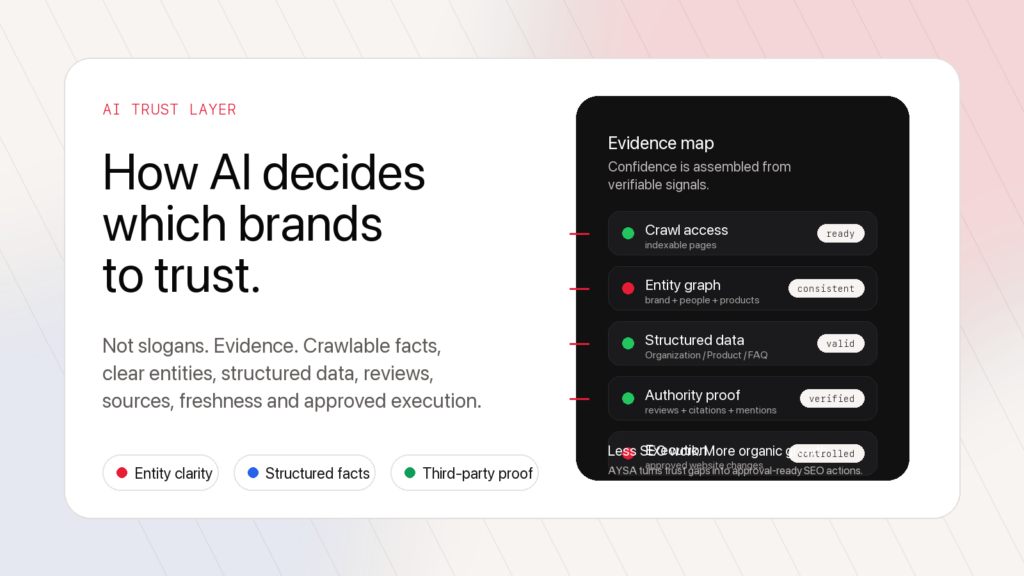
WordLift recently framed a question that every serious SEO team should now be asking: how does AI decide which brands to trust?
It is a good question because the search interface is changing. People no longer discover businesses only through classic blue links. They search through Google, Maps, AI Overviews, AI Mode, ChatGPT Search, Perplexity, Gemini, shopping surfaces, social recommendations and increasingly through assistants that compare options before the user ever opens a website.
That creates a new problem for brands. Ranking is still important, but ranking alone is no longer the full visibility layer. A brand also needs to be understandable, verifiable and easy to recommend inside systems that synthesize information.
For a small business owner, this can sound abstract. It is not. If a parent asks an AI assistant for a pediatric clinic in Bucharest, the system needs to understand which clinics exist, where they operate, what services they provide, whether reviews and third-party signals support the recommendation, whether booking and contact information are clear, whether the website can be accessed, and whether the answer can be grounded in sources. If an ecommerce buyer asks for a product recommendation, the system needs product names, descriptions, availability, price, shipping, return policy, identifiers, reviews, category context and trustworthy references.
In other words, AI trust is not a branding exercise. It is an information architecture problem, a content quality problem, a structured data problem, a reputation problem and an execution problem.
Why this matters now
Google’s own guidance for generative AI features does not say “forget SEO.” It says the fundamentals still matter. The official Google Search AI optimization guide points website owners back to Search Essentials, Crawlability, Indexability, helpful content, page experience, visible content and the same controls used across Search.
That matters because it gives us a grounded starting point. AI features do not create a separate universe where random tricks replace search quality. They build on systems that still need to discover, understand and evaluate content.
At the same time, the user experience is changing. A traditional search result might show ten links. An AI answer may mention only a handful of sources, summarize several pages, compare entities, extract product facts, identify pros and cons, or recommend a path forward. The cost of being unclear is higher because the user may never reach the page that would have explained the missing detail.
This is why “AI trust” is becoming a practical SEO layer. The question is not only “Can Google index us?” The question is also “Can search systems, answer engines and assistants understand enough about us to use us confidently?”
AI trust is not a magic score
Let’s remove the biggest risk first: there is no public, universal “AI trust score” that you can optimize in a simple checklist.
Different systems work differently. Google’s AI features, ChatGPT Search, Perplexity, Gemini and Bing Copilot do not expose one shared trust model. Their retrieval, ranking, grounding, citation and answer generation systems can vary by query, market, language, freshness, source availability and product surface.
So when we talk about AI trust, we should not pretend we know the private scoring formula of every model. A better way to think about it is this:
AI trust is the confidence a system can build from available evidence.
That evidence can include your website, structured data, public profiles, product feeds, reviews, citations, news coverage, authoritative mentions, social context, local business data, documentation, policies, author information and the consistency of all those signals.
Google’s documentation about helpful content is useful here. In its people-first content guidance, Google explains the importance of experience, expertise, authoritativeness and trustworthiness, and explicitly says trust is the most important member of E-E-A-T. Google also recommends asking “Who, How and Why” about content, because authorship, creation process and purpose help people and systems evaluate reliability.
That is not an AI citation guarantee. But it is a strong indicator of where the web is going: trustworthy content is not anonymous, vague, unsupported or disconnected from real experience.
Confidence from evidence, not slogans
Weak brand signal
Generic copy, inconsistent names, thin service pages, missing proof, unclear policies, no structured data and little third-party validation.
AI-ready trust layer
Clear entities, crawlable facts, structured data, source consistency, reviews, citations, author/business transparency and updated pages.
What AI systems can actually observe
A useful way to avoid hallucinating about AI trust is to ask a simple question: what can the system observe?
It can observe crawlable text. It can observe links. It can observe structured data. It can observe page titles, headings, author information, contact details, product data, category structure, reviews where available, external references, location information, documentation and public profiles. It can observe whether content is accessible or blocked. It can observe whether different sources agree or conflict.
It cannot reliably infer a complete business from vague branding. It cannot trust a product catalog if critical facts are missing. It cannot compare services well if every page says the same thing. It cannot cite a claim that exists only in an image, a video without transcript, a hidden tab that never renders, or a JavaScript interface that exposes little meaningful HTML.
This is why Technical SEO and semantic SEO are converging. The website has to be accessible and meaningful at the same time.
The practical trust signals tend to fall into seven groups:
- Access: can important pages be crawled, rendered and indexed?
- Entity clarity: is it clear who the brand is, what it offers and where it operates?
- Content usefulness: does the page answer real user questions with specific information?
- Structured facts: does structured data reflect visible content?
- External corroboration: do reviews, references, citations and trusted mentions support the brand?
- Freshness and maintenance: are facts, policies, prices, locations and product details current?
- Governance: are claims controlled, consistent and safe enough to use?
That is already a lot of work. This is why “just use ChatGPT” is not a complete answer for most businesses. A chat model can help draft, analyze and explain, but it does not automatically maintain entity consistency across a website, fix internal links, update structured data, monitor Google signals, track content decay, evaluate citation gaps and apply approved changes inside the website workflow.
Entity clarity: the brand must be easy to identify
AI systems need entities. A brand, a founder, a product, a service, a location, a clinic, a hotel, a restaurant, a parking provider or an ecommerce store are all entities that must be identifiable and connected.
For humans, brand ambiguity may be annoying. For machines, it can be fatal.
If the company name appears in several formats, the address differs between the website and Google Business Profile, product names are inconsistent, authors are anonymous, local pages are thin, and external mentions use older names, the system has to work harder to understand what is true.
Entity clarity includes:
- consistent brand name and legal/business name where relevant;
- clear Organization, LocalBusiness, Product, Service, Article or Person relationships;
- consistent NAP data for local businesses;
- clear author and reviewer information for editorial or YMYL content;
- consistent product names, categories and identifiers;
- clear links between service pages, location pages, guides and FAQs;
- about, contact, pricing, policy and support pages that reinforce legitimacy.
This is where semantic SEO becomes practical. The goal is not to stuff entities into a page. The goal is to make the business reality visible.
If a florist serves Bragadiru and Bucharest with same-day delivery, the site should make that clear through service pages, location context, delivery rules, product categories, FAQs, reviews, internal links and Google Business Profile consistency. If a pediatric clinic provides neonatology, vaccines, pediatric cardiology and online booking, those facts should not be buried in a paragraph that says “complete medical services.”
Structured data: explicit clues for machines
Structured data is not magic, but it is still one of the cleanest ways to make page meaning explicit.
Google’s structured data documentation describes it as a standardized format for providing information about a page and classifying its content. Google says structured data helps it understand page content and can make search results more engaging when rich result eligibility applies.
For AI search, the broader value is even more intuitive: structured data reduces ambiguity. It can clarify that a page is an article, a product, an organization, a local business, a breadcrumb trail, a review, an FAQ, a how-to, a video, an event or a job posting.
But there is an important rule: structured data must reflect visible content. Adding schema that says things the page does not actually show is not a trust signal. It is a risk.
For SMEs, the useful structured data layer usually includes:
- Organization or LocalBusiness markup for brand identity;
- Product markup for ecommerce pages;
- Article markup for editorial content;
- BreadcrumbList for hierarchy;
- FAQPage only where FAQs are visible and useful;
- VideoObject where real videos are embedded;
- Review or aggregate ratings only when compliant and supported by visible reviews.
Schema.org is the vocabulary layer, but implementation quality matters more than vocabulary enthusiasm. A clean, accurate, modest schema implementation is better than a bloated graph full of claims the business cannot support.
Third-party proof: AI confidence is not only on your website
Brands often think trust is built only on their own domain. That is not how discovery works.
Search engines and AI systems can use external signals when they are available: reputable mentions, reviews, citations, directories, news coverage, industry references, social discussions, local listings, comparison pages, public profiles and links. The exact weighting varies by system and query, but the principle is obvious: a claim repeated by credible independent sources is easier to trust than a claim made only by the brand itself.
This does not mean buying random links or publishing low-quality advertorials. That is the old mistake.
The modern authority question is: where should this brand be mentioned so that a human, a search engine and an AI assistant can see it as a real participant in its market?
For a local clinic, that may include Google Business Profile, medical directories, review platforms, local press and relevant informational pages. For an ecommerce store, it may include product reviews, comparison guides, publisher coverage, marketplace consistency, product feeds and customer review ecosystems. For a SaaS product, it may include documentation, integrations, software directories, founder profiles, case studies and editorial mentions.
AYSA’s integration with Adverlink exists in this context: not as “link buying” in the crude sense, but as an authority-building workflow where opportunities can be surfaced, reviewed, approved and tracked. The important business principle is control: no authority action should happen blindly, and no purchase should happen without approval.
Product trust: catalogs, feeds and Digital Product Passports
WordLift’s article is especially relevant for ecommerce because product discovery is becoming more machine-mediated.
The article highlights AI-ready catalogs, machine-readable product data, Digital Product Passports and the idea that brands should organize, validate and activate product data they already have. This is a strong direction because ecommerce trust depends on facts: product name, variant, price, availability, material, dimensions, care instructions, brand, category, images, reviews, delivery, returns and compatibility.
In Europe, Digital Product Passports are also becoming part of the broader product data conversation. They are not “SEO tags.” They are a way to connect products with traceability, compliance and lifecycle information. But from an AI discovery perspective, the lesson is the same: product facts that are structured, verified and connected are easier to use than product facts scattered across PDFs, images, old descriptions and internal spreadsheets.
GS1’s GS1 US: GS1 Digital Link for brands is another useful piece of the puzzle because it connects identifiers and web resources. Again, this is not a ranking trick. It is part of the shift from pages as marketing brochures to products as machine-readable entities.
For ecommerce SEO in the AI search era, product trust usually requires:
- accurate product structured data;
- consistent product identifiers and variants;
- clear availability and pricing information;
- shipping and return policies that are easy to find;
- unique category and product descriptions;
- reviews and proof that can be verified;
- comparison content that helps buyers decide;
- clean product feeds;
- internal links between categories, guides and products;
- fast, crawlable product pages.
That is a lot for a small ecommerce team. It is also exactly why execution systems matter. A report that says “improve product data” is not enough. Someone or something has to find the missing fields, prioritize them, prepare fixes, ask for approval and apply the approved updates.
Local SME trust: the business must look real everywhere
For local SMEs, AI trust is often more basic and more urgent.
A local business needs to prove that it exists, serves a specific area, offers specific services, has real customers, has current contact information and can help with a concrete need. This applies to clinics, florists, hotels, restaurants, airport parking, car rental, salons, repair services, law firms, dentists and many other businesses.
The trust layer includes:
- Google Business Profile consistency;
- clear service pages;
- city and area relevance without doorway pages;
- visible address, phone and booking/contact options;
- real reviews and review response strategy;
- photos that support the business reality;
- pricing or process information where possible;
- FAQ content based on real customer questions;
- local citations and relevant mentions;
- pages that answer comparison and decision-making questions.
AI systems are especially sensitive to specificity. A page that says “professional services in Bucharest” is weak. A page that explains what the service includes, who it is for, where it is available, what a customer should compare, what it costs or how booking works is much stronger.
This is also where “quality content” becomes practical. A useful page about “best pediatric clinic in Bucharest” should not be a generic list. It should help a parent compare emergency vs private consultation, reviews, specialties, booking, parking, location, opening hours and trust signals. A useful page about airport parking should explain distance to terminal, shuttle frequency, security, booking, cancellation, pricing and what happens if the flight is delayed.
That kind of content is better for people. It is also easier for AI systems to use.
What breaks AI trust
Trust can be weakened by obvious technical problems, but also by small inconsistencies repeated across many pages.
The most common problems I see are:
- Vague claims: “best,” “premium,” “trusted,” “leading” without proof.
- Inconsistent entity data: different names, addresses, phone numbers or product names across sources.
- Thin pages: service or category pages that do not answer real questions.
- Hidden facts: important information trapped in images, scripts, PDFs or tabs that are hard to parse.
- Outdated content: old prices, old services, discontinued products and stale opening hours.
- Fake authority: low-quality mentions, irrelevant links and paid placements that add no real context.
- Schema mismatch: structured data that does not match visible content.
- Technical noise: duplicate URLs, canonical conflicts, broken links, redirect chains and blocked pages.
- No authorship or ownership: no clear author, founder, company, editorial policy or support path where users expect it.
Many of these are not dramatic. They are operational. They happen because businesses publish pages over time without a system that continuously audits, updates and executes.
The AYSA view: trust is an execution problem
My view is simple: the AI trust conversation will fail for SMEs if it stays at the level of theory.
Most small businesses do not need another 80-page PDF explaining entity SEO, GEO, AEO, schema, product data and AI citations. They need a system that can look at the real website, identify what is missing, prepare the work, explain it in plain language, ask for approval and apply accepted changes.
That is the reason AYSA exists.
AYSA is built as an SEO execution agent, not just a reporting tool. It can help monitor classic SEO, AEO, GEO and AI visibility signals, identify weak pages, prepare content and technical improvements, surface authority-building opportunities and move approved changes into the website workflow. WordPress execution is available now, and the product direction is broader website execution across platforms.
In the specific context of AI trust, AYSA can help with:
- finding pages that do not clearly explain the business, product or service;
- detecting missing structured data opportunities;
- identifying weak internal links between related topics;
- monitoring pages that receive impressions but do not answer the query well;
- preparing FAQ, comparison and answer-ready content;
- checking technical issues that reduce crawlability or indexability;
- surfacing authority and publisher opportunities for review;
- tracking whether important pages and entities remain consistent over time;
- turning recommendations into approval-ready website actions.
The last step matters most. AI search will keep changing. Google, OpenAI, Microsoft, Perplexity and other systems will continue to evolve. The winning businesses will not be the ones that read every update and panic. They will be the ones that build a repeatable operating system for discovery.
Less guessing. More structure. Less manual SEO work. More approved execution.
Turn unclear brand signals into approved website action.
If your business is real, useful and trusted by customers, your website should make that obvious to search engines, AI answers and buyers. AYSA helps find the gaps, prepare the work and execute approved changes.
Sources and further reading
- WordLift: How AI Decides Which Brands To Trust
- Google Search Central: Optimizing for generative AI search
- Google Search Central: Creating helpful, reliable, people-first content
- Google Search Central: Introduction to structured data markup
- GS1 US: GS1 Digital Link for brands
- AYSA: Cloudflare Agent Readiness Score and AI Search
- AYSA: Semantic SEO in the AI Search Era
- AYSA: AI Search Visibility
Continue the AI search topic inside AYSA.
Use these pages to connect the article with AI SEO tools, AI visibility monitoring, AI Overviews and approved website execution.
Turn this topic into a website action plan.
Use these AYSA hubs to move from reading to technical fixes, AI visibility monitoring, research, glossary context and approval-first SEO execution.

