
Semantic SEO In The AI Search Era: How To Build Meaning, Not Just Keywords
Semantic SEO is no longer a specialist trick. In the AI search era, it is how websites make entities, intent, expertise and relationships clear enough to be understood, cited and acted on.
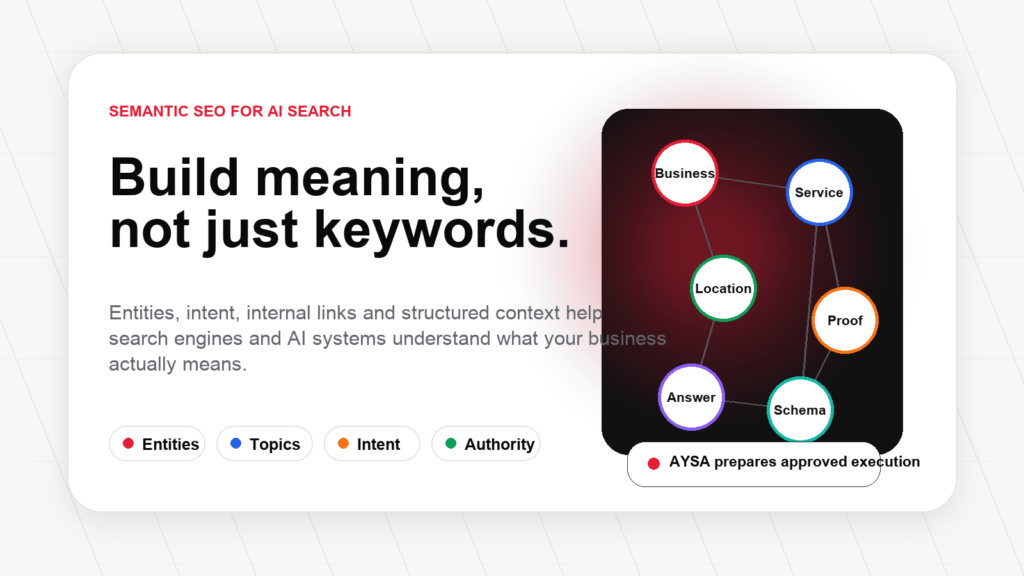
Semantic SEO is one of those terms that sounds more complicated than it should. Many people hear it and think it means “use related keywords,” “write longer content,” or “add schema.” Those things can be part of the work, but they are not the point.
The point is meaning.
Search engines no longer need a page to repeat the exact same phrase ten times to understand what it is about. They can process language, identify entities, map relationships, detect intent, compare documents and evaluate whether a page is likely to help the user. AI-assisted search adds another layer: systems now synthesize answers, compare options, cite sources and continue conversations across follow-up questions.
That means the old question “How do I rank for this Keyword?” is incomplete. A better question is: “Can a search engine or AI assistant understand exactly what this page is about, how it connects to the rest of the website, why it is trustworthy and when it should be used in an answer?”
That is semantic SEO.
What semantic SEO actually means
Search Engine Land’s guide to semantic SEO frames the topic around meaning, context and intent rather than isolated keywords. That framing is important because modern search is built to understand information, not just match strings.
In practical terms, semantic SEO means organizing your website so the following are clear:
- Entities: the people, organizations, products, services, locations, brands, categories and concepts that matter.
- Relationships: how those entities connect to one another.
- Intent: what the user is trying to do, learn, compare or buy.
- Topical coverage: whether the website covers a subject deeply enough to be useful.
- Internal links: how related pages help search engines and users navigate the topic.
- Structured data: machine-readable markup that describes visible content accurately.
- Evidence: authorship, examples, reviews, citations, experience and proof.
For example, a page about “Technical SEO audit” should not only define the term. It should explain crawlability, indexability, redirects, canonical tags, sitemaps, structured data, Core Web Vitals, JavaScript rendering, internal links, prioritization and what happens after issues are found. It should also connect to deeper pages about those concepts.
A page about “best pediatric clinic in Bucharest” should not look like a generic directory. It should help a parent compare private clinics by symptoms, urgency, doctor availability, reviews, parking, online booking, location, insurance, opening hours and trust signals. The semantic structure of that page is what helps both humans and AI systems understand the answer.
meaning layer
Old keyword page
Focus: exact phrase repetition, generic headings, thin examples and weak internal links.
The page may rank temporarily, but it often fails when search engines need deeper context.
Semantic page
Focus: entities, intent, examples, related pages, structured data, proof and clear next steps.
The page becomes easier to understand, cite, compare and improve over time.
Why keywords still matter, but are not enough
Keywords are not dead. They are still useful because they reveal how people describe problems. Keyword research shows demand, language, modifiers, questions, commercial intent and market vocabulary.
The mistake is treating keywords as the whole strategy.
If a florist wants to rank for “wedding bouquet Bucharest,” keyword research can reveal the phrase. Semantic SEO asks the next questions:
- What types of wedding bouquets does the florist offer?
- Which venues or neighborhoods matter?
- Does the page explain seasonal flowers, delivery timing, budget ranges and consultation process?
- Are there examples, photos, reviews and related services?
- Does the website link between wedding flowers, bridal bouquets, event flowers and delivery pages?
- Can Google, AI Overviews or answer engines understand that this business is a real florist with relevant local expertise?
That is the difference between targeting a keyword and building a topic.
Google’s own Search documentation says Search uses many systems to understand query meaning, page relevance, quality, usability and context. Google also explains that structured data can help Search understand a page, but it must represent content that is visible to users. In other words: the website must be useful first, and machine-readable second.
This is why semantic SEO is not a shortcut. It is a discipline for making real usefulness legible.
Why semantic SEO matters more in AI Search, AEO and GEO
AI-assisted search changes the output. Instead of showing only a list of blue links, systems may generate summaries, comparisons, recommendations and follow-up paths. Google’s AI optimization guidance does not describe a separate magic playbook for AI features. It emphasizes the same fundamentals: make content crawlable, indexable, helpful, visible, technically sound and aligned with user needs.
That is exactly where semantic SEO becomes practical.
AI systems need to retrieve and assemble information. If your website has vague pages, weak internal links, inconsistent entity names, missing service details and thin topic coverage, the system has less to work with. If your website has clear entity definitions, strong topical structure, evidence, schema, FAQs, comparison points and updated content, it becomes easier to interpret.
This does not guarantee inclusion in AI Overviews, AI Mode, ChatGPT, Perplexity, Claude or any other answer engine. No serious SEO strategy should promise that. But semantic clarity improves the website’s eligibility to be understood, retrieved and evaluated.
Think of it this way:
- SEO asks whether the page can be crawled, indexed, ranked and clicked.
- AEO asks whether the page can answer a question clearly.
- GEO asks whether the page can be used by generative systems when they synthesize answers.
- AI visibility asks whether the brand is being mentioned, cited, compared or recommended across AI-assisted surfaces.
Semantic SEO is the foundation underneath all four.
SEO → AEO → GEO
A practical semantic SEO framework
For SMEs, semantic SEO should not become an academic exercise. It should become a practical workflow. Here is the framework I recommend.
1. Start with the business entity
Before creating content, define the business clearly. What is the company? What does it sell? Where does it operate? Who does it serve? What makes it trustworthy? What proof exists?
This matters because search engines and AI systems need consistent signals. If one page says “AI SEO automation,” another says “SEO agency,” another says “SEO software,” and none of them explain the relationship, the entity becomes fuzzy.
For AYSA, the entity is not “a blog about SEO.” It is an AI SEO execution agent for websites, currently executing through WordPress, designed to monitor, prepare, request approval and execute accepted SEO, AEO, GEO and AI visibility work.
2. Map topics by user intent, not only volume
High-volume keywords can be tempting, but semantic SEO rewards intent coverage. A topic map should include informational questions, comparison pages, commercial pages, examples, glossary definitions, product workflows and objections.
For example, “SEO automation tools” is not one page. It connects to AI SEO tools, SEO audit tools, rank tracking, on-page automation, technical SEO, link building, monitoring, pricing, agency workflows and “why not just use ChatGPT?”
3. Build internal links that teach meaning
Internal links are not only navigation. They are semantic signals. A good internal link tells users and crawlers that two concepts belong together.
If an article mentions topical authority, it should connect to a definition or deeper guide. If it mentions entity SEO, it should point to the concept. If it discusses structured data, it should connect the reader to the relevant glossary or guide.
This is especially important for AI retrieval because related content helps systems understand clusters, not isolated pages.
4. Use structured data where it matches visible content
Google’s structured data documentation is clear that markup helps Search understand content and can make pages eligible for certain search features, but the markup must describe what users can actually see.
That means schema should not be used as decorative code. Use Organization, Article, BreadcrumbList, FAQPage, Product, LocalBusiness, Service or Review markup only when the visible content supports it and the implementation follows Google’s guidelines.
5. Add evidence and examples
Semantic SEO is stronger when pages include real-world details. Generic pages are hard to trust and hard to cite. Examples make meaning concrete.
A strong medical clinic page might explain how parents should compare urgency, doctor specialization, parking, reviews, online booking and after-hours support. A strong ecommerce page might explain sizes, delivery, returns, comparisons, use cases and customer questions. A strong technical SEO page should show actual checks and what decisions follow from those checks.
6. Keep the content updated
Semantic clarity is not a one-time project. Markets change. Google changes. AI search changes. Competitors publish. Products change. Reviews change. Prices change. If the content layer becomes stale, its semantic usefulness declines.
Semantic SEO examples for SMEs
A private clinic
A clinic does not need a page that repeats “pediatric clinic Bucharest” twenty times. It needs a page that explains services, doctors, symptoms, appointment options, emergency boundaries, reviews, location, parking, insurance, prices where appropriate, FAQs and what a parent should do next.
The semantic cluster might include pages about pediatric consultations, neonatology, fever in children, vaccination, emergency care, online booking, doctor profiles and local clinic pages.
An ecommerce store
An ecommerce site should not rely only on product pages. It needs category pages, buying guides, comparison pages, product attributes, availability, delivery, return policies, review content and structured product data.
In AI search, a user may ask for “the best bouquet delivery option for an anniversary tomorrow in Bucharest with premium flowers and card payment.” The winning website is not simply the one that says “flower delivery.” It is the one that makes delivery timing, product quality, location, trust and transaction details clear.
A local service business
A parking or car rental business near an airport should clarify location, shuttle, distance, booking process, cancellation policy, security, opening hours, pricing, airport transfer and customer proof. Those details turn a keyword page into a decision page.
This is the difference between SEO content and useful search infrastructure.
The AYSA view: semantic SEO needs execution, not another checklist
My opinion is simple: semantic SEO is extremely important, but most businesses will not implement it manually at the required speed.
It is easy to say “build topical authority,” “improve internal linking,” “add structured data,” “refresh content” and “optimize for AI search.” It is much harder to identify the exact pages, prepare the improvements, explain them in plain language, ask for approval and apply the accepted changes.
That execution gap is why AYSA exists.
AYSA learns the business context, monitors SEO and AI visibility signals, identifies gaps, prepares approval-ready actions and executes accepted improvements inside the website workflow. It can help connect glossary definitions, product pages, blog articles, internal links, schema opportunities and monitoring signals into a practical execution loop.
Semantic SEO should not become another dashboard for business owners. It should become an operating system for making the website clearer, more useful and easier to understand over time.
That is also why we keep connecting this topic to recent changes in search. In our article on Google information agents, we discussed how search is moving toward always-on discovery. In our analysis of Google I/O 2026 and agentic search, we explained why websites need to prepare for agents, not only rankings. Semantic SEO is the connective tissue between those ideas.
Sources and further reading
- Search Engine Land: What is semantic SEO?
- Google Search Central: How Search works
- Google Search Central: Creating helpful, reliable, people-first content
- Google Search Central: AI optimization guide
- Google Search Central: Introduction to structured data
- AYSA Glossary: Semantic SEO
- AYSA: AI Search Visibility
Turn semantic SEO into approved website execution.
If your website has scattered pages, weak internal links, unclear topics or AI visibility gaps, AYSA can help monitor the work, prepare improvements, ask for approval and execute accepted changes inside your website workflow.
Continue the AI search topic inside AYSA.
Use these pages to connect the article with AI SEO tools, AI visibility monitoring, AI Overviews and approved website execution.
Turn this topic into a website action plan.
Use these AYSA hubs to move from reading to technical fixes, AI visibility monitoring, research, glossary context and approval-first SEO execution.

