
Google Information Agents: SEO Is Moving From One-Time Searches To Always-On Discovery
Google is bringing information agents to AI Mode: background systems that monitor topics and notify users. Here is what that means for SEO, AI visibility and SMEs.
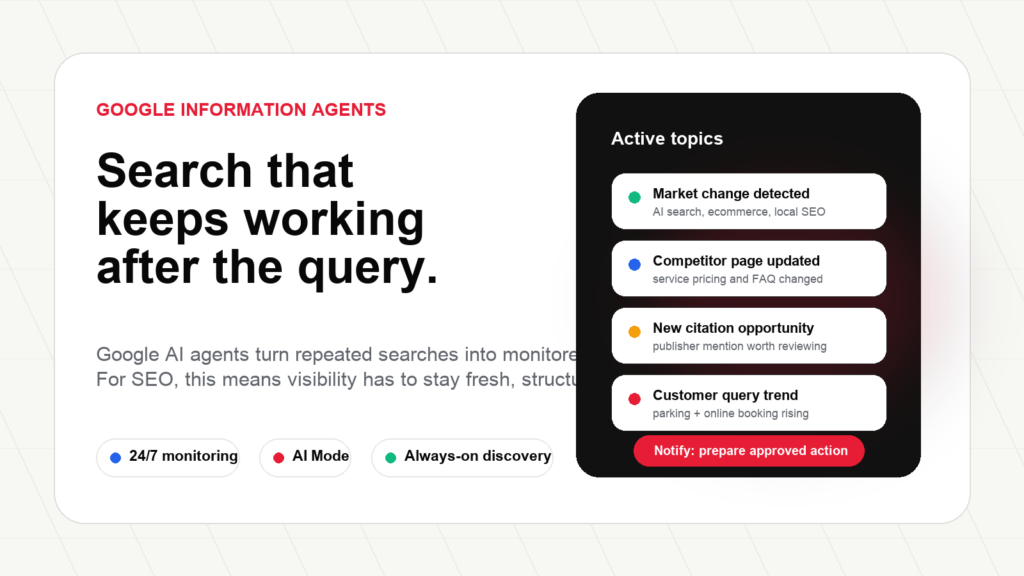
Google Search has always been reactive. A user types a query. Google returns results. The user Clicks, refines, compares and eventually acts.
Google’s new information agents point to a different pattern. The user explains a topic once, and the system keeps watching. TechCrunch described the feature as a more advanced version of Google Alerts inside AI Mode. Google describes it as agents that can “keep track of a topic for you” and provide updates when new information appears.
That may sound like a small product feature. It is not. It changes the time dimension of search.
Classic SEO has mostly optimized for the moment of search. Agentic discovery optimizes for a continuing relationship between the user, the topic and the system. That means the website is no longer competing only when the user types a Keyword. It may also compete when an agent checks whether something changed, whether a new option appeared, whether a product is back in stock, whether a price moved, whether a competitor published something better or whether a local business now matches the user’s criteria.
What Google announced
At Google I/O 2026, Google presented AI Mode as a deeper search experience where users can ask more complex questions and continue exploring with context. In the same direction, Google discussed information agents: systems that run in the background and monitor topics for the user.
According to Google’s own Search I/O announcement, these agents can search across web content, social posts, news, finance data, sports data and shopping data. They can track a topic over time and alert the user when something relevant happens.
TechCrunch’s practical description is useful: this is not simply another search result page. It is closer to an assistant that keeps a thread alive. The user does not have to repeat the same search every day. The agent does the Monitoring.
Examples are easy to imagine:
- A user wants to know when a specific apartment appears in a preferred area.
- A parent wants updates about pediatric clinics with online booking, good reviews and parking.
- An ecommerce buyer wants to know when a product is discounted or back in stock.
- A founder wants to monitor competitors, funding news or regulatory changes.
- A marketer wants to follow new AI Search features or algorithm changes.
In each case, search becomes less like a single lookup and more like a background process.
agentic discovery
Classic search
User action: Search, click, compare, repeat later.
SEO focuses on ranking for the query at the moment the user searches.
Information agents
User action: Explain the goal once and let the agent monitor.
SEO must support freshness, Structured data, clear entities and ongoing relevance.
Why it matters for SEO
The SEO industry has spent years measuring ranking positions, Impressions, clicks and conversions. Those metrics still matter. But information agents introduce a new layer: persistent eligibility.
If a user asks an agent to monitor “private pediatric clinics in Bucharest with good reviews, easy parking and online booking,” the agent needs machine-readable evidence. It needs to understand locations, services, reviews, booking availability, parking, opening hours, doctors, trust signals, and whether the clinic is a good match for the user’s criteria.
If that information exists only as vague marketing copy, the business is weaker. If it is structured across service pages, local pages, FAQs, reviews, Google Business Profile data and clear website content, the business has a better chance of being understood.
The same applies to ecommerce. An agent monitoring a product category may care about price, stock, variants, shipping, return policy, reviews, merchant reputation, product feeds and comparison criteria. A category page that only repeats keywords may not be enough.
This is why the phrase “AI search optimization” can be misleading when it is reduced to prompt tricks. AI search visibility is not only about being mentioned in a chatbot. It is about building a website and brand footprint that AI systems can retrieve, verify, compare and use.
The new visibility model: being selected repeatedly
Traditional SEO often asks: “Can we rank?” AI-assisted discovery asks a broader question: “Can we be selected repeatedly as the context changes?”
That means freshness matters more. Monitoring matters more. Entity clarity matters more. Product and service details matter more. Reviews matter more. Internal links matter more. Technical health matters more. And execution speed matters much more.
A website may be technically visible today and irrelevant tomorrow if a competitor updates pricing, improves service information, publishes stronger content, adds better proof, fixes technical issues or becomes easier for AI systems to interpret.
For SMEs, this is uncomfortable because most small businesses do not have an SEO team waiting to adjust pages every week. They have limited time, limited budget and too many disconnected tools. That is exactly why automation matters, but not blind automation. The winning model is monitored intelligence plus approved execution.
SME example
What SMEs should do now
Small and mid-sized businesses do not need to rebuild everything because Google shipped a new AI feature. But they do need to stop treating SEO as a static checklist.
1. Make business information explicit
Do not force users or agents to infer critical details. If you offer online booking, say it. If parking matters, explain it. If delivery windows matter, publish them. If returns matter, make them clear. If a service has limits, explain those limits.
2. Build pages around decisions, not only keywords
A page should help someone decide. For “airport parking near Otopeni,” the page should compare distance, shuttle, security, pricing, booking, cancellation, reviews and practical arrival timing. For “SEO automation tools,” the page should explain what the tool does, what it does not do, how approval works and what happens after analysis.
3. Keep content current
Information agents increase the value of freshness. Product availability, pricing, clinic programs, event dates, service conditions and documentation should not be stale.
4. Strengthen structured and semantic signals
Schema is not a magic ranking factor, but accurate structured data can help systems understand visible content. Internal links, headings, glossary definitions, author pages, organization data and local profiles also help build semantic clarity.
5. Monitor AI visibility and classic SEO together
Rank tracking alone is not enough. Businesses should watch Search Console, AI mentions, citations, branded searches, local visibility, content performance, technical drift and competitor changes.
The AYSA view
My view is that information agents make one thing very clear: SEO cannot remain a report business.
If agents are monitoring topics in the background, your website also needs an operating layer that monitors the business, detects opportunities, prepares improvements and helps execute them. Otherwise, the gap between “we know what changed” and “we updated the website” becomes too large.
That is where AYSA fits naturally. AYSA monitors SEO, AEO, GEO and AI visibility signals, prepares approval-ready actions and executes accepted changes inside the website workflow. It is not just another dashboard. It is a way to move from discovery to action without asking a non-specialist business owner to manually interpret every SEO signal.
This matters because the future of search will not reward businesses that only read about AI search. It will reward businesses that make their websites easier to understand, easier to compare and easier to trust.
Google’s information agents are another sign that search is becoming more operational. The businesses that adapt will not be the ones that chase every feature. They will be the ones that continuously improve the information layer that agents and humans rely on.
Sources and further reading
- TechCrunch: How to use Google’s new AI agents to go beyond your standard searches
- Google: Search at I/O 2026
- Google Search Central: AI optimization guide
- AYSA: Google I/O 2026 and preparing websites for agents
- AYSA: Microsoft Clarity grounding queries and AI citations
Search agents will keep watching. Your website should keep improving.
AYSA helps SMEs monitor SEO and AI visibility, prepare website improvements, request approval and execute accepted changes without turning every search update into manual busywork.
Continue the AI search topic inside AYSA.
Use these pages to connect the article with AI SEO tools, AI visibility monitoring, AI Overviews and approved website execution.
Turn this topic into a website action plan.
Use these AYSA hubs to move from reading to technical fixes, AI visibility monitoring, research, glossary context and approval-first SEO execution.

