
Google I/O 2026 Confirms The Real SEO Shift: From Ranking Pages To Preparing Websites For Agents
Google I/O 2026 did not end SEO. It confirmed something more practical: Search is becoming agentic, multimodal and task-oriented, which means websites must become easier for machines to understand, compare and act on.
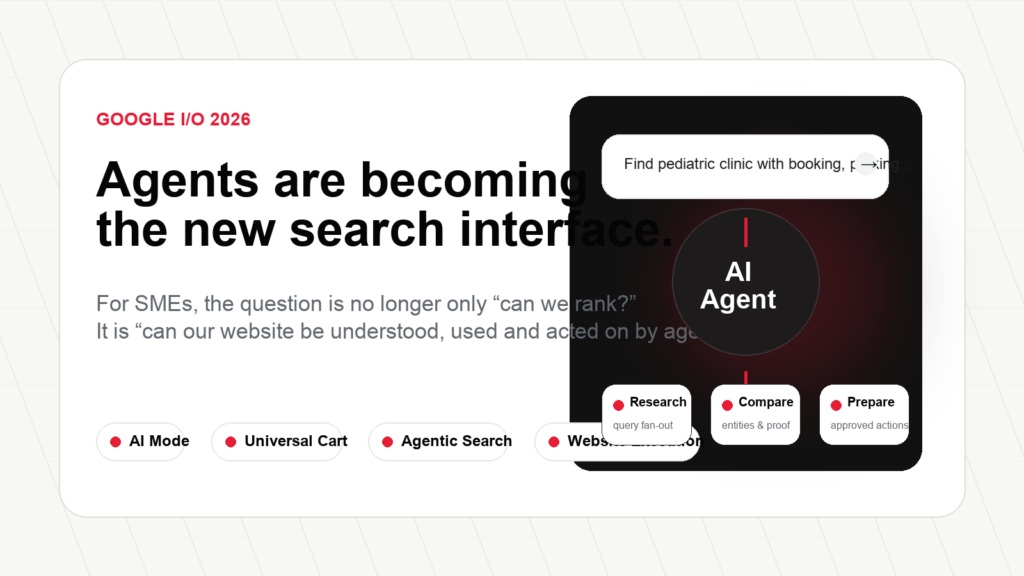
Every major Google event produces a wave of dramatic conclusions. After Google I/O 2026, one of the loudest narratives was that apps are ending, search is becoming software, and agents will replace the way people use the internet.
That framing is useful as a warning, but dangerous as a strategy. Businesses do not need panic. They need an operating model.
Google’s own announcements show a clear direction. The company described AI Mode as a deeper search experience where users can ask longer, more complex questions, continue from AI Overviews into follow-up exploration, and use multimodal input across text, images and other context. Google also presented new developer tooling around Gemini, Antigravity and agentic workflows. In parallel, the commerce side of Search is moving toward experiences where product discovery, comparison, carting and purchase support become more integrated into Google surfaces.
That matters for SEO because SEO has always followed user behavior. When people searched in short keywords, pages were built around keywords. When mobile became dominant, performance, Local intent and page experience became more important. When AI-assisted search becomes a normal interface, the website has to do more than rank. It has to be understandable, trustworthy, structured, crawlable and useful enough to be selected inside a synthesized answer or agentic workflow.
In my opinion, this is not the end of SEO. It is the end of treating SEO as a monthly report and a list of recommendations nobody implements.
What Google I/O 2026 actually changed
The most important signal from Google I/O 2026 was not one isolated product. It was the convergence of several product directions:
- Search is becoming more conversational and multimodal.
- AI Mode is turning Search into a deeper exploration surface.
- Generative interfaces can change the way answers are presented.
- Shopping experiences are moving closer to agentic comparison and carting.
- Developer tools are becoming more agent-first, not only editor-first.
- Google is increasingly training users to express tasks, not just keywords.
Google’s Search announcements around AI Mode and AI Overviews are especially relevant for businesses. Google says the new experience is designed to let users ask longer and more complex questions, keep context, and explore through follow-ups. That moves the search journey away from a single query and toward a chain of decisions.
For example, the old query might be: “pediatric clinic Bucharest”. The new task might be: “I need a private pediatric clinic in Bucharest for a toddler with recurring fever, preferably with good reviews, online booking, easy parking and doctors who communicate well with parents. What should I compare?”
That is not a Keyword. It is a decision workflow.
For businesses, this changes what “being visible” means. It is no longer enough to have a page that contains the right keyword. The page should explain the offer clearly, show trust signals, provide practical criteria, expose structured information, answer real questions, and make the next step easy.
The search box becomes a task box
The classic search box was optimized for short input. Users learned to compress intent into keywords: “best clinic Bucharest”, “SEO tools”, “airport parking Otopeni”, “flower delivery Bucharest”.
AI-assisted search encourages the opposite. Users can describe the situation. They can add constraints. They can ask follow-up questions. They can compare options. They can move from general discovery to decision support without restarting the journey from zero.
This is a major reason why keyword-only SEO feels increasingly incomplete. Keywords still matter because they reveal demand, language and market structure. But the page that wins in AI-assisted search has to satisfy a broader context window. It must be clear enough for retrieval, complete enough for comparison, and trustworthy enough for recommendation.
Classic search
Query: “Technical SEO audit”
The user compares blue links, opens several pages and manually decides what matters.
AI-assisted search
Task: “Audit my WordPress site, explain what is urgent, what can be automated and what needs approval.”
The system looks for structured, specific and actionable information it can use in a decision flow.
This is why pages need to become more precise. A service page should not only say “we are the best”. It should explain who the service is for, where it operates, what it includes, pricing or pricing logic where possible, process, proof, reviews, limitations, FAQs, and how someone can act.
That is also why thin content is becoming more dangerous. A thin page may still be indexed, but it has very little to contribute to a synthesized answer, a comparison or an AI agent’s decision process.
Generative UI changes what visibility means
Google has been clear that AI Overviews and AI Mode still connect users to the web, but the user experience is not the same as ten blue links. When an answer is summarized, expanded, reorganized or presented with a custom interface, visibility becomes more than rank position.
A business can technically rank, but still be invisible if the result is pushed below rich features, AI blocks, shopping modules, maps, videos or other surfaces. This is why the industry is moving from Rank tracking toward visibility measurement: Impressions, citations, mentions, visible pixels, assisted clicks, branded demand, local map presence, AI citations and conversion behavior.
In earlier AYSA analysis, we discussed why Microsoft Clarity exposing grounding queries behind AI citations matters. The same principle applies here. The next generation of search measurement will not be only “where do we rank?” It will be “where are we used, cited, compared, included and acted on?”
Generative UI makes this more important. If search can build an interface around a query, the content it chooses must be machine-readable, structured and reliable. That means clear headings, consistent entities, crawlable HTML, useful media, schema where appropriate, strong internal links and practical detail.
Universal Cart and ecommerce SEO
The commerce part of Google’s direction may be even more important for ecommerce businesses. Universal Cart and related shopping experiences point toward a world where the user does not simply search, click, browse, compare and buy. Instead, the user can ask for help, compare products, watch prices, receive alerts and move closer to purchase across Google surfaces.
For ecommerce SEO, this means product data becomes strategic infrastructure. Product titles, descriptions, feeds, availability, price, shipping information, returns, images, reviews, merchant reputation, category structure and entity clarity all matter because they help systems compare options.
In the old model, the ecommerce SEO question was often: “How do we rank category pages?” In the agentic commerce model, the question becomes broader:
- Can Google understand each product and category?
- Can AI systems compare the product against alternatives?
- Is availability and price clear?
- Are reviews, returns and delivery information easy to extract?
- Does the website provide enough useful context for recommendation?
- Can the user move from discovery to checkout with minimal friction?
This is the bridge between SEO, AEO, GEO and conversion. Search visibility is no longer isolated from the buying experience. If the page is confusing, slow, unstructured or missing commercial details, it may lose in both classic search and AI-assisted comparison.
We have written before about ecommerce SEO in the AI Search era. Google I/O 2026 makes that argument more urgent. Ecommerce websites must be built for both human trust and machine interpretation.
Background agents create a new kind of competition
One of the most important shifts is the move from “the user searches now” to “the system keeps working in the background”. If agents can monitor opportunities, compare options, track changes and alert users, businesses will compete for inclusion in persistent discovery loops, not just one-time SERP clicks.
Think about travel, local services, real estate, ecommerce, jobs, healthcare, legal services, restaurants and B2B software. In all these markets, users often have criteria that evolve over time. They want alerts, comparisons, shortlists and recommendations. If AI agents become the interface for that work, the website has to provide clean, updated and credible information.
This makes stale SEO dangerous. A website that was optimized six months ago may no longer match current user behavior, competitor positioning, AI search surfaces or Google’s evolving interpretation of the market.
That is why SEO execution speed matters. The issue is not only strategy. Many businesses already know what needs to be done: update pages, fix titles, clarify service areas, add missing FAQs, improve internal links, fix canonical issues, improve product information, add structured data, refresh content, monitor AI mentions and clean technical debt. The problem is that this work is slow, fragmented and often left unfinished.
What SMEs should do now
For small and mid-sized businesses, the correct response is not to chase every AI announcement. The correct response is to make the website operationally ready for a search environment where machines compare, summarize and act.
Here is the practical checklist I would use.
1. Make the business easy to understand
Your website should clearly explain who you serve, where you operate, what you sell, what makes you credible, how pricing works, what the user should do next and what proof supports the offer. This is basic for humans and essential for AI systems.
2. Make pages answer real decision questions
A page should not only target a keyword. It should help a user decide. For a pediatric clinic, that means doctors, services, age groups, appointments, emergency limitations, reviews, parking, location, insurance, pricing logic and booking. For an ecommerce category, that means product differences, availability, shipping, returns, use cases and trust signals.
3. Keep technical SEO clean
AI search does not remove the need for crawlability. Indexability, canonical consistency, redirects, sitemap hygiene, internal links, performance, structured data and clean HTML still matter. If crawlers cannot access or interpret the site, AI systems have less reliable material to work with.
4. Build topical authority with useful coverage
Generic content will not be enough. A business should cover the topics, questions, comparisons, problems and objections that matter in its market. This is not about publishing content for content’s sake. It is about becoming the most useful source in a specific business context.
5. Treat authority as evidence, not vanity
Mentions, citations, publisher coverage, reviews, local profiles and backlinks matter because they help systems evaluate trust and relevance. But authority building should be controlled, relevant and approved. It should not become random link buying.
6. Monitor AI visibility separately from classic SEO
Rank tracking is still useful, but it is not complete. Businesses should monitor brand mentions, AI citations, answer engine inclusion, AI Overview opportunities, local pack behavior, query changes and competitor movement.
Where AYSA fits
AYSA was built around a simple observation: SEO is not failing because business owners lack dashboards. It is failing because research, prioritization, approval and execution are too slow.
Google I/O 2026 reinforces that point. If Search is becoming more agentic, websites need continuous improvement. They need monitoring, technical cleanup, content updates, internal links, AI visibility checks, authority workflows and approval-safe execution.
That is exactly the layer AYSA is designed to provide. AYSA connects to the website, learns the business context, monitors SEO and AI visibility signals, prepares actions, explains why they matter, asks for approval and executes accepted changes inside the website workflow.
approved execution
This is why AYSA is not positioned as “another SEO tool”. Traditional tools show problems. Agencies can provide expertise, but execution often depends on meetings, documents, developers and delayed approvals. ChatGPT or Claude can help with ideas, but they are not, by default, connected to your website, your approval history, your Search Console context, your WordPress execution workflow, your monitoring system and your authority-building process.
AYSA is the execution layer between search intelligence and website change.
My view: the winners will be operational, not just informed
The biggest misconception in AI Search is that knowledge alone will win. It will not. The companies that win will be the ones that turn knowledge into shipped improvements faster and more consistently than competitors.
That means better pages, better structure, better product data, better local context, better technical health, better internal linking, better authority signals and better monitoring.
Google I/O 2026 should not make SMEs feel that SEO is impossible. It should make them realize that SEO is becoming an operating system. The work has to be continuous. The work has to be connected to the website. The work has to be approved. And the work has to actually get done.
Less SEO work does not mean no SEO work. It means less manual chaos, fewer forgotten recommendations and more approved execution.
Sources and further reading
- Google: Search at I/O 2026
- Google: Developer highlights from Google I/O 2026
- Google Search Central: AI optimization guide
- TechRadar: Google Universal Cart and shopping AI
- TechRadar: Google Search makeover and AI Mode
Prepare your website for search agents, AI answers and approved execution.
If Google Search is becoming more task-oriented, your website needs more than rankings. AYSA helps you monitor, prepare, approve and execute SEO, AEO and AI visibility work inside your website workflow.
Continue the AI search topic inside AYSA.
Use these pages to connect the article with AI SEO tools, AI visibility monitoring, AI Overviews and approved website execution.
Turn this topic into a website action plan.
Use these AYSA hubs to move from reading to technical fixes, AI visibility monitoring, research, glossary context and approval-first SEO execution.

