
Google, llms.txt And Lighthouse: What SMEs Should Actually Do About AI Crawlers
Google’s Lighthouse now checks llms.txt for agentic browsing, but that does not make llms.txt a ranking signal. Here is the practical SEO and AI visibility view for SMEs.
Every few months, the SEO industry finds a new file, tag, schema type or technical pattern that feels like it might become the next magic lever. `llms.txt` is now in that category.
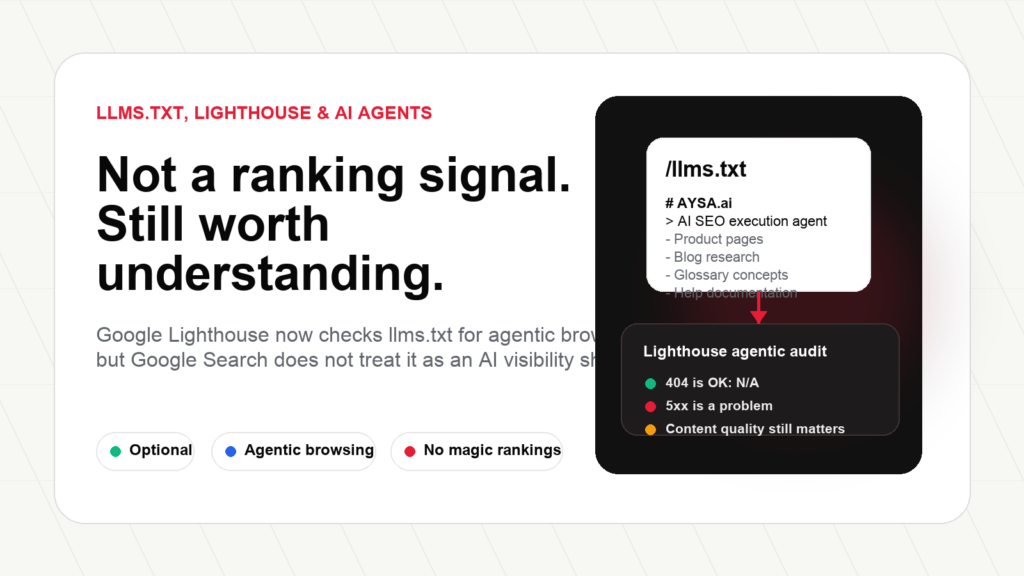
The recent discussion started because Google’s Chrome Lighthouse added an audit connected to `llms.txt`. Search Engine Land covered the change and framed the key nuance correctly: this is a Chrome/Lighthouse agentic browsing check, not an announcement that Google Search suddenly uses `llms.txt` for rankings or AI Overviews.
That distinction matters. If you run a small business, ecommerce store, clinic, local service, publisher or agency, the wrong conclusion would be: “We need `llms.txt` because it will make ChatGPT, Gemini and AI Overviews cite us.” The right conclusion is more practical: “AI agents may increasingly need clear public orientation files, but our real work is still to make the website useful, structured, crawlable and trustworthy.”
In other words: `llms.txt` may become a useful layer. It is not the foundation.
What happened
Search Engine Land reported that Google added an `llms.txt` audit to Lighthouse. The audit is connected to how agentic browsing tools can discover whether a website offers an `llms.txt` file. The practical behavior is simple: Lighthouse can check whether the file exists and whether it responds correctly. A missing file is not automatically treated as a website failure. A server error can be a problem because it indicates broken server behavior.
This is important because Lighthouse is not the same thing as Google Search ranking systems. Lighthouse is a diagnostic tool. It helps developers evaluate performance, accessibility, best practices and other signals. A new Lighthouse audit can indicate where the web platform is moving, but it does not automatically mean Google Search uses that item as a ranking signal.
That is the first thing SMEs need to understand. The existence of a diagnostic check is not the same as a ranking factor.
Still, the timing is not random. Google, OpenAI, Anthropic, Perplexity, Microsoft and others are all moving toward agentic browsing, AI-assisted search, retrieval workflows and generated answers. When agents browse the web, they need to decide which pages to read, what content is useful, what should be ignored, and how to summarize a website’s public resources. `llms.txt` is one possible way for website owners to provide a simple map for that layer.
What llms.txt is
`llms.txt` is a proposed convention for helping large language model systems and AI agents understand the useful public content on a website. It is usually placed at the root of a domain, such as:
HTTPS://example.com/llms.txt
The concept is similar in spirit to other web orientation files, but it has a different purpose:
- Robots.txt tells crawlers what they may or may not crawl.
- sitemap.xml lists URLs for search engines to discover and index.
- llms.txt can summarize or point AI agents toward useful public resources.
A basic `llms.txt` file might include the site name, a short description, important documentation pages, product pages, blog hubs, glossary terms, API docs or other public resources that are useful for AI systems to understand the website.
That sounds attractive, but it also creates a risk: many people will treat `llms.txt` as if it can compensate for weak content. It cannot.
If your service pages are vague, your product data is incomplete, your internal links are weak, your articles are thin, your schema is wrong, your website is slow and your brand has no trustworthy references, adding `llms.txt` will not magically make AI systems trust you.
It can point to useful material. It cannot create usefulness.
Wrong expectation
“If we add llms.txt, AI engines will cite us.”
This treats the file as a visibility shortcut. There is no reliable evidence that this is how Google Search or AI Overviews work.
Better expectation
“We can use llms.txt to help agents find our most useful public content.”
This treats the file as one orientation layer on top of real SEO, content, structure and authority work.
What Google does and does not say
Google’s public guidance around AI Optimization remains broader than `llms.txt`. In its Search Central documentation, Google emphasizes that websites should continue following the fundamentals: make content accessible to Googlebot, allow crawling of important resources, provide useful and reliable content, use structured data accurately when appropriate, and avoid blocking important content from being fetched or rendered.
Google’s AI optimization guidance also reinforces a theme we have discussed often on AYSA: AI search does not remove classic SEO foundations. It makes the foundations more important. AI systems need clear, accessible, well-structured information.
So what does Google’s Lighthouse change mean? It means `llms.txt` is visible enough in the agentic browsing conversation that Chrome’s diagnostic tooling can check for it. It does not mean:
- `llms.txt` is a Google ranking factor.
- `llms.txt` guarantees AI Overview inclusion.
- `llms.txt` guarantees ChatGPT, Gemini, Claude or Perplexity citations.
- `llms.txt` replaces sitemaps, internal linking or structured data.
- `llms.txt` fixes weak content or weak authority.
This is exactly the kind of nuance that businesses need. The SEO industry often moves from “new signal appeared” to “everyone must implement it immediately.” That creates noise. The operational question is not “is this shiny?” The operational question is “does this help users, crawlers or AI agents understand the business better?”
Why Lighthouse still matters
Even if `llms.txt` is not a ranking factor, Lighthouse matters because it shows what technical teams are being encouraged to inspect. When Lighthouse adds an audit, developers notice. Agencies notice. Tool vendors notice. CMS platforms notice. Over time, diagnostic conventions can influence best practices.
That is why I would not ignore `llms.txt` completely. I would simply put it in the correct priority order.
For most SMEs, the order should be:
- Make the website crawlable and indexable.
- Fix canonical, redirects, sitemap and robots issues.
- Improve page speed and mobile usability.
- Write useful pages that answer real decision questions.
- Clarify entities: business, locations, services, products, authors, reviews and proof.
- Use structured data only where it matches visible content.
- Build topical authority and relevant internal links.
- Monitor AI visibility and classic SEO performance.
- Then consider `llms.txt` as an additional orientation file.
That order matters because AI agents cannot use what does not exist. If the pages are weak, the file points to weak pages. If the pages are strong, the file can help expose the strongest public resources.
What SMEs should do now
For small and mid-sized businesses, I recommend a calm, practical approach.
1. Do not treat llms.txt as urgent unless the website is already strong
If your site has broken internal links, duplicate titles, poor mobile performance, thin service pages, unclear product data or unstructured local information, fix those first. Those problems affect humans, search engines and AI systems.
2. If you create llms.txt, keep it honest
Do not stuff it with every URL. Do not write marketing fluff. Do not make claims that the website content cannot support. Treat it as a concise guide to the best public resources on your website.
3. Point to the pages that actually help decisions
For an ecommerce site, this might include category guides, product collections, shipping and returns, product feeds, buying guides and comparison resources. For a medical clinic, it might include service pages, doctor profiles, location pages, appointment information, FAQs and trust pages. For a B2B SaaS, it might include product pages, documentation, pricing, help center articles and case studies.
4. Keep it consistent with your sitemap and internal links
If `llms.txt` points to pages that are noindex, broken, redirected or not internally linked, the file becomes a mess. It should reflect your actual public information architecture.
5. Monitor, do not guess
AI visibility is still difficult to measure. Do not assume that adding one file changed everything. Track brand mentions, AI citations where available, grounding queries, Search Console performance, crawl behavior, rankings, conversion paths and content changes.
not a shortcut
Where AYSA fits
AYSA’s view is simple: AI visibility is not solved by one file. It is solved by a system.
A business needs to know which pages are weak, which topics are missing, where internal links should improve, what technical issues block crawlability, what content should be refreshed, what schema matches visible content, what authority opportunities make sense and what actions should be approved before execution.
`llms.txt` can be part of that system, but only after the website itself is worth guiding agents toward.
This is where AYSA is different from a normal report. AYSA can monitor your website, identify SEO and AI visibility opportunities, prepare actions, explain why they matter, ask for approval and execute accepted changes inside your website workflow. That is the difference between reacting to every new SEO headline and running an actual search visibility operating system.
In my opinion, SMEs should not ask: “Do we need `llms.txt`?” They should ask: “If an AI agent tried to understand our website today, would it find clear, accurate, useful and current information?”
If the answer is no, `llms.txt` is not the first fix. The website is.
Sources and further reading
- Search Engine Land: Google adds llms.txt to Chrome Lighthouse
- Google Search Central: AI optimization guide
- Google Search Central: robots.txt introduction
- Sitemaps protocol
- llms.txt proposal
Make your website easier for people, search engines and AI agents to understand.
AYSA helps SMEs monitor SEO and AI visibility, prepare useful website actions, request approval and execute accepted changes without turning every new search update into manual busywork.
Continue the AI search topic inside AYSA.
Use these pages to connect the article with AI SEO tools, AI visibility monitoring, AI Overviews and approved website execution.
Turn this topic into a website action plan.
Use these AYSA hubs to move from reading to technical fixes, AI visibility monitoring, research, glossary context and approval-first SEO execution.

